

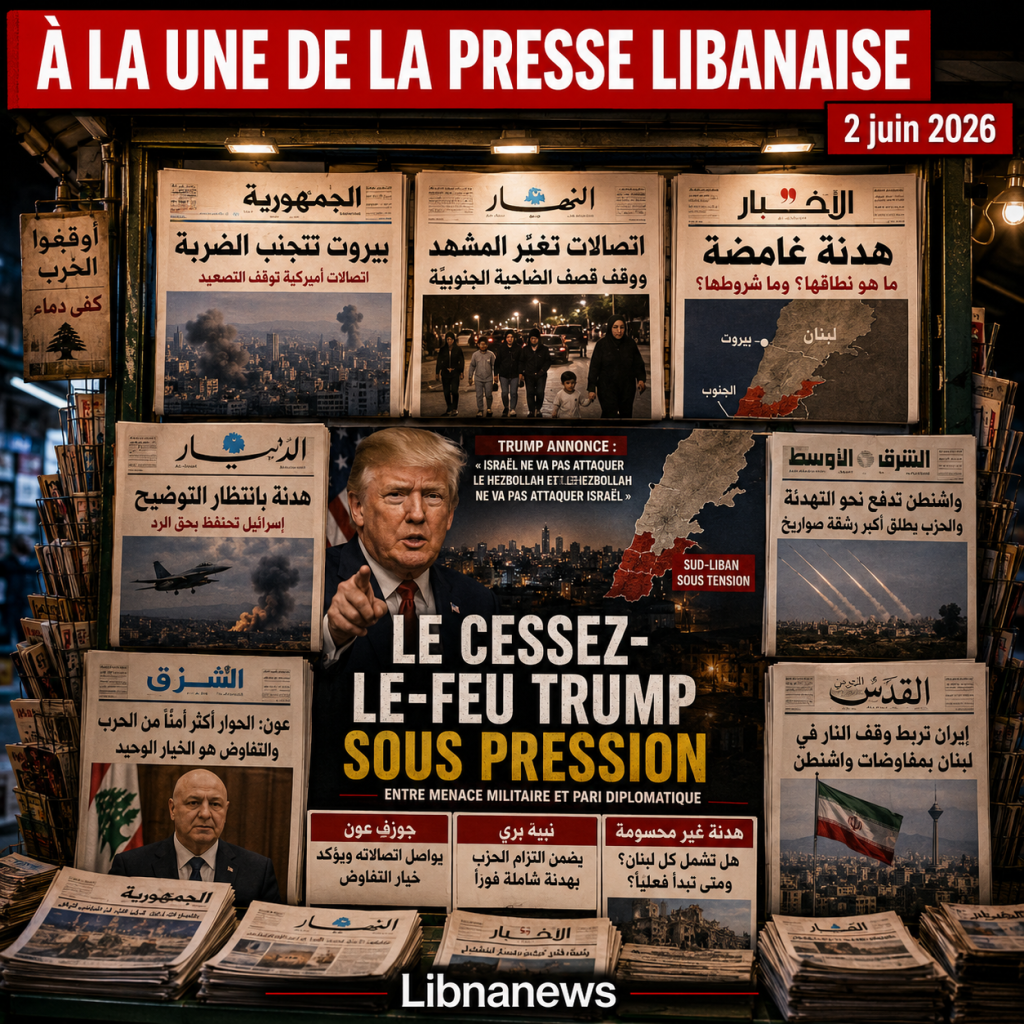
American announcement after the threat to Beirut
Al Joumhouriyat, dated 2 June 2026, places Donald Trump’s announcement at the centre of the political and military day. The President of the United States claims to have obtained a ceasefire between Israel and Hezbollah, following a call with Benjamin Netanyahu and indirect contacts with Hezbollah. According to the newspaper, Trump states that Israel will not attack Hezbollah and that Hezbollah will not attack Israel. This announcement came after several hours of intense tension, as the southern suburbs of Beirut feared an Israeli strike. The newspaper states that the call between Trump and Netanyahu lasted more than an hour and was preceded by American and Israeli contacts to avoid the collapse of the negotiating process in Washington. In this account, the American decision does not look like an agreement already stabilized. Rather, it appears to be an urgent intervention to prevent an extension of the war to Beirut.
Nahar, dated 2 June 2026, describes a similar sequence under the angle of a quick turn. The newspaper talks about contacts that changed the scene and stopped the bombing of the southern suburbs. He points out that families left the area on foot after the Israeli warning of evacuation. This image gives an immediate social dimension to a crisis first presented as military and diplomatic. The ceasefire is therefore not just a political formula. It comes after a panic movement, an alert to the population and a direct threat against a dense area of the capital. Nahar adds that an American source claims that Joseph Aoun informed Washington of guarantees received from Hezbollah about a halt to the escalation. The presidential role is thus at the heart of the de-escalation mechanism.
A truce announced, but still blurred
Al Akhbar, dated 2 June 2026, insists on the uncertain nature of the American announcement. The newspaper reports that Trump said he had very good contact with Hezbollah through high-level representatives. However, he added that the limits of the ceasefire remained unclear in the evening. The main question is its perimeter. Does the text cover the whole of southern Lebanon, or only a limited exchange between the cessation of the strikes on Beirut and the southern suburbs, and the cessation of the fire on the settlements in northern Israel? This uncertainty is decisive. It determines whether the American announcement can become a real truce, or whether it remains a partial protection measure in Beirut. Al Akhbar states that MP Hassan Fadllallah defended a common position with Nabih Berri. This position requires a complete ceasefire, an Israeli withdrawal and the refusal of any Israeli freedom of action after the agreement.
Ad Diyar, dated 2 June 2026, repeats this reservation by speaking of an ambiguous ceasefire. The newspaper notes that the position published by the Lebanese Embassy in Washington evokes a reciprocal halt to the attacks, with a subsequent extension to all Lebanese territory. However, it notes that the Israeli position remains different. Israel Katz claims that Trump would have accepted Israeli reading and that the Israeli army would strike the southern suburbs if Hezbollah did not respect the ceasefire. The newspaper also points out that the US announcement does not clearly set the time of entry into force of the agreement. This absence feeds several questions. Will Israel retain the right to conduct air strikes? Will demolition operations in the south stop? Will targeted assassinations be included in the cessation of hostilities? Thus, the core of the case is not just the announcement of the ceasefire. It deals with its operational definition.
The role of Joseph Aoun, Nabih Berri and Nawaf Salam
Al Sharq, dated 2 June 2026, puts forward Joseph Aoun’s position. The President of the Republic defends the choice of negotiation. He claims that dialogue is safer than war, without presenting it as a capitulation or a concession. According to the newspaper, Joseph Aoun believes that negotiations will not resolve the crisis in a few moments, but that it remains the only way to reduce losses and stop fighting. This presidential framing gives a clear official line. Lebanon accepts the political path, while seeking to prevent the truce from turning into unilateral pressure on its territory. The same article states that Joseph Aoun received political leaders who expressed support for his option of direct negotiation to end the military escalation.
Al Sharq, dated 2 June 2026, also reports the words of Ali Hamdan, Nabih Berri’s adviser. According to him, Nabih Berri informed the Trump administration that Hezbollah was ready to respect a complete and immediate ceasefire with Israel. He added that Berri was committed to ensuring this application. The same account states that the original US proposal was for a partial ceasefire. It provided for the cessation of Hezbollah fire against northern Israel in exchange for an Israeli commitment not to target Beirut. Berri would have proposed a broader formula, covering land, sea and air. He also reportedly requested a halt to the destruction of houses in southern Lebanon. This precision is important. It shows that the debate is not just about the silence of weapons. It also addresses the daily effects of occupation, incursions and destruction.
Ad Diyar, dated 2 June 2026, adds that Joseph Aoun followed the contacts with the various Lebanese actors, in particular with Nabih Berri. The newspaper also reports that it informed Prime Minister Nawaf Salam of the results of consultations and efforts to establish a ceasefire and prevent escalation. This entry places the dossier within the framework of the institutions. Trump’s announcement is not only treated as an American initiative. It includes the Presidency, the Presidency of Parliament, the Government and the Embassy of Lebanon in Washington. In this architecture, Nawaf Salam appears to be part of the political follow-up, even though the role of operational mediation lies primarily with Joseph Aoun and Nabih Berri.
Iran transforms the Lebanese front into a regional issue
Al Quds, dated 2 June 2026, insists on the articulation between the Lebanese front and the negotiations between Washington and Tehran. The newspaper reports that Iran suspended the exchange of messages with the United States in the context of the indirect negotiations, due to the continued Israeli attacks on Lebanon. He adds that Tehran conditions the resumption of such exchanges to the cessation of Israeli attacks and the complete withdrawal of the occupied areas. The spokesman for the Iranian Foreign Ministry, Esmail Baghai, also claims that the ceasefire in Lebanon is an integral part of any agreement to end the war. The Lebanese crisis is therefore becoming a lever in wider negotiations. It can no longer be separated from the balance of power between Iran and the United States.
Ad Diyar, dated 2 June 2026, describes a rapid increase in contacts following the Israeli threat to the southern suburbs. According to the newspaper, Tehran considered that the red lines had been crossed and transmitted that it would not allow a strike against the area. The newspaper then mentions the Iranian announcement of the suspension of trade with Washington, then the Iranian military threat to hit Israel if the southern suburbs were attacked. At the same time, contacts were conducted with several capitals, including Paris, Riyadh, Doha and Cairo, in order to protect Lebanon and stop the Israeli escalation. This reading gives a decisive place to regional pressure. She suggests that Netanyahu found himself compelled by Trump’s decision, itself influenced by the fear of an enlargement of the war.
Southern terrain remains the decisive test
Al Sharq Al Awsat, dated 2 June 2026, reports that Marco Rubio spoke with Benjamin Netanyahu to push for a ceasefire. The newspaper adds that at the same time, Hezbollah launched its strongest rocket salve until then, with accurate missiles towards Kiryat Shmona and Nahariya. Washington reportedly conveyed an Israeli message that if Hezbollah agreed to stop its fire, Beirut could be spared. Secondly, this measure could be integrated into a wider scheme, gradually leading to a complete shutdown. This formulation shows that the American offer first worked as an emergency measure for Beirut, before being presented as the possible beginning of a general truce.
Al Joumhouriyat, dated 2 June 2026, points out that southern Lebanon remains the area where the soundness of the announcement will be verified. The newspaper states that Hezbollah supports a complete ceasefire throughout Lebanese territory, but links it to an Israeli withdrawal and the abandonment of all freedom of action. He also reports that Netanyahu maintained a tough position, claiming that he would strike Beirut if Hezbollah did not cease its attacks, while continuing operations to the south according to the plan established. The newspaper adds that Nabih Berri played a central role, stating that the commitment should be complete and reciprocal. The truce is therefore played in a fragile balance. It depends on the ability of mediators to transform a US presidential announcement into a controllable mechanism on the ground.
Al Jumhouriyat, dated 2 June 2026, finally presents Israeli control of the Beaufort fortress area as an element of additional pressure before the negotiations. The newspaper estimates that Israel is seeking to accumulate trading cards by expanding its deployment north of the Litani River. He added that Hezbollah, for its part, was trying to reduce the value of these maps by the wear and tear of advanced Israeli forces. In this perspective, the ceasefire announced by Trump does not close the crisis. He opens an immediate test. If strikes, incursions and demolitions continue, the agreement will remain fragile. If the contacts in Washington, Beirut and Tehran translate into a real stoppage of operations, the sequence could become the starting point for wider negotiations on withdrawal, security in the south and the role of the Lebanese State.
Local policy: the executive and Parliament seek a common line against the risk of escalation
Joseph Aoun sets the political framework for negotiations
Al Sharq Al Awsat, dated 2 June 2026, presents Joseph Aoun as the main institutional defender of the negotiated route. The President of the Republic affirms that Lebanon chose to negotiate because of the war. It states that this option is safer than war, without being a surrender or concession. This formula aims to contain two opposing criticisms. On the one hand, part of the opinion can see in direct negotiation a step backwards. On the other hand, supporters of a rapid cessation of fighting can judge the process too slow. Joseph Aoun responded to both readings by stressing that negotiations did not work out anything in a few moments, but that they were the only way to stop the war with as little damage as possible. He added that Lebanon would not retreat from that choice, even if the talks could be delayed or hindered.
Al Quds, dated 2 June 2026, reports the same position with an emphasis on long time. Joseph Aoun states that all cases can be settled through negotiation, even if it takes time. He also stressed that the war could not bring a positive result to any of the parties. This sentence gives the Presidency a clear course of action. She doesn’t deny the balance of power. Rather, it seeks to limit its cost. Thus, the Head of State does not speak of a rapid exit from crisis. It presents the negotiation as a slow but necessary path in a country where the state is trying to regain a central place between Israeli pressure, American demands, Hezbollah’s positions and the expectations of an exhausted population.
The debate on the south and weapons remains at the heart of the tensions
Al Sharq, dated 2 June 2026, reports that Joseph Aoun also answered the question of arms control in the south. He said the army did not declare the area empty of weapons. According to him, the army instead imposed operational control over the area. The Head of State adds that the complete evacuation of weapons requires time, due to the geography of the south, made up of mountains and valleys. This shade is important. It avoids presenting Lebanese military action as an already completed result. It also indicates that the State wants to show a real presence, without promising an immediate solution. At the same time, Joseph Aoun accuses Israel of not helping to implement the ceasefire agreement, maintaining its five-point occupation and continuing its attacks on villages on the pretext of defence.
This presidential scoping places the army at the centre of the state response. It also shows the limits of this response. The Lebanese State affirms its will to control, but it cannot separate this issue from the Israeli military presence and the pressure on southern localities. The local debate is therefore trapped in a double constraint. On the one hand, external partners demand measures on weapons and the role of the army. On the other hand, Lebanese officials recall that the army cannot act as if occupation, bombing and destruction did not exist. Local politics thus becomes a debate about the real capacity of the state, and not only about its intentions.
Nabih Berri as guarantee channel
Nahar, dated 2 June 2026, devotes an article to the role of Nabih Berri in the attempt to cease fire. The newspaper states that the President of Parliament is not at his first announcement of a guarantee of Hezbollah’s commitment. According to the article, his entourage recalls that it is the third time since the resumption of the clashes in the south, after 2 March 2026, that he claims to be able to assume responsibility for Hezbollah’s commitment to cease fire if Israel responds to the efforts of de-escalation. This position gives Ain al-Tiné a special role. Nabih Berri acts as both institutional leader, political relay and channel of communication with Hezbollah.
Al Sharq, dated 2 June 2026, reports the words of Ali Hamdan, Nabih Berri’s adviser. He claims to have contacted the American Ambassador to Lebanon, Michel Issa, to inform him that Hezbollah would be ready to respect a complete ceasefire and that Nabih Berri was ready to guarantee its implementation. The same account states that the Trump administration proposed a partial stop. This would have consisted in suspending Hezbollah’s fire north of Israel in exchange for an Israeli commitment not to target Beirut. Nabih Berri reportedly responded with a broader proposal, covering land, air and the sea, with the cessation of house destruction in the south. This difference summarizes the Lebanese political issue. A ceasefire limited to the southern suburbs would be seen as a protective measure in Beirut. A complete ceasefire would raise the question of the south, withdrawal and daily life of the inhabitants.
The role of Nawaf Salam and the government response
Ad Diyar, dated 2 June 2026, states that Joseph Aoun followed contacts with various Lebanese actors, including Nabih Berri, and then informed Prime Minister Nawaf Salam of the results of consultations and efforts to establish a ceasefire and prevent escalation. This statement gives the executive a more legible structure. The Presidency leads the political line. Parliament serves as a guarantee channel with Hezbollah. The government follows the administrative, military and social components. This distribution does not remove tensions, but shows an attempt at minimal coordination at the top of the state.
Al Sharq, dated 2 June 2026, reports that Nawaf Salam chaired a regular ministerial meeting at the Grand Sérail. The Minister of Information reported that the Prime Minister had presented the developments related to the launch of the military negotiations in Washington. He also outlined Lebanese efforts with friendly and fraternal countries to restore the ceasefire. The meeting then discussed aspects of the issue of population displacement, especially after the latest developments. The Government announces the publication of a three-month report responding to housing and displacement needs, as well as a renewed urgent appeal to the international community to meet the growing needs of internally displaced persons.
This sequence shows that local politics is not limited to military debate. It also affects the State’s capacity to protect civilians. Threats to the southern suburbs and strikes in the south create direct pressure on institutions. Nawaf Salam is therefore seeking to include the internally displaced in a public response framework. The government is trying to turn the emergency into a follow-up case. However, the demand for international aid also reveals the limited resources available. The executive must act, but it knows that its internal resources are not enough.
Walid Jumblatt calls for patience and inner unity
Al Sharq, dated 2 June 2026, reports that Walid Jumblatt met Nabih Berri in Ain al-Tinah. After this meeting, the former leader of the Progressive Socialist Party claims that priority is not in the great analyses, but in the internal unity, whether the country goes towards peace or war. He believes that the cease-fire can remain far away, or far away. His primary concern, he said, was that of Nabih Berri and all Lebanese: to improve conditions for the reception of displaced persons, to ensure a dignified life for the inhabitants of the south and to mobilize the means of the State as well as those of international donors. He concluded by calling for patience, believing that Lebanon would go through this ordeal even if it lasted.
Ad Diyar, dated June 2, 2026, echoes the same tone. Walid Jumblatt insists on internal unity, the issue of displaced persons and the need for a dignified life for the inhabitants of the south. This position comes at a time when public debate can quickly be polarized between negotiating supporters, defenders of resistance, Hezbollah critics and supporters of stronger state intervention. Joumblatt chooses a social and national angle. It does not propose a new security formula. It focuses on maintaining internal cohesion and protecting exposed populations.
Parliament recalls its economic and legislative responsibilities
Al Sharq, dated 2 June 2026, also announces the publication of Decree No. 3146, dated 1 June 2026, by which Joseph Aoun summoned Parliament to an open special session from 2 June to 19 October 2026. The decree, also signed by Nawaf Salam, sets out the programme around bills transmitted or to be transmitted to Parliament, in particular those relating to financial, monetary and economic situations, as well as other drafts and proposals which the parliamentary bureau will decide to include. This decision shows that the military crisis does not interrupt the institutional agenda. On the contrary, it makes economic matters more urgent.
The convening of Parliament also gives a political signal. The country cannot reduce its entire activity to war management. Public finances, currency, economic reforms and the role of the private sector remain subjects of national survival. This institutional continuity remains fragile. It depends on security, Parliament’s ability to work and the level of agreement between political forces. But it allows the power to show that the state still exists through procedures, decrees and legislative activity. In a period dominated by military threats, this institutional message has a direct political significance.
A local scene dominated by the search for a common minimum
Al Bina, dated 2 June 2026, reports the telephone call between Mohammad Bagher Ghalibaf and Nabih Berri, in which the Iranian official claims that Iran wants to set the ceasefire throughout Lebanon, especially in the south. Berri thanked Iran for its efforts to stop Israeli attacks and said that Lebanon would not forget those positions. This sequence shows that Lebanese policy continues to be crossed by regional ties. Berri’s role goes beyond the parliamentary framework. It is part of a network of mediations in which Beirut, Tehran, Washington and Arab channels cross.
Al Akhbar, dated 2 June 2026, analyses in parallel the position of Nawaf Salam as an equation that presents direct negotiations with the enemy as the least expensive option, even if it does not offer a sure guarantee. The newspaper believes that the real debate in Lebanon is not about a simple opposition between negotiation and military action, but about two ways of assessing costs, possible results and political realism. This reading sheds light on the state of the local scene. Officials are not just debating a ceasefire. They discuss the price of each option, the role of the State, external guarantees, the south, displaced persons and Lebanon’s ability not to undergo a written solution elsewhere.
Quote and speech by politicians: the word of crisis between Lebanese guarantee, American pressure and regional threat
Donald Trump claims to stop climbing
Al Joumhouriyat, dated 2 June 2026, places Donald Trump at the centre of the verbal sequence following the Israeli threat against the southern suburbs of Beirut. The President of the United States claims to have had a « very productive » call with Benjamin Netanyahu. He adds that Israel will not send forces to Beirut and that the forces already en route have been recalled. In the same message, he also claims to have had « very good contact » with Hezbollah by high-level representatives. The main sentence is a simple formula. Israel will not attack Hezbollah, and Hezbollah will not attack Israel. The purpose of this declaration is to have immediate effect. It seeks to calm the population, reassure diplomatic actors and save the discussions planned in Washington. But it leaves several shades. It does not state whether the judgment applies to all Lebanese territory. It also does not specify what happens to strikes in the south, house destruction or targeted assassinations. Thus, Trump’s speech acts first as an emergency signal, more than as a stabilized agreement text.
Al Bina The newspaper reports that the scene remains confused about the causes that led Trump to publish its announcement, about the nature of its indirect contacts with Hezbollah, about the actual content of the ceasefire, its timetable for entry into force and about Israeli engagement. He claims Trump may have wanted to talk about a limited arrangement. This arrangement would involve stopping strikes on the southern suburb in exchange for stopping fire on northern Israeli localities. This reading reduces the scope of the American declaration. It turns the announcement into a possible first step, but not a complete ceasefire. The American presidential speech therefore serves two purposes at a time. It blocks an immediate attack on Beirut. It also retains room for negotiation.
Joseph Aoun refuses to present the negotiation as a concession
Al Sharq, dated 2 June 2026, gives a central place to Joseph Aoun’s speech. The President of the Republic affirms that the choice of negotiation is a just choice, taken by Lebanon because of the war. He says the negotiation is safer than the war. It also states that it is neither a surrender nor a concession. This sentence responds to internal criticism. It targets those forces that consider direct dialogue too risky or too humiliating. Joseph Aoun seeks to move the debate. It does not present negotiation as a sign of weakness. He presents it as the only available way to stop wars with as little damage as possible. He also insists on long time. The negotiation, he said, does not solve the problem in a few moments. It takes time, but Lebanon has no other choice.
Nahar, dated 2 June 2026, takes up the same idea in a formula put forward. Joseph Aoun asserts that negotiations are safer than war, for the Lebanese still see the misfortunes of war and its results. He added that Lebanese officials were doing the impossible and that the country would not step back from that choice, even if discussions were blocked or delayed in reaching their goal. This presidential speech seeks to establish continuity. It does not promise rapid success. Rather, it protects the very principle of the process. In a climate of fear, this discourse becomes a tool for political stability. It recalls that the State wants to act through an official channel, not through a series of military reactions.
Al Sharq Al Awsat, dated 2 June 2026, adds an important clarification on Joseph Aoun’s speech on weapons in the south. The president said the army did not announce that the south was empty of weapons. According to him, she imposed operational control over the area. He explains that the complete evacuation of weapons requires time, because of the terrain, mountains and valleys. By this nuance, he avoids an unrealistic promise. It also shows that the Lebanese State is trying to speak with caution. The presidential speech wants to be firm on the authority of the army, but it refuses the slogans. At the same time, he accused Israel of failing to comply with the terms of the ceasefire, maintaining the occupation of five points and continuing its military operations.
Nabih Berri turns his word into a political guarantee
Al Sharq, dated 2 June 2026, quotes Ali Hamdan, an adviser to Nabih Berri, who claims to have called American Ambassador Michel Issa on behalf of the Speaker. The message is clear. Hezbollah would be ready to commit itself fully to a full ceasefire, and Nabih Berri would be ready to guarantee that commitment. This sentence gives Berri a pivotal role. He is not content to comment on the crisis. It offers a political guarantee in Washington. It also seeks to expand the American offer. According to Ali Hamdan, the Trump administration proposed a partial stop. Hezbollah would stop targeting northern Israel, while Israel would not target Beirut. Berri offers a broader formula. It must cover the land, the air and the sea. It must also include stopping the destruction of houses in the south.
Al Joumhouriyat, dated 2 June 2026, insists on the centrality of this Berri word. The newspaper states that it played a major role in the agreement mentioned, stating on the American side that the commitment should be global and reciprocal. He also highlighted the need for an Israeli commitment not to destroy houses. This clarification is political and social. It shows that Berri’s speech seeks to bring the ceasefire out of a simple military exchange. The case isn’t just about shooting. It is also that of houses, villages and the possible return of the inhabitants. In this sequence Berri speaks as a guarantor of Hezbollah, but also as a spokesman for a wider Lebanese demand.
Hassan Fadllallah refuses a partial ceasefire
Al Joumhouriyat, dated 2 June 2026, reports the position of deputy Hassan Fadllallah. He states that Hezbollah supports a complete ceasefire throughout Lebanese territory. He explains that the messages arrived in Nabih Berri and also in Hezbollah by Joseph Aoun. According to him, the original American proposal was that Hezbollah should stop its attacks, and that Israel should not strike Beirut or the southern suburbs. Fadallah considers this formula unacceptable. He claims that the common position with Berri requires a complete ceasefire as a point of entry into Israeli withdrawal. He adds that there can be no return to the situation before 2 March, nor freedom of Israeli action. This word gives a red line. Hezbollah refuses to separate the protection of Beirut from the southern question.
Ad Diyar, dated 2 June 2026, reiterates this position by stressing the ambiguity of the announced ceasefire. The newspaper notes that Hezbollah, by Hassan Fadllallah, accepts a complete stop if Israel respects it. But he also noted that the Lebanese Embassy in Washington described a more limited arrangement, which would be expanded later. This difference shows the importance of words. In a military crisis, one diplomatic formula can reassure one actor and worry another. Fadllallah’s speech therefore sought to close the door to a flexible Israeli interpretation. He called for the cessation of fire to become a complete framework, linked to withdrawal and the end of freedom of action.
Mohammad Bagher Ghalibaf links Lebanon to the regional front
Al Akhbar, dated 2 June 2026, reports the appeal of Mohammad Bagher Ghalibaf to Nabih Berri. The President of the Iranian Parliament states that the efforts of the last two days have focused on stopping Israeli attacks. He warns that if the attacks continue, Iran will not simply suspend the negotiations. He will stand in confrontation with Israel. He added that Iran wanted to establish a ceasefire throughout Lebanon, particularly in the south. Lastly, he said that any agreement between Iran and the United States should include the cessation of attacks on the various fronts, especially in Lebanon. This word gives the Lebanese dossier a regional dimension. She states that Tehran does not want to separate negotiations with Washington from the fate of Lebanon.
Al Bina, dated 2 June 2026, also reports Nabih Berri’s response to Ghalibaf. The President of Parliament thanked Iran for its efforts against Israeli attacks. He claims that Lebanon will not forget Iran’s positive positions in this sensitive phase. This sentence shows the place of alliances in Lebanese political discourse. It is not limited to diplomatic politeness. She writes Berri in a regional reading of the crisis. It also highlights tension. The Lebanese State wants to defend the path of negotiation. But part of the balance of power on this negotiation is also built by the messages from Tehran.
Walid Jumblatt brings the debate back to inner unity
Al Sharq, dated 2 June 2026, quotes Walid Jumblatt after his meeting with Nabih Berri. The former leader of the Progressive Socialist Party claims that the primary concern is not in the experts’ major analyses. He says that the basic concern is inner unity, at peace and at war. He believes that the ceasefire can still be distant. His attention therefore focused on displaced persons, housing conditions and life worthy of the inhabitants of the south. It calls for the mobilization of the State, the international community and donor agencies. His conclusion lies in a voluntary repetition. We need patience. Lebanon has gone through difficult stages, and it will still go through this ordeal, even if it lasts.
This word differs from other speeches of the day. Trump talks about a fire stop. Joseph Aoun defends the negotiation. Berri offers a guarantee. Fadallah sets the conditions for Hezbollah. Ghalibaf threatens to broaden the confrontation. Joumblatt moves attention to society. His speech does not contradict the security debate. It only recalls that any political formula will remain fragile if the displaced, the inhabitants of the south and the families threatened are left unsupported. In this sense, political speech is used less to negotiate the front lines than to preserve the inner fabric.
Netanyahu and Israel Katz maintain verbal pressure
Al Joumhouriyat, dated 2 June 2026, reports that Benjamin Netanyahu maintains his position. He said that if Hezbollah continues to attack Israeli cities and civilians, Israel will strike targets in Beirut. He also claims that operations in southern Lebanon will continue according to the plan. This speech contradicts in part the reassuring effect sought by Trump. It suggests that Israel wants to retain a military margin of action. It therefore maintains pressure on Beirut, even after the American announcement.
Ad Diyar, dated 2 June 2026, reports that Israel Katz claims Trump would have accepted the Israeli reading. According to this reading, Israel could attack the southern suburbs if Hezbollah did not respect the ceasefire. The newspaper then questions the freedom of action that Israel would seek to preserve. This is a decisive point. The Israeli discourse is not just about response. He tries to maintain a permanent threat. In front of him, Lebanese discourse seeks to impose a reverse principle. A ceasefire only makes sense if it is complete, reciprocal and applicable to all Lebanon.
Diplomacy: Washington, Beirut and Tehran seek to prevent the burning of the Lebanese front
US mediation dictated by urgency
Al Joumhouriyat, dated 2 June 2026, describes a diplomatic sequence conducted in an emergency. Donald Trump intervenes after the Israeli threat to hit the southern suburbs of Beirut. That threat could derail the planned discussions in Washington between Lebanon and Israel. The newspaper reports that the U.S. president had an over an hour call with Benjamin Netanyahu. This exchange was preceded by intensive US and Israeli contacts to avoid the collapse of the negotiations. American diplomacy therefore acts as a crisis cell. It is trying to prevent a strike on Beirut, to preserve the Washington Canal and to maintain a link with broader negotiations between the United States and Iran. According to Al Joumhouriyat, Trump then contacted the Lebanese ambassador in Washington, Nada Hamadeh Moawad. She met with the American ambassador to Lebanon, Michel Issa, in the wake. This channel shows that the American announcement was not only addressed to Israel and Hezbollah. It also transited through the Lebanese diplomatic representation in order to give an official form to a still fragile arrangement.
Al Sharq Al Awsat, dated 2 June 2026, reports that Trump presented his contacts with Hezbollah as « performing », through high-level representatives. He also stated that discussions with Iran were continuing at a rapid pace. This dual mention is important. It states that Washington does not separate the entire Lebanese crisis from the dialogue with Tehran. The ceasefire in Lebanon becomes a tool for preserving another diplomatic process. The threat to the southern suburbs was not only likely to cause another wave of bombing. It could also end the indirect exchange between Washington and Tehran. In this context, American diplomacy is not only seeking to calm the Lebanese front. It also defends its own regional negotiations.
Lebanese diplomacy between presidency, embassy and political guarantees
Al Joumhouriyat, dated 2 June 2026, states that the Lebanese Embassy in Washington issued a communiqué after the call between Joseph Aoun and US Secretary of State Marco Rubio. According to the communiqué, the Lebanese authorities have received confirmation of Hezbollah’s agreement on an American proposal for a mutual ceasefire. The proposed arrangement provides for the cessation of Israeli strikes against the southern suburbs of Beirut in exchange for the cessation of Hezbollah’s attacks on Israel. It also provides for a further extension of the ceasefire to all Lebanese territory. This diplomatic formulation seeks to preserve several positions. It gives Washington an immediate result. It gives Beirut an official channel. It also avoids closing the door to an extension towards a complete cessation of hostilities. But it opens up a difficulty. For Hezbollah and Nabih Berri, a limited arrangement in Beirut is not enough. Southern Lebanon, strikes, demolitions and occupation of border points remain at the heart of the issue.
Ad Diyar, dated June 2, 2026, insists on this ambiguity. The newspaper notes that the Embassy of Lebanon in Washington, D.C., spoke of a limited reciprocal ceasefire initially, then expanded to cover the entire territory. At the same time, Hassan Fadallah claims that Hezbollah supports a complete ceasefire, if Israel respects it. He refuses any return to the situation prior to 2 March and any Israeli freedom of action. This difference between Washington’s diplomatic vocabulary and Hezbollah’s political line creates a space of uncertainty. Lebanese diplomacy must therefore transform a de-escalation measure into a global agreement. It must also avoid the understanding being interpreted by Israel as a right to continue certain operations in the south.
Nabih Berri activates Arab relays
Ad Diyar, dated 2 June 2026, reports that sources close to the Shiite duo claim that Nabih Berri sent Ali Hassan Khalil to Doha to continue contacts, especially with regard to the Israeli withdrawal following the ceasefire. This information expands the diplomatic card. The case is not limited to Washington. Doha appears to be a possible relay, in particular to prepare the stage that would follow the end of the fire. The Israeli withdrawal then becomes the central point of the next phase. Diplomacy is not just about avoiding a strike on the southern suburbs. It is trying to link the ceasefire to a more lasting exit from the conflict in southern Lebanon.
The same article by Ad Diyar, dated June 2, 2026, states that the original US offer was perceived by these sources as an booby-trapped device. It could have brought to Hezbollah responsibility for a strike against the southern suburbs, in case of refusal. This reading explains the role given to Nabih Berri. It is not just a matter of conveying a message. The aim is to change the framework. Berri seeks to move the proposal from a limited exchange to a complete truce, including land, air and sea. This is an indirect diplomacy. It associates Washington, Beirut, Doha and internal contacts with Hezbollah. It also reflects the particular structure of the Lebanese decision, where official institutions must deal with armed actors and regional mediators.
Tehran makes Lebanon a condition for negotiations with Washington
Al Quds, dated 2 June 2026, reports that Iran has officially suspended the exchange of messages with the United States in the context of the indirect negotiations. According to the newspaper, Tasnim says this decision is linked to the continuation of Israeli attacks on Lebanon. Tehran conditions the resumption of trade by halting Israeli attacks and complete withdrawal from occupied areas. Iranian diplomacy thus transforms the Lebanese front into a central element of regional bargaining. Lebanon is no longer a separate case. It becomes a part of the global ceasefire that Iran says it wants to apply to all confrontational lines.
Al Quds, dated 2 June 2026, also cites the spokesman of the Iranian Foreign Ministry, Esmail Baghai. He affirms that the ceasefire in Lebanon is an integral part of any agreement to end the war. This statement gives direct diplomatic scope to Israeli strikes. Each attack in Lebanon, according to Tehran, becomes an obstacle to negotiations with Washington. The same newspaper reports about Iranian Foreign Minister Abbas Araghchi’s statement that a ceasefire violation on a front is a violation on all fronts. This approach increases the risk of burning. It also gives mediators a reason to act quickly. To prevent a strike against Beirut is to preserve the discussions between the United States and Iran.
Pakistan Canal between Tehran and Washington
Al Sharq Al Awsat, dated 2 June 2026, reports that the freeze of contacts between Iran and the United States occurred after Pakistan intensified its efforts. Islamabad acted as a mediator between Tehran and Washington. The newspaper reports that Abbas Araghchi had two separate appeals with Pakistan’s Deputy Prime Minister and Foreign Minister Mohammad Ishaq Dar, as well as with Pakistan’s army leader, Marshal Asim Munir. These contacts show that the Pakistani channel is not just a traditional diplomatic mediation. It also includes a security dimension, since the leader of the Pakistani army is associated with the exchanges.
Ad Diyar, dated 2 June 2026, gives a more direct version of this Pakistani role. According to a diplomatic source quoted by the newspaper, Abbas Araghchi called his Pakistani counterpart to ask him to send a firm message to the US administration. The message is that everything could collapse if the escalation continued in Lebanon. The Iranian official also said that Iranian military warnings were serious and that a response would be inevitable if the southern suburbs were attacked. The Pakistanis would then have asked for more time to contact the Americans. Trump’s intervention would have come next. This chronology, if confirmed, shows that the American announcement results from cross-pressure. It comes from the Lebanese alarm, the Iranian channels and the role of a third-party mediator.
Arab capitals and the demand for an international framework
Al Quds, dated 2 June 2026, reports a Saudi position extending the file to Lebanese sovereignty. The Saudi Ministry of Foreign Affairs believes that the international community must stop Israeli military movements aimed at spreading to Lebanon. It also stresses the importance of the Taif agreement to extend the authority of the Lebanese State in its territory. This statement combines two messages. The first concerns Israel and its military operations. The second concerns the Lebanese internal order and the need for a sovereign State. Riyadh therefore treats the crisis not only as a military emergency. It places it in an older Lebanese political framework, that of the State, its authority and respect for the national agreement.
Ad Diyar, dated 2 June 2026, also refers to the need for an urgent Arab and international movement to provide humanitarian and medical aid. The newspaper calls for coordination with the World Health Organization and friendly countries to provide medicines and medical equipment. He stressed that the humanitarian disaster required Arab countries to speed up the sending of aid and support Lebanon. This dimension complements ceasefire diplomacy. Political contacts are not enough. They must be accompanied by a humanitarian component, especially if displacement continues. The Lebanese demand for Arab and international partners is therefore twofold. The first concerns the pressure on Israel. The second concerns the capacity of the Lebanese State to meet the needs of civilians.
A process threatened by the issue of disarmament
Al Jumhouriyat, dated 2 June 2026, recalls that the discussions between Israel and Lebanon through American mediation are not limited to the immediate ceasefire. They also affect the disarmament of Hezbollah, a matter presented as a central axis of ongoing diplomacy. The newspaper quotes the idea of plans put forward by Arab and Western leaders, including an independent international commission inspired by the experience of reconciliation in Northern Ireland. He also recalls that Marco Rubio announced in April that the United States was working to strengthen verified units within the Lebanese army so that they could target Hezbollah without Israel having to do so. This orientation shows the depth of American pressure. Washington doesn’t just want to stop shooting. It also seeks to reshape the security balance in Lebanon.
This explains the distrust of Lebanese actors. For Beirut, disarmament cannot be separated from Israeli withdrawal or State sovereignty. For Hezbollah, any mention of Israeli freedom of action or unilateral pressure remains unacceptable. For Washington, the truce must pave the way for a new security architecture. Thus, the diplomacy of 2 June 2026 is played on several floors. There is an urgent need to protect Beirut. There’s the Washington negotiation. There’s the Iranian channel. There’s the Pakistani relay. Finally, there is the debate on the Lebanese state, its army and the south. It’s not just a military break. It is a diplomatic test where each word can change the balance of the ground.
International politics: the fronts of crisis multiply between electoral recompositions, regional wars and power rivalries
Syria, Yemen and Sudan: Conflicts Reshaping the Relationship of Force
Al Sharq Al Awsat, dated 2 June 2026, describes southern Syria as an area where Israel gradually imposes an undeclared security zone. The newspaper reports almost daily Israeli incursions, with the arrival of military vehicles near villages in Deraa and Quneitra. According to a study cited by researcher Rachid Hourani of the Jusoor Centre, these operations prevent civilians from gaining access to their agricultural lands, limit their movement and accompany repeated interrogations and temporary dams. The analysis cited by Al Sharq Al Awsat estimates that Benjamin Netanyahu is seeking to keep Syrian border areas under security control even after the end of the current wave of regional escalation. The newspaper compares this approach to that observed in Gaza and southern Lebanon. It is based on an extension of field control, a weakening of the local environment and the creation of sustainable facts, in parallel with economic and settlement projects in the occupied Golan. Syria, for its part, considers these measures null and void and without legal effect. The Syrian government also presents negotiations with Israel as a strategic issue related to state reconstruction.
Al 3arabi Al Jadid, dated 2 June 2026, places Yemen in another logic of security recomposition. The newspaper reports the presence of Pakistani forces in Hadramaout governorate, arriving according to its sources at the request of Riyadh. Local interpretations diverge. Some sources refer to military commissions to reassess positions and reorganize government forces. Others, close to the Southern Transition Council, claim that these forces are carrying out military and security tasks and are beginning to receive camps and sites. The same newspaper adds that witnesses have seen Pakistani soldiers in the streets of Mukalla and in the areas of Al Khasha and Nahb. The mission would be linked to the training of legitimate forces or the protection of facilities and fields of wealth in Hadramaout. Al Akhbar, dated 2 June 2026, reports that the arrival of these forces caused a strong local tension, particularly after the refusal of Hadramaout protection factions to hand over a camp to them. The question therefore goes beyond simply replacing forces. It affects the balance between Riyadh, Yemeni authorities, local forces and actors who want more autonomy for this oil province.
Al 3arabi Al Jadid, dated 2 June 2026, also describes Sudan as a country threatened by the institutionalization of the division. The newspaper reports that Mohammad Hamdan Daglo, said Hemetti, leader of the Rapid Support Forces, announced arrangements to form an army parallel to the Sudanese army. According to the article, this initiative is part of an attempt by the Rapid Support Forces and their allies to devote the country’s breakup to a possible final solution. The newspaper recalls that this announcement joins a long series of parallel institutions created in areas controlled by these forces. Allied political groups and armed movements, grouped in the Sudanese Founding Alliance, had signed a political charter in Nairobi in February 2025 to form a government in the areas under the control of the Rapid Support Forces. In this context, the creation of a parallel military structure is not a mere war manoeuvre. It gives a political and administrative form to Sudanese fragmentation. It also threatens what remains of the institutional unit of the state.
East Africa, Somaliland and Morocco: the ballot box, legitimacy and external pressures
Al Sharq Al Awsat, dated 2 June 2026, reports that Ethiopia held its seventh general election, with broad participation by the authorities and an expected victory of the Prosperity Party, led by Abiy Ahmed. The Prime Minister promised, after his vote, to accept the results to be announced on 11 June and to lead the country towards a development-friendly transformation phase. But there are still important limits to the vote. There is no vote in Tigray because of the continuing tensions with the federal government. In Amhara, the Fano militia threatened to disrupt the process. In Oromia, polling stations were to open despite the activities of the Oromo Liberation Army. Al Quds, dated 2 June 2026, adds that Ethiopia has refused a European Union proposal to send an observer mission, while welcoming observers from the African Union and the Intergovernmental Organization for Development. The election therefore combines two narratives. Power presents it as proof of sovereignty and participation. However, its territorial and security limits show that political consolidation remains incomplete.
Al 3arabi Al Jadid, dated 2 June 2026, devotes another African component to Somaliland, a region not internationally recognized. The newspaper reports that religious and critical voices say they are under pressure after the announcement of the intention of local authorities to open a representation in occupied Jerusalem. Sheikh Abdullah Al Fatih calls for serious and responsible national dialogue. Other religious leaders denounce normalization with Israel, which they describe as the occupying force of the Palestinian territories. The article also refers to undeclared guidelines to avoid certain political subjects in mosques. The question of Somaliland’s international recognition is thus linked to the Palestinian issue. The authorities sought external support, while religious and social actors refused to allow a relationship to be established with Israel. The subject reveals a tension between survival diplomacy, recognition calculation and local public opinion.
Al Quds, dated 2 June 2026, observes another form of political competition in Morocco. The Justice and Development Party, in the opposition, is launching an electronic platform to receive citizens’ proposals about its electoral programme before the legislative elections scheduled for 23 September. Mostafa El Khalfi explains that the goal is to restore trust, to reconnect with the popular base and to build the image of a listening party. The journal details the fields covered by the platform, including food, water, energy, health and industrial sovereignty, as well as economics, taxation, employment, social protection, education, research, the family, women and children. Al Quds also states that the party targets 50,000 participants, more than 10,000 members, and that the programme is to be ready by mid-July. The Moroccan case illustrates an attempt at partisan revival through the digital tool and framed participation. It also shows that opposition parties are trying to reposition themselves before the elections by talking about economic and social sovereignty.
Latin America, Turkey and Europe: rising oppositions and tightening rivalries
Al 3arabi Al Jadid, dated 2 June 2026, presents the presidential election in Colombia as a test of the rise of right-wing populism in Latin America. Abelardo De La Espriella, 47, a tough right-wing candidate, came in the lead of the first round against left-wing candidate Iván Cepeda. It did not reach the 50% mark, but it imposed a new dynamic before the second round scheduled for 21 June. The newspaper notes that De La Espriella gets about 44% of the vote, compared to 41% for his opponent, long led by the polls. His campaign focuses on combating organized crime, drug traffickers and armed groups. It is also part of a climate where Donald Trump’s administration is putting increased pressure on several Latin American countries to crack down on criminal networks. The Colombian election then appears as an indirect referendum on Gustavo Petro’s legacy, which sought to pursue reforms and open a constitutional debate.
Al Quds, dated 2 June 2026, reports, however, that the left-wing camp contests the immediate result. Iván Cepeda, an ally of Gustavo Petro, refused to recognize the end of the first round immediately. He states that he awaits verification by the electoral authorities and mentions, without evidence established in the article, suspicions of manipulation of hundreds of thousands of votes. The newspaper notes that it nevertheless admits that the election is probably heading for a second round. This reaction gives the Colombian vote a tense institutional dimension. It is not limited to the choice between right and left. It also tests confidence in electoral procedures, as security, investment and the future of social policies strongly divide the country.
Al Sharq Al Awsat, dated 2 June 2026, is following the crisis of the People’s Republican Party in Turkey. Özgür Özel, temporarily dismissed by court decision, launched a campaign to collect delegates’ signatures and force the holding of an extraordinary congress. He wants to take over the leadership of the party against Kemal Kilicdaroglu, who has returned to the leadership of the party in the same judicial decision. The newspaper reports that this crisis is accompanied by a new wave of arrests in the municipality of Buca, Izmir, led by the opposition. Sixty-two persons are targeted, including the current and former mayor, for charges of corruption and misappropriation. Al 3arabi Al Jadid, dated 2 June 2026, reports the arrest of 53 people out of 62 wanted. Turkey thus appears to be a confrontation between municipal opposition, justice, the fight against corruption and the battle for control of the main opposition party.
Al Sharq Al Awsat, dated 2 June 2026, finally devotes a European component to the confrontation between Moscow and Paris after the arrest of a Russian tanker by the French navy. The Kremlin denounces a measure which he considers illegal and describes it as international piracy, in response to Emmanuel Macron, who claims that the operation is in conformity with international law. Dmitri Peskov rejects this reading and claims that Russia will take the necessary measures to ensure the safety of its maritime cargoes. The newspaper recalls that Europe has already sanctioned about 600 vessels suspected of belonging to the fleet used to circumvent the sanctions linked to the war in Ukraine. This incident shows that the Russian-Ukrainian war is no longer confined to the battlefield. It is also played on the seas, in cargo control, sanctions, accusations of piracy and the struggle around international legality.
Economy: War weighs on recovery and tests monetary stability
The cost of war becomes the first economic indicator
Nahar, dated June 2, 2026, puts the cost of war at the forefront of economic signals. The newspaper headlines that the losses in Lebanon have exceeded $20 billion. This figure sets the tone for an economy that no longer deals only with a crisis of growth, debt or currency. It must also absorb destruction, population displacement, the cessation of entire sectors of activity and the loss of confidence of private actors. In this context, the economic debate cannot be separated from the ceasefire. The continuation of the fighting blocks the resumption. It reduces capital flows. It delays investment decisions. It pushes households and businesses to postpone their spending. Finally, it adds a layer of risk to a country that is emerging from years of deep financial crisis.
Nahar, dated 2 June 2026, also reports the data presented by the Lebanese Private Sector Network during a meeting with Joseph Aoun. According to this network, daily economic losses are estimated at between $50 million and $80 million. The same diagnosis suggests a fear of unemployment exceeding 45% if current conditions continue. These figures give a more concrete measure of the shock. Every day of climbing becomes a direct loss to the real economy. The risk does not only affect the affected areas. It also covers services, trade, tourism, transport, catering, distribution and small businesses. The private sector says that time is not neutral. The longer the war lasts, the more the cost of recovery increases.
Private sector seeks a place in recovery
Nahar, dated 2 June 2026, states that the President of the Lebanese Private Sector Network, Rima Moussa Freiji, proposed to Joseph Aoun the establishment of a private sector support group. This structure would be linked to a permanent line of consultation with the Presidency of the Republic, in parallel with the existing cooperation with the Presidency of the Council. The network assigns it four functions. It aims to provide a sovereign economic council, strengthen Lebanon’s legitimacy before international partners, translate presidential decisions into concrete results, and mobilize a broad formal private sector front behind national recovery. This shows that employers do not want to remain mere observers. It wants to participate in the decision-making framework, or at least in the follow-up to the recovery measures.
This proposal also reveals a deeper concern. The private sector believes that the economy no longer supports postponements. It links recovery to sovereignty, institutions and the State’s ability to speak with one voice. This approach corresponds to the political moment. War threatens financial flows. Negotiations with Israel and the United States set the stage for stability. Relations with Arab countries, particularly the Gulf countries, remain decisive for capital, tourism and aid. The private sector therefore seeks to integrate into a space where economic decisions depend as much on security as on reforms.
Bank of Lebanon protects stability, but its reserves decline
Ad Diyar, dated 2 June 2026, devotes his economic page to the policy of the Bank of Lebanon. The paper quotes economist Nassib Ghobril, who explains that the Bank of Lebanon has begun to diversify some of its foreign currency assets. According to Ad Diyar’s economic report, foreign currency assets invested in foreign financial instruments increased from $200 million at the end of 2024 to $4.3 billion at the end of 2025. The Bank of Lebanon’s total foreign currency assets reached $12 billion at the end of 2025, down to $11.46 billion by mid-May 2026. This decline is part of a period dominated by war and prudent markets.
Ad Diyar, dated 2 June 2026, states that these reserves declined by $415 million between the end of February 2026 and mid-May. The newspaper also recalls that the Bank of Lebanon has monthly commitments in excess of $200 million for withdrawals related to circulars 158 and 166, plus public sector salaries estimated at $250 million per month. These amounts show why stability remains fragile. Although the exchange rate is maintained, reserves are subject to regular outflows. War complicates this equation because it reduces entry and increases demand for monetary security.
Exchange rate remains stable through strict policy
Ad Diyar, dated 2 June 2026, reports that Nassib Ghobril attributed monetary stability to two decisions taken by the Bank of Lebanon in 2023. The first was to withdraw much of the liquidity in books from the market in order to curb speculation against the national currency. The second was the cessation of the financing of the budget deficit and government expenditure. According to this reading, the Bank of Lebanon forced the government to find its own resources, as the financing of the deficit exhausted foreign exchange. These choices would have allowed the reserves to be gradually restored and the exchange rate would have stabilized around £89,500 per dollar.
The same article by Ad Diyar, dated June 2, 2026, indicates that the market money supply reached £624 billion in mid-May, a 25% decrease from mid-May 2025. This contraction is presented as a result of coordination between the Bank of Lebanon, led by Karim Suaid, and the executive branch through the Ministry of Finance. It also implies budgetary discipline, as any increase in public spending would increase the volume of books in circulation, hence the demand for dollars. The current stability therefore depends less on a strong recovery than on a restrictive policy. It calms the market, but it does not yet create sustainable growth.
External flows dry up with war
Ad Diyar, dated 2 June 2026, notes that the offer of dollars in the market was stopped pending political and military clarification. The newspaper states that the expected flows of the tourist season are completely blocked. The only regular entries remain the transfer of expatriates to their families, estimated at $6.5 billion per year. This data is central. It shows that Lebanon still depends heavily on shipments from its diaspora. These transfers support households, consumption and part of liquidity. But they are not enough to compensate for the cessation of tourism, the decline in investment and the freezing of trade decisions.
Ad Diyar, dated 2 June 2026, adds that exports to Lebanon fell by 35% in the first quarter of the year. The newspaper also states that most export earnings are not repatriated to Lebanese banks, but kept in foreign banks. This practice reflects continued distrust of the local banking system. It deprives the internal market of some of the currencies. It also recalls that the banking crisis is not resolved. Economic agents can continue to produce, export or trade, but they avoid putting their income back into a bank system deemed too risky.
Gold reserves and U.S. Treasury bills as a tool of prudence
Ad Diyar, dated June 2, 2026, reports that the Bank of Lebanon has decided to invest approximately $5 billion in US Treasury bills. Nassib Ghobril sees this decision as a stage of diversification. He believes that these securities are among the least risky in the world and provide fixed annual income from interest. The aim is not only to invest funds. It is also necessary to avoid over-concentration of reserves in low-yield deposits, while interest rates are falling in the United States and Europe.
The same article points out that the Bank of Lebanon’s gold reserves reached $42 billion in mid-May. Nassib Ghobril believes, however, that there is still no serious political will to explore the possibility of taking advantage of this increase. This issue remains sensitive. It is a trusted asset, but it is also a symbol of national security. So the debate is not just about one figure. It affects how the State can finance the recovery without compromising its remaining strong assets. In the current situation, the Bank of Lebanon favours prudence, limited yield and stability.
Oil costs regional bill
Al Quds, dated 2 June 2026, reports that oil prices rose by more than 3 per cent after the Iran-US trade strikes, as well as following Israel’s order to deepen its progress in Lebanon. The U.S. gross earned $2.88, or 3.3 per cent, to reach $90.24 per barrel. The Brent increased by $2.78, or 3.05 per cent, to $93.9 per barrel. This increase is not only for large producers. It also affects importing countries such as Lebanon, where energy, transport and electricity remain highly sensitive to fuel prices.
For Lebanon, this oil pressure comes at the worst moment. War weakens revenue. Tourism flows are blocked. Foreign currency reserves are declining. The country must fund growing public and social needs. In this context, more expensive oil increases import costs, weighs on households and complicates price stabilization. Exchange rate stability is therefore not enough to protect purchasing power if imported goods become more expensive. The regional energy shock acts as a crisis multiplier.
Confidence remains the condition of recovery
Ad Diyar, dated 2 June 2026, finally quotes Nassib Ghobril on the conditions for a sustainable return of capital. According to him, technical measures are not enough. There is a need for comprehensive reforms, the extension of state authority throughout the country, the monopoly of arms by the central government, the control of the decision on war and peace by the executive, the restoration of relations with the Gulf countries, the fight against the parallel economy, customs and tax fraud, respect for the separation of powers, the independence of justice and the revival of commercial banks. This list shows that the Lebanese economy is no longer a separate file. It depends on security, sovereignty, justice, taxation and institutional trust.
The economic section of 2 June 2026 therefore reads as an equation with several unknowns. War losses already exceed a heavy threshold. The private sector requires a place in recovery. The Bank of Lebanon seeks to preserve the exchange rate and reserves. Tourism flows are at a standstill. Expatriate transfers remain vital. Oil prices are rising. Investors expect political and security guarantees. In this context, the ceasefire is not just a military issue. It becomes the first condition of an economy capable of breathing again.
Society: displaced people, schools and public opinion facing a war that redefines daily life
A social crisis beyond the military front
Ad Diyar, dated 2 June 2026, describes a humanitarian and social crisis that is worsening in parallel with ceasefire efforts. The newspaper reports that the number of internally displaced persons exceeded 1.3 million. He added that the need for shelter, food and medical care was rapidly increasing. This data turns war into a social crisis. Strikes, threats against the southern suburbs and the expansion of the occupied areas to the south and the western Bekaa do not only affect combatants or politicians. They move families, cut off the inhabitants of their villages, saturate the places of reception and place a burden on the State that its means do not allow to absorb alone. Ad Diyar therefore stresses the need for an effort parallel to military negotiations. It is not enough to talk about the ceasefire. The human consequences already visible in schools, reception centres, hospitals, host families and municipalities must also be addressed.
Al Akhbar, dated 2 June 2026, also places the displacement in the centre of the day, with one showing a wave of departures from the southern suburbs after the Israeli threat of bombing. The image chosen by the newspaper gives a concrete face to the crisis. It shows that fear of a strike is enough to empty entire neighbourhoods, cause rapid departures and create a psychological shock. The displacement is therefore not limited to the southern villages. He goes to the capital and his relatives. This extension alters the perception of war. When the southern suburbs are threatened, the crisis enters a dense urban space, already experienced by years of economic crisis. It involves rent, transportation, family networks, education, work and care. The population movement then becomes a form of direct social pressure across the country.
Government tries to organize response to displaced persons
Al Sharq, dated 2 June 2026, reports that Nawaf Salam chaired a regular ministerial meeting at the Grand Sérail. The Minister of Information explained that the Prime Minister outlined the latest developments related to the military negotiations in Washington, D.C., as well as efforts with friendly and fraternal countries to restore the ceasefire. But the meeting is not limited to diplomacy. It also examines the file of internally displaced persons, especially after the latest events. The Government announces the publication of a report covering three months of accommodation and travel needs. It also reiterates its urgent appeal to the international community to respond to the growing needs. This sequence shows an attempt to transform the urgency into public policy. The State seeks to assess, identify needs and obtain external support.
However, this response remains constrained by the size of the crisis. When more than one million people are affected, day-to-day management exceeds the normal capacity of departments. Displaced persons need shelter, water, electricity, medicine, school enrolment, transportation and income. Families who receive relatives or strangers are also under economic pressure. Municipalities must manage accommodation, waste, local tensions and access to basic services. In this context, the call for international assistance is not a secondary element. It becomes one of the pillars of social response. The government tries to maintain an institutional line, but the weight of war reduces its policy space. Society thus absorbs part of the shock through family, local and community solidarity, while the State seeks to give a broader framework to this solidarity.
School between safety and educational justice
Al Akhbar, dated 2 June 2026, reports that Israeli threats to hit the southern suburbs of Beirut reinforce doubts about the possibility of holding school deadlines in a safe and stable environment. The newspaper states that opponents do not stop at the security argument. They also refer to educational justice and the possibility of ensuring equal conditions for all pupils in the different regions. This issue is social before being administrative. Displaced families do not live in the same conditions as those left at home. Students from the south, the southern suburbs or threatened areas do not have the same access to quiet, electricity, the Internet, books or teachers. In such a situation, maintaining a school calendar as if the country were stable amounts to ignoring the differences created by the war.
Al Akhbar, dated 2 June 2026, added that the Parliamentary Committee on Education had requested the postponement of the first session of the examinations in mid-July. The newspaper also reports that the League of Teachers of Public Vocational and Technical Education called for the cancellation of this year’s deadline. This divergence shows the magnitude of the dilemma. Reporter saves time. Cancelling avoids imposing an unfair test. But each option also produces effects. A postponement prolongs the uncertainty of students and families. A cancellation raises the question of the value of diplomas and guidance of pupils. The war thus enters the homes in a way less visible than the strikes. It disrupts the educational path, the mental health of young people and the confidence of families in the future.
Public opinion mobilized but crossed by contradictions
Al Akhbar, dated 2 June 2026, publishes a study on media usages and political positions during the current Israeli war against Lebanon. The survey, conducted by Jad Melki and his team at the Lebanese-American University, is based on a national sample of 1,000 participants. It indicates that about 90 per cent of Lebanese see Israel as an enemy. It also shows that more than half of the respondents support the diplomatic option, while about one third support armed resistance. However, the newspaper notes a contradiction. Almost half support the idea of destroying Israel, while about one third approve the signing of a peace agreement with Israel. This tension reveals a society marked by both the memory of the conflict, the fear of war and the desire to exit the crisis.
Al Akhbar, dated 2 June 2026, gives more detailed figures. According to the study, 87% of respondents consider Israel an enemy, 51% consider the United States an enemy and 38% consider Iran an enemy. Diplomatic choice as the only way to free Lebanon reached 54 per cent, compared with 35 per cent for armed resistance. At the same time, 51% support the idea that Israel should be destroyed, while 34% endorse a peace agreement with Israel. These figures should not be read as mere inconsistency. Rather, they translate a society under pressure. The same citizens can reject Israel, want a diplomatic solution, fear war and refuse normalization. The war thus produces a mixed opinion, made up of anger, fatigue, mistrust and search for security.
Mobile phone becomes the central tool of the war
Al Akhbar, dated 2 June 2026, shows that the war is also changing information modes. The study published by the newspaper indicates a decline in television and a rise in mobile phones, social networks and especially WhatsApp. The mobile phone exceeds television by about ten points as the main tool for monitoring war news. The newspaper states that the computer and radio are shrinking sharply. This is a major development. It means that war is followed in the pocket, continuously, through alerts, family groups, discussion channels, videos and voice messages. The news no longer comes only through the news or an identified editorial. It circulates in dense, fast and sometimes difficult to verify networks.
Al Akhbar, dated 2 June 2026, also states that WhatsApp dominates the platforms used to track war news, ahead of Facebook and Instagram. The newspaper notes that the younger ones are more dependent on WhatsApp and Instagram, while the older ones still prefer TV and then Facebook. This generational fracture counts a lot. Young people experience war through rapid flows and visual content. Older people remain more attached to mainstream media. This can produce different perceptions of the same event. An evacuation warning, a strike rumor, a displacement video or a political announcement can affect age groups unevenly. In a panic setting, this difference can amplify confusion. Information becomes a social protection issue as well as a media issue.
A society suspended between negotiation, fear and daily survival
Al Bina, dated 2 June 2026, believes that the negotiations conducted by Joseph Aoun could lead to a ceasefire and the return of displaced persons to their villages north of Litani and to part of the villages south of the river. The newspaper adds, however, that negotiations may also fail, for several reasons. He claims that countries protect themselves not only at the international market table, but also through internal strength, state justice and public confidence. This reading directly links society to politics. A cease-fire without return, confidence and protection of the inhabitants would remain incomplete. The social question therefore becomes one of the tests of negotiation.
This idea echoes the concerns expressed in several newspapers. Displaced persons do not only ask for the cessation of strikes. They are waiting for the opportunity to return, to find houses still standing, open schools, practical roads and basic services. Students want fair exams. Families want reliable information. Municipalities want resources. Patients want medication. Lebanese society therefore saw war as an accumulation of constraints. She’s not just being afraid of bombing. She has to reorganize her days, income, education, travel and information. In this context, the truce announced by Donald Trump will be socially credible only if it reduces fear, slows down displacement and opens a real way for people to return.
Technology: Platforms become complete ecosystems and war accelerates digital uses
TikTok seeks to overcome the social network
Ad Diyar, dated June 2, 2026, presents TikTok as a platform that no longer wants to be limited to short entertainment or video sharing. The newspaper explains that the application seeks to become a global platform, based on the WeChat model in China. This model brings together messaging, trade, payments, public services and social uses in a single space. According to Ad Diyar, TikTok follows this logic in order to reduce the need to move from one application to another. The objective is clear. The platform wants to become a unique place to entertain, search for information, buy, book and access financial services. This strategy marks a turning point. The social network no longer seeks attention. It also seeks to capture the transactions, searches and daily actions of users.
Ad Diyar, dated June 2, 2026, cites the launch of GO TikTok in the United States as an important milestone. This service allows users to discover hotels, tourist destinations and activities, then book directly from the app. The same article states that TikTok does not limit its ambitions to travel and e-commerce. Recent reports also refer to applications for financial licences in Brazil. The newspaper finally recalls that Shop TikTok is already the most advanced example of this extension. Launched in the United States in 2023, this service has become a player in electronic commerce and competition from platforms like Amazon and Shein. Thus, TikTok is not content to influence purchases. He wants to house them, conclude them and monetize them in his own space.
Research, music, games and short video in one platform
Ad Diyar, dated June 2, 2026, points out that TikTok is also advancing in the field of local research. More and more users are looking for restaurants, tourist places and shops, instead of using conventional search engines. This development is important. It changes the way young audiences discover urban space, brands and leisure. Search no longer merely a request written in an engine. It becomes a visual, social and video-recommended experience. As a result, businesses can increasingly depend on their visibility on entertainment platforms. This change also affects tourism, catering and local advertising.
The same article by Ad Diyar, dated 2 June 2026, also evokes TikTok’s essay in music, with the launch of a musical broadcasting service in 2023. He also notes the arrival of very short fiction, with episodes of one minute, and the addition of playable light games in the app. These choices respond to the same logic. The longer the user stays in the application, the more the platform can collect data, sell services and display commercial content. The boundary between entertainment, commerce, research and service gradually disappears. The phone becomes a closed space where the same application wants to organize a growing part of the digital day.
Artificial intelligence also transforms the browser
Ad Diyar, dated June 2, 2026, also devotes a passage to navigators enriched by artificial intelligence. The newspaper quotes Neon d-Opera, which uses agents able to search, buy, write code and even perform certain tasks when the user is not connected. He also evokes Atlas, presented as a browser for obtaining ChatGPT answers on search results and browsing sites from a conversation interface. The same article mentions Aside, a young grower supported by Y Combinator, who wants to automate tasks in the browser, such as filling out forms, managing data and working with several services.
This evolution moves the browser function. It is no longer only used to display pages. He becomes an assistant deaction. It can search, summarize, fill, compare and act. The change is profound for businesses, administrations and users. On the one hand, time saving can be important. On the other hand, the risks increase. A browser acting on behalf of the user can manipulate sensitive data, modify documents or perform online operations. The question of trust is therefore becoming central. Who controls the agent? Where are the data going? Who is responsible in case of error? Ad Diyar does not treat these issues as a detailed legal debate, but the examples cited show that the next stage of mainstream technology will be less visible than spectacular. It will be in the automation of ordinary gestures.
The war in Lebanon makes the telephone the first medium
Al Akhbar, dated 2 June 2026, gives another technological angle, more directly linked to Lebanon. The newspaper publishes data on media usage during the 2026 war. According to the study cited by the newspaper, the mobile phone exceeds television as the main tool for monitoring war news. The gap is about ten points. The computer and the radio are back down sharply. Together they represent only a marginal part of the use. This data shows that war is now happening in real time, in the hand, through messages, videos, alerts and focus groups.
Al Akhbar, dated 2 June 2026, also states that WhatsApp dominates the platforms used to track war news. Facebook then arrives, then Instagram. Platforms such as X, YouTube, and Telegram are significantly declining in this study. This hierarchy is important for understanding the flow of information in Lebanon. WhatsApp is not just a private courier. It becomes a social infrastructure. Families, neighbours, colleagues and local groups share news, warnings, videos and rumours. During a crisis, this speed can save time. It can also amplify fear or spread false information.
A generational divide in digital information
Al Akhbar, dated 2 June 2026, notes that young people are turning more to WhatsApp and Instagram, while older people remain more attached to TV and Facebook. This difference creates a fracture of perception. The same alert can happen to young people in the form of video, short message or shared content in a group. It can reach older people through a TV news or a more classic publication. Speed, tone and source change. This can change the reaction. In a situation of threat, such as the warning of evacuation from the southern suburbs, these deviations can produce different behaviours depending on age, neighbourhood and social network used.
This also poses a challenge to the authorities. Public press releases can no longer be considered solely for television or institutional sites. They must travel through the messaging and platforms where the audience is actually located. The clarity of the message becomes essential. A confused instruction can be cut, distorted or relayed without context. The war thus gives digital tools a civil security function. Platforms are used to inform, alert, reassure or move crowds. They become part of the social field.
Algorithms also influence health behaviours
Al Joumhouriyat, dated 2 June 2026, deals with a different subject, but linked to the influence of platforms on behaviour. The newspaper reports that Z-generation members are reviving tanning, despite awareness campaigns about the dangers of the sun and ultraviolet rays. He cites the case of Makay Wallace, 19, in the United States, who posted a video from a tanning device on TikTok. The video provoked numerous criticisms from specialists, concerned about the risks to the skin, while the young woman derided the fear of skin cancer.
This case shows that platforms do not only broadcast light trends. They can also make risky behaviours attractive. The mechanism is simple. A short, personal and viral video can give a practice a fun, desirable or rebellious image. Medical warnings then seem distant. Experts lose ground in terms of style, humour and social visibility. This logic applies to tanning, but also to other practices related to body, diet or sport. Digital technology thus becomes a field of struggle between medical knowledge, social influence and the search for visibility.
Scientific models facing the limits of the planet
Al Liwa, dated 2 June 2026, presents a study based on a mathematical model of the evolution of the world population. The paper explains that researchers do not seek to predict the future directly. Rather, they test the effect of a sharp drop in the world’s capacity to accommodate, i.e. the maximum number of inhabitants it can sustain in a sustainable way. According to the cited study, published in Chaos, Fractals and Solitons, a severe decline in this capacity could lead to a rapid decline in the world population, which could reach half in the next few decades in some scenarios.
Al Liwa, dated June 2, 2026, states that researchers have analyzed more than 12,000 years of demographic data to understand the forms of human growth, from the slow periods of ancient history to the rapid surges of modern times. This subject is not a matter of consumer technology. Rather, it shows the use of models, long data and mathematics to think about global risks. Technology is used here to test scenarios. It does not give certainty, but it helps to measure the fragility of a system. In a world marked by war, climate shocks, food crises and energy tensions, this type of model reminds us that political and economic choices remain linked to the physical limits of the planet.
The same logic: capture, automate and direct
The technological subjects identified in the June 2, 2026 newspapers draw the same trend. Large platforms want to capture more uses. Browsers want to automate more tasks. Couriers become information networks in wartime. Viral videos influence health behaviours. Scientific models seek to test the limits of the future. Technology therefore does not appear as a separate domain. It affects trade, safety, health, information and the environment.
In the Lebanese case, Al Akhbar shows that the mobile phone and WhatsApp are already at the heart of war life. In the global case, Ad Diyar shows that TikTok and intelligent browsers want to organize more and more daily gestures. Between these two levels, the central issue remains control. Anyone with the application, algorithm, browser or messaging group can guide access to information, services and decisions. This is the discrete but major issue of this technological sequence.




