

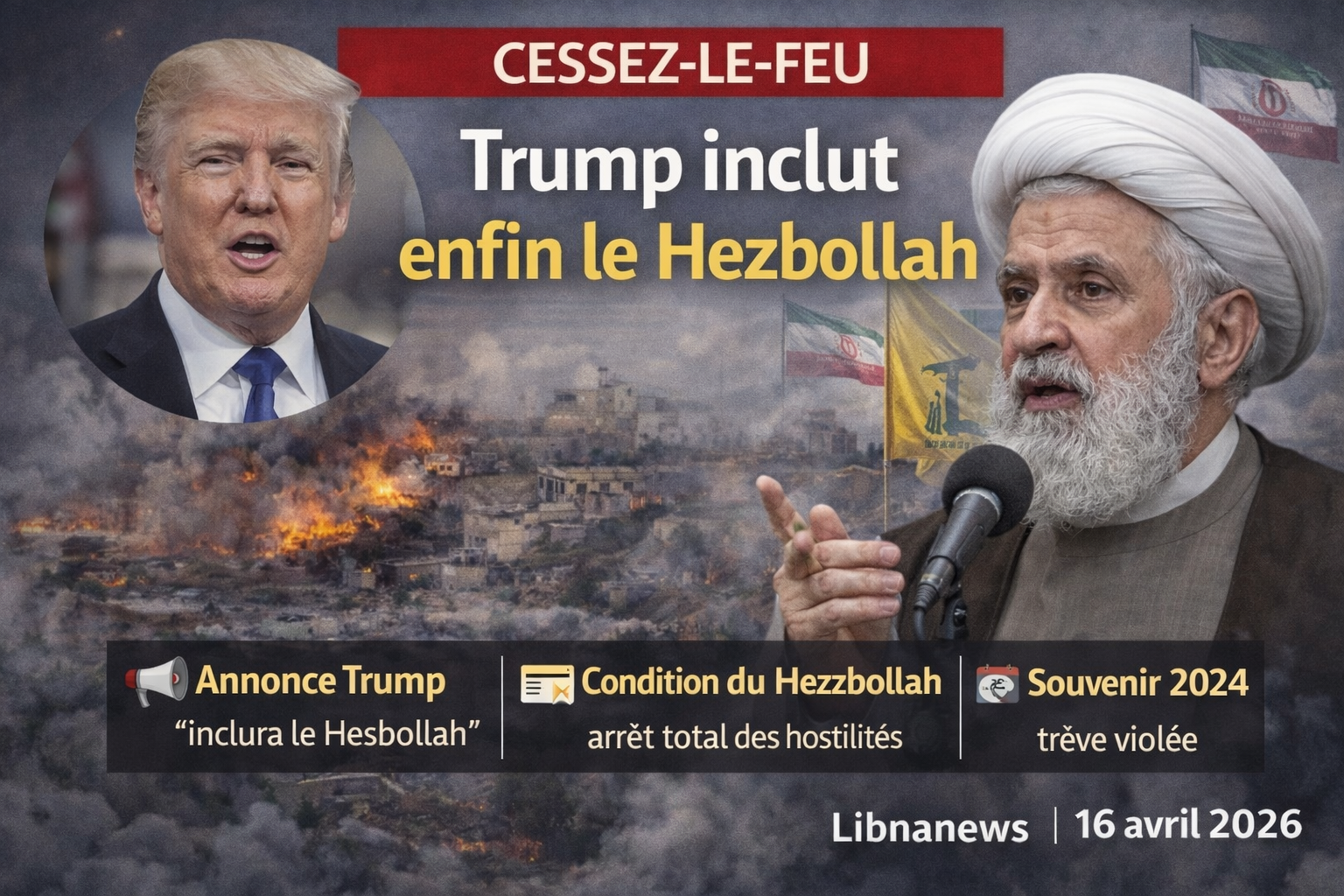
Donald Trump gave a new political scope to the announced ceasefire between Lebanon and Israel on Thursday evening, saying that he « will include Hezbollah ». The formula counts, because it implicitly recognizes a reality that Washington, Beirut and the mediators could no longer circumvent: no truce in Lebanon can work if the main armed actor of the southern front is not, in one way or another, integrated. The American President has thus moved the initial narrative of the truce, first presented as an agreement between states, towards a more concrete reading, closer to military ground.
This precision comes after several hours of blur. In his first message, Donald Trump announced a ten-day ceasefire between Lebanon and Israel, scheduled to begin at 5 p.m. in Washington, D.C., at 11 p.m. in Lebanon. He had explained that he had spoken with Benjamin Netanyahu and Joseph Aoun, and had instructed JD Vance, Marco Rubio and Joint Chief of Staff Dan Caine to work towards a more lasting peace. But the central question remained: what about Hezbollah, while Israel was fighting this movement first and not the Lebanese state in the strict sense?
The answer began to come from the movement itself, then from Tehran, before being taken over by Donald Trump. Hezbollah stated that it would respect the ceasefire in Lebanon provided that Israel ended all its hostilities, including targeted strikes against its members. Iran, for its part, has been insisting for several days on the need for a ceasefire in Lebanon as a central element of any regional de-escalation. Now saying that the truce « will include Hezbollah », Donald Trump acts a political and military fact: the ceasefire in Lebanon is not only a matter between Beirut, Washington and Israel. It depends directly on the behaviour of Hezbollah, its conditions and how Israel chooses to suspend its strikes.
The subject is all the more sensitive as in Lebanon, the memory of the previous ceasefire remains very vivid. The November 2024 agreement was presented as the end of the war, but it was quickly perceived as a largely one-way truce. Israeli strikes continued for months. According to the Lebanese authorities relayed in March 2026, approximately 850 people were killed from the November 2024 truce until the war began on 2 March 2026. In these circumstances, when Hezbollah today speaks of « conservation » of the ceasefire in Lebanon, it refers directly to this experience and to this accumulated distrust.
Trump’s public focus on Hezbollah
The new American wording has an immediate effect. It corrects, or at least corrects, the original narrative. At the beginning of the sequence, the White House was mainly talking about discussions between Lebanon and Israel, conversations with Joseph Aoun and Benjamin Netanyahu, and a truce supposed to open a political path. But very quickly, the question of Hezbollah was imposed as the dead corner of the device. Without clarification of the Shiite movement, the ceasefire in Lebanon might appear as a theoretical diplomatic arrangement, without a real take on the ground.
By saying that the ceasefire « will include Hezbollah », Donald Trump implicitly admits that the truce cannot be only bilateral in its state form. It must also integrate the armed actor who occupies the centre of the conflict. This development is not insignificant. For several days Washington and several Israeli officials had tried to separate the levels, suggesting that the dialogue with Beirut was primarily about the Lebanese state, its leaders and the stability of the front. However, military reality makes it clear that until Hezbollah is included in the concrete mechanism of the ceasefire in Lebanon, the truce remains incomplete.
This American recognition comes at a time when official Lebanon continues to use a more cautious language. Beirut first talks about a ceasefire, an end to hostilities, an Israeli withdrawal and the return of internally displaced persons. The Lebanese Presidency did not resume the vocabulary of direct political negotiations with Hezbollah as a formal party. It remains on an institutional line. But Trump’s words come, in fact, to broaden the framework and recognize what regional actors already knew: in Lebanon, the cease-fire is not just between chanceries.
In this perspective, Donald Trump’s sentence also has a test value. It creates an immediate political expectation. If the ceasefire in Lebanon « includes Hezbollah », this means in practice that Israeli strikes against the movement’s cadres, vehicles, positions or networks must cease. This also means that Hezbollah must suspend its own fire and refrain from presenting the truce as external to it. In other words, Trump formulated a short sentence, but he actually defined a very high credibility threshold for the following hours.
Hezbollah had already set its conditions
Even before this new American precision, Hezbollah had given its own reading of the ceasefire in Lebanon. MP Ibrahim Moussawi stated that the movement would respect the truce « in a cautious manner », provided that it was a global cessation of hostilities against him and that Israel was not exploiting the situation to pursue targeted assassinations. This formula became one of the anchor points of the entire sequence.
First, it has the merit of clarifying the movement’s position. Hezbollah does not reject the ceasefire in Lebanon as a matter of principle. He is not in the role of the actor who would refuse to suspend the fighting. On the other hand, he says that he will only observe the truce if Israel really respects it. The movement therefore sets a framework for reciprocity. He is not talking about peace, normalization or political openness. He talks about an effective halt to strikes and assassinations.
The important word here is « global ». For Hezbollah, a ceasefire in Lebanon cannot be limited to halting massive bombings while leaving Israel the freedom to conduct targeted strikes. It is precisely this type of distinction that undermined the credibility of the previous agreement. The movement says, in essence, that it will not be confined to a scenario where its own fire would cease while Israel would continue to strike on an ad hoc basis under cover of security or prevention.
This line was reinforced by other party officials. The same idea was emphasized in the evening statements: the ceasefire in Lebanon must apply to the entire territory, not offer Israel freedom of movement in Lebanese territory and not be used to perpetuate an Israeli presence in the South. This insistence shows that Hezbollah seeks to transform a defensive posture into an immediate doctrine of the truce.
Trump’s formula therefore comes after this position, not before it. That too is important. The U.S. president doesn’t create any pieces of Hezbollah inclusion. It endorses a balance of power and a political fact already laid down by the ground: the movement has indicated the minimum conditions for its behaviour, and Washington can no longer act as if this word did not exist.
Iran also called for the inclusion of the Lebanese front
Tehran had been defending the same logic for several days, on a more regional register. Iranian officials had made it clear that they considered the ceasefire in Lebanon an essential element of any wider de-escalation. The President of the Iranian Parliament, Mohammad Bagher Ghalibaf, had even declared that a ceasefire in Lebanon was « as important » as in Iran. This sentence had been read as a message to Washington, but also as a signal to Hezbollah.
The meaning of this position was transparent. For Tehran, the Lebanese front could not remain apart in the current diplomatic phase. If Iran discussed, directly or indirectly, with the Americans a truce extension or regional de-escalation, it wanted Lebanon to be part of the political package. This line responded to a clear concern: to prevent Iran from getting a respite on its own front while Hezbollah would continue to suffer Israeli pressure alone.
That’s where Trump’s formula takes on additional resonance. By saying that the ceasefire in Lebanon « will include Hezbollah », he joins, even if he does not formulate it in the same way, a demand raised by both Hezbollah and Iran. That doesn’t mean Washington is marrying the Iranian strategy. This means that the United States had to take into account a reality imposed by Tehran and the ground: Lebanon could not be treated as an abstract dossier, detached from Hezbollah and regional balances.
This de facto convergence will not appeal to everyone, particularly Israel. Part of the Israeli press and several security commentators had already begun to explain that the ceasefire in Lebanon looked like an American gesture to facilitate discussions with Iran. The argument was as follows: if Washington agreed to slow down or freeze the Lebanese front, it is not only for Lebanon itself, but also to make the talks with Tehran more fluid. Trump’s new sentence may feed this reading again.
For Beirut, however, the fact that Hezbollah and Iran demanded the inclusion of the Lebanese front in the truce can be used in another way. Official Lebanon can argue that it has also been calling for a ceasefire for several days for humanitarian and security reasons. In this regard, the fact that Hezbollah and Iran have pushed in the same direction does not detract from the legitimacy of Lebanese demand. It only shows that several separate calendars converge temporarily around the same immediate objective: to stop the strikes.
The 2024 precedent weighs on the entire sequence
However, the November 2024 precedent continues to haunt every statement. It is he who explains the caution of Hezbollah, but also the reservations of part of Lebanese opinion. At the end of the previous war, a ceasefire had been proclaimed. It was to reduce the clashes, reorganize the South around a Hezbollah withdrawal north of the Litani and a Lebanese army deployment. On paper, the text seemed structured.
In fact, Lebanon has not experienced a real lasting halt to the strikes. The Lebanese authorities claimed in March 2026 that some 850 people had been killed since the truce of November 2024 until the war began on 2 March 2026. Those deaths included fighters, as well as civilians and personnel affected by Israeli strikes. In Lebanon, therefore, this period was experienced as a very imperfect or even unilateral ceasefire.
We must insist on this, because it structures the entire reception of the current truce. When Hezbollah today demands an end to targeted assassinations, it does not make a theoretical demand. It refers to the very flaw of the previous agreement. When Beirut insists on a real cessation of hostilities, it speaks from the same experience. And when Trump says that the ceasefire in Lebanon « will include Hezbollah », he probably takes note of the fact that a truce left half-implemented would be politically dead from his birth.
This also explains why the land counts so much. The Lebanese have already experienced a ceasefire proclaimed but partly contradicted by the facts. Hezbollah too. The US officials know, therefore, that a new agreement, if it were to be transformed again into a bank truce, would lose its credibility in a few hours. The weight of 2024 gives the 2026 ceasefire a very simple requirement: it must produce a visible, immediate, concrete change.
Until the last hours, the strikes continued
The American announcement was not made in a calming climate already installed. On Thursday, the Lebanese National Information Agency reported shelling of Bint Jbeil and Yarun, extensive damage to the government hospital in Tebnine, and destruction of the Qasmiyeh bridge. Other dispatches reported strikes on roads and civilian areas in the South and beyond.
Bint Jbeil remained one of the major centers of fighting. Artillery fire and clashes around the city continued to be reported. For both Hezbollah and the Lebanese State, this sector will be one of the first tests of the reality of the ceasefire in Lebanon. If the bombings actually stop, the truce will begin to take shape. If they continue, Trump’s formula for the inclusion of Hezbollah will immediately become more fragile, if not purely declarative.
The destruction of the Qasmiyeh bridge also marked the day. She recalled that civil and logistical infrastructure remained directly targeted until the hours before the truce. Similarly, the damage to the Tebnine hospital reinforced the feeling that the war continued without a real slowdown. It was in this context that Hezbollah set its conditions and Trump spoke about including the movement in the ceasefire.
This chronology gives the first night a vital importance. The ceasefire in Lebanon will not be judged on its announcement, but on whether or not the noise of the strikes has disappeared. Trump’s new formulation also raises the requirement. Since he says the truce will include Hezbollah, every targeted strike against the movement can be read as an immediate violation of the very spirit of the agreement.
For Beirut, a wider but still fragile truce
The Lebanese power is in a delicate position. On one side, he can see Trump’s sentence as a useful recognition of the reality of the ground. While Hezbollah is included in the ceasefire in Lebanon, the truce is more likely to exist in practice. On the other hand, this inclusion also confirms that the Lebanese State alone is not sufficient to carry or guarantee the cessation of fighting.
Joseph Aoun and the government have, however, for several days sought to build a state narrative. They talk about the ceasefire, Israeli withdrawal, sovereignty and return of the displaced. They want to show that an institutional path exists. But Trump’s formula brutally recalls that the southern front continues to be structured by another armed actor, rooted, with a own decision-making chain: Hezbollah.
For Beirut, this means that the success of the ceasefire in Lebanon will depend on two levels at the same time. The diplomatic level, where Washington continues to play the central role. And the practical level, where Hezbollah and Israel will really have to stop their operations. Official Lebanon cannot ignore this reality. It can only try to contain it in a wider architecture where the state remains the political face of the truce.
This point is all the more sensitive as Joseph Aoun refused, according to an official Lebanese source, direct contact with Benjamin Netanyahu. The Lebanese President wants the ceasefire, but he does not want to be dragged too quickly towards a political scene that would resemble normalization or conventional bilateral negotiations. Trump’s formula on Hezbollah further reinforces this difficulty: it expands the ceasefire, but it also confirms that it is based on actors and logics that Beirut does not control alone.
The first measure will be military, not diplomatic
In the end, Donald Trump’s sentence changes the public framework for the ceasefire in Lebanon. She now explicitly states that Hezbollah is part of it. This corresponds to what the movement was demanding on the ground, what Iran was pushing at the regional level, and what military reality already required. But this clarification does not erase strangers. She’s focusing on them.
Everything will now depend on a series of very concrete facts: do drones continue to fly? Do targeted strikes stop? Do the bombings around Bint Jbeil, Yarun or Tebnine really stop? Does Hezbollah suspend its fire if these conditions are met? As long as these responses do not exist, the inclusion of Hezbollah in the ceasefire in Lebanon will remain a strong but fragile political formula.
For the Shiite movement, the line is already ready: no real truce if targeted assassinations continue. In Tehran’s view, the ceasefire in Lebanon must in any case be part of a wider de-escalation. For Washington, the new wording makes it possible to adapt the American narrative to reality. But in Lebanon, after the experience of 2024, no one will give a lasting credit to the single word until the first night says whether the front, too, has heard Donald Trump’s new definition.




