

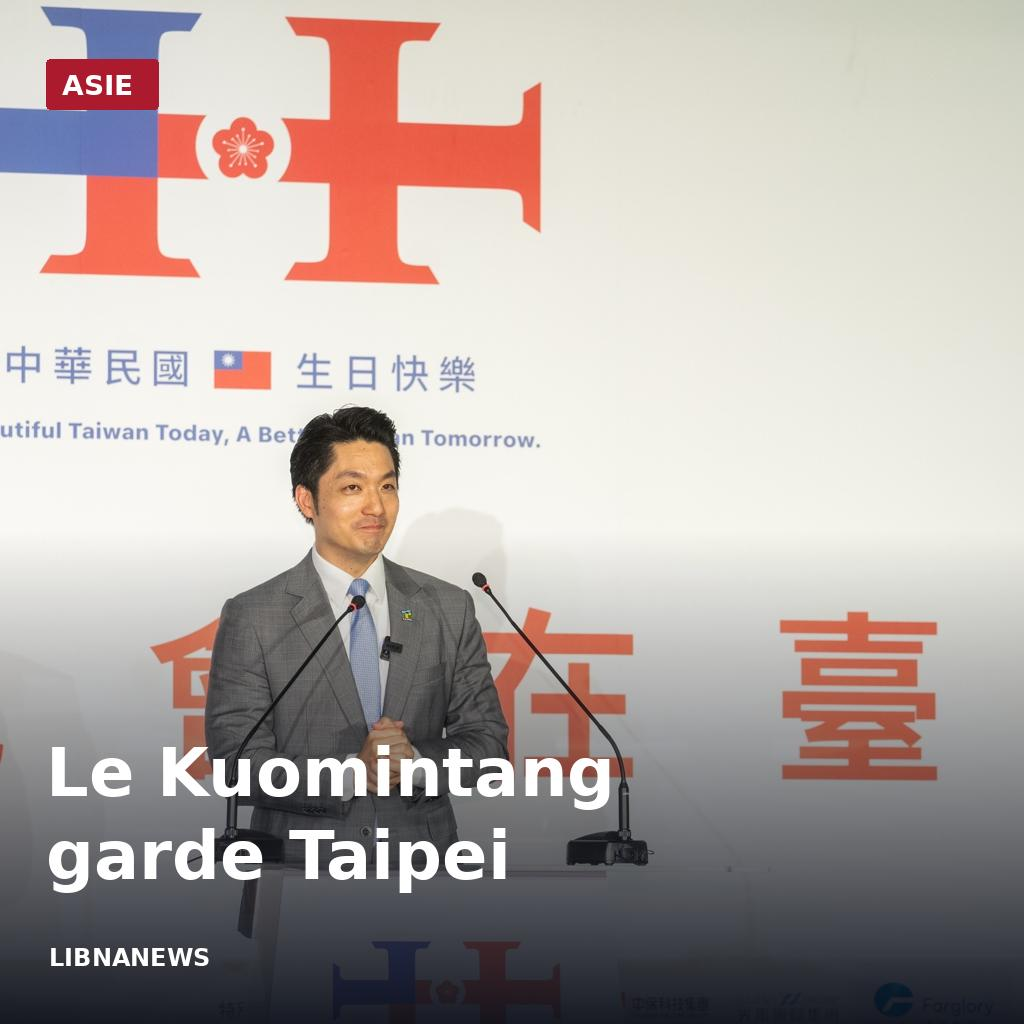
The Kuomintang (KMT), the main opposition party in Taiwan, kept Taipei City Hall in local elections on 28 November. However, President Lai Ching-te’s Progressive Democratic Party (PPD) has doubled the number of cities and counties he runs. The count gives 11 local executives to the KMT, 10 to the DPP and one to an independent candidate.
In Taipei, Chiang Wan-an won a second term with 53.72 per cent of the valid votes, compared with 45.69 per cent in Puma Shen, the DPP candidate. The outgoing mayor obtained 781,312 votes, 116,726 more than his main opponent. Participation was 72.14 per cent. His party, however, did not have a single majority on the municipal council: he held 28 seats out of 61, compared to 23 for the DPP.
KMT keeps north, DPP takes back Taichung
KMT also preserves New Taipei. Li Sichuan is ahead of Su Chiao-hui, of the DPP, by 64,925 votes, according to the statement of the municipal election commission. The party also retains Taoyuan, where Chang San-cheng gets 55.68 per cent. In Taichung, on the other hand, Ho Hsin-chun took over town hall for the DPP with 50.68% of the vote, compared with 48.39% for Johnny Chiang.
In Yunlin County, the counting gives only 173 votes in advance to Liu Chien-kuo of the DPP on Chang Chia-chun of the KMT. In this county, a variation of a few hundred votes is enough to rock one of the 22 executives. The party balance sheet is therefore to be read with the local margins: the KMT has increased from 14 to 11 executives since 2022, while the DPP has increased from 5 to 10.
A local vote and a separate national referendum
The election renews mayors, county chiefs and local assemblies, not the presidency or Parliament. The re-election of the mayor of the capital gave the KMT a support point before 2028, while the DPP’s gains expanded its municipal establishment. These results alone do not tell how voters will arbitrate in the presidential elections on relations with Beijing.
On the same day, voters voted separately on the use of nuclear energy and the abandonment of the policy of leaving the atom. The « yes » crossed the statutory threshold of one-quarter of registrants based on provisional results. The question submitted by the Central Electoral Commission did not designate a specific central office or a starting date. A favourable result therefore does not return a reactor to service on its own.





Comments