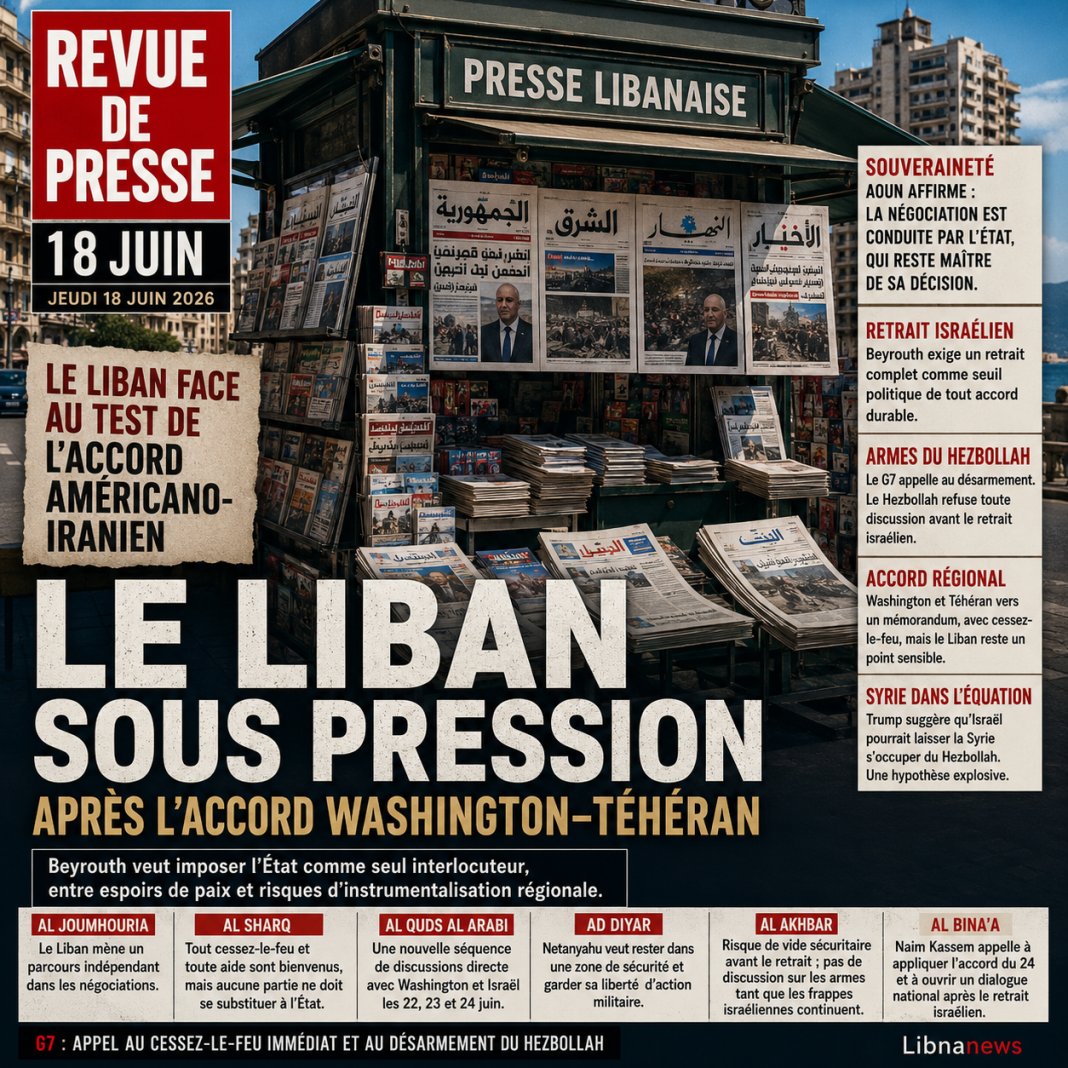







Syria chose caution when Donald Trump sought to move part of the Hezbollah file to Damascus. According to press reports and comments reported at the G7 summit in France, the US president suggested that Ahmed al-Sharaa, the new Syrian leader, might « occupy » Hezbollah in Lebanon better than Israel. The Syrian response, as it emerges from the available evidence, stands in one line: Damascus does not want to enter the Lebanese quagmire militarily. This refusal illuminates the regional moment. Syria, still fragile, refuses to end a war that could rekindle its internal fractures. Israel, on the contrary, remains committed to Lebanon by its strikes, safe areas and its desire to maintain freedom of action against Hezbollah.
The Syrian refusal is not a matter of sympathy for Hezbollah. It is a survival calculation. Ahmed al-Charaa must consolidate an exhausted State, restore public services, contain armed groups, manage refugees, reassure minorities and negotiate with foreign powers that still occupy or influence parts of Syrian territory. Adding an intervention to Lebanon would mean importing a new war into a country seeking to close the previous one.
A risky American proposal
Donald Trump formulated his idea in a context of tensions with Benjamin Netanyahu. He had just criticized Israeli conduct in Lebanon, which was considered too long and too destructive. In particular, the US President suggested that Israel was destroying buildings for limited purposes. With this in mind, Syria could have become a substitute force, able to deal with the Hezbollah problem without the Israeli army continuing its direct operations.
This approach seems simple on paper. It becomes explosive as soon as it touches the ground. The Syrian-Lebanese border is not an abstract line. It crosses smuggling areas, family networks, military roads, mixed localities and areas where the Lebanese State and the Syrian State have long been weak. A Syrian operation against Hezbollah in eastern Lebanon or border areas would not be police action. It would be immediately read as a foreign intervention in a sovereign country.
Lebanon has a heavy memory of the Syrian military presence. Damascus troops entered the country during the civil war. They stayed there for almost thirty years. Their withdrawal in 2005, after the assassination of Rafic Hariri and a major popular mobilization, was one of the turning points in Lebanese contemporary history. Proposing a Syrian return, even under the pretext of the disarmament of Hezbollah, is therefore a profound political wound.
Washington seems to want to test all options to reduce Hezbollah’s role without directly engaging more American forces. But entrusting this issue to Damascus would mean delegating part of Lebanese sovereignty to a convalescent neighbour. This would also place Syria in an untenable position: to fight an ally of Iran, on Lebanese territory, while being perceived as executing an American and Israeli demand.
Damascus refuses the confessional trap
The first reason for the Syrian refusal is the religious risk. Hezbollah is a Lebanese Shiite movement, supported by Iran, but rooted in a community and territory. A Syrian offensive against him could be interpreted as a Sunni war against a Shiite force, especially if it was led by a power dominated by former opponents of Bashar al-Assad. This reading would be dangerous for Syria, where denominational divisions have already fed years of violence.
Ahmed al-Charaa knows that his regional legitimacy remains fragile. His past as leader of Hayat Tahrir al-Sham continues to arouse mistrust. He now seeks to present himself as a state leader, not as the leader of a faction. Engaging in Lebanon against Hezbollah would make him lose this beginning of normalization. He would be accused by his opponents of serving Israel. He is suspected by Arab actors of rekindling Sunni-Shiite divisions. It could also push pro-Iranian groups to hit Syria.
The internal risk is just as serious. Syria remains fragmented. Some regions are not fully controlled. Jihadist cells remain. Foreign forces keep positions. Displaced populations expect a minimum return or security. An adventure in Lebanon would divert military and political resources from the new power. It would also give its opponents an obvious argument: Damascus would start an external war before it had rebuilt the state.
This caution may seem frustrating for Washington. Yet it is rational. Syria today did not have the means to be the Lebanese gendarmerie. She’s already having trouble becoming the policeman of her own territory. His immediate interest is to close the fronts, not open a new one. It can cooperate on border control, curb certain traffic, cut logistical roads and engage in dialogue with Beirut. It cannot absorb the political cost of a military campaign against Hezbollah.
Israel remains caught in the Lebanese front
The contrast with Israel is clear. Where Syria refuses to enter the Lebanese quagmire, Israel remains deeply committed. The Israeli army is conducting strikes against positions attributed to Hezbollah, maintaining pressure on southern Lebanon and claiming to prevent the movement from returning near the border. Israeli officials also refer to the maintenance of safe areas, both in Lebanon and on other fronts.
This presence is not only military. She’s political. The Israeli Government makes the Lebanese front a central issue of internal security. Tens of thousands of people in northern Israel have lived under the threat of Hezbollah fire. Their return depends, in the eyes of the Hebrew state, on a lasting distance from the Shiite movement and its capabilities. Netanyahu cannot ignore this pressure. Its most radical ministers turned it into a demand for prolonged war.
Itamar Ben Gvir and Bezall Smotrich embody this hard line. They refuse that the American agreement with Iran limits Israeli freedom of action. They defend a strategy of force, destruction of enemy infrastructure and maintenance of pressure. Their discourse feeds on a conviction: any restraint will be interpreted by Hezbollah as a weakness. This logic pushes Israel to remain in the Lebanese file, even when Washington is seeking de-escalation.
The problem is that this strategy is itself sluggish. The more Israel strikes Lebanon, the more Hezbollah can present itself as a resistance force. The more the Israeli army maintains positions or threatens to remain in safe areas, the more the Lebanese state can denounce an infringement of its sovereignty. The longer the war lasts, the more Washington sees its agreement with Tehran weakened. Israel wants to get Hezbollah out of the border. He may be locked in a confrontation without a clear political outcome.
Syrian precedent haunts Lebanon
The refusal of Damascus is also explained by Syrian history in Lebanon. The Syrian military presence has long been justified by Lebanese stabilization, Arab security or internal equilibrium. It has evolved over time into a guardianship system. Syrian services controlled parts of political life. The Presidents, Governments and major appointments were often under the direct or indirect influence of Damascus. For many Lebanese, this memory remains incompatible with the idea of even limited return.
A Syrian intervention against Hezbollah would therefore not be received as a mere technical contribution to disarmament. It would immediately awaken Lebanese divisions. Some opponents of Hezbollah may see this as a useful weakening of the movement. But many would refuse the idea that a foreign army would forcefully resolve a question that affected national sovereignty. Lebanon would then risk moving from contested Iranian guardianship to further Syrian interference, encouraged by Washington and tolerated by Israel.
Damascus knows that this perception would be disastrous. The new Syrian power is trying to get out of isolation. It needs aid, recognition, investment and border stability. Returning to Lebanon by force would ruin part of this effort. Arab capitals, already cautious in the face of the new Syria, could see a flight forward. Europeans would talk about risk of burning. The Lebanese would denounce a return to the old Syrian reflex of domination.
Syria may therefore need to cooperate quietly, but not intervene. It can strengthen certain crossing points. It can exchange information with foreign actors. It can prevent its territory from serving as an open logistics corridor. But she doesn’t want to be the one who crosses the border to disarm Hezbollah. This difference between cooperation and intervention is the key to its position.
Hezbollah, Syrian opponent but Lebanese danger
Hezbollah is not a neutral actor for Damascus. During the Syrian war, he supported the former regime and fought rebel groups. For many Syrians close to the new power, the Lebanese movement remains associated with sieges, offensives and violence. Political hostility does exist. But this hostility is not enough to produce a military decision.
Hezbollah retains significant capabilities. He has experience of war, networks in Lebanon, Iranian support and social settlement. Combating him on his own ground would be costly. A Syrian army still under reconstruction could not guarantee a speedy victory. On the contrary, it could suffer losses, trigger reprisals and provoke an Iranian reaction. Even a limited operation in the Bekaa could open a climbing chain.
Lebanon is not an empty space either. The Lebanese army exists. The Lebanese authorities claim the sovereignty of the country. UNIFIL operates in the South. Community balances remain sensitive. A Syrian intervention would short-circuit all these actors. It would give the impression that the disarmament of Hezbollah is no longer the responsibility of the Lebanese State, but rather of an external coalition. It would be an admission of failure for Beirut and an internal crisis factor.
For Hezbollah, such an intervention would even be a narrative bargain. The movement could abandon the nuances and denounce an American-Israeli offensive against Lebanon. He would mobilize his environment in the name of resistance. It would seek to broaden the conflict. He would put his Lebanese opponents in an uncomfortable position, between hostility to Hezbollah and the refusal of a foreign army. Damascus therefore has little to gain and much to lose.
Washington is looking for an unobtainable performer
The American idea reveals a deeper difficulty. Washington wants the disarmament or weakening of Hezbollah, but no actor wants to pay the price of this operation alone. Lebanon is too divided to quickly impose the arms monopoly. Israel could strike, but its strikes did not necessarily produce a political solution. Iran may ask Hezbollah to modulate its action, but it has no interest in completely abandoning its Lebanese map. Syria may hinder the movement’s networks, but it refuses to become the main opponent.
The United States is therefore looking for an actor capable of solving a contradiction that no one has yet been able to resolve. Hezbollah is both a Lebanese party, an armed force, a social actor, an Iranian ally and an enemy of Israel. Treating it as a simple military problem leads to silencing. Treating him as a mere political actor ignores his weapons. Treating it as a Lebanese problem only underestimates its regional anchor.
The Syrian proposal reflects this impasse. It outsources the difficulty. It assumes that Damascus, because it has to settle with Hezbollah, would agree to do what Israel is unable to complete and what the Lebanese State cannot impose alone. This hypothesis neglects the weight of history, Syrian fragility and the risk of regionalized denominational conflict.
That’s why the Syrian refusal is a signal. Damascus wants to be useful in Washington. He wants to be a responsible actor. It can even publicly support the objective of a Lebanese state monopoly on weapons. But he doesn’t want to be the military tool of a strategy that could slug. The formula is simple: Syria wants to leave the war, not inherit from the Lebanese front.
Lebanon in the face of disputed sovereignty
For Beirut, this sequence is revealing. Everyone is talking about Lebanon, but few actors seem willing to let it define the solution itself. Israel is talking about security. Iran speaks of resistance and regional balance. The United States is talking about disarmament and stabilization. Syria speaks of caution. Hezbollah is talking about defending the country. The Lebanese State must try to transform these competing speeches into a national strategy.
Syrian refusal can serve Lebanon if it prevents further military interference. He recalls that the disarmament of Hezbollah cannot be entrusted to a foreign army without creating a more serious crisis. It can reinforce the argument of a gradual Lebanese solution, supported by international guarantees, the Lebanese army and diplomatic pressure on both Israel and Hezbollah.
But this solution requires difficult conditions. Israel must stop the strikes and withdraw its forces from the disputed areas. Hezbollah must accept that the decision of war and peace should come back to the state. The United States must support Lebanese institutions instead of seeking regional shortcuts. Iran must recognize that Lebanese sovereignty cannot be a mere variable in its negotiations with Washington. Syria must stabilize its border without returning to a logic of guardianship.
Trump’s proposal therefore had an involuntary merit. It showed the absurdity of an imported military solution. It recalled that Lebanon does not lack only armed forces. There is a lack of universal national consensus, consistent external guarantees and a regional environment that respects its territory. As long as these elements are missing, each actor will look for another performer to solve the problem in his place.
Syrian Caution Isolating Israel
By refusing to get involved, Syria leaves Israel facing its own strategy. Netanyahu can no longer expect Damascus to take over from Lebanon. Washington can continue to criticize Israeli methods, but it does not have a credible substitute. Hezbollah stays here. Lebanon remains fragile. The agreement with Iran adds a diplomatic constraint. Israel is therefore caught between the continuation of the strikes and the need not to sabotage the American framework.
This situation exposes a defeat of method. Israel has demonstrated its ability to strike. He did not demonstrate his ability to produce a political outcome in Lebanon. Syria, by refusing to enter this file, shows that it understands the trap. A war against Hezbollah can begin with simple goals and end up with an occupation, a counter-guerrilla, a confessional crisis and dependence on foreign arbitration. Damascus knows this kind of silencing. Israel too, but its government still seems to believe that prolonged pressure can make lasting changes to the ground.
The Syrian refusal does nothing. He doesn’t disarm Hezbollah. It does not protect Lebanese civilians. It does not guarantee the return of the inhabitants of northern Israel. He doesn’t stabilize the border. But he’s closing a bad lead. He says that a new Syrian entry into Lebanon cannot be the answer to the current impasse. The file therefore returns to where it should have remained: between the Lebanese State, international guarantees, pressure on Israel and wider negotiations on Iranian influence.
The follow-up will depend on the final content of the Islamabad agreements, the role of the Security Council and Beirut’s ability to prevent its sovereignty from being negotiated by others. Damascus chose not to return to Lebanon. Israel, for its part, is still engaged, with a real military margin but an increasingly narrow diplomatic margin.