

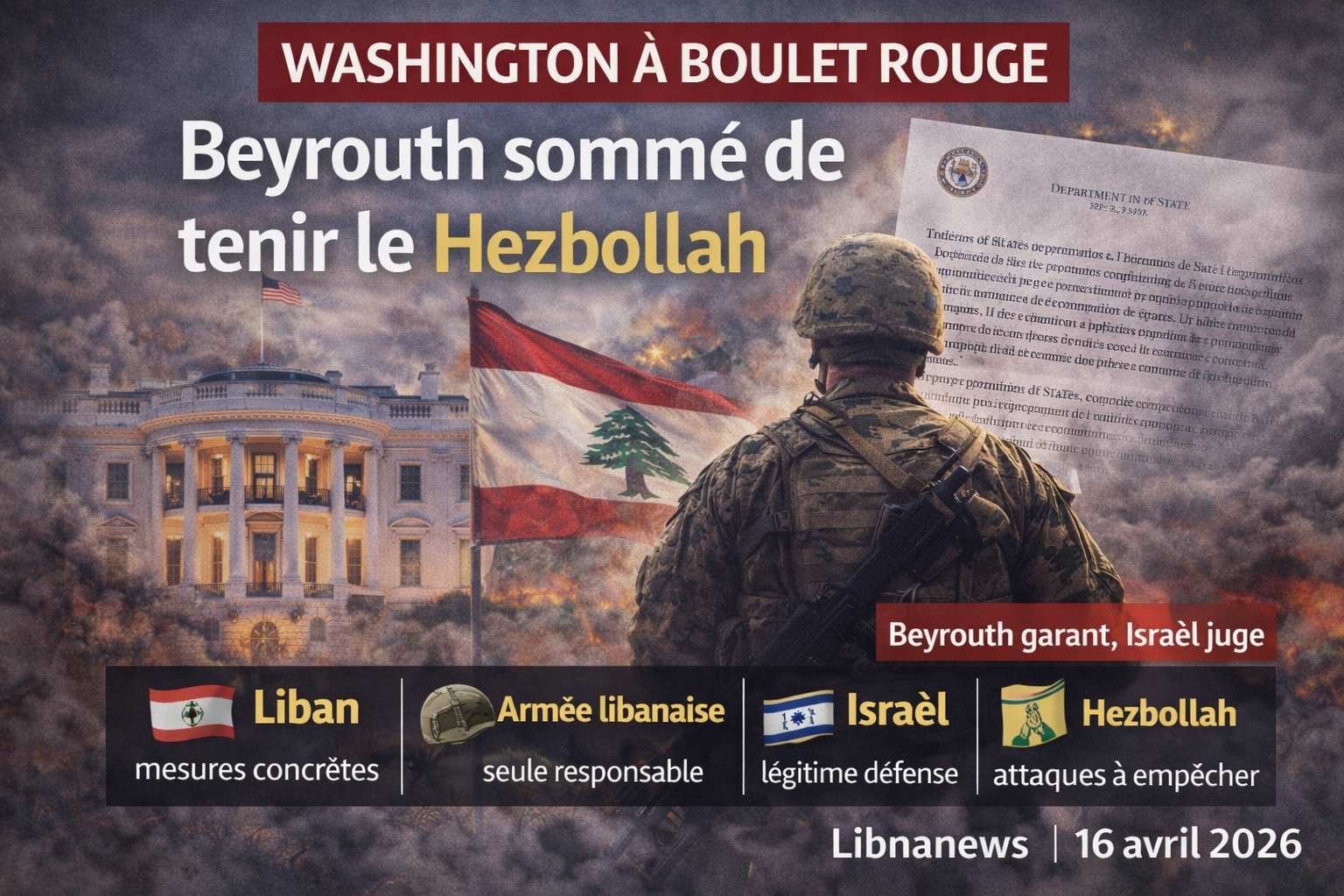
The American text on the ceasefire in Lebanon does not merely announce a 10-day break between Israel and Lebanon. It clearly redistributes responsibilities. According to the U.S. State Department, the Lebanese government is committed to taking « concrete measures » to prevent Hezbollah, but also « all other non-State rebel armed groups present on Lebanese territory », from carrying out attacks, operations or hostile activities against Israeli targets. In the same communiqué, Israel reserves the right to take « at any time » such measures as it deems necessary in self-defence. This double statement alone sets the heart of the new sequence: in Beirut the task of preventing attacks, in Israel the ability to judge what is within its own defence.
This formulation gives the ceasefire in Lebanon a far greater scope than simply suspending fighting. It makes the Lebanese government the first guarantor of the neutralization of the Lebanese side of the southern front. It also affirms that the Lebanese security forces must be recognized as the sole responsibility for the sovereignty and defence of the country. In a hollow, the American message is clear: there is no longer, in this context, a recognized place for an autonomous military logic of Hezbollah. The cease-fire, therefore, is not only intended to silence the weapons for ten days. It is also used to place the Lebanese State, at least on paper, at the exclusive centre of the security file.
The contrast with the reality of the terrain remains immense. The Israeli bombing continued until the last hours before the truce came into effect. Hezbollah, for its part, said that it would respect the ceasefire in Lebanon only if Israel ended all its hostilities, including targeted strikes against its members. Benyamin Netanyahu has already rejected the principle of a simple « quiet against calm » and announced the maintenance of a seat belt in southern Lebanon. In other words, the American text outlines an ambitious framework, but it comes into force when the three major players in the sequence — Washington, Israel and Hezbollah — do not yet speak exactly the same language.
The American text changes the meaning of the ceasefire
The most significant element of the US press release is its accuracy. Washington is not just talking about a cessation of hostilities. The State Department describes a political and security mechanism. Starting on 16 April at 5 p.m., Washington time, that is, in the night on the Lebanese side, the Government of Lebanon must take concrete measures to prevent Hezbollah and any other non-State armed group from attacking Israel. It is therefore not a vague formula on de-escalation. This is an explicit commitment attributed to the Lebanese State.
The text adds a second clause, which is almost heavier. He claims that all parties recognize the Lebanese security forces as the sole holders of responsibility for sovereignty and national defence. This sentence is crucial. It places the Lebanese army and the State security apparatus at the centre of the system. It also implicitly means that Hezbollah is not recognized as a legitimate actor in the defence of the country within the framework of this ceasefire in Lebanon.
This formulation extends an ancient American line, but here it takes a particular relief. For years Washington has been pushing for the consolidation of the Lebanese army as the only legitimate security structure in Lebanon. The ceasefire turns this principle into an operational requirement. Lebanon must not only defend, in theory, the monopoly of law enforcement. It must show, in fact, that it can prevent Hezbollah attacks on Israel. It’s a much more demanding threshold.
At the same time, the US communiqué provides that the ten-day truce may be extended by mutual agreement and that it must open negotiations on a permanent security and peace agreement. So it’s not just about buying time. Washington wants to use this window to structure a new political phase. This includes, according to Reuters, further direct discussions between Lebanon and Israel, including on the demarcation of the international land border. Again, the ceasefire in Lebanon appears less as an end than as the first floor of a broader arrangement.
Beirut faced a concrete obligation
For the Lebanese State, the difficulty begins precisely here. Accepting a ceasefire, calling for a halt to strikes and defending sovereignty are politically consensual objectives in Beirut, at least in principle. But committing to preventing Hezbollah from launching attacks against Israel is a very different ambition. This implies, in practice, that the State is able to exercise real authority over the Shiite movement, or at least a credible capacity for coercion. This is precisely what has been one of the major flaws of the Lebanese system for years.
The US press release puts Beirut in the face of a challenge that no Lebanese government has so far resolved. It does not only ask Lebanon to agree with the ceasefire. He asked him to become the man executing on the Lebanese side. In a country where Hezbollah has its own military, political and territorial weight, this requirement is immediately strategic. It puts the state at the foot of the wall on the issue of the monopoly of legitimate violence.
The problem is not only legal. It’s also operational. South Lebanon is emerging from weeks of bombing, displacement, destruction of infrastructure and ground operations. Roads have been affected, bridges destroyed, hospitals damaged, and some areas remain very unstable. To ask the Lebanese government to prevent any attack by Hezbollah against Israel in this context is to demand from it a security control capability that it does not yet fully possess, or that it can only exercise at the cost of a potentially explosive internal confrontation.
This difficulty explains the caution of Lebanese communication in recent days. Joseph Aoun and the government spoke about ceasefire, Israeli withdrawal, return of displaced persons and sovereignty. They praised the efforts of the United States. But they avoided publicly detailing commitments that would give the impression of imminent direct confrontation with Hezbollah. The text of the State Department goes much further. It translates into a very clear American language what Washington expects of Lebanon in this truce.
Israel keeps room for manoeuvre
The second side of the US press release is equally important. He states that Israel « reserves the right to take all necessary measures in self-defence at any time ». This sentence has considerable weight, as it introduces obvious asymmetry in the reading of the ceasefire in Lebanon. Lebanon is under an obligation to prevent Hezbollah attacks. Israel retains, at least in the American text, the ability to assess itself what is within its legitimate defence.
However, Reuters adds another element: according to the Washington text, Israel must refrain from offensive operations in Lebanon during the ceasefire. This clarification nuances the scope of the self-defence clause, but it does not erase it. In practice, everything will depend on what Israel considers offensive, preventive or defensive. It is precisely on this point that the precedent of 2024 weighs heavy.
After the ceasefire of November 2024, Israel continued to carry out targeted strikes against Hezbollah members and certain infrastructure, claiming to be acting against persistent threats. On the Lebanese side, these strikes were seen as proof that the truce did not really protect the territory or the inhabitants. According to the Lebanese authorities relayed in March 2026, approximately 850 people were killed between the beginning of the ceasefire in November 2024 and the outbreak of fighting on 2 March 2026. It is this memory that today makes the self-defence clause particularly sensitive in Lebanon.
In the American text, therefore, asymmetry is clear. The Lebanese government must prevent Hezbollah attacks. Israel retains the right to say when its security warrants action. From a diplomatic point of view, Washington presents this as a balance between Lebanese obligations and Israeli security. From a Lebanese point of view, this architecture inevitably recalls a fear already felt: that of a ceasefire in Lebanon that would reduce the firing from Lebanon without completely preventing Israeli strikes.
Hezbollah has already responded
The Shiite movement did not wait to lay its own reading of the truce. MP Ibrahim Moussaoui affirmed that Hizbullah would respect the ceasefire in Lebanon, but « in a cautious manner », provided that Israel halts its overall hostilities and does not use the truce to continue targeted assassinations. Other leaders of the movement also insisted that no ceasefire should allow Israel freedom of movement on Lebanese territory.
This answer immediately sheds light on the fragility of the American text. Washington may write that Lebanon will take steps to prevent any attack by Hezbollah. But Hezbollah says that it will only observe the truce if Israel really stops all its operations, including targeted strikes. This means that the movement does not recognize a ceasefire in Lebanon that would leave Israel a unilateral right of action under cover of security. In other words, it is not enough for Beirut to be hired on paper. Hezbollah must also consider Israeli conduct compatible with its own definition of a real truce.
This position is not marginal in the architecture of the ceasefire. She’s one of the hot spots. Donald Trump himself said that the ceasefire « will include Hezbollah ». It implicitly recognizes that no truce in Lebanon can hold without the main armed actor of the southern front. But if we follow the logic of the State Department, the same cease-fire is based on the idea that the Lebanese State must prevent the same actor from attacking Israel. One of the major contradictions of the moment is that Hezbollah is both external to the state and central in the real application of the ceasefire.
The movement adds another dimension to this difficulty. He recalls that as long as Israel maintains a presence in Lebanese territory, Lebanon and its inhabitants maintain, in his view, a right to resistance. This wording is directly aimed at the Israeli will to maintain a safety belt in southern Lebanon. It means that a ceasefire in Lebanon will not be accepted as fully valid by Hezbollah if the truce serves to consolidate a lasting Israeli military presence on Lebanese soil.
Netanyahu refuses precisely what Hezbollah demands
The Israeli reading further hardens the picture. Benyamin Netanyahu claimed that Israel had refused two Hezbollah conditions: withdrawal to international borders and a ceasefire based on the principle of « quiet against calm ». He also announced that his army would remain in a safety belt in southern Lebanon, with a depth of about ten kilometres, and reiterated that the issue of Hezbollah missiles should be addressed in any perspective of wider agreement.
These words are essential to understand the real scope of the American text. On the one hand, the State Department announces that Lebanon will prevent Hezbollah attacks and that the Lebanese security forces will be the only ones responsible for national defence. On the other hand, Netanyahu makes it clear that Israel will not return to the conventional border line and will not be content with mere military reciprocity. The ceasefire in Lebanon is therefore born in a major contradiction: the Lebanese State must prevent Hezbollah from attacking, even though Israel announces that it does not withdraw its forces to the international border.
This configuration is politically formidable for Beirut. The government can hardly ask Hezbollah to refrain entirely if, at the same time, part of Lebanese territory remains occupied or under reinforced Israeli military presence. Hezbollah will necessarily use this argument to challenge any too unilateral reading of the ceasefire. Netanyahu, on the contrary, claims that this presence is necessary for the security of northern Israel. The two logics clash frontally.
It should be noted here that the American wording does not really resolve this contradiction. It affirms the exclusive role of Lebanese forces and gives Israel a right to self-defence, but it does not clearly state how the issue of the Israeli presence in southern Lebanon will be arbitrated during the ten days of truce. It is precisely this point that can decide the real stability of the ceasefire in Lebanon.
A truce announced as the strikes continued
The immediate military context further reinforces the sensitivity of the mechanism. The American announcement came as Israeli strikes and fighting continued in several areas of Lebanon. On Thursday, the Lebanese National Information Agency reported further bombings around Bint Jbeil and Yarun, severe damage to the Tebnine Government Hospital and the destruction of the Qasmiyeh bridge. Reuters also reported the destruction of the last bridge over the Litani directly connecting part of the South to the rest of the country, according to a Lebanese security source.
This means that the ceasefire in Lebanon did not begin on a calmed ground. It was proclaimed in the middle of a still strong military intensity. In this context, the American commitment to Lebanon to prevent Hezbollah attacks appears almost as a projected demand on a still deeply unstable space. The Lebanese army is not entering a pacified zone. It enters, if the truce holds, in a period of transition still saturated with tensions, destruction and suspicion.
The Bint Jbeil sector illustrates this problem. This is where some of the heaviest ground fighting has been concentrated for several days. If the hostilities actually cease there, the Lebanese State will be able to try to project more presence there. If they resume or if targeted strikes continue, the American clause on the « concrete measures » required in Lebanon will become much more difficult to translate into action. The American requirement is therefore not only political. It depends very directly on the material possibility of a gradual return of calm.
American text pushes towards a redefinition of the Lebanese state
Beyond the truce alone, the American communiqué says something else about Washington’s vision. By affirming that the Lebanese security forces have exclusive responsibility for the defence and sovereignty of the country, it is developing a redefinition of security Lebanon. The ceasefire is not only thought of as a pause. It is presented as an opportunity to place the Lebanese State at the centre and to marginalize, at least politically, any claim by Hezbollah to act as a parallel guarantor of the country’s security.
This is a line that several Lebanese officials in favour of strengthening the State can support in principle. But it faces a tougher reality. Hezbollah is not a marginal actor that a mere US statement would disappear. It is an armed formation, but also a political and social force rooted in part of the country. To ask the Lebanese State to prevent it from attacking Israel is therefore, indirectly, to ask it to take up a confrontation with one of the most powerful actors in the Lebanese system.
Washington seems to be betting on something else: the combined pressure of the ceasefire, international support, security redeployment and Lebanese fatigue in front of the war. In this reading, the state would not necessarily have to face Hezbollah frontally from the first hour. It would be sufficient for him to gradually occupy the legitimate political and military terrain, while the truce would reduce the area of the movement’s autonomous operations. But this scenario depends on an essential factor: that Israel itself refrains from actions that would make any consolidation of the Lebanese state politically impossible.
It is here that the American text reveals all its fragility. It demands a lot of Beirut. It gives guarantees of principle to Israel. But it still leaves open the question of who will arbitrate, in fact, the first accusations of violation, the first disputed strikes, the first ambiguities on self-defence and the first major dispute over the exact scope of the ceasefire in Lebanon.
Between American demand and Lebanese reality
The document published by the State Department is therefore far-reaching. It makes the Lebanese government the first actor to prevent any Hezbollah attack on Israel. It presents the Lebanese security forces as the sole responsibility for national defence. It gives Israel a margin of self-defence, while calling on Israel to refrain from offensive operations. And it places the ceasefire in the perspective of broader negotiations on security and peace.
On paper, the text is consistent. In reality, it is based on a series of simultaneous bets. Betting on the ability of the Lebanese State to act. Betting on Israeli restraint after the truce came into force. Bet on Hezbollah discipline if Israel really stops its strikes. Finally, betting on the possibility of opening wider discussions even though the starting positions remain very far away.
For Beirut, the immediate challenge is less to comment on the text than to prevent the ceasefire in Lebanon from turning, as in 2024, into a formally proclaimed but militarily unbalanced agreement. The State Department gave an architecture. The ground will say whether it can survive the first hours, the first accusations of violation and the question that already dominates all others: can the Lebanese State really prevent Hezbollah from attacking Israel without the ceasefire itself being undermined from the outset by the way Israel will exercise its claim to self-defence?




