

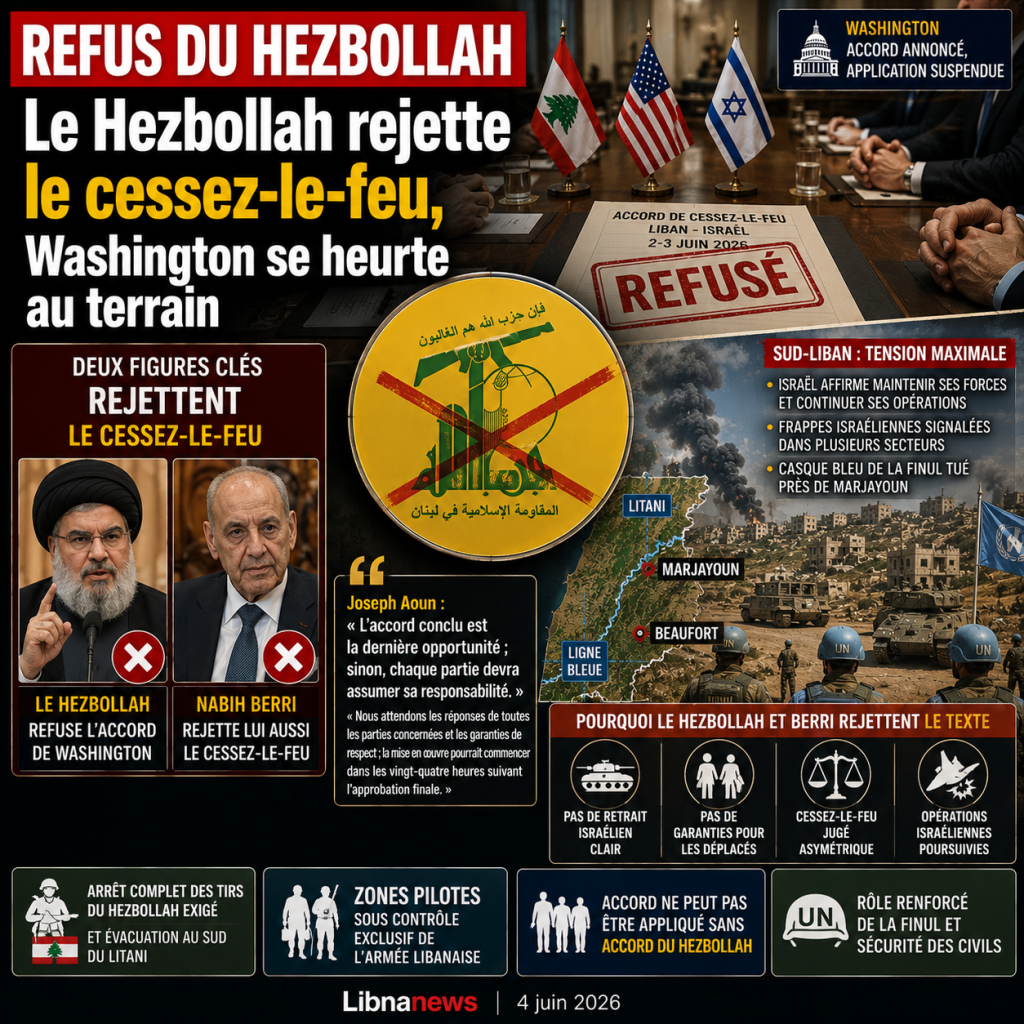
Hezbollah informed the Lebanese authorities of its refusal to accept the ceasefire agreement announced in Washington between Lebanon and Israel. The position, transmitted on Thursday 4 June to a state official, was communicated to the Speaker of Parliament Nabih Berri, an ally of the Shiite movement, who shares the same line, according to a head of the formation quoted by a press agency. This rejection came as Joseph Aoun said he was waiting for the movement’s response to pass it on to the United States. It immediately weakens the open diplomatic sequence after two days of discussions in Washington. It also intervenes while Israeli operations continue in southern Lebanon, where Israel claims to maintain its forces and continue its actions against infrastructure attributed to Hezbollah.
The United States communiqué made the cease-fire conditional on a complete cessation of Hizbullah fire and the evacuation of its agents from the area south of the Litani River. It also provides for the establishment of pilot areas under the sole control of the Lebanese Armed Forces. However, from the point of view of Hezbollah and some Lebanese officials, the text does not contain the expected guarantees. It does not set a public Israeli withdrawal schedule. It does not guarantee the return of displaced persons. It does not formulate an Israeli obligation as precise as those imposed on the Lebanese camp. The movement’s refusal therefore turns a diplomatic announcement into an internal political crisis.
The refusal that blocks Washington
The rejection of Hezbollah is about the heart of the device. The Washington text is not just asking for a reduction in fire. It requires a complete cessation of movement operations and its visible withdrawal from the area south of the Litani River. This condition corresponds to the American and Israeli objective of placing the South under the exclusive authority of the Lebanese army. In theory, it also joins the principle of resolution 1701. But it remains difficult to enforce without clear Israeli counterpart.
The pro-Iranian movement refuses a formula which it considers a one-way ceasefire. His position, previously announced by his secretary-general, Naïm Qassem, was passed on to the Lebanese authorities. The message is simple: Hezbollah does not want an agreement that would demand its withdrawal while Israel maintains forces in southern Lebanon and continues military operations. The refusal therefore applies less to the principle of stopping fighting than to the balance of the proposed text.
This position complicates Washington’s task. The United States presented the communiqué as a step towards sustainable stabilization. But the agreement cannot be implemented on the ground if the main armed actor in the South rejects it. The Lebanese Government can accept a diplomatic framework. He cannot guarantee the end of Hezbollah’s firing alone if he believes that conditions do not protect Lebanese sovereignty.
Nabih Berri placed in the centre of the Lebanese canal
The transmission of the position to Nabih Berri gives the refusal a wider political scope. The President of Parliament remains one of the main channels between Hezbollah, Lebanese authorities and foreign mediators. For months he has been acting as an intermediary in discussions on de-escalation. His agreement with Hezbollah’s position, as reported by the quoted official, means that rejection is not limited to partisan posture.
Berri had already defended the idea of a complete and reciprocal ceasefire. Its line is based on one principle: Lebanon cannot ask Hezbollah to cease fire unless Israel clearly undertakes to stop its own operations and withdraw from the occupied territory. This position places the Speaker of Parliament in a state of error with the American formula, which details the obligations of Hezbollah but remains less explicit about those of Israel.
For Joseph Aoun, this convergence between Berri and Hezbollah reduces room for manoeuvre. The Lebanese President had described the agreement as the last opportunity and had indicated that its entry into force could begin within 24 hours of the final approval of the parties concerned. Hezbollah’s negative response, relayed by Berri, means that this approval does not yet exist. It requires Beirut to renegotiate, clarify or postpone any implementation.
Operations still ongoing in South Lebanon
Hezbollah’s rejection comes in a context where military operations are not complete. Israeli strikes have again been reported in southern Lebanon, while the Israeli army claims to continue its actions on the ground. Israeli Defense Minister Yisrael Katz said Israel will continue its operations in Lebanon for the time being. He also defended the maintenance of a safe area and the refusal of Lebanese residents to return to certain areas until Israeli security conditions were in place.
These statements directly fuel Hezbollah’s refusal. They give the movement a political argument: how can we accept a ceasefire if the other party claims that it will continue its operations? The question goes beyond rhetoric. It affects the reality of the ground. The bombing, military positions, evacuated villages, closed roads and destroyed infrastructure make it difficult to apply a ceasefire limited to Hezbollah alone.
Lebanon thus faces an immediate contradiction. Washington is talking about a ceasefire. Israel speaks of continuing operations. Hezbollah speaks of refusal. The Lebanese authorities are talking about guarantees. This divergence of vocabulary reveals the lack of a common mechanism. As long as each actor defines alone what the ceasefire means, the truce will remain vulnerable to the first shot, first strike or first charge of violation.
A text perceived as unbalanced in Beirut
The main complaint against the press release concerns its asymmetry. The text imposes specific conditions on Hezbollah. It calls for its withdrawal from the south of Litani and the establishment of areas without non-State actors. He referred to a security framework that must prevent the re-emergence of armed groups. On the other hand, it does not clearly mention the Israeli withdrawal, does not set a date and does not specify the modalities for the return of Lebanese displaced persons.
This absence weighs heavily in the Lebanese debate. A full ceasefire should include verifiable commitments on both sides. It should include halting Hezbollah fire, stopping Israeli strikes, withdrawing the Israeli army, protecting civilians, the role of UNIFIL, returning displaced persons and the effective presence of the Lebanese army. In the known text, the most concrete obligations relate mainly to the Lebanese camp.
This reading does not mean that the debate on Hezbollah’s weapons disappears. It remains central. The existence of an armed force beyond the complete control of the State constitutes a crisis of sovereignty. But the movement’s refusal shows that this issue cannot be separated from the Israeli military presence and ongoing operations. The more Israel maintains a safe area, the more Hezbollah asserts that its weapons remain necessary.
Pilot zones become uncertain
The pilot areas were to be the first concrete translation of the agreement. They must be under the exclusive control of the Lebanese army, without the presence of non-State armed actors. The objective is to test a model of gradual return from the state to the south. But Hezbollah’s refusal makes this system very fragile.
To operate, a pilot zone requires three conditions. Israel must withdraw from it. Hezbollah must agree not to operate there. The Lebanese army must be able to deploy with security guarantees. These three conditions remain uncertain. Israel says it is continuing its operations. Hezbollah refuses to agree. The Lebanese army cannot settle in a disputed area without risking being caught between the two logics.
The choice of sectors will therefore be decisive. Areas close to Marjayoun, Khiam, Bint Jbeil, Naqurah or Beaufort Castle cannot be treated as mere technical spaces. They concern villages, families, agricultural lands, roads and military positions. A pilot area cannot be just a map. It must enable the return of civilian life and the real exercise of Lebanese sovereignty.
Return of internally displaced persons remains absent
One of the most sensitive points remains the return of displaced persons. The Washington communiqué does not place this issue at the centre of the scheme. For the inhabitants of the South, however, this is the main criterion. A cease-fire only makes sense if it makes it possible to return to the villages, to reopen the roads, to check the state of the houses, to take over the land and to revive the schools.
Israeli statements on the maintenance of restrictions in certain areas aggravate this concern. If the Lebanese inhabitants cannot return, the ceasefire will be perceived as incomplete. It could even be seen as a form of territorial freezing, where Israel maintained de facto control while Lebanon was called upon to reorganize its internal security.
Hezbollah’s refusal does not resolve this issue. It may prevent the application of a text deemed unbalanced. It can also prolong the uncertainty of displaced families if no other formula emerges. Civilians therefore remain caught between Israeli demands, Hezbollah’s position and the limits of the Lebanese State. Their return should become a central clause in any further discussion.
Joseph Aoun before a more difficult equation
Joseph Aoun wanted to pass on Hizbullah’s response to the United States. This answer is now negative. The Head of State must therefore decide how to preserve the diplomatic channel without giving the image of a Lebanon unable to speak with one voice. His difficulty is that Hezbollah’s refusal is also a concern shared by other Lebanese actors: the agreement does not involve sufficient Israeli commitment.
The Lebanese President defended the negotiation as the only option available. He stated that it should not be considered a surrender, concession or defeat. This line remains valid. But it requires negotiations that produce tangible results. If the final text requires Lebanon to apply the American conditions without imposing an Israeli withdrawal, the Presidency will face immediate challenge.
The next step must therefore clarify the expected guarantees. Beirut should call for an explicit halt to Israeli operations, a timetable for withdrawal, precise maps, a strengthened role for UNIFIL, the return of internally displaced persons and the modalities for the deployment of the Lebanese army. Without these elements, Hezbollah’s refusal is likely to settle as a sustainable position.
UNIFIL caught in the same gear
The death of a UNIFIL blue helmet near Marjayoun recalls that the land remains dangerous despite diplomatic announcements. The peacekeeper succumbed to his wounds after the fall of mortar shells at his position. Two other peacekeepers were injured. The mission reported a high number of trajectories and impacts in southern Lebanon.
This incident confirms that the war is not suspended by the communiqués. If UNIFIL positions can be affected, the pilot areas will not be able to operate without robust safeguards. The Lebanese army will not be able to control an area where fire continues. The inhabitants will not be able to return if the international forces themselves are exposed.
Resolution 1701 remains the frame of reference. It calls for the absence of unauthorized weapons between the Blue Line and the Litani River, but also for respect for Lebanese sovereignty. Applying half will not suffice. The withdrawal of Hezbollah from southern Litani cannot be separated from the Israeli withdrawal, the end of operations and the protection of the population.
Washington in the face of an agreement to rewrite
Hezbollah’s refusal forces Washington to review its method. The United States obtained a text with governments. They did not obtain the support of the armed actor who conditions the application on the ground. That limit was known. It is now becoming official.
Two tracks open. The first would be to maintain pressure on Beirut to enforce the communiqué despite Hezbollah’s refusal. This option would expose the Lebanese army to an almost impossible mission and could exacerbate internal tensions. The second would be to rebalance the text by also imposing public obligations on Israel. This route would be more difficult with Tel Aviv, but it could give Lebanon a stronger basis for asking Hezbollah to respect the truce.
The planned resumption of political and security aspects during the week of 22 June therefore becomes an uncertain deadline. It will not be limited to confirming the communiqué. She’ll have to deal with her shortcomings. The refusal passed on to Nabih Berri means that Lebanon cannot advance on a text whose one of the main clauses is rejected by the movement concerned.
A political crisis at the heart of the ceasefire
The rejection of Hezbollah reveals the Lebanese impasse. The state wants to resume its role in the South. Hezbollah refuses to retreat without Israeli withdrawal. Israel maintains operations in southern Lebanon. The United States is seeking a quick formula to stabilize the border and separate the Lebanese issue from regional negotiations. Each actor advances with its own definition of security.
Official Lebanon must now avoid two traps. The first would be to accept an unbalanced text that would weaken the sovereignty it claims to restore. The second would be to let Hezbollah’s refusal close all diplomatic channels. Between the two, there remains a narrow margin: to achieve a truly reciprocal ceasefire, with Israeli withdrawal, return of the displaced, control of the Lebanese army and international guarantees.
Hezbollah’s response does not only put Washington in trouble. It forces Beirut to clarify its position. A cease-fire cannot only stop the firing of a Lebanese actor. It must also mean the end of ongoing Israeli operations in southern Lebanon and the withdrawal of the enemy from the occupied areas. As long as this condition is not clearly reflected in the scheme, the agreement will remain suspended from a refusal, strike or new military declaration from Tel Aviv.




