





Some Lebanese officials and commentators describe the current war in southern Lebanon as a defeat of Hezbollah against Israel. This reading is based on real elements: Israel has air, technological, electronic and intelligence superiority. Its strikes destroyed infrastructure, killed executives, razed neighbourhoods and imposed a huge human cost on Lebanon. But it forgets a simple rule of asymmetric wars: the strongest can win almost all visible battles and lose the strategic outcome. In this war, Israel was not just about to strike. He wanted to restore his deterrence, sustainably secure his North, reduce Hezbollah to powerlessness and prevent Iran from turning Lebanon into a negotiating map. On these four points, the balance sheet appears unfavourable.
The analysis does not deny the losses of Hezbollah or the destruction suffered by the villages of the South. It consists of measuring war according to the objectives of each. Israel is waging a war of superiority: strike faster, see further, destroy more heavily. Hezbollah is waging a war of attrition: surviving, preventing the enemy from imposing its order, maintaining a human and political cost, and then entering into negotiations without having disappeared. It is this difference in method that distorts many comments. A conventional army can occupy a hill and lose the desired effect. A lower force can lose men and retain most of its lever.
Destruction does not always mean defeat
The comparison with France of 1914-1918 is not a historical equivalence. Human, industrial and military scales are not comparable. It only helps to recall that part of the occupied territory, an industry affected and very heavy losses are not enough to designate the defeated. France has suffered the occupation of part of its northern and eastern territory, immense destruction and considerable human bleeding. However, it was part of the winning camp, as Germany did not achieve its strategic objective. It is the same reasoning that must be applied here, with caution: destruction is not automatically victory.
Israel can display tactical successes. He has control of the sky. It has drones, aircraft, sensors, guided ammunition, armored units, electronic warfare capabilities and American support with no regional equivalent. Hezbollah cannot compete on this ground. Moreover, he does not seek to do so. He does not claim to win a classic maneuver war or to protect every house from strikes. Its logic is to remain able to fight, to inflict losses, to prevent an honourable political withdrawal for Israel and to make South Lebanon a front that the Israeli army cannot stabilize without cost.
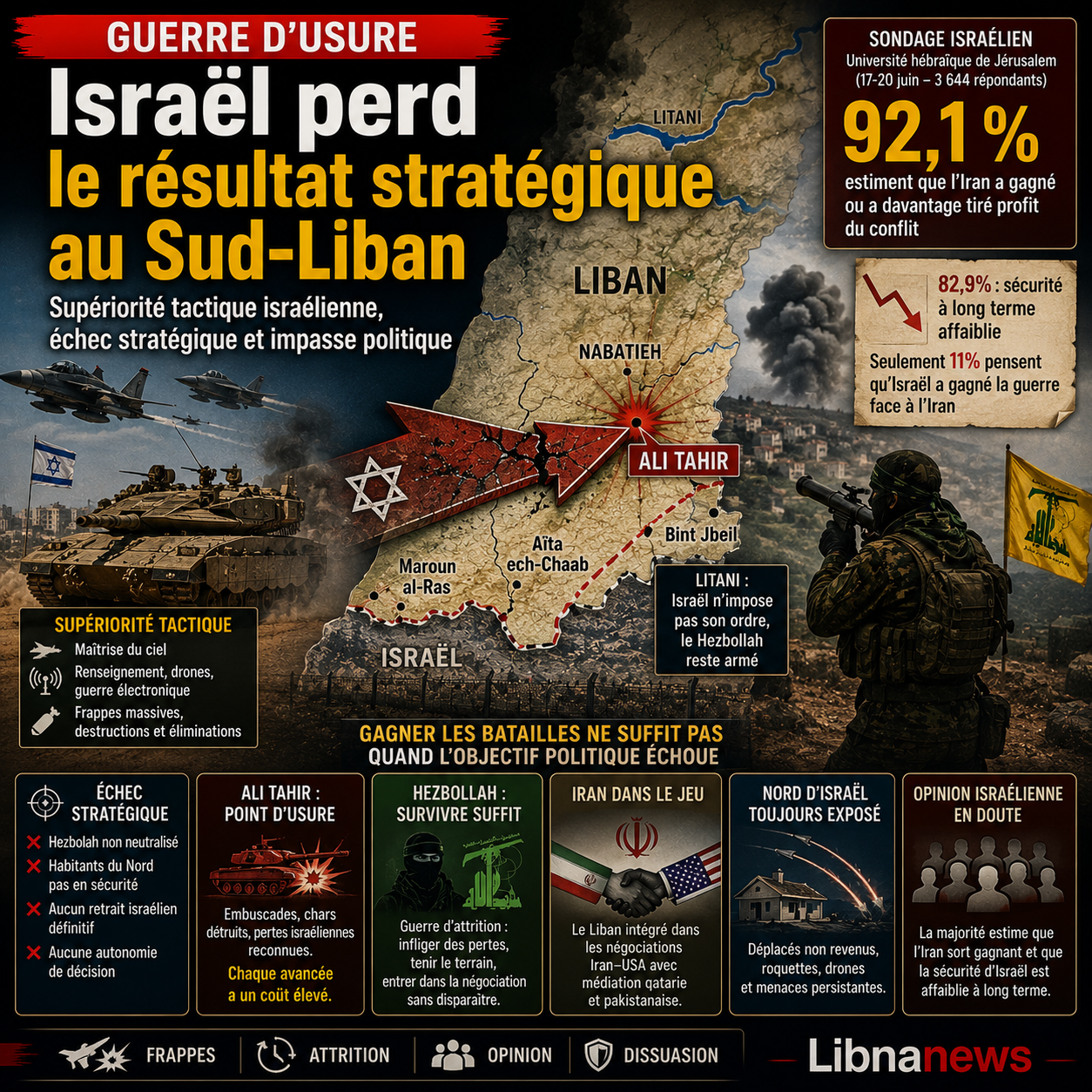
The difference between tactical victory and strategic victory is therefore central. A tactical victory is measured at a destroyed site, an eliminated frame, a position taken, an advanced tank, a controlled road. A strategic victory is measured by the state of the problem after these operations. Is Hezbollah neutralized? Can the people of northern Israel return with certainty? Has the Lebanese State imposed its authority on its own south of the Litani River? Has Israel obtained an agreement in accordance with its requirements? Was Iran excluded from the Lebanese file? The answer to these questions remains largely negative. This is where the Israeli defeat lies.
Ali Tahir, the fixing point
The battle around Ali Tahir Hill illustrates this dynamic. This height, located in the Nabatiyah environment, has become a binding point. According to a news agency, the fighting was concentrated there as Israeli forces attempted to advance. Hezbollah claimed to have ambushed, destroyed several Merkava tanks with guided missiles and targeted troops who had come to recover losses. Israel acknowledged the death of several soldiers in that phase, while its strikes killed many Lebanese in the region. Even when the versions diverge, the political fact is clear: Israel does not advance in an empty space. He pays for every attempt to advance.
Qualifying Ali Tahir as « Israeli Verdun » would be excessive if one spoke of scale. Verdun refers to an industrial disaster and a battle of several months that has not been equivalent here. But the formula can have a limited meaning if it designates a wear point. A Verdun, in this sense, is not only a place of death. It is a place where one belligerent tries to exhaust the other by imposing politically difficult losses on him. For Israel, a few soldiers killed in an ambush can have a much heavier public effect than dozens of casualties in an army accustomed to a long and asymmetric war. Asymmetry is not only found in weapons. It is also within the threshold of acceptability of losses.
This fact explains why the gross number of victims is not enough. Hezbollah suffers heavier losses, and Lebanese civilians pay a considerable price. But Israel is a mobilized society, technologically dominant and politically sensitive to military casualties, especially when they strike reservists, young soldiers or units sent to an area whose objective seems confused. Every Israeli loss questions the promise made to the northerners: does this war really make their return safer? If the answer is not obvious, attrition begins to produce its effect.
A war that has become dependent on Iran
The Israeli difficulty also comes from its moving objective. Initially, the aim was to reduce the threat of Hezbollah. Then there was the question of establishing a safe area. Next, to maintain a presence as much as necessary. Finally, the discussion shifted to a de-conflict cell resulting from talks between Iran and the United States. This slip shows a failure. A power that wanted to impose a military order is dependent on a diplomatic mechanism where its regional opponent, Iran, weighs directly on the outcome. Israel wanted to get Hezbollah out of the South. He sees Lebanon entering into Iran-USA negotiations.
This is a decisive point. An Israeli victory should have had three effects: to permanently remove Hezbollah, isolate Iran from the Lebanese file and restore Israeli decision-making autonomy. The current sequence produces almost the opposite. Hezbollah remains a military actor. Iran is present in de-escalation architecture. Washington negotiates with Tehran, with Qatari and Pakistani mediation, because the war in Lebanon threatens the entire regional compromise. Israel retains considerable firepower, but it is no longer alone in defining tempo. It’s a strategic loss.
The poll that contradicts the official account
The survey published in Israel reinforces this reading. According to an Israeli media report, a survey by the Hebrew University of Jerusalem, conducted with the Agam Institute of 3,644 respondents between 17 and 20 June, indicates that 92.1% of respondents believe that Iran has gained or benefited more from the conflict. The same poll indicates that a very large majority believe that Israel’s long-term security has been weakened. Another survey quoted by an Israeli media already showed that only 11% of respondents considered Israel to have won the war against Iran, while many spoke of defeat or indecisive outcome.
We need to be specific about this. The poll does not say that 92.1% of Israelis say word for word that Hezbollah defeated Israel in southern Lebanon. He said that an overwhelming majority saw Iran as the beneficiary of the conflict and the subsequent agreement. But Hezbollah belongs to the Iranian equation. If the Israeli opinion considers Iran to be a winner, this means that the population does not perceive the military campaign as a strategic victory. In a democracy at war, this perception counts. It affects government, reservists, families and the political duration of operations.
The Hebrew state suffers here from a contradiction. His doctrine is based on a strong, fast and legible deterrent. The adversary must understand that the cost of any attack will be unbearable. But the current war shows that punishment is not always enough. Hezbollah accepts the cost, because its goal is not to preserve all its positions intact. He wants to survive punishment and maintain an open front. Iran accepts the cost, because Lebanon becomes a map in a wider negotiation. Israel punishes, but does not turn punishment into a solution. This is the definition of a strategic impasse.
The safety zone, symbol of failure
The so-called security zone also illustrates the failure. Israel presents it as a necessity to protect its northern inhabitants. But a security zone on foreign territory is never only defensive. It becomes a target, a reason for resistance, a diplomatic record and an argument for the adversary. As long as Israel remains in southern Lebanon, Hezbollah can say that its fight continues. As long as Hezbollah retains weapons, Israel can say that it cannot leave. Each one therefore feeds the justification of the other. The victory would be to break this circle. For now, Israel has extended it.
Military history shows that this type of war is often lost by inability to define an exit. The strongest destroys more, but it simmers in the management of a hostile space. He wins cards and loses time. He inflicts losses and discovers that the enemy does not need to win frontally. He just has to last. In the case of South Lebanon, lasting means surviving the strikes, maintaining an ambush capacity, remaining present in the negotiations and preventing Israel from proclaiming a regained security. Hezbollah does not need to enter Haifa to prevent Israel from winning. It is enough to make expensive points of Ali Tahir, Nabatiyah and the border area.
What Israeli defeat does not mean
However, it would be wrong to turn this analysis into a celebration. Lebanon has no advantage in seeing its villages destroyed, its displaced families, its rescue workers killed and its marginalized State. Israel’s strategic defeat does not mean a Lebanese national victory. It means that the Israeli power has failed to produce the desired political effect. For Hezbollah, surviving can be presented as a victory. For Lebanon, survival is not enough. The country needs a State that controls the territory, an army deployed, an Israeli withdrawal and reconstruction that is not confiscated by the logic of war.
This is where comparison with 1914-1918 reaches its limit. The victorious France emerged from a war with a strong state, a national army and a structured alliance. Lebanon, for its part, emerges from this sequence with a weak State, an underfunded army and a divided military decision. It can be said that Israel failed without saying that Lebanon has won. It can be said that Hezbollah has prevented Israel from achieving its goals without ignoring the price paid by civilians. This nuance is indispensable to avoid the inverse propaganda of the one that is critical.
The human parameter here counts as much as the military parameter. Israel can replace a drone, repair an armoured tank or mobilize a new unit. It is more difficult to justify a series of transactions whose final profit remains uncertain. Reservists belong to families, businesses, border villages, and a company that follows each loss announcement. When goals become blurred, the marginal cost of a killed soldier increases politically. In a war of attrition, the adversary knows. He’s not just trying to kill. He seeks to cast doubt on the other side of his loss.
This psychological dimension explains the importance of surveys. An army can continue to fight when there is doubt. But a government cannot sustainably sell a victory that its own people do not recognize. The figure of 92.1% should not be read as an absolute military truth. It must be read as a signal of a break between official narrative and social perception. When a population subjected to war considers massively that the regional adversary has won, the government has already lost an essential part of the battle: that of the legitimacy of the result.
The real Israeli defeat is therefore threefold. It is military, because the Israeli army is unable to convert its qualitative superiority into lasting peace on the front. It is political, because the Israeli government must deal with an opinion that doubts the outcome and with American allies negotiating with Iran. It is strategic, because Iran, far from being excluded, now appears to be an actor in de-escalation in Lebanon. In a war designed to reduce the opposite axis, this is a reverse result.
The next few days will tell if this defeat crystallizes or if Israel manages to limit diplomatic losses. It will depend on the de-conflict cell, the American position, whether or not the security zone is maintained and the ability of Hezbollah to respect attrition without causing uncontrollable escalation. Ali Tahir will remain a symbol as long as every Israeli attempt to advance results in politically sensitive losses and further strikes on Lebanon. War will be judged less by images of destruction than by the question already posed by many Israelis: after all, is their country safer than before?