





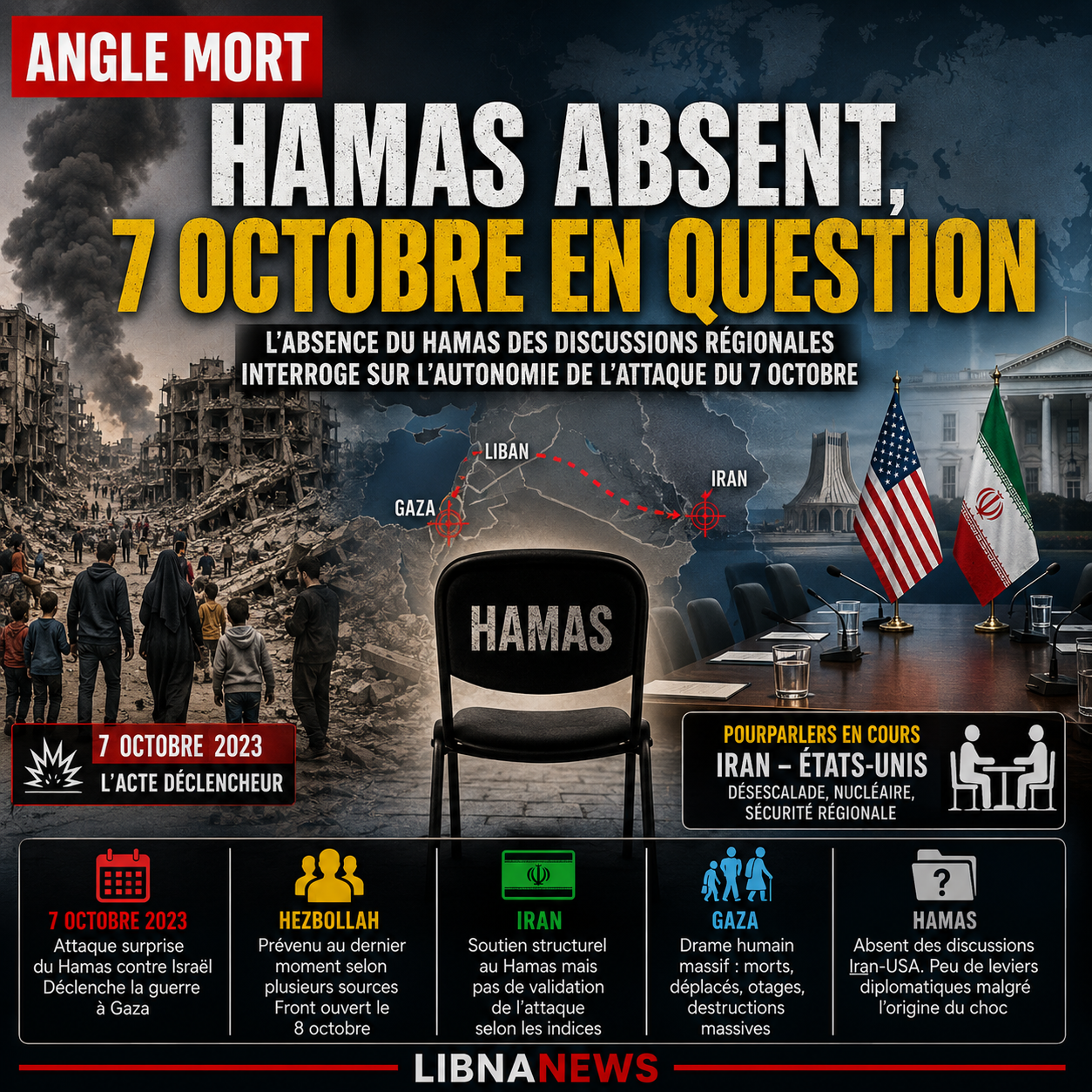
The role of Hamas in regional discussions is now a political indicator as well as diplomatic silence. Since the exchanges between Washington, Tehran and several mediators have focused on de-escalation, Iranian nuclear power, the Lebanese front and security assurances, the Palestinian question seems less structuring than the October 7, 2023 shock would have suggested. Gaza remains at the heart of the human tragedy. The hostages, prisoners, displaced persons, destruction and the administrative future of the enclave remain hot topics. But Hamas does not appear to be the central subject of the Iran-US negotiations. This absence feeds a sensitive hypothesis: the October 7 attack would have raised a largely Palestinian initiative, decided by Hamas in a small circle, then effectively imposed on its regional allies.
This reading must be cautious. Iran has supported Hamas for years. Hezbollah has a political, security and ideological relationship with him. The pro-Iranian axis groups share the same vocabulary of confrontation with Israel and the United States. But structural support does not necessarily mean shared operational decision. A movement can receive weapons, funds, formations and political protection without consulting all its allies on the precise timing of an attack. It is this gap between alliance and command that deserves to be examined.
The point is all the more important as Hassan Nasrallah, in his first major speech after 7 October, himself presented the operation as a Palestinian decision. According to his reports from several media outlets, the Hizbullah leader claimed that the attack had not been prepared with his movement and that his secret had contributed to its success. Other press reports then indicated that he would have been warned very shortly before the outbreak, about half an hour according to a media, which fueled the idea of a surprise at the top of Hezbollah. This is not independent evidence. It is an actor’s statement, so also an element of communication. But it weighs in the analysis.
Hamas, absent from the diplomatic heart
The current paradox is the dissociation between the origin of the crisis and the content of the discussions. October 7 opened the sequence. It provoked war in Gaza, the expansion of the fronts, the displacement of civilian populations and lasting military pressure on Lebanon. However, when negotiating channels seek to avoid wider regional war, they focus first on Iran, Israel, Hezbollah and de-escalation mechanisms. Hamas remains treated in other formats, mainly related to Gaza, hostages, truce and Qatari or Egyptian mediation.
This cutting shows a cold reality. Hamas has triggered or accelerated a regional crisis, but it does not have the main levers for exiting the crisis between states. He can negotiate hostages. It can affect the security future of Gaza. It can prevent complete stabilization of the territory. But it cannot offer the United States what Iran can offer: a framework of its nuclear programme, guarantees of its armed relays, moderation on certain fronts or a signal on regional navigation. Diplomacy follows the available levers, not the moral order of responsibility.
That marginalization did not mean that Palestine had disappeared. It remains central in Arab public opinion and part of the international debate. It also remains an element of legitimacy for Iran and its allies. Tehran continues to use the Palestinian cause as a political and ideological argument. But in a negotiation with Washington, the Palestinian cause rarely becomes the main object. It serves as a discursive framework. It does not structure the transaction.
Nasrallah’s statement enlightening Hamas’ autonomy
Hassan Nasrallah’s speech of November 3, 2023 became an important piece of the file. The Hezbollah leader was looking for a difficult balance. He had to show solidarity with Gaza, meet the expectations of its base, not seem to abandon Hamas and avoid an immediate total war with Israel. In this context, he insisted on one point: the operation of 7 October, according to him, was a Palestinian decision. He did not present it as a coordinated regional plan from Beirut or Tehran.
This statement was politically useful. It protected Hezbollah from a charge of direct codecision. It also protected Iran from overly visible operational responsibility. But it cannot be reduced to a simple manoeuvre. It also corresponds to several observable signs. Hezbollah did not launch a general offensive on the same day. He opened a front on October 8, but in a limited format. His strikes were aimed at supporting Gaza, fixing part of the Israeli forces and maintaining calculated pressure. It was not the immediate entry into a total war.
Reports that Nasrallah was warned very shortly before the attack began reinforce this reading. The most frequently reported version evokes an alert about thirty minutes before the trigger. Your formulation, that of a leader awakened in the night barely an hour before the facts and without being able to influence the decision, translates the same political background: Hezbollah would have been informed too late to discuss, amend or block the operation. Although the exact details vary according to the narratives, the main idea remains the same. Hamas would have retained control of the calendar.
This is a decisive point. A military alliance does not always function as a chain of command. Hamas, Hezbollah, Iran, Iraqi groups and the Houthis share convergences. They can coordinate postures. They can sustain themselves in the long term. But everyone keeps their local constraints. Hamas responds to the situation in Gaza, its Palestinian rivalries, its relationship with Israel, its prisoners and its political survival. Hezbollah responds to Lebanon, its Shiite environment, internal equilibrium, the southern border and the risk of destruction. Iran is responding to its national security and the survival of its regime.
Secret as a condition of 7 October
The October 7 procedure involves a high level of secrecy. A surprise attack requires a reduction in the number of informed actors. The more external officials involved in an operation, the more likely it is to be detected. Hamas therefore had an interest in compartmentalizing information. He could inform some allies of the existence of an offensive intention, without revealing the actual plan, date, objectives or scope of the operation.
This distinction is essential. Knowing a general orientation is not about validating an attack. Knowing that a movement is preparing an action does not mean knowing its time, means and possible consequences. The information available since 2023 also shows that the attack surprised many services, including Israelis. In this context, it is not inconsistent that regional allies were also surprised by the magnitude or timing.
Hamas could have several specific objectives. He wanted to break the status quo of Gaza, put Palestinian prisoners back at the centre of an exchange, hit the image of Israeli security superiority, block certain dynamics of regional normalization and put Palestine at the centre of the international agenda. These goals do not always coincide with those of Tehran. Iran could benefit from increased tension with Israel, but it did not necessarily have an interest in a sequence leading to direct exposure of its territory, executives and infrastructure.
Hamas’ autonomy therefore does not reduce Iranian responsibility for building its capabilities. It only specifies the nature of this responsibility. Tehran helped create a military environment conducive to Hamas. This is not enough to demonstrate that Iran has chosen the date of October 7, validated all details or ordered the operation. Nuance is important to understand why Iran is not putting Hamas at the centre of its negotiations today.
Hezbollah trained in reaction dynamics
Hezbollah was caught between two imperatives. The first was ideological and strategic: it could not remain completely inactive while Gaza was bombed and Hamas, its ally, was facing Israel. The second was Lebanese: it must avoid causing a total war that would have exposed the country to massive destruction. His initial response sought to reconcile these constraints. The southern front of Lebanon was opened, but graduated.
This posture gives weight to the idea of a Hezbollah trained in the sequence rather than co-author of the initial shock. The movement chose to act. He was not content to observe. His shooting directly affected civilians on both sides of the border, Lebanese villages, Israeli communities and the southern economy. But his initial action seems to have been that of an ally facing a fait accompli, not that of an actor simultaneously launching a long-prepared regional offensive.
The first days were also marked by information on possible Israeli intentions to strike Hizbullah preventively. The media reported that Israeli officials had planned a major attack on Lebanon in the days following 7 October, before Washington sought to curb this option. For Hezbollah, this type of scenario reinforced the argument of a defensive and dissuasive posture. He could say that he had opened the front to support Gaza, but also to prevent Israel from choosing alone the moment of a war in Lebanon.
This justification should not mask the Lebanese cost. A limited war remains a war. It emptys villages, destroys homes, blocks crops, paralyses the local economy and installs fear. Lebanon, already weakened by the financial and institutional collapse, has found itself dependent on decisions taken by actors who do not fully respond to the state. On 7 October, therefore, acted as a brutal indicator of Lebanese weakness.
The scenarios of expulsion and Lebanese anguish
Another element has weighed on Lebanese perception: the fear of forced displacement of Palestinians. Following the beginning of the war in Gaza, several scenarios suggesting a transfer of civilians outside the enclave circulated. Some were mainly concerned with the Egyptian Sinai. Others in Lebanon have fuelled the wider fear of a demographic recomposition imposed on neighbouring countries. Even without a confirmed operational plan for Lebanon, these discussions aroused a profound political memory.
Lebanon has a special history with the Palestinian question. The 1948 refugees, the following waves, the installation of the PLO, the internal clashes and the civil war left a lasting mark. Any hypothesis of permanent implantation, even indirect, becomes immediately explosive. It affects religious balance, sovereignty, the right to return and the official refusal to transform the country into an alternative.
In this context, Hezbollah could present its commitment as a regional lock. He could argue that the battle in Gaza also concerned Lebanon, not only out of ideological solidarity, but for fear of the consequences of a total Israeli victory. Moreover, Hassan Nasrallah often linked the fate of Gaza to that of Lebanon, explaining that a Palestinian defeat would have direct regional effects.
Again, we must separate facts and perceptions. There is no solid public evidence of an Israeli plan to expel Gazans massively to Lebanon. On the other hand, the existence of displacement scenarios, public debates and extreme statements was sufficient to create an alarm. In an area as burdened by historical precedents, a hypothesis discussed can alter military calculations before even becoming a formal policy.
Iran in the face of the consequences of an initiative it may not have chosen
Iran’s place in this sequence remains ambivalent. Tehran has built a regional network for years to exert indirect pressure on Israel and the United States. Hamas is part of this environment, even if it retains its Palestinian and Sunni specificity. Hezbollah is the strongest pillar. The Iraqi groups and the Houthis complement this mechanism. This network gives Iran strategic depth. It allows it to respond without always directly committing its territory.
But on 7 October, this system may have moved beyond what Tehran wanted at that time. A Hamas operation put pressure on the whole axis. Iran had to support the story of resistance, preserve its credibility and avoid the image of abandonment. But it also had to prevent direct war with the United States or Israel. This tension explains the behaviour of many pro-Iranian actors: multiplication of the fronts, but seeking a certain dosage; rhetoric hard, but caution on the total war threshold.
The current discussions between Iran and the United States confirm this priority. Tehran is negotiating for Iran. It seeks to protect its territory, resources, economy and nuclear programme. He wants to keep his relays, but without necessarily linking his diplomatic future to the immediate fate of Hamas. Had 7 October been a fully assumed Iranian operation, Gaza could be expected to be a central focus of the transaction. But this is not what we see.
This absence does not exonerate Iran. Rather, it indicates a more complex division of responsibilities. Hamas could have decided the shock. Iran would have made this shock possible by its long-term support. Hezbollah was reportedly dragged into a war of support. Israel would have chosen a massive response. The United States would then have sought to contain the regional extension. Each actor retains its own share.
A negotiation that treats the effects more than the cause
Diplomacy often treats what can be stabilized, not what should be resolved as a priority. In this case, they attack the fronts where concrete levers exist. Lebanon offers measurable de-escalation ground: cessation of fire, withdrawal of combatants, role of the Lebanese army, American guarantees, return of displaced persons. The Iranian nuclear issue offers technical parameters. Sanctions offer economic instruments. Regional navigation and strikes provide safety thresholds.
Palestine, for its part, requires a comprehensive political solution. It requires dealing with Gaza, the West Bank, Jerusalem, settlements, Israel’s security, refugees, the Palestinian Authority, prisoners and political representation of Palestinians. None of these issues can be settled in a bilateral American-Iranian negotiation. Moreover, Hamas does not represent the entire Palestinian people. He controls a portion of the file, but he can’t act alone as a solution.
That is why his current absence is revealing. The movement that opened the crisis is not one that possesses the main diplomatic keys. He imposed the agenda by the attack. He doesn’t control the way out. Gaza can become a subject administered by other Arab mediators, competing Palestinian institutions, international guarantees, Israeli demands and American constraints. Hamas therefore risks seeing its military centrality transformed into political marginality.
This paradox is cruel to the Palestinians. Their cause has regained global visibility, but their decision-making capacity remains fragmented. The Palestinian people are suffering the consequences of a war whose parameters are often negotiated without it. This situation feeds anger, weakens conventional political channels and reinforces the accounts that only force can impose international attention.
A useful but not definitive hypothesis
The hypothesis of an autonomous Hamas initiative offers a coherent reading of the sequence. She explained the relative absence of the Palestinian issue in the Iran-US talks. It informs Nasrallah’s statements on a Palestinian decision. It corresponds to the graduated opening of the Lebanese front. It reflects the initial caution of Iran and Hezbollah. It also helps to understand why the current negotiations focus primarily on regional consequences, not on the Palestinian origin of the shock.
But this assumption must not become a convenient certainty. Clandestine alliances rarely leave simple evidence. The actors have a better chance of scrambling the tracks. Hamas can exaggerate its autonomy to claim a symbolic victory. Hezbollah can exaggerate its surprise to avoid a codecision charge. Iran can minimize its role in reducing the risk of retaliation. Israel can increase Iranian responsibility for internationalizing the conflict. Everyone builds a useful story.
The most robust method is therefore to distinguish three levels. First level: Iranian structural support for Hamas is established. Second level: political coordination between Hamas and Hezbollah has long existed. Third level: precise operational codecision of 7 October remains less publicly demonstrated. It is at this third level that Nasrallah’s statement and the information on its late warning become important.
The Palestinian issue remains the great visible absence of regional discussions. It is everywhere in the root causes, public justifications and images of Gaza. But it is not at the centre of diplomatic mechanics between Iran and the United States. This absence says something about the current war: October 7 was the trigger, but the exit from the crisis is now being played out by actors who are trying to limit the effects of an initial decision that Hamas wanted to keep under control.