





The Lebanese Forces leader, Samir Geagea, reaffirmed Wednesday, 12 August 2026 his support for the general amnesty law and assured him that he would continue to defend it until its adoption. This declaration comes after a particularly tense parliamentary session on Tuesday in Beirut, where the discussion of the text led to the withdrawal of Members, quarrels over the conditions of amnesty and the risk of loss of quorum. Geagea thus intervenes at a time when the proposal, far from reaching consensus, crystallizes differences between blocs on the fate of some detainees and on the consideration of army reserves.
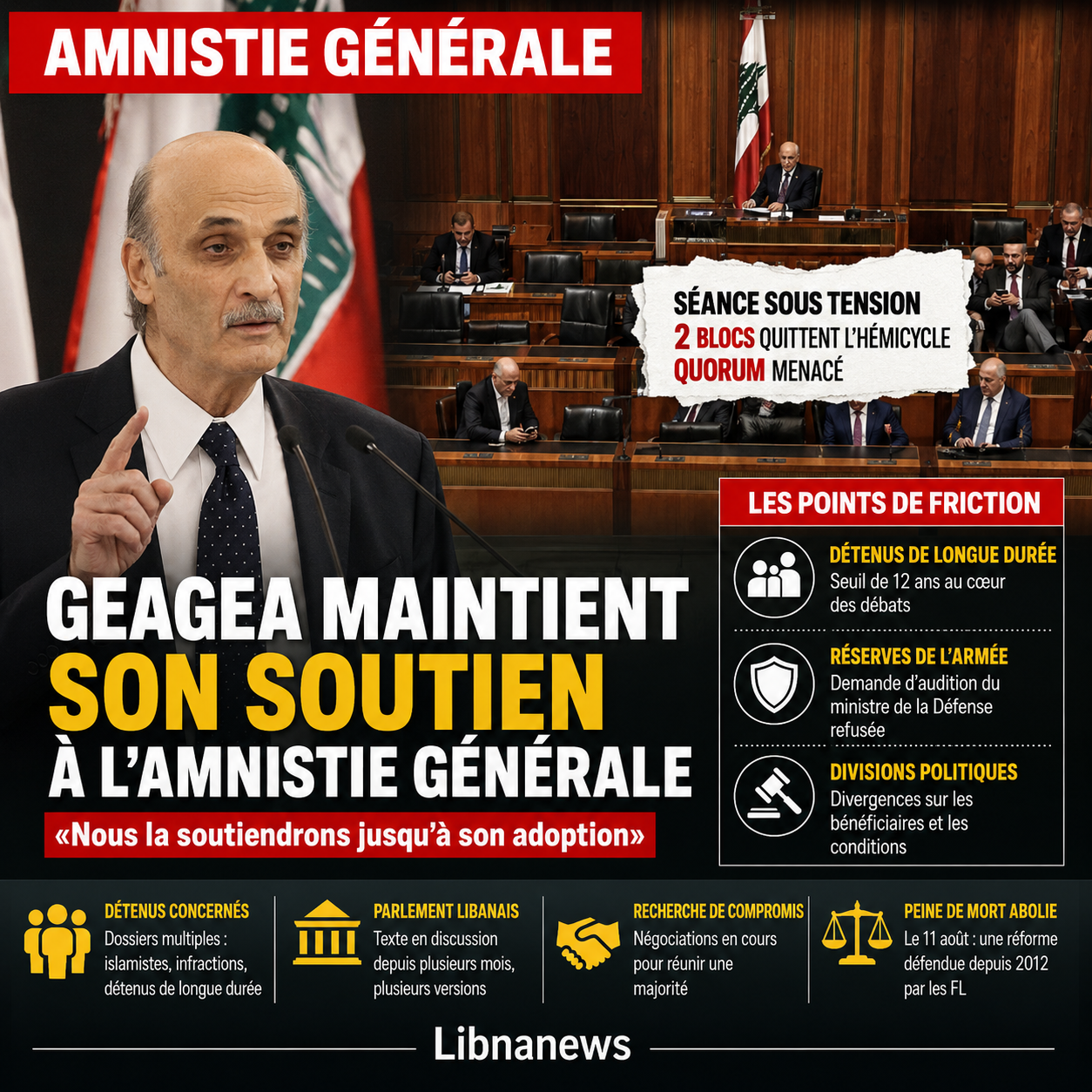
Geagea reaffirms its support for the general amnesty
In his statement published Wednesday morning, Samir Geagea said he hoped that the amnesty law could finally be adopted despite the « many obstacles » placed on his way.
The President of the Lebanese Forces goes further in promising to maintain his commitment. « We are determined to continue to support and support it until it is adopted, » he says.
This position responds directly to tensions in Parliament over the text. The day before, his examination had led to heated exchanges between Members and withdrawals from the sitting. Disagreements no longer concern only the principle of amnesty. They now concern the precise conditions under which certain categories of prisoners can benefit.
The Geagea statement is therefore intended to confirm that the Lebanese Forces are not withdrawing from the compromise sought. The party maintained its support for the text despite the controversies that had accompanied its parliamentary journey.
This position is all the more significant since the Lebanese Forces were directly involved in Tuesday’s exchanges. Member of Parliament Strida Geagea asked the Speaker of the House, Nabih Berri, to vote after the withdrawal of several deputies.
A live session after two blocks are removed
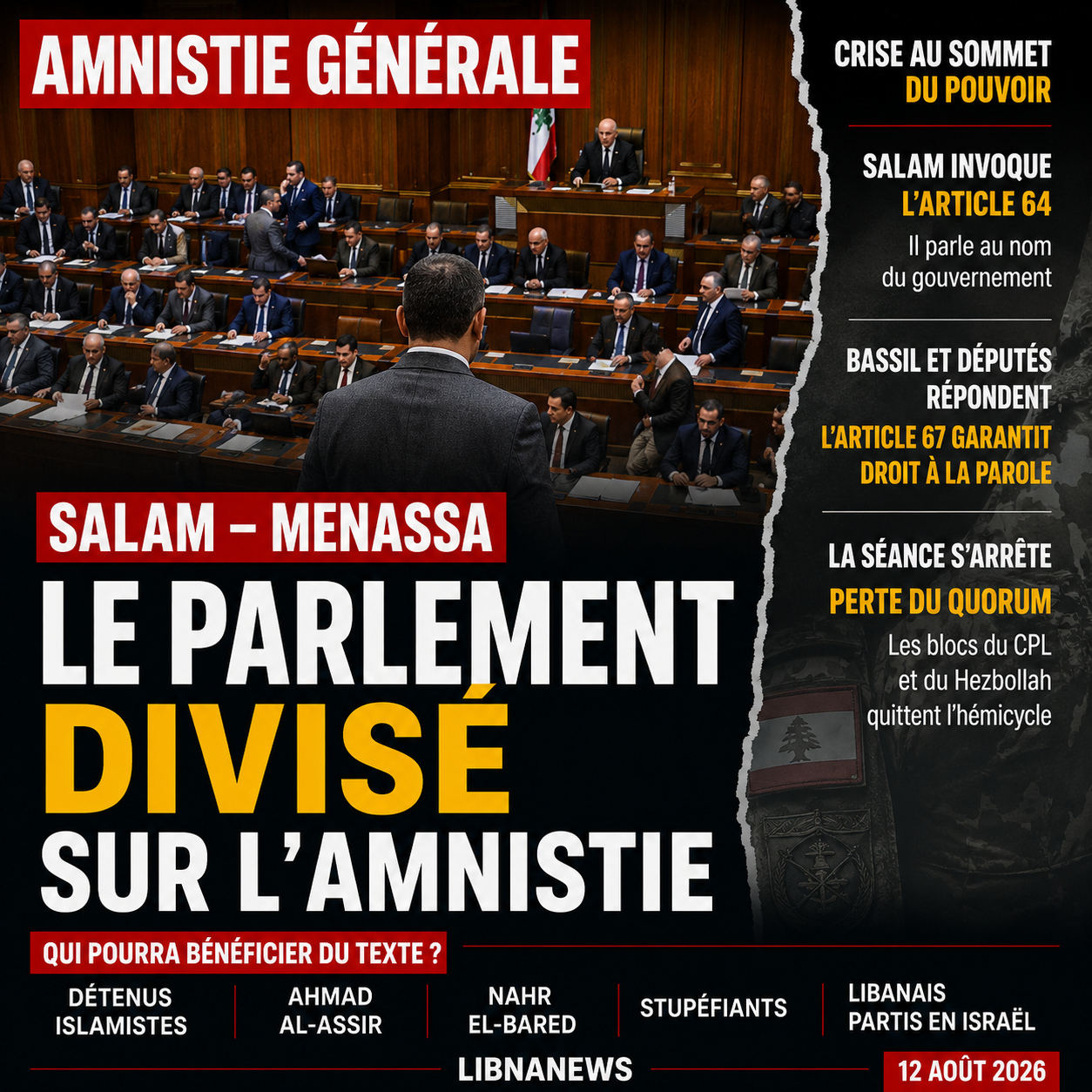
The controversy took on a new dimension on Tuesday 11 August in the Chamber. Members of the Free Patriotic Movement and those of the Resistance Loyalty Block, linked to Hezbollah, left the meeting during the examination of the amnesty.
Their challenge included the need to hear the comments of Defence Minister Michel Menassa and the military’s position on certain provisions of the text.
MP Ibrahim Kanaan himself had left the meeting to protest the refusal to hear these remarks. The departure of the two blocks then weakened the quorum and complicated the possibility of submitting the proposal immediately to the vote.
Nabih Berri was willing to wait for the Minister of Defence to come, provided that the head of government accepted it. The discussion then led to another controversy, this time around the relationship between Parliament and the executive.
Prime Minister Nawaf Salam defended the principle of separation of powers. He argued that the government did not intervene in the conduct of parliamentary work and that he did not intend to accept external intervention in the way he conducted his government.
These exchanges have moved the debate away from the content of the amnesty alone. They added an institutional dispute to existing differences on the beneficiaries of the text.
The length of detention at the heart of the controversy
One of the most sensitive points concerns prisoners who have spent very long years in prison without final judgement.
A formula around a 12-year detention threshold is at the centre of the discussion. The question is, among other things, to determine under what conditions a prisoner who has reached this length of time could be released while continuing his or her judicial procedure outside prison.
This point is politically explosive because it affects, in particular, the dossier of Islamist detainees, which has long been mobilising part of the Sunni representation and the families concerned.
The reservations expressed during the negotiations concerned the safeguards surrounding this provision. In particular, the Ministry of Defence had advocated a more restrictive approach for some inmates who had already been the subject of court decisions or whose procedural behaviour was problematic.
Sunni Members, on the other hand, called for amendments before any final vote. On Tuesday evening, when Nabih Berri planned to put the text to the vote in its existing form, several of them maintained their request for amendments.
The controversy thus reveals a central difficulty: to obtain a majority in favour of amnesty without giving the impression that Parliament indiscriminately erases convictions or ignores the particular situation of persons detained for years.
Army, another point of friction in the debate
The other major element of the parliamentary crisis is the emphasis placed on the observations of the military institution.
The case is sensitive because some cases that may be affected by the sentencing mechanisms involve persons prosecuted or convicted in cases involving the Lebanese army. Previous discussions had already shown the difficulty of reconciling the principle of an amnesty with the desire to preserve the rights of the military institution and the victims.
The withdrawal of the Free Patriotic Current and the Fidelity Block to the Resistance put this issue back at the forefront on Tuesday. Both sides challenged the continuation of the examination without the remarks of the Minister of Defence and the Army being heard.
In this climate, Strida Geagea’s request to proceed to the vote illustrated a different line. The Lebanese Forces chose to push for a parliamentary decision rather than condition the vote at a new stage of consultation.
This sequence directly enlightens Samir Geagea’s statement on Wednesday. When he refers to the obstacles encountered by the law, his speech comes the day after a concrete demonstration of these blockages in the Chamber.
Geagea intervenes while a compromise remains sought
Despite Tuesday’s tensions, the case is not considered abandoned. Discussions are continuing to find a formula capable of reaching a majority.
On Wednesday morning, parliamentary information reported a possible advance on the provision concerning detainees who had not yet been tried after 12 years of detention. This leads to the search for a broader compromise on the reservations expressed around the text.
Prime Minister Nawaf Salam also posted on Wednesday his wish for the amnesty to succeed. In the aftermath of the abolition of the death penalty, he had publicly hoped that the general amnesty law could in turn be adopted.
Geagea’s position fits into this sequence. It does not constitute the announcement of a new amendment or a final agreement. On the other hand, it confirms the existence of a parliamentary camp decided to push the text until the vote despite disagreements.
The vote on the death penalty against the background
Samir Geagea also devoted part of his statement to the abolition of the death penalty, adopted by Parliament on 11 August. He described this decision as a very important step on the human level and for the image of Lebanon.
The leader of the Lebanese Forces recalled that his party had carried this long-standing reform. According to him, a proposal had been tabled as early as February 2012 by former MP Elie Keyrouz. The successive deputies of the bloc of the Strong Republic then continued to work on the issue.
Geagea also welcomed the work of the Administration and Justice Committee, which had completed the review of the provisions before they were forwarded to the plenary.
This reference to the abolition of the death penalty serves mainly as a transition to the still incomplete case of amnesty. Geagea implicitly opposes a reform now adopted to another that continues to stem from political disagreements.
Support maintained despite divergent interests
The path of the amnesty law shows that the main obstacle lies in building a sufficiently broad compromise. For several months, discussions have focused on different categories of prisoners, the reduction of certain sentences and the treatment of long-term prisoners.
The text has already undergone several changes. The parliamentary committees had put forward a formula that provided for reductions of sentences and special provisions for certain cases. But these compromises did not remove differences on conditions of release and exclusion.
The political dimension is also strong. The case of Islamist detainees is an important claim for several Sunni leaders. Other political components insist on the persons who left in Israel after May 2000. Drug-related offences were also part of the previous negotiations.
This accumulation of requests explains why the term « general amnesty » actually covers several separate files. Each change may change the political balance that has brought positions closer together.
It is in this context that Geagea reaffirms its commitment. Its communiqué does not resolve any of the controversies that arose on Tuesday and does not specify which final version the Lebanese Forces would be ready to vote on. However, it establishes a clear political line: the obstacles encountered in Parliament will not lead his party to abandon the general amnesty law.
The parliamentary discussions must now determine whether the compromise sought on the long detentions and reserves of the military institution makes it possible to bring together enough Members. Geagea’s statement comes precisely when this negotiation remains open.