






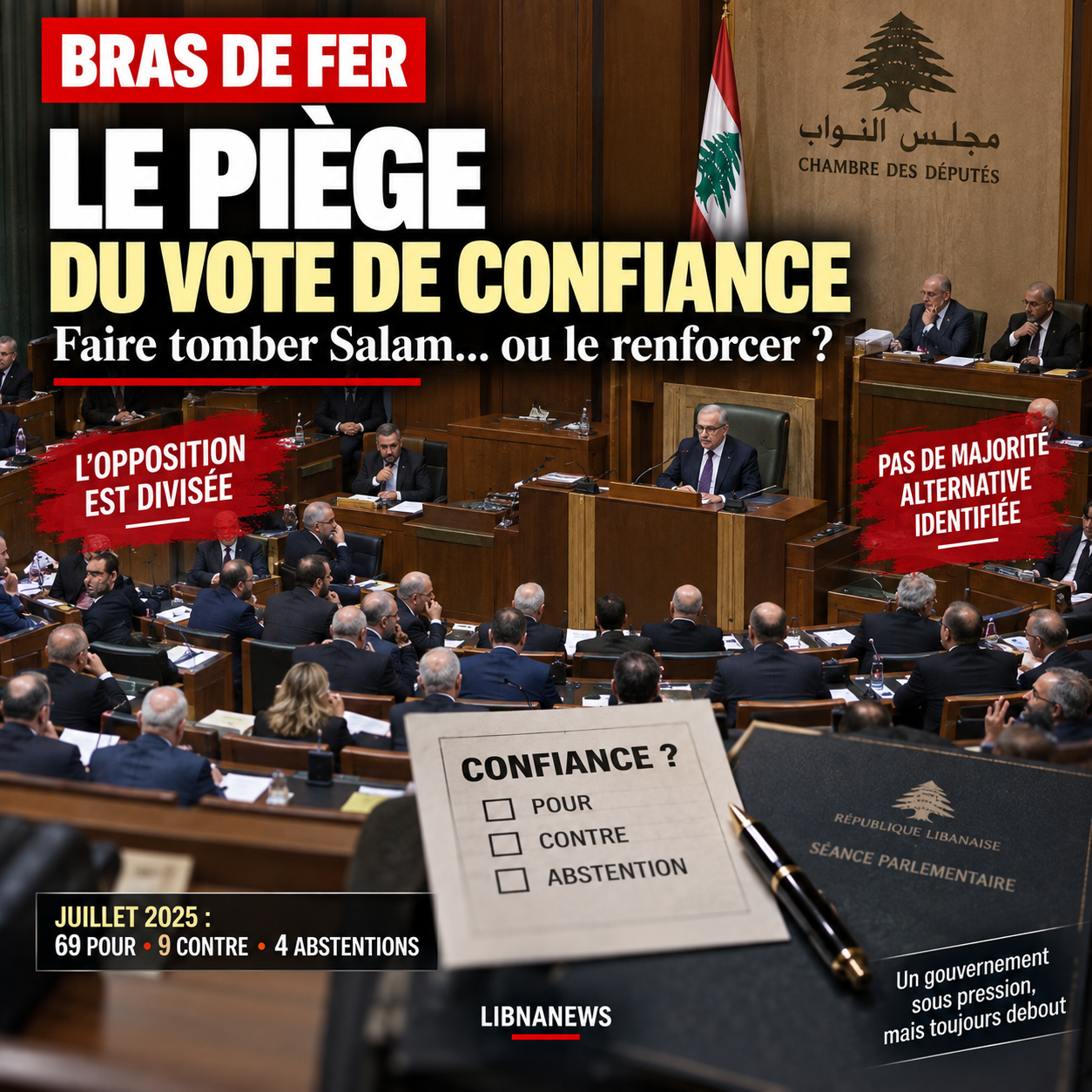
The parliamentary session devoted to the government of Nawaf Salam was intended to allow its opponents to put pressure on the executive. It could produce the opposite effect. According to several reports published in the Lebanese press on 16 September 2026, the criticisms against the government remain strong, but at this stage they do not seem to form a majority ready to cause its fall. More importantly, a vote of confidence could force critical or hesitant MPs to stand behind Nawaf Salam in order to avoid the opening of a new political crisis.
Ad Diyar of 16 September reports that circles in favour of the government consider that a possible demand for confidence would turn the session into a much wider political test. According to them, it could lead to the reconstitution of a parliamentary majority around the Prime Minister, including with MPs who do not necessarily support all of his policy.
The reasoning put forward is less about joining the government than about the consequences of its fall. In a fragmented Parliament, causing the departure of Nawaf Salam would immediately open the question of its replacement and the formation of a new executive. Ad Diyar believes that a quick agreement on a new team would be very difficult.
The newspaper goes so far as to evoke the existence of a known political limit of the protagonists. Oppositions can criticize, challenge ministers and challenge government choices. However, the transition to a battle to bring it down would be another step.
A majority of circumstances around Salam
However, the September 15 session showed the extent of the differences.
Government policy towards Israel, the framework for negotiations, Hezbollah’s weapons, the consequences of war, economic reforms, bank deposits and administrative appointments have sometimes given rise to harsh interventions.
Openly playing the opposition card, Gebran Bassil presented a real list of accusations against the executive. Ad Diyar of 16 September reports that the president of the Free Patriotic Current called Nawaf Salam’s team a government of the axes, darkness and promises without results. He blamed him for his economic performance, his management of the arms case and several political choices.
Bassil nevertheless allowed uncertainty about confidence. He stated that his group retained the right to request it at the end of the session.
This reserve is politically significant.
Requesting a vote would allow the Free Patriotic Current to push its opposition logic to the end. But a parliamentary victory of the government would give Nawaf Salam a new legitimacy precisely at a time when his opponents are trying to demonstrate its weakening.
Al Joumhouria, in its 15 September edition, had already identified this risk before the session. The newspaper reported that a politician considered that a demand for confidence could lead to either a close to the previous result or a slight increase in the government. In both cases, the operation could consolidate the executive rather than shake it.
Annahar of 16 September made the same observation after the first day of the debates. The newspaper believes that the majority that continues to trust the government has not really changed. He stressed that a new vote could even lead the executive to regain Parliament’s confidence despite the virulence of criticism in the Chamber.
The three readings thus converge on one point: the parliamentary challenge is real, but it does not automatically turn into a replacement majority.
Opponents who do not form one side
The difficulty lies in the very nature of the opposition.
Members who attack the government do not do so for the same reasons. Some blame him for going too far in negotiations with Israel. Others accuse him of not moving fast enough in the application of the state monopoly on arms. Some focus their criticisms on economic and financial issues. Others refer to appointments or institutional functioning.
This fragmentation appeared very clearly during the session.
Hezbollah MPs reacted strongly to Nawaf Salam’s speech on the war and the framework for negotiations. In particular, Hassan Ezzeddine accused the power of accepting a framework drafted for the benefit of Israel without sufficient elements of force.
At the other end of the debate, MPs from the Lebanese Forces and Kataeb defended the general orientation of the government, including the arms monopoly.
George Adwan chose irony to support Nawaf Salam. He asked him how he could » dare » engage his government in the arms monopoly, before encouraging him to pursue this policy. Samy Gemayel also presented the government as an opportunity to rebuild the state, while asking it to turn its positions into action.
Between these two camps, other groups have adopted more nuanced positions. The Progressive Socialist Party defended the principle of arms monopoly while challenging some of the results of the negotiations and asking for guarantees for those who fought the occupation.
The government’s criticism therefore exists on several fronts that cannot easily be added up.
A deputy opposed to Nawaf Salam’s economic policy will not necessarily vote with Hezbollah against the government. A parliamentarian hostile to Hezbollah weapons can criticize some ministers while refusing to provoke a government crisis. Another can challenge negotiations with Israel without wishing to return to several months of consultations to form a new executive.
It is this parliamentary geography that today protects Nawaf Salam more than just uniform support for its action.
The external factor in parliamentary calculations
Ad Diyar adds another dimension to this protection.
According to the circles mentioned by the daily on 16 September, foreign actors following the Lebanese case consider the stability of the government as an important element of the next stage. A battle of confidence would therefore also be read outside as a test of Nawaf Salam’s ability to continue to manage this phase.
This assessment does not mean that foreign capitals would determine the vote of Members. It nevertheless weighs heavily on political calculations at a time when several Lebanese issues depend directly on international negotiations and support.
The timetable is particularly busy. Lebanon is preparing for the Paris conference to support the army and the security forces. Negotiations with Israel continue under American mediation. At the same time, the government is seeking funding for reconstruction and is trying to advance financial issues with international institutions.
A fall of the executive would interrupt or complicate these different processes.
Al Liwaa of 16 September also insists on this element of stability. The newspaper considers that parliamentary balances do not reveal a sufficiently coherent political force to cause the government to fall and immediately assume the consequences of such a decision.
The support enjoyed by the executive should not, however, be confused with a satisfaction on its balance sheet. Several Members who might maintain their confidence in him have themselves expressed serious criticism.
The majority of Nawaf Salam thus resembles a majority of necessity rather than a homogeneous political bloc.
Session reveals weaknesses as well as government resistance
This parliamentary protection does not remove the problems facing the government.
The interventions of Members recalled the weakness of the results achieved on several dossiers. The South remains subject to Israeli operations. Residents still cannot return to their villages. Reconstruction depends on external funding. The weapons file remains in conflict. The economic situation continues to weigh heavily on households.
Nawaf Salam himself recognized the magnitude of the difficulties.
According to Ad Diyar of 16 September, he insisted before the deputies on the considerable cost of war and the need to obtain Arab and international support for reconstruction. He also defended the use of negotiation as a means of achieving Israeli withdrawal and the return of the inhabitants.
His speech did not convince his opponents. But it has put his government’s political responsibility in an exceptional regional context, an argument that his supporters use to explain the slow pace of results.
The session thus becomes a paradoxical exercise. The more the Members expose the weaknesses of the executive, the more difficult it is to build an alternative that can bring about a majority.
The risk of giving Salam new legitimacy
This is ultimately the dilemma facing Gebran Bassil.
The Free Patriotic Current wants to impose itself as the main force of parliamentary opposition. Bassil it said explicitly during the session. To make this position credible, a demand for confidence would be the strongest political gesture.
But the result could be exactly contrary to that sought.
A majority in favour of Nawaf Salam would allow the Prime Minister to emerge from two days of criticism by saying that he retains the confidence of Parliament. The vote would partly erase the image of a besieged government and move the debate towards the inability of its opponents to gather a majority against it.
Ad Diyar specifically highlights this risk. According to the government’s sources cited by the newspaper, a battle of confidence could cause reluctant MPs to join the executive maintenance camp, not through adherence to all its policies, but to prevent institutional destabilization.
This is probably the main protection of Nawaf Salam at this stage.
His opponents can put his government in trouble. They can challenge its record, target certain ministers and denounce its choices. They can even come together around a particular criticism of MPs from very different camps.
But bringing down the government requires something else: a majority able to take on what would happen the next day.
However, the information published by Ad Diyar, Annahar, Al Joumhouria and Al Liwaa shows that such a majority did not emerge on the first day of the debate.
The parliamentary sitting therefore reveals an unusual situation. Nawaf Salam does not have a uniform political majority, but his opponents have no alternative majority. In this balance, the threat of a vote of confidence may become less dangerous for the government than for those who decide to provoke it.