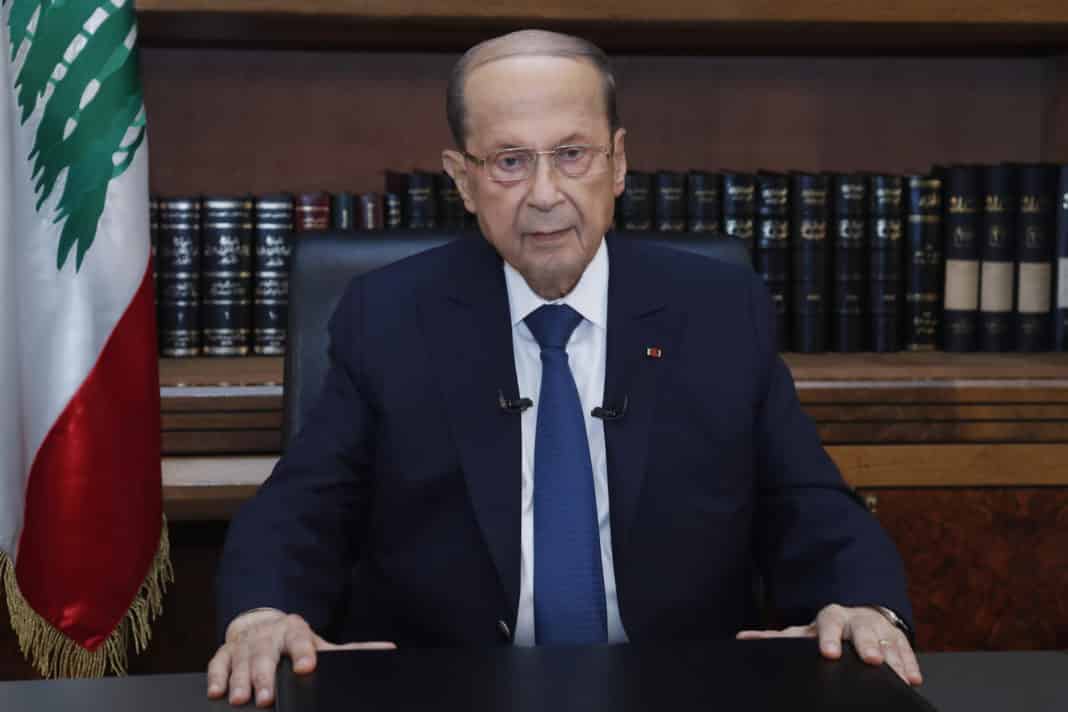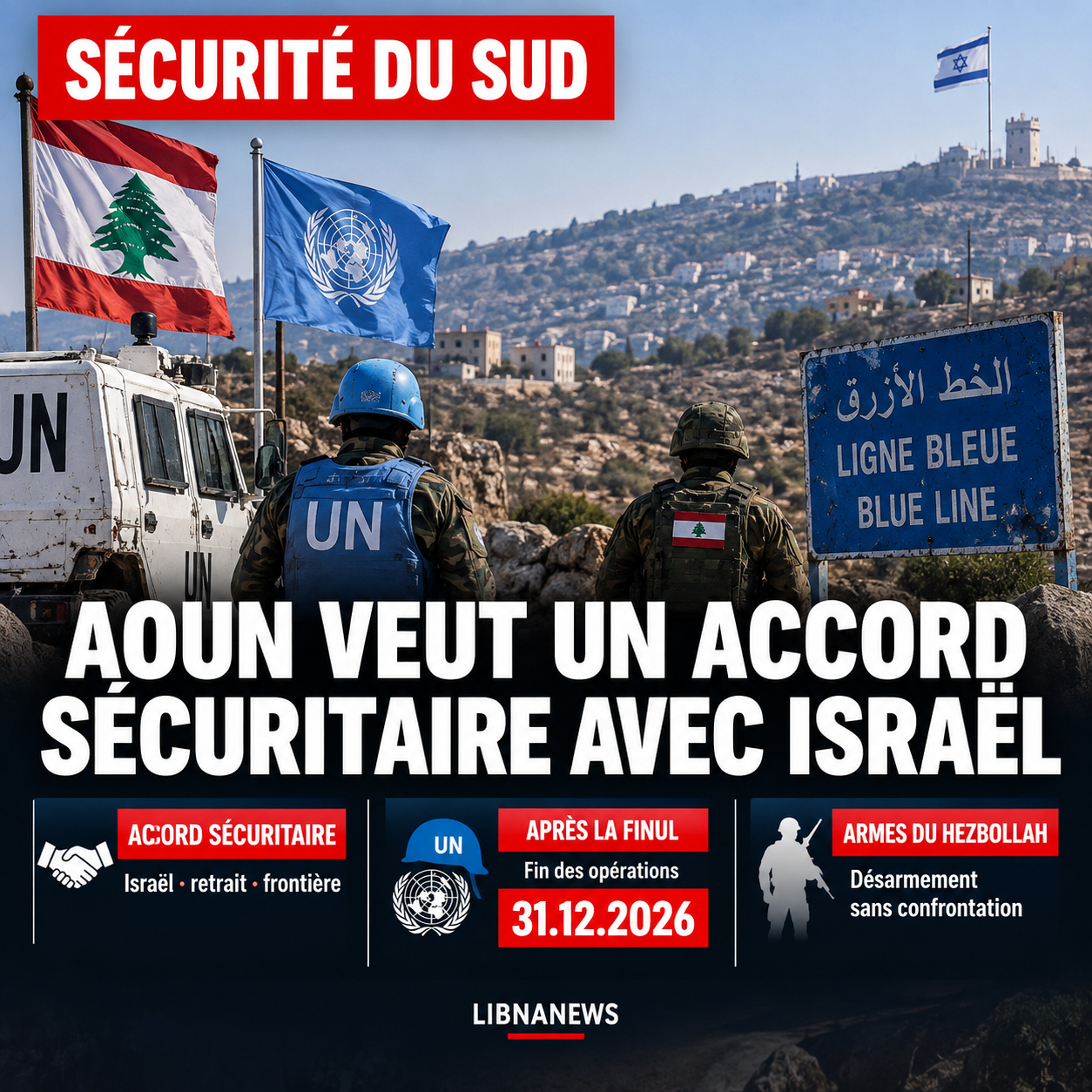
Lebanese President Joseph Aoun said Tuesday 15 September 2026 that he wanted to negotiate asecurity Agreement with Israelbefore any peace, while reaffirming its will to disarm Hezbollah without causing internal confrontation. At the same time, the Head of State calls for a temporary European or international force to avoid a security vacuum in southern Lebanon after the end of the Finul operations, scheduled for 31 December 2026.
A security agreement with Israel before peace
Joseph Aoun now places the security issue at the centre of the relationship with Israel. In an interview with an international news agency, the Lebanese President explained that a security agreement should first end the hostile state and fully deploy the Lebanese army at the border.
The Head of State therefore did not present a peace treaty as an immediate step. Instead, he established a sequence. Lebanon would first seek a security arrangement, including the Israeli withdrawal from Lebanese territory and the deployment of the army. This agreement could then pave the way for broader political negotiations.
This formulation represents a desire to dissociate two files. The first concerns the military and security measures necessary to stabilize the border. The second concerns possible future normalization of relations between the two countries. Joseph Aoun believes that it is not possible to proceed directly to this second stage.
The issue of Israeli withdrawal remains central to this approach. A part of southern Lebanon remains under Israeli occupation, while Beirut demands respect for its sovereignty and the restoration of exclusive State authority over the entire national territory.
Joseph Aoun wants to avoid a vacuum after the Final
The other emergency concerns the future of the south after the Finul. Joseph Aoun hopes that a new European or other international force will be able to provide a temporary presence after the United Nations mission has stopped operations.
The Chair summarized his priority by emphasizing the need to avoid any « empty » security. This force would not, however, be expected to replace the Lebanese army on a lasting basis. According to the outline presented by the Head of State, it would have a transitional function until the Lebanese armed forces had the means to ensure their deployment alone.
This issue becomes urgent as the end of 2026 approaches. The UN Security Council decided in August 2025 to extend the term of office of the Finul one last time until 31 December 2026. On that date, the mission must cease operations and begin an orderly withdrawal, which must be completed within one year.
The resolution therefore provides for a withdrawal phase in 2027, but the Mission will no longer maintain its current operational functioning after 31 December. The objective of the United Nations remains to make the Lebanese government the sole security authority in the south.
For Beirut, the transition represents a military and diplomatic challenge. Finul has been present in Lebanon since 1978. Its role was strengthened after the 2006 war between Israel and Hezbollah. In particular, it monitors the cessation of hostilities and accompanies the Lebanese army in its deployment to the south.
The disarmament of Hezbollah without confrontation
Joseph Aoun also reaffirmed his determination to address the issue of Hezbollah’s weapons. He wished to achieve the disarmament of the Shiite movement, but excluded a confrontation that might open an internal crisis.
This position places the state in a difficult balance. On the one hand, the Lebanese authorities affirm their objective of restoring the state monopoly on arms and military authority. On the other hand, a coercive operation against Hezbollah could cause major political and security tensions.
The issue is directly related to the future of the south. Security Council resolution 1701, adopted after the 2006 war, provides, inter alia, for an area between the Blue Line and the Litani free of armed personnel, goods and weapons other than those of the Lebanese Government and the Finul. International resolutions also recall the objective of effective State control over the whole territory.
Joseph Aoun thus links three dossiers that converge towards the same institutional objective: the Israeli withdrawal, the deployment of the army and the settlement of the issue of Hezbollah’s weapons. But he insists on a gradual method, which must avoid turning this process into an internal confrontation.
A security transition under high pressure
The timetable makes this strategy particularly sensitive. The Finul must stop operations at the end of the year, while the situation in the south remains fragile. In 2026, the United Nations again reported tensions along the Blue Line and highlighted the risks associated with renewed hostilities.
The strengthening of the Lebanese army is therefore one of the key elements of the coming period. The resolution organising the end of the Finul also calls on the Secretary-General of the United Nations to examine ways of supporting the implementation of Resolution 1701 following the withdrawal of the mission, in particular for the monitoring of the Blue Line and support for the redeployment of the army south of the Litani.
Joseph Aoun’s proposal for a temporary force falls within this range. It aims to prevent a brutal break between the international presence and the rise of the army from creating an area of security uncertainty.
However, its composition, mandate, funding and legal framework remain to be determined. The President spoke of a force coming from Europe or elsewhere, without announcing at this stage an international agreement on its creation.
Israeli withdrawal as a political condition
The presidential process is also based on a major political condition: the Israeli withdrawal from Lebanese territory. For Beirut, a security arrangement cannot be separated from national sovereignty.
The President thus seeks to establish a sequence in which the stabilization of the border would precede possible diplomatic developments. The deployment of the Lebanese Armed Forces would be the internal pillar of this arrangement, while a security agreement with Israel would set the border and military framework.
Such architecture, however, depends on several actors. It implies an agreement between Lebanon and Israel, international support for the post-Final transition and increased capacity of the Lebanese army. It also implies a progressive settlement of the issue of Hezbollah’s weapons without internal confrontation.
Joseph Aoun’s statements therefore draw a roadmap rather than an agreement already reached. Three and a half months from the end of the operations of the Final, the immediate priority of the Lebanese presidency remains to avoid a vacuum in the south, while preparing for the transfer of security responsibility to the army and seeking a negotiating framework with Israel.