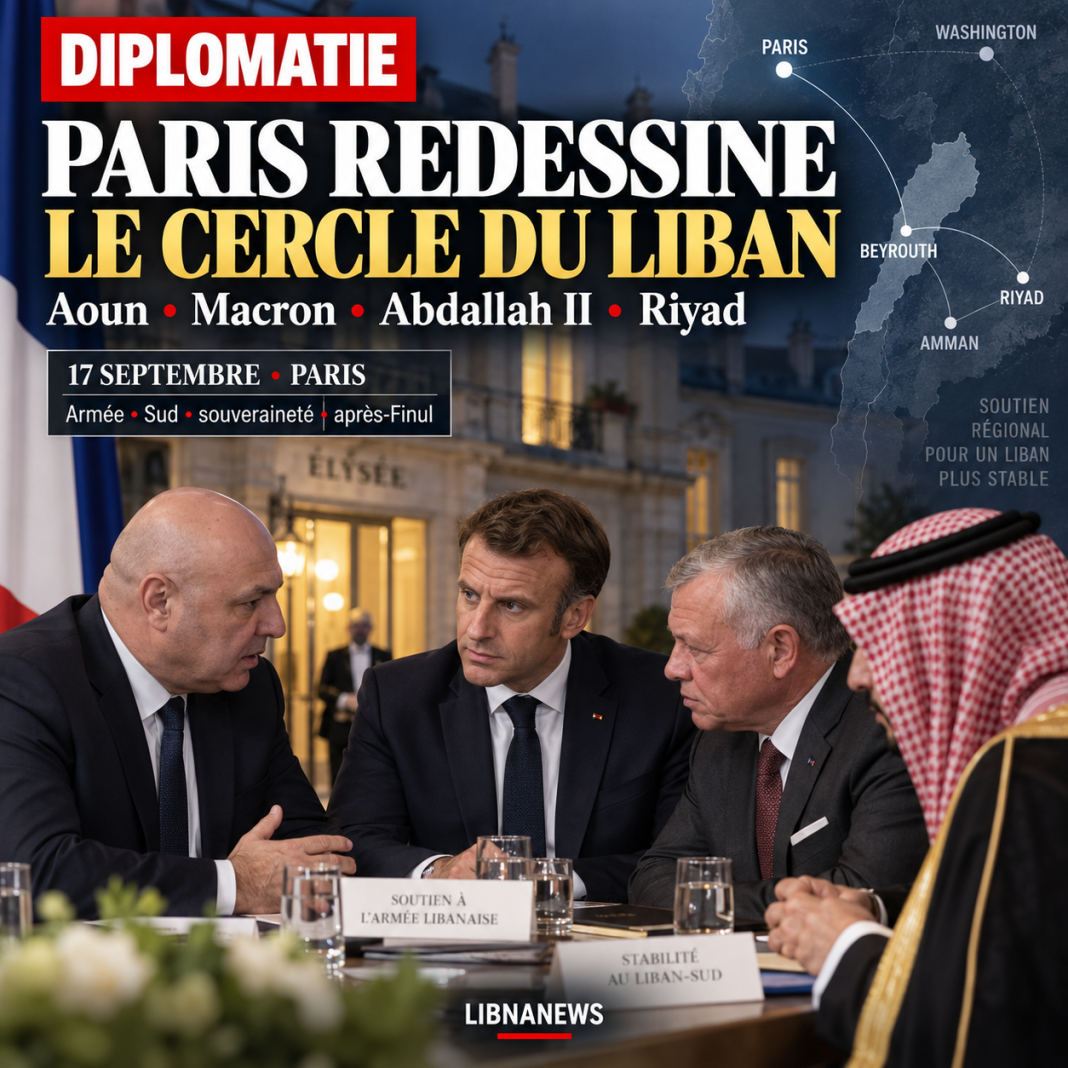






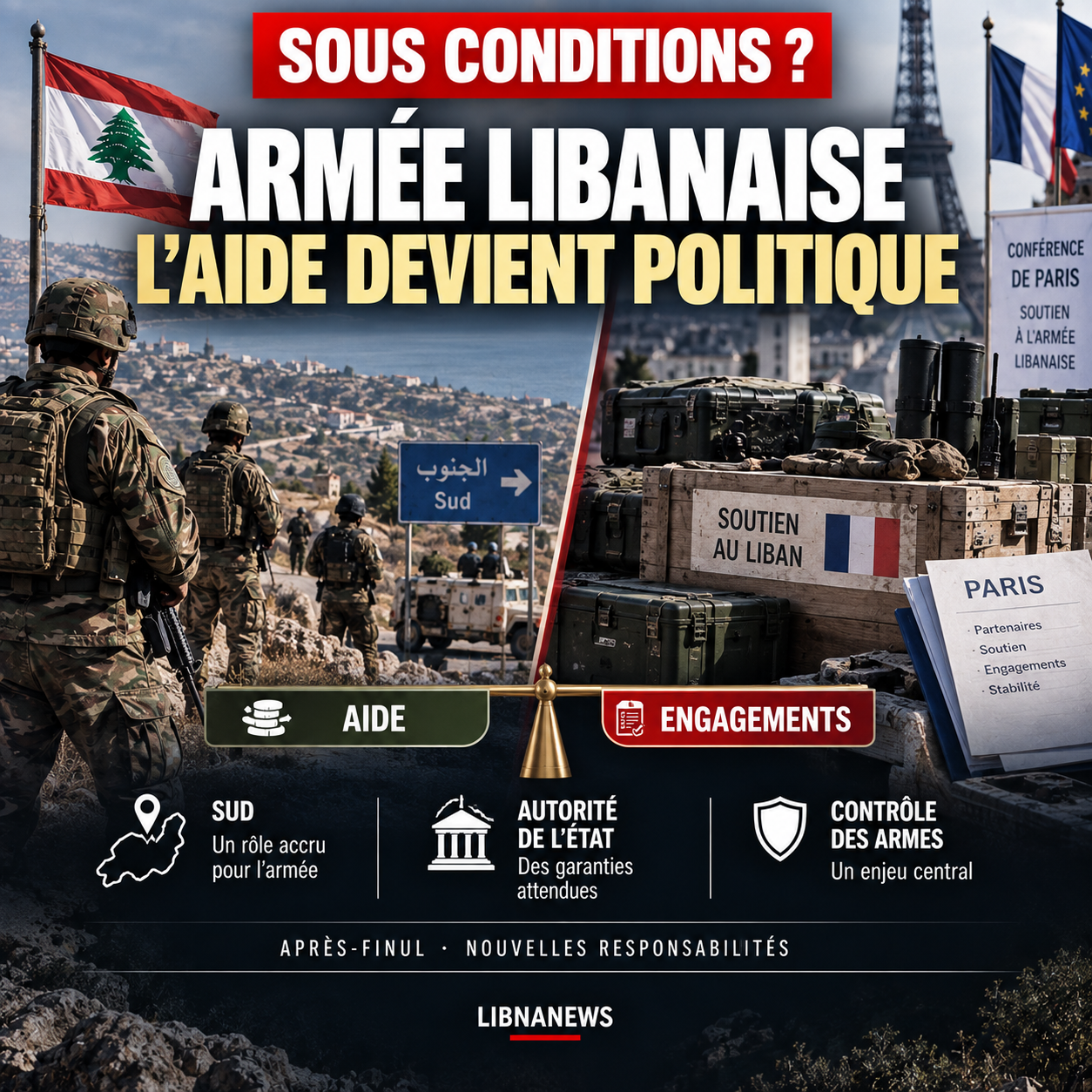
On the eve of the Paris preparatory meeting on support for the Lebanese army, the discussions no longer focus solely on the vehicles, equipment or financial means needed by the military institution. Part of Lebanon’s partners now want to know what the strengthening of the army will really change on the ground, especially in the south and in the case of weapons beyond the control of the State.
According to diplomatic sources cited by Al Jumhouria on 15 September 2026, Washington tends to link the volume and nature of international aid to the ability of the Lebanese State, with its army, to implement its arms control commitments and the exclusive exercise of public authority. The same sources describe donors who are still cautious, pending political guarantees and reforms to ensure that the strengthening of the military institution will be accompanied by an effective extension of State authority.
This conditionality, if confirmed in the Paris talks, places Beirut before a delicate equation. Lebanon explains that it needs a better equipped army to gradually regain control of the territory and assume more responsibilities in the South. On the other hand, some of its partners seem to want to measure their aid against the progress already made by the State.
The dossier takes on additional importance with the prospect of the end of the Finul mission. The army could be called upon to occupy a much greater place in the future security arrangements of the South, while negotiations with Israel have still not resolved several central issues: Israeli withdrawal, control mechanisms, security arrangements and the fate of Hezbollah weapons.
A list of needs, but also commitments
The Lebanese dossier presented in Paris is however very concrete. Al Joumhouria details several requests for transportation, logistics, communication systems, protective equipment and capabilities for field deployment. To this is added the financial situation of the military, weakened by several years of economic crisis.
Paris would also seek to include the Internal Security Forces in the support mechanism. The aim would be to enable them to assume more responsibility within the country and thereby free up military capabilities for border missions and the South.
But this technical list is no longer sufficient to summarize the discussions.
The meeting took place after several months during which the government of Nawaf Salam made the arms monopoly and the decision on war and peace one of its main political commitments. Before Parliament, the Prime Minister defended this line again at the sitting on 15 September.
Ad Diyar of 16 September reports that he insisted on the lack of lasting stability without extending State authority to the whole territory by his own forces. Nawaf Salam also reaffirmed that the decision on war and peace must belong exclusively to the State.
Hezbollah’s reaction to Parliament showed the difficulty of translating this position into concrete measures. Hassan Ezzeddine accused the power of signing the negotiating framework with Israel without sufficiently strong maps. Ibrahim Moussaoui, for his part, overturned the question by asking what the State had done to arm the army and give it the means to defend the territory.
The Paris debate thus meets directly with the Beirut debate: the international partners ask for guarantees of state authority at the very moment when part of Parliament asks why the army has not yet received the military means necessary to fully exercise this authority.
The South, first life-size test
The negotiations with Israel give this issue an immediate dimension. Al Joumhouria reports that aid to the army is closely linked, in diplomatic discussions, to its ability to deploy to the South.
Sectors described as « experimental areas » in the negotiation process have become a test. The principle is to allow the Lebanese army to take a position in certain areas in order to establish State authority and to prepare, or accompany, an Israeli withdrawal.
The success of this formula could pave the way for its extension. On the contrary, its failure would provide an argument to the opponents of a rapid withdrawal.
It was precisely at that time that Israel intensified its accusations against the Lebanese army.
Al Liwaa of 16 September reports that the Israeli authorities accuse the military institution, up to its command level, of coordinating its action with Hezbollah. The daily believes that these accusations directly target the credibility of the army on the eve of the Parisian appointment.
For Beirut, the danger is obvious. Israel can argue that it cannot abandon certain sectors to an army which it considers insufficiently independent of Hezbollah. At the same time, Lebanon’s partners ask the same army to demonstrate that it can become the only security reference on the ground.
President Joseph Aoun responded publicly to these accusations. During the visit of the Finnish Minister of Defence Antti Häkkänen, he assured that the army had strengthened its deployment in the unoccupied villages and other areas of the South. He claimed that she was fulfilling her duties of maintaining security, monitoring armed demonstrations and assisting with the return of the inhabitants.
Joseph Aoun mainly rejected the Israeli accusations against the conduct of the army.
This defence comes at a time when the international credibility of the institution becomes directly linked to the means it hopes to obtain.
The departure of the Finul changes the nature of the support
The Paris meeting is finally taking place with a deadline that weighs heavily on all the discussions: the post-Final.
Al Joumhouria reports that Paris, Rome and Washington are already discussing several alternatives to the international mission in the South. The question of support for the army therefore becomes inseparable from that of the future international machinery.
If the army is to recover some of the responsibilities so far carried out with the support of the Finul, it will need to have additional surveillance, mobility, communication and territorial control capabilities. The Lebanese state, struck by the financial crisis, cannot finance this surge alone.
But the requested States want to know in which political environment their aid will be used.
This is where the case becomes particularly sensitive to Hezbollah. Aid explicitly presented as a counterpart to disarmament could be interpreted in Lebanon as an instrument of external pressure. The information of Al Joumhouria, however, does not allow for such a great deal. They do not mention an amount conditional on a specific measure or a timetable for the disarmament of the party.
Instead, they indicate that donors want to relate the importance of their commitment to the state’s progress in exercising its authority.
This nuance will be decisive in Paris.
The Lebanese government will have to convince its partners that a stronger army will precisely speed up the return of the state. Donors will have to decide whether they are ready to finance this upsurge before all political obstacles have been removed.
In the middle of this negotiation, the army finds itself in a paradoxical position. It is expected to become the centrepiece of the future southern apparatus, but the means necessary for this mission may depend on results that it cannot achieve alone.
The issue of arms is a matter of national political decision as well as military operation. Negotiations with Israel also depend on Washington and Tel Aviv. The Israeli withdrawal is not in Beirut alone. As for the post-Final period, he was already arguing between several capitals.
It is in this entanglement that Paris must determine how far Lebanon’s partners are ready to support its army. Behind the lists of materials and financial needs, the discussion will therefore also focus on the role Western capitals want to play in the military institution in post-war Lebanon.