





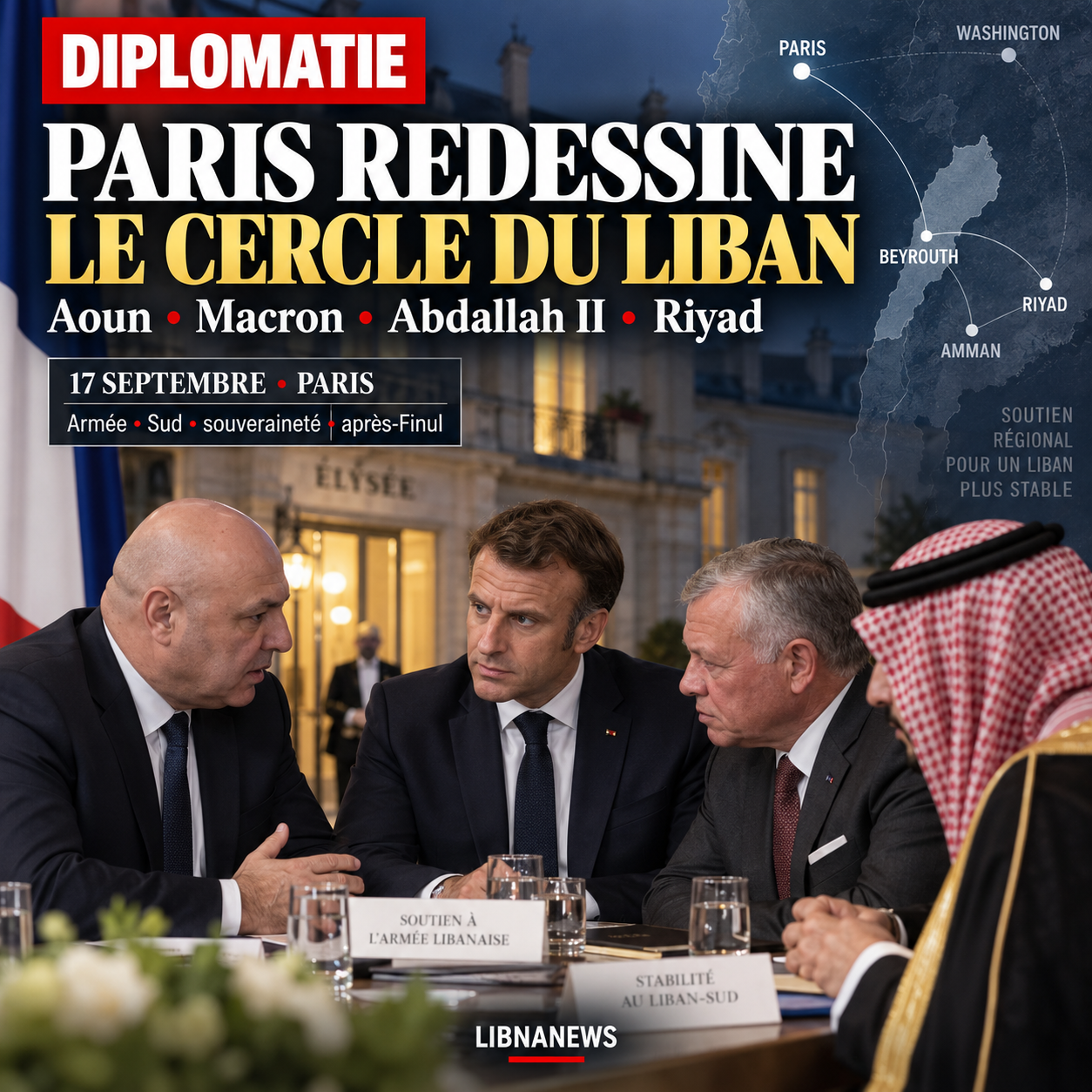
The Paris conference on support for the Lebanese Armed Forces could host a much larger political sequence than its official military programme. According to information published by Ad Diyar on 16 September 2026, the meetings organized on the sidelines of the meeting should allow President Joseph Aoun, French President Emmanuel Macron and King Abdullah II of Jordan to discuss directly the situation in South Lebanon, the arrangements for the next stage and the role of the army.
But more discreet information attracts attention. Ad Diyar reported discussions on possible participation of Saudi leader Yazid bin Farhan in the meeting. He must arrive in France after a passage through Washington, where he would have conducted a series of interviews devoted in particular to the Lebanese file.
If its participation is confirmed, the meeting initially presented as a Franco-Lebano-Jordan summit could take on a new dimension. It would bring together, directly or indirectly, four actors with different levers on the Lebanese issue: Beirut, Paris, Amman and Riyadh.
A military conference with a political appointment
Ad Diyar of 16 September 2026 explains that preparations for the conference continue simultaneously at the military and political levels. President Joseph Aoun discussed with Defence Minister Michel Menassa the needs of the army to be presented in Paris.
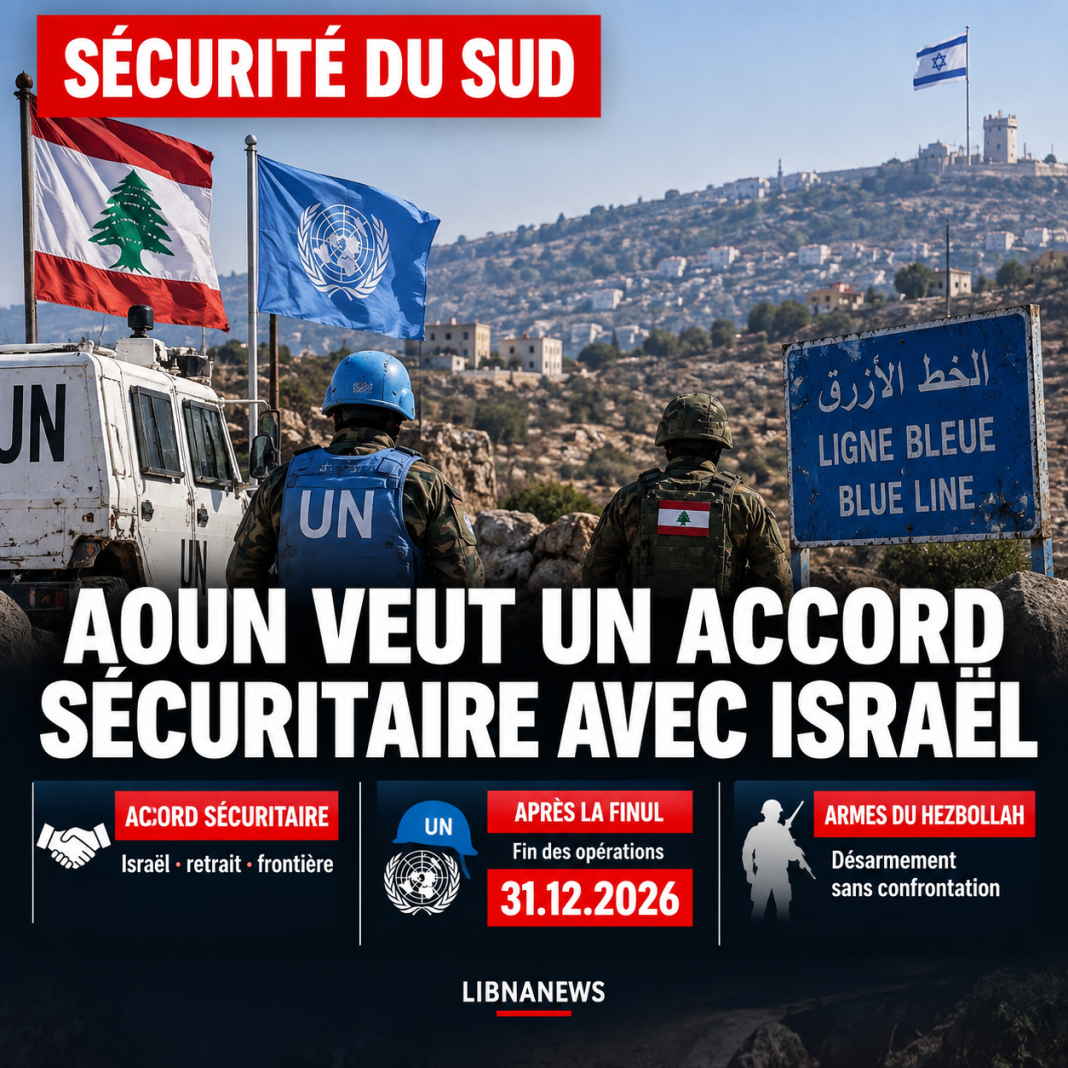
These needs are the official part of the appointment. Lebanon seeks to strengthen the capabilities of its army in a time when it must assume increasing responsibilities in the South. The scheduled departure of the Finul adds an additional constraint. The military institution must be able to expand its deployment, maintain security and accompany any arrangements that may result from negotiations with Israel.
But Ad Diyar points out that one of the most important issues is the meetings planned on the margins of the conference.
The newspaper announces a meeting between Emmanuel Macron, Abdallah II and Joseph Aoun before the opening of the works. The programme referred to far exceeds the equipment or financial needs of the army. It should include the South, the arrangements envisaged for the next phase and the role of the military institution in stabilizing the country.
The military conference therefore provides the framework. Political negotiations could take place around it.
Unknown Saudi
It is in this context that the most sensitive information published by Ad Diyar on 16 September 2026 comes into play.
The daily reports on discussions about Yazid bin Farhan’s possible participation in the summit. The Saudi official must join France from Washington. He reportedly held several meetings at which the Lebanese situation was discussed.
Ad Diyar presents this possibility as an uncertain element. Therefore, information should not be transformed into officially decided participation.
But the hypothesis is politically significant.
A Saudi presence would move the meeting from a Franco-Lebanese-Jordanian format to a configuration bringing together several of the actors most directly involved in Lebanon’s political and security restructuring.
France retains a historic diplomatic role in Beirut and leads the conference. Jordan has an important military and security experience and maintains close relations with Lebanon’s Western and Arab partners. Saudi Arabia, for its part, has a major political and financial weight and has gradually regained its central position in the Lebanese balance.
Lebanon would thus be at the centre of an Arab and Western dialogue that could go far beyond the question of financing its army.
Why Washington’s Passage Matters
Yazid ben Farhan’s movement from Washington to Paris adds to the information reported by Ad Diyar.
The newspaper reports that the Saudi official conducted a series of meetings in the United States, including on the Lebanese situation. It does not provide, in the relevant passage, the details of the interlocutors or the exact content of these discussions.
It would therefore be excessive to talk about an American-Saudi agreement already established on Lebanon.
On the other hand, the Washington-Paris succession shows that consultations on the Lebanese issue are not only taking place between Beirut and the European capitals. They are part of an environment where Washington, Riyadh and Paris each have a specific role.
This configuration is all the more important as the United States remains directly engaged in negotiations between Lebanon and Israel.
The meeting in Paris thus coincides with several issues: support for the army, negotiations with Israel, security in the South, the future of the international presence and the role of Lebanon’s Arab partners.
Behind the equipment, the question of the role of the army
The conference is not simply about providing vehicles, communication equipment or financial assistance.
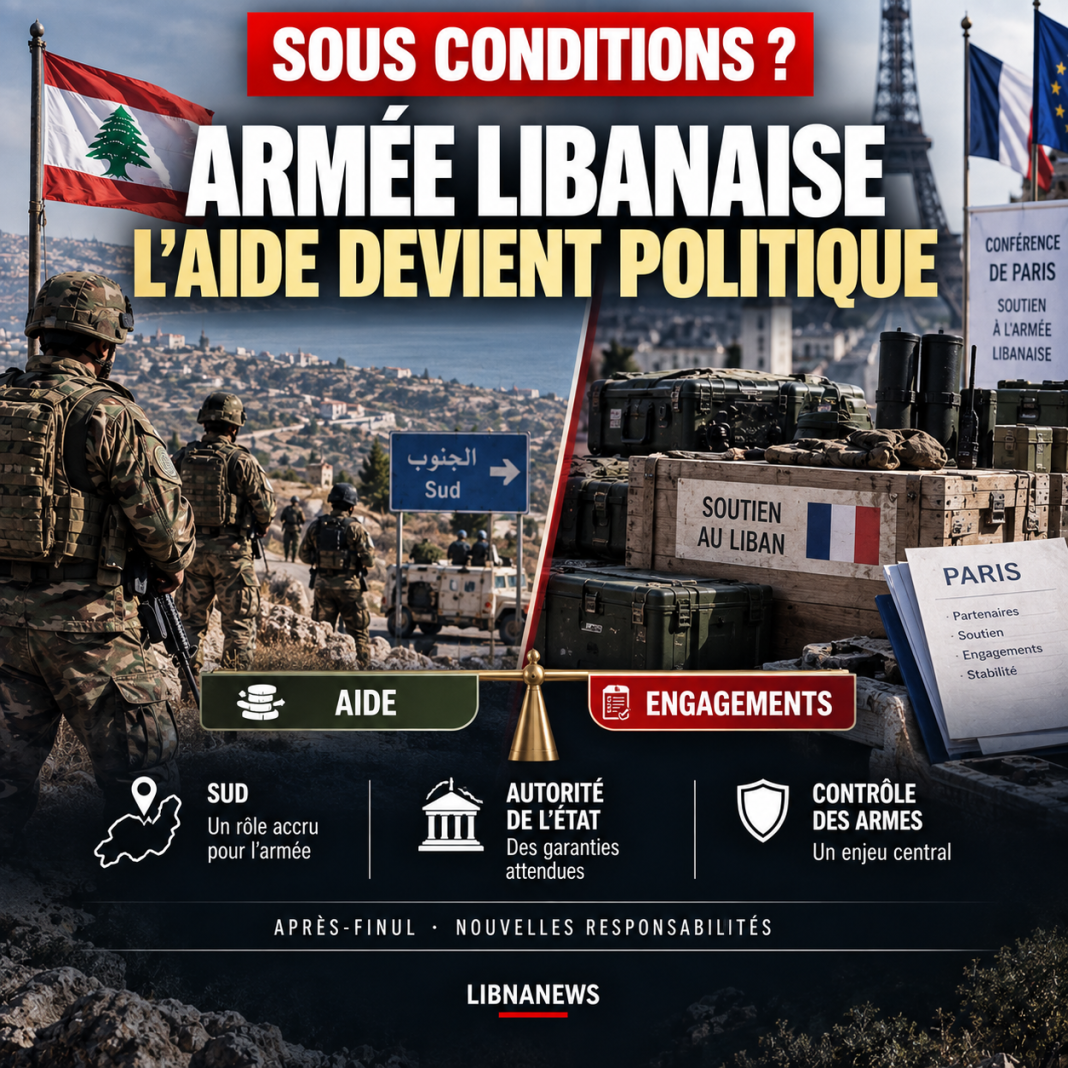
Al Jumhouria of 15 September 2026 reports, citing diplomatic sources, that the requirements presented by the Lebanese delegation relate to equipment, logistics, means of transport, communications, protection and field capabilities. The financial situation of the military is also a concern.
But the newspaper adds an essential fact: international support would be closely linked to the ability of the army and the state to extend their authority.
In other words, Lebanon’s partners are not only discussing the means to be provided to the army. They question what it will actually be called upon to do with these means.
The question of the South becomes central.
The Israeli withdrawal, the return of the inhabitants, the future of the Finul, the control of the territory and the file of arms are now linked. The army is at the meeting point of all these files.
In these circumstances, the presence of the French, Lebanese and Jordanian heads of State around the conference takes on special significance. Possible Saudi participation would further strengthen this dimension.
Can Riyadh become one of the guarantors of the new stage?
Saudi involvement is one of the important issues of the moment.
The kingdom does not have the same role as Washington in negotiations with Israel. Nor does he have the military function of the Lebanese army or the operational experience of certain countries engaged in the Final. Its weight is elsewhere.
Riyadh can provide Arab political support to the Lebanese authorities. It can also play a financial role in supporting institutions and ultimately in reconstruction. Finally, its positioning can help to give regional coverage to a policy of strengthening the Lebanese State.
This is precisely what makes the possible presence of Yazid ben Farhan significant.
If the Saudi official actually joins the exchanges between Joseph Aoun, Emmanuel Macron and Abdullah II, the Lebanese file would be discussed in a format capable of combining security, diplomacy and Arab support.
This would not yet be a permanent institutional mechanism. Nothing in the available information makes it possible to talk about a new official group dedicated to Lebanon.
But the meeting could be a draft for closer coordination.
Jordan as a discreet but central partner
The presence of King Abdullah II is not secondary.
Jordan has a long history of cooperation with Western and Arab military institutions. It is also directly affected by the security transformations in the Middle East.
Its participation in the summit gives support to the Lebanese army an Arab dimension that is not based solely on Saudi Arabia.
Amman can also serve as an interface between several partners. His relationship with Washington is close. His military and security services have long worked with their Western counterparts. At the same time, the kingdom retains its place in the mechanisms of Arab cooperation.
The format announced by Ad Diyar therefore combines complementary rather than similar actors.
Paris brings the diplomatic initiative. Amman brings a security and regional dimension. Riyadh, if he joins the meeting, adds his political and financial weight. Beirut seeks to transform this convergence into concrete support for the state and its army.
A conference that takes place as the post-Final prepares
The calendar gives even more importance to the Parisian appointment.
Al Joumhouria of 15 September 2026 reports that parallel discussions are taking place between Paris, Rome and Washington concerning the future of the Finul. Its mission must end at the end of the year. Several alternatives would be explored.
Support for the army and post-Final therefore do not constitute two independent dossiers.
The more the Lebanese army is called upon to take over the ground, the more it will need new capabilities. And the more the international arrangement is reduced or transformed, the more Lebanon’s partners will have to define the guarantees that will accompany the military institution.
The Paris conference could thus be used to prepare materially a decision that will be primarily political.
The question is how far Lebanon’s partners are prepared to go.
Washington sets conditions
Al Joumhouria also reports, citing diplomatic sources, that the United States tends to link the volume and nature of aid to the ability of the State and the military to fulfil their commitments regarding arms and the exclusive exercise of public authority.
This dimension complicates the search for consensus.
Beirut calls for additional resources to enable the army to carry out its missions. International partners want to know whether strengthening the institution will bring about a concrete change in the country’s security organization.
The Paris conference is therefore taking place in a form of political conditionality.
Support would not only be assessed for military needs. It would also depend on the trajectory of the Lebanese State.
It is precisely on this point that coordination with Riyadh can become important. A Saudi commitment could give more Arab depth to international support. It could also make it possible not to leave the matter exclusively in the hands of Washington and European capitals.
Paris as a point of convergence
The meeting announced by Ad Diyar must therefore be observed beyond his official photograph.
Joseph Aoun arrives in Paris with the needs of the army, but also with the South dossier. Emmanuel Macron hosts a military conference while remaining involved in discussions on the future of the international presence. Abdullah II brings an Arab and security dimension. And Yazid ben Farhan could join the exchanges after consultations in Washington.
These movements are not sufficient to demonstrate the birth of a permanent quadripartite group.
However, they indicate that a coordination space is being formed around Lebanon.
The central question will be results. If Paris is limited to drawing up a new list of military needs, the political scope of the appointment will be reduced. If, on the other hand, the discussions bring together positions on the South, support for the army, post-Final and regional guarantees, the conference could become a much more important step.
In this case, the real information would no longer be just the amount of aid promised to the Lebanese army. It would reside in the gradual formation of a coordination axis between Beirut, Paris, Amman and Riyadh, with Washington in the background.
For now, Ad Diyar speaks only of a possible Saudi participation in the meeting. This caution should be maintained. But the displacement of Yazid ben Farhan from Washington, the planned discussions between Joseph Aoun, Emmanuel Macron and Abdallah II and the parallel negotiations on the future of the South give the Parisian rendezvous a scope that already far exceeds its military title.