

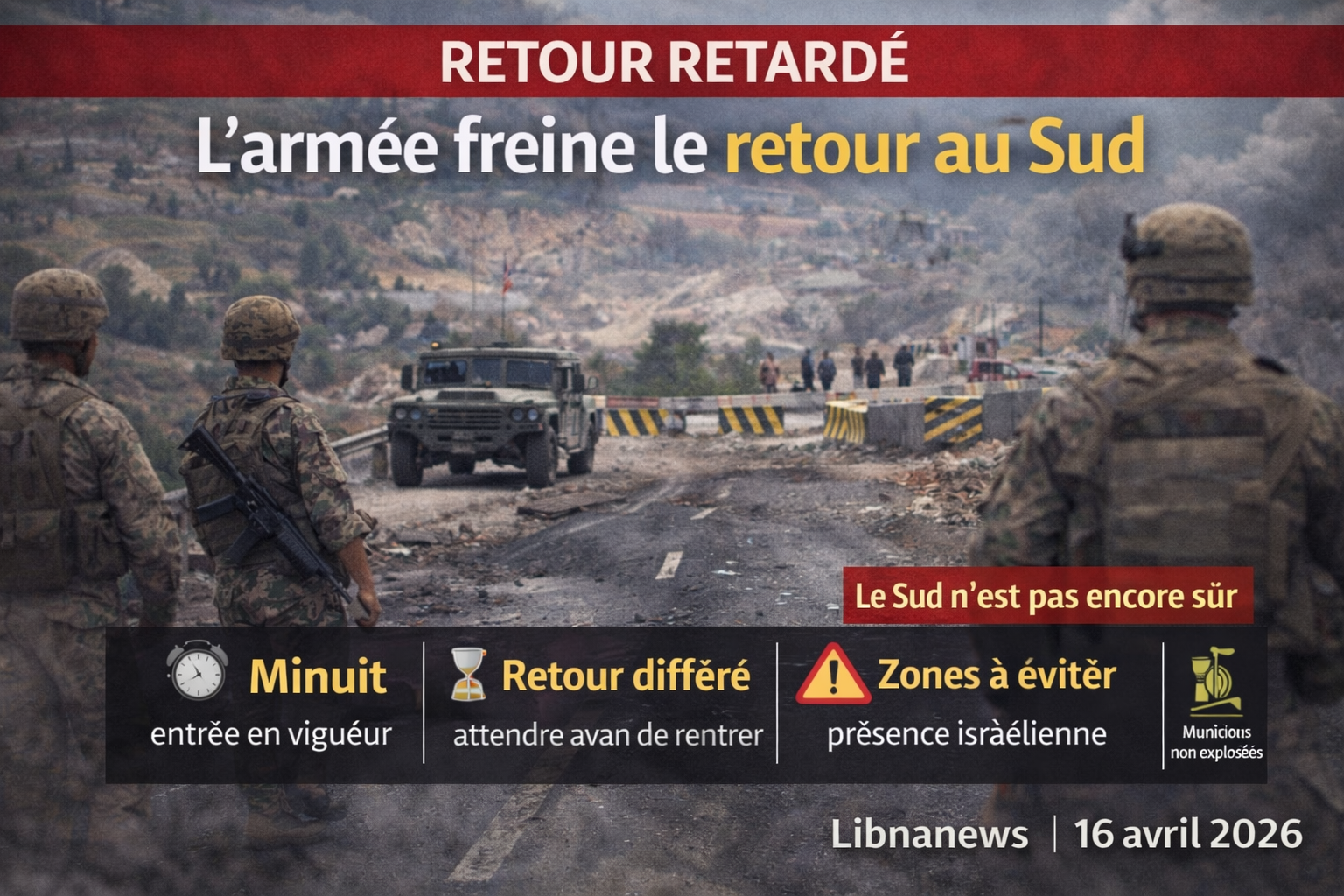
In southern Lebanon, the hour of the ceasefire did not erase the fear of the ground. On Thursday, the Lebanese Army asked the inhabitants to postpone their return to the villages and localities of the South until the entry into force of the announced truce with Israel at midnight local time, or 23 hours in Paris. In a communiqué, the army command urged the population not to approach areas where Israeli forces are present, to comply with the instructions of units already deployed and to be wary of unexploded ordnance and suspicious objects. The approach is simple in its form, but it is very meaningful in the current context: the Lebanese State wants to avoid the political announcement of a ceasefire in Lebanon becoming, in the very first hours, a human tragedy for civilians tempted to return too quickly to their homes.
The message reflects a raw reality. Even when a truce is announced, South Lebanon does not become a safe space in a few hours. Israeli troops are still present in several sectors. Roads, bridges and buildings were hit until the last hours before the announced ceasefire schedule. Unexploded ordnance remains dispersed in repeatedly targeted locations. Above all, neither the Lebanese army nor the civilian authorities want to see scenes already observed in previous war sequences repeated, when people return too soon to their villages, at the risk of being caught between military positions, residual fire or equipment left behind. The instruction given on Thursday evening is therefore part of an immediate protection logic, much more than in a political logic.
Lebanese Army speaks first security
The command statement is written in unambiguous language. He’s not just asking to wait. It clearly calls on the inhabitants not to return to the villages and localities of the South before the effective entry into force of the truce. The shade is important. The army does not rely on diplomatic announcements alone. It distinguishes the announcement of a ceasefire from its actual implementation. In other words, it considers that the danger remains intact as long as the precise hour is not reached and until the terrain has started to stabilize.
This caution is accompanied by a second and equally important warning: do not approach areas where Israeli forces have advanced. This sentence recalls that, despite speeches on de-escalation, the Israeli army remains present in several areas of southern Lebanon. For the inhabitants, therefore, the risk comes not only from aerial bombardments. It also comes from physical proximity to forces still deployed, in a moving military environment, where the legibility of the front remains weak and where a simple attempt to return can be interpreted as a hostile movement or result in a serious incident.
The army adds a third level of alert: unexploded ordnance and suspicious objects. This aspect is often underestimated in the early hours of a truce. Yet this is one of the most constant dangers in southern Lebanon after the bombings. Residents who return sometimes find creviced roads, houses destroyed, lands ploughed by artillery and debris that they cannot know if they are inert or active. In stressing this point, the military institution recalls that the war leaves behind a field of threats that survives the cessation of strikes.
Report back, not give up
In reading the Lebanese Army, it is not a question of telling the displaced that they will not return. It is a question of asking them to delay this return. This distinction counts politically and humanly. Tens of thousands of families have been living for weeks, sometimes months, waiting to be able to return to their homes, return to their villages, measure the damage, save what can be and get back to life. Every announcement of a ceasefire in Lebanon therefore triggers an immediate emotional movement. The inhabitants want to return as soon as possible. They want to see with their eyes. They want to stop being displaced.
That is precisely why the army intervenes. She knows that the danger is all the higher than hope. In a war situation, the most risky moment is not always that of the strike. It may be the announcement of a truce, when civilians think the threat has disappeared while the terrain remains saturated with soldiers, explosives, rubble and uncertainty. By asking to wait a few hours or more depending on the area, the army tries to break the reflex of immediate return.
This posture also has a logistical dimension. A massive and spontaneous return, even before the units deployed could control access, check certain roads or report dangerous areas, would further complicate the situation. It could hinder the movement of the army itself, relief, medical teams and units responsible for checking the most exposed areas. The command therefore also asks the inhabitants to follow the instructions of the military in the South. This sentence shows that the hierarchy of priorities is already laid down: first minimum security, then return.
Consistent with the last hours of war
The warning of the Lebanese army does not intervene in a vacuum. It is said that the last hours before the ceasefire have been marked by Israeli strikes and sustained fighting in several areas of the South. News reports reported shelling around Bint Jbeil and Yarun, extensive damage to the Tebnine government hospital, and the destruction of the Qasmiyeh bridge. Other reports have reported road strikes and damage to critical infrastructure. This chronology explains in itself why the army refuses to let believe that midnight instantly erases the danger.
Bint Jbeil remains the most emblematic point of this tension. The city and its surroundings have concentrated a significant part of the ground fighting and artillery fire in recent days. In such a sector, the ceasefire in Lebanon cannot be regarded as acquired solely on the grounds that one hour was announced in Washington. It must first be observed, confirmed, and tested locally. Moreover, the inhabitants often know this better than the chancelleries: a truce really exists only once the sound of the strikes has fallen back.
The case of Tebnine further reinforces this caution. The damage suffered by the government hospital recalls that health facilities, roads and civilian buildings have been affected until the last hours. This means that even a locality where fighting is not direct can remain dangerous because of debris, blown glass, damaged infrastructure or remnants of ammunition. The military command therefore reason from this reality. As long as the first hours of the ceasefire in Lebanon have not been verified, the protection of civilians requires waiting.
The precedent of false departures
Military training also refers to experience accumulated for months. South Lebanon has already experienced announcements of truces, periods of relative decline in fighting, rumours of ceasefires and floating phases that have prompted people to attempt to return earlier than recommended. However, these moments have often been followed by new strikes, persistent tensions or danger reports on the ground. The Lebanese army, which had already issued a similar warning at the beginning of April, was therefore in line with a prudent repetition logic: it preferred to curb a return movement rather than have to manage its human consequences.
The memory of the ceasefire of November 2024 also weighs on this caution. This agreement was presented as the end of the previous war. Yet, it has never established a complete calm on Lebanese territory. Israeli strikes continued, including targeted strikes. According to the Lebanese authorities, hundreds of people were killed between this truce and the outbreak of fighting in March 2026. For much of the opinion in Lebanon, this precedent has left the image of an imperfect, sometimes unilateral, often unstable ceasefire.
In these circumstances, the army knows that a displaced inhabitant does not just listen to the news of the day. He also judges with the memory of the previous months. Some will want to return immediately, because of fatigue, attachment to their land or concern for their property. Others will hesitate precisely because they have already seen a truce proclaimed without real security. The role of the military command is therefore to set a clear line in this moment of uncertainty: we do not anticipate the ceasefire in Lebanon, we expect it to enter into force and begin to produce concrete effects.
South Lebanon remains a military space
One of the most important aspects of the communiqué is that it points out, quite frankly, that certain areas of the South remain marked by the Israeli presence. This is essential. It means that the return of the inhabitants is not only a matter of finished or incomplete bombings. It is also a matter of soil control. Areas have been penetrated by the Israeli army, others have been evacuated, and others are in the immediate vicinity of disputed or occupied areas. For a civilian, this geography of danger is not always visible.
That is precisely why the army is asking not to approach the areas where Israeli forces have advanced. A family returning to a southern village does not return to an ordinary space. It is potentially returning to the vicinity of a contact line in an area where Israeli units can still be deployed, where axes can have been transformed militarily and where a simple vehicle movement can be sufficient to create an incident. This reality reinforces the need for a gradual, framed return, not a spontaneous movement.
The Israeli presence is all the more sensitive as Benyamin Netanyahu has already claimed that Israel would not withdraw to international borders immediately and would maintain a safety belt in southern Lebanon. Even if the ceasefire in Lebanon enters into force, this means that the risk line does not automatically disappear. The inhabitants therefore do not return to a Pacific South, but to a South where the cessation of fighting will have to coexist, at least at the beginning, with an Israeli military presence claimed.
For the Lebanese army, this adds a major difficulty. It must both reassure the public that return is possible in the long term, and make it clear that some areas are not yet safe. Hence this very concrete language about prudence, the instructions of deployed units and suspicious objects. The ceasefire in Lebanon does not immediately open normal civilian weather. First, it opens a period of military transition.
The Lebanese Army enters the front line
The communiqué also reveals something else: the Lebanese army knows that it will be immediately expected within hours and days of the entry into force of the truce. Residents want to know when to return, where to go, which roads are practical, which villages can be reached safely and which areas remain prohibited or too dangerous. The civilian authorities will need the army to organize the return, but also to report sensitive areas, guide the population and coordinate with other security services.
This expectation is reinforced by the United States text on the ceasefire, which affirms that the Lebanese Government will take concrete steps to prevent Hezbollah and other non-State armed groups from launching attacks against Israel, and which recognizes the exclusive responsibility of the Lebanese security forces for sovereignty and national defence. On paper, the Lebanese army is therefore given a central role in the beginning phase. She is no longer merely a civil manager; It becomes, theoretically, a safe post-minuit frame.
But this responsibility is exercised under extremely difficult conditions. The institution must deploy its units to damaged areas, where roads are sometimes cut off, where communities have suffered heavy damage and where unexploded ordnance pose a permanent danger. It must also reassure the inhabitants without lying to them, avoid panic movements, prevent premature returns and make it clear that a ceasefire in Lebanon does not mean that war has instantly disappeared from the landscape. Thursday’s communiqué therefore also reads as a message of authority: the army requires time, order and discipline to prevent the first hours of the truce from turning into disorder.
Displaced persons between impatience and prudence
It is difficult to overestimate the human tension behind this instruction. For weeks, a large part of the inhabitants of southern Lebanon have been living in displacement. Families are scattered. Some live with relatives, others in precarious conditions. Many do not know exactly how they will find their home, or whether it still stands. The announcement of a ceasefire in Lebanon therefore acts as a magnet. It triggers the idea of return, almost before any other consideration.
This is precisely where the authorities are concerned. Asking displaced people to wait a few more hours or days may seem simple from a military statement. On the ground, this means asking to extend uncertainty to already exhausted families. This also means accepting that the dream return is still waiting, even though political announcements give the feeling of an immediate break. The command therefore knows that his message may be badly received, or at least difficult to accept emotionally.
That is why the army does not use only a language of prohibition. It also stresses safety and concrete risks. Unexploded ordnance and suspicious objects are not abstractions. They have already injured or killed in other war sequences. A field, garden, road or house can become mortal places long after the silence of the cannons. By recalling this danger, the army is trying to turn the frustration of the delay into understandable prudence.
The same reasoning is found in Nabih Berri, who also called on the displaced to postpone their return until things were clearer on the ground. This convergence is not anomaly. It shows that, despite the deep divisions over war, the moment of return imposes a minimum shared discipline: no one, neither the army nor the politicians, wants to see the first hours of the ceasefire in Lebanon turn into a civilian tragedy.
Midnight does not erase rubble
The real lesson of this sequence is probably there. A ceasefire in Lebanon begins at a specific time in the press releases. But on the ground, reality moves more slowly. At midnight, the destroyed bridges do not reappear. Areas where troops are still present do not automatically empty. Unexploded shells do not disappear. The heavily affected villages do not become habitable again by mere announcement effect. The Lebanese army, in asking to wait, recalls this elementary truth with the sobriety of military institutions: the theoretical end of hostilities is not the immediate end of danger.
That is also why the first night will be decisive. If the strikes actually stop, if the roads remain relatively stable, if Lebanese units can begin to better mark access and indicate areas at risk, then the return may start gradually. But if violations, incidents or targeted strikes occur in the early hours, the caution requested on Thursday evening will appear retrospectively as indispensable.
For the people of the South, the time of the ceasefire in Lebanon is now at double speed. There is political time, set by Washington, Beirut and official announcements. And there is the time on the ground, which depends on the actual cessation of fighting, the safety of the roads, the military presence, the debris of war and the rhythm at which the army can say, village after village, if the return can finally begin.




