

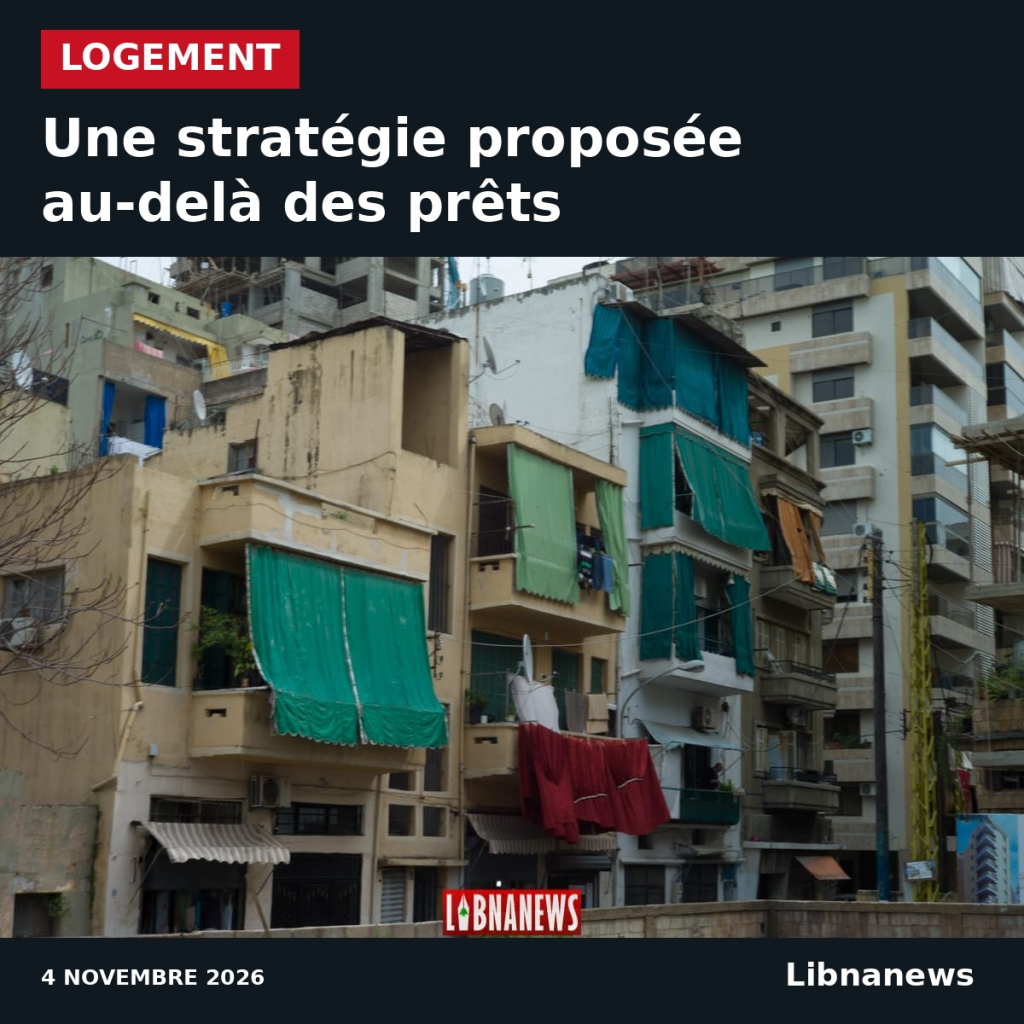
The Lebanese housing strategy proposed by Ronnie Lahoud aims more than the resumption of real estate credits. The President and Chief Executive Officer of the Habitat Public Establishment defends a roadmap linking governance, accessible housing, data and emergencies. The document, of about thirty pages, remains a proposal. As of 4 November 2026, it is not a national policy adopted and funded as a whole.
The envisaged return of the loans gives new visibility to the case. An envelope of $24 million is included in the next year’s budget proposal for low-income households. This does not mean that funding is already available. Nor is it possible to confuse a credit programme with the execution of a housing strategy.
Lebanese housing strategy: organizing responsibilities
The first focus of the roadmap is governance. Lahoud proposes a more coherent coordination of public policies, now distributed among several stakeholders. He called for the immediate strengthening of the public housing establishment, pending a possible ministry responsible for housing and cities.
This proposal concerns competences, means and monitoring. It does not correspond to the announced creation of a ministry. The document also envisages cooperation with municipalities and field organizations. These can help identify local needs and housing.
The challenge is to link decisions that affect the same household. A loan, a building permit, the rehabilitation of a building and access to services do not follow the same procedures. Without coordination, their addition does not guarantee that housing is accessible at the appropriate time.
Developing an offer that is not limited to purchasing
The second focus is on supply and accessibility. The roadmap combines several paths: property, affordable rental, co-operatives, rehabilitation and public housing. It also includes the quality of the buildings and their supervision.
The diversity of solutions responds to situations. Some households can repay a credit. Others need rent compatible with their income or work in the housing they already occupy. The resumption of loans does not directly address all these needs.
Measures envisaged include land inventory, use of public land and support for repairs. Cooperation between public and private actors is also proposed. None of these tools should be presented as a program already open to applications.
The paper also discusses taxation. In particular, Lahoud proposes to abolish a tax on vacant housing in order to encourage its return to the market. Other general sources of funding refer to levies related to vacancies, permits or registration. These guidelines still require arbitration; they do not constitute a definitive tax measure.
Data to track needs and results
The third axis concerns a national database, transparency and monitoring. The roadmap also envisages an advisory committee. These tools are intended to better describe needs and evaluate programs.
A housing policy cannot be judged solely on the number of loans distributed. It would be important to know which households benefited, in which territories and with what monthly burden. Monitoring of rehabilitated or rented housing at affordable prices would also be necessary.
The document describes rents exceeding the 30 per cent income benchmark, informal contracts and the remoteness of modest households. This diagnosis does not provide an verified national rate of expulsion or vacancy. The proposed data should help to measure situations that are still insufficiently documented.
Linking the emergency and reconstruction
The fourth axis deals with displacement, emergency housing and reconstruction, particularly in the South. It combines temporary accommodation with the preparation of more durable solutions.
This articulation is important for defining objectives. Putting a family in shelter, repairing housing and rebuilding a neighbourhood do not require the same time and resources. A strategy should specify when emergency aid ends and how it reaches a stable solution.
The roadmap includes these situations in the overall habitat policy. However, it does not include funding already acquired for all reconstruction operations.
Budget decision will not replace implementation plan
Lahoud advocates sustainable financing combining public allocations, incentives and dedicated resources. The question relates as much to the continuity of the means as to their initial amount. An interrupted system cannot guarantee a long-term policy on its own.
A first roadmap presented in 2018 had not been formally adopted. The new document therefore still has to go through several stages: arbitration, adoption, funding and definition of responsibilities. For households, the result will have to be accessible criteria, identified programmes and a published implementation schedule.





Comments