

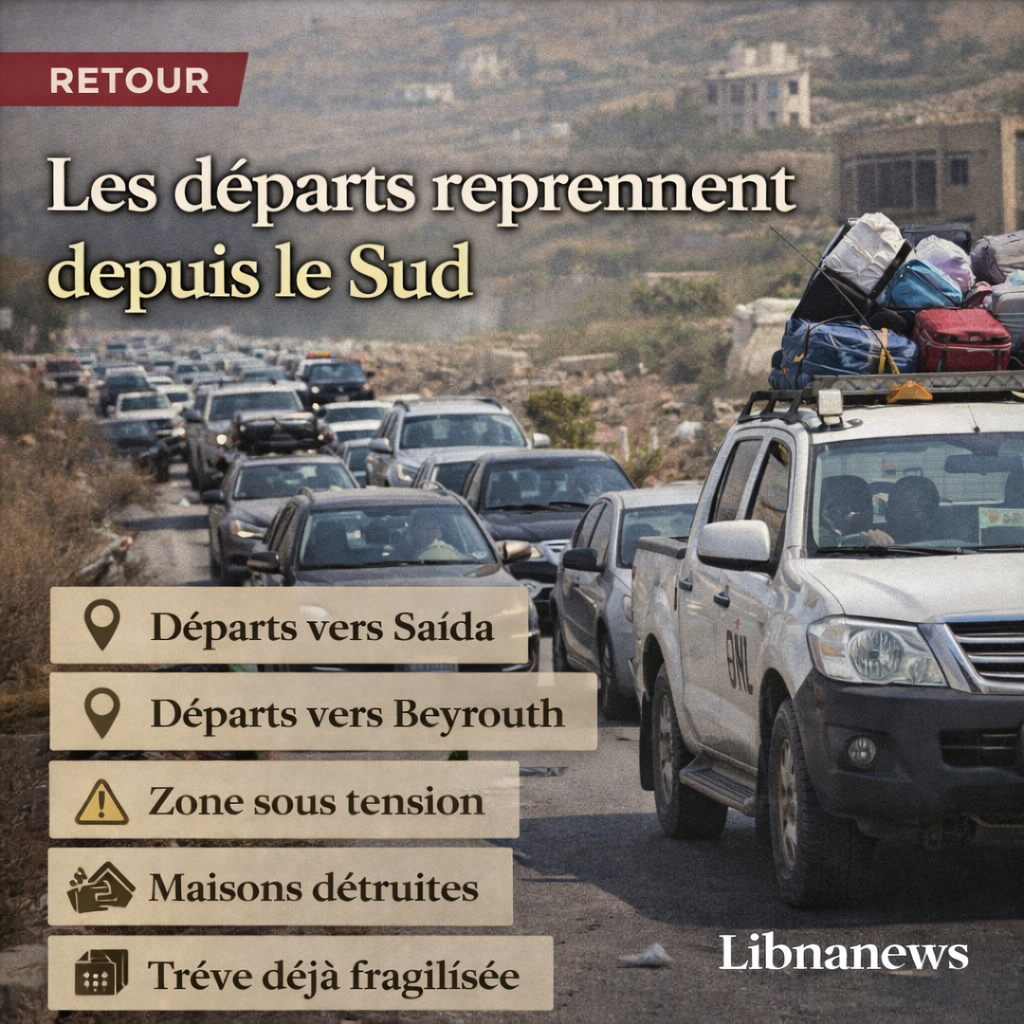
A population movement resumed from southern Lebanon towards Saida and Beirut, according to an alert broadcast on Saturday. On several roads, vehicle lines were reported, confirming a significant departure of civilians from areas still considered unstable despite the ceasefire.
This new exodus occurs in a security environment that is deteriorating again on the ground. In the south, several areas are now described as de facto areas under strict military control, sometimes as a « yellow zone », where Israeli forces are conducting targeted operations. These include one-off strikes against individuals designated as combatants, based on a modus operandi already observed in the Gaza Strip, as well as destruction of homes, including by blasting, in certain border localities.
These practices, reported in recent days, maintain a climate of persistent insecurity for the inhabitants, including in the absence of open confrontations. They directly contribute to the decision of many families to leave their villages for fear of being taken in new military operations or being exposed to residual risks.
At the same time, the regional situation adds to the tension. In the Gulf, signs of deterioration were noted, in connection with the evolution of the Lebanese file and its ramifications with Iran. Fears of an enlargement of the conflict or maritime incidents fuel a sense of uncertainty that goes far beyond Lebanese theatre.
No official assessment has yet been made of the extent of these movements. The Lebanese authorities have not, at this stage, detailed specific arrangements to control this influx into the major cities, already weakened by months of crisis and previous waves of displacement.
This renewed departures underscores the fragility of the ceasefire and the lack of real stabilisation on the ground. More than just a precautionary movement, it reflects a continuing loss of confidence among civilian populations in the face of a security situation that remains, for the time being, deeply volatile.




