

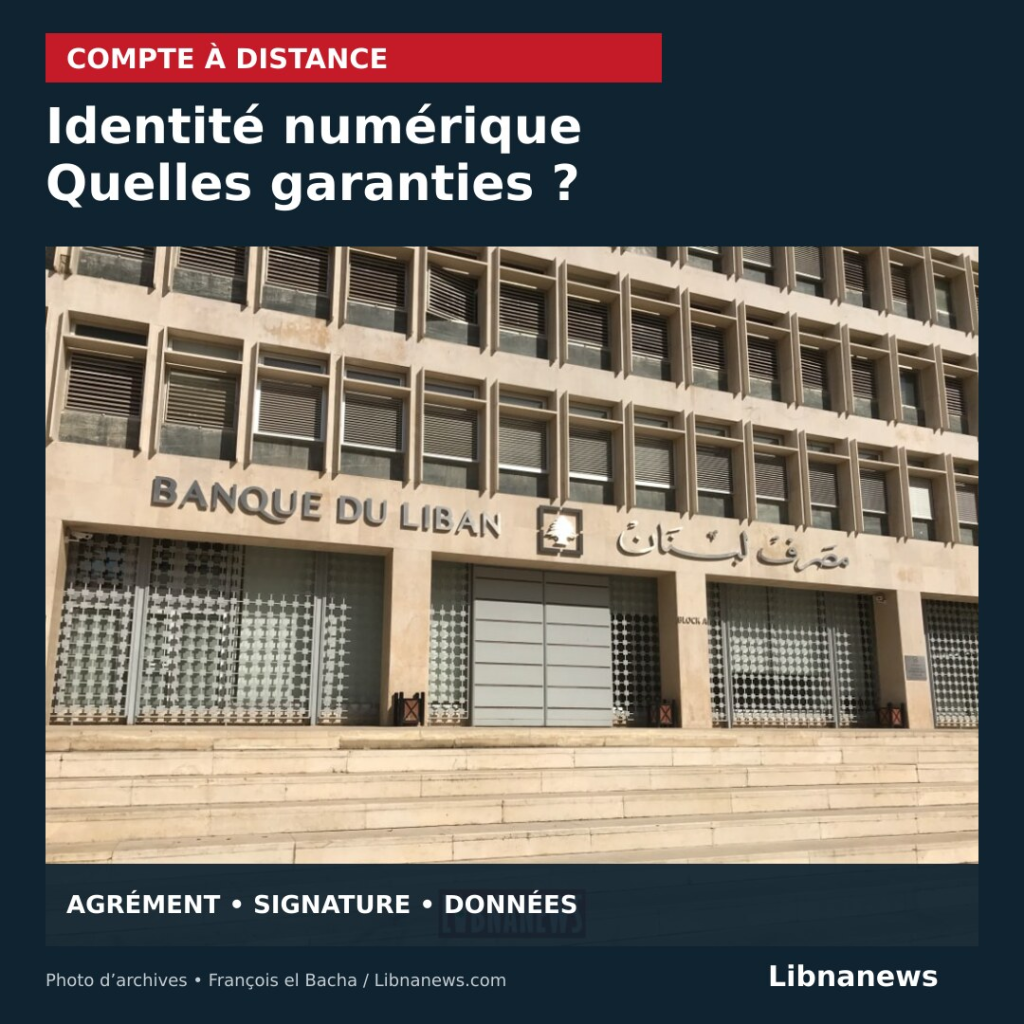
Opening a remote account in Lebanon involves more than just an application and a photo of ID. The revised banking framework on 9 January 2026 requires prior authorisation for the electronic identification of new customers. It also sets requirements for signatures, data and monitoring of operations. The ceiling for payment accounts opened by this method does not constitute an automatic right to a full bank account.
Intermediate Circular 750 replaced the operative articles and annexes on electronic banking and financial transactions. It retains its historical reference, Decision 7548 and Basic Circular 69. Read only its 2000 date would therefore miss the recast of January 2026.
Another decision, 13790 of the same day, organises electronic payment service providers. Both texts complement each other, but their recipients differ. To know the guarantees of a service, it is necessary first to identify the institution that provides it and the legal nature of the account.
Remote account: an approval for the KYC
The KYC refers to the electronic verification of the client’s identity. For banks and financial institutions, its supply requires the prior agreement of the Bank of Lebanon. The techniques, mechanisms and software used must be included in the file submitted to that authority.
Electronic transactions not requiring prior authorisation are subject to notification to the BDL. The electronic money service of financial institutions remains subject, like the KYC, to a specific authorisation. The text provides for 90 days before the launch or promotion of the service concerned. Therefore, the KYC is not a mere trade declaration. A bank cannot present the download of its application as sufficient proof of authorisation of this procedure.
Institutions must post the BDL licence number on their site and application. This indication helps to identify the claimant. It does not exempt it from reading the conditions of the proposed product or checking which service the approval covers.
What the $10,000 threshold means
Article 4 allows banks and financial institutions to accommodate new customers by e-KYC form. It is intended to open payment accounts with a value not exceeding $10,000, as well as the banking and financial transactions concerned, as appropriate and under authority.
This amount should not be converted into a universal ceiling for all digital accounts. The text describes a specific procedure and product. It also provides that the BDL may exceptionally accept a higher ceiling for a bank. This exception requires a reasoned request from the establishment and approval: it is not acquired by each user.
| Element | Rule to be retained |
|---|---|
| Newly identified customer | Physical person in Article 4 device |
| Payment account opened by e-KYC | Value not exceeding $10,000 in the framework described |
| Higher banking ceiling | Exceptional approval on reasoned request |
| Updating an existing folder | The e-KYC form may also renew or modify the KYC |
The Regulation does not promise acceptance of each application. Compliance checks remain applicable. For a minor or private person with full contractual capacity, the intervention of the legal representative remains required.
Identity must be verified and followed
The procedure must apply enhanced vigilance to identification and verification. It must also include appropriate digital identity systems and a ranking of customers according to their level of risk. The form therefore does not replace the analysis of the file.
Control continues after opening. Electronic transactions must be monitored, particularly in the fight against money laundering and the financing of terrorism. The ceilings themselves may indicate risks to be taken into account. The absence of travel to an agency does not mean the absence of proofs or checks.
The establishment must promptly notify the client of the details of an operation performed. The text provides for an application notification, email or SMS. It also requires, where necessary, a detailed monthly electronic record of transactions. These traces allow to reconcile a requested action, its execution and the transaction entered in the account.
The signature is not limited to the code received
The device recognizes the single-use password, or OTP, as the customer’s electronic signature. But this provision is in a set of cumulative conditions. Client consent to the associated risks must be obtained, and adequate security measures must be applied.
The signature must be uniquely linked to the signatory and allow its identification. The data used to create it must remain under its control. Any subsequent change in signed data must be detectable. A code received on the phone does not therefore allow these other guarantees to be considered optional.
Data hosted in Lebanon
The banks and financial institutions concerned must keep data on clients and transactions carried out in Lebanon. The text had given them six months to comply with this local accommodation requirement. This transition period should not be confused with permanent permission to store folders anywhere.
Access to personal data must remain limited to professional needs. When a third party intervenes for their treatment, the customer must be informed and give explicit and written consent for defined purposes. The contract must govern the use and protection of data. The bank or financial institution retains its responsibility to the customer.
Finally, the Regulation provides for a detailed customer protection policy. It must specify the confidentiality measures, the categories of fees and commissions, and the dispute resolution mechanism. The customer must be able to identify the service responsible for receiving a complaint.
A payment portfolio has its own status
In the case of providers covered by Decision 13790, the payment account is used exclusively for the execution of payments. The text explicitly distinguishes it from a deposit account, including savings. It states that its user does not benefit from the scheme of the National Deposit Guarantee Institute on this account.
This distinction prohibits the promise of equal protection to all balances visible on an application. Before a remote opening, the service documents must identify the provider, the account category, the usage limits, the fees and the interlocutor responsible for the disputes.





Comments