

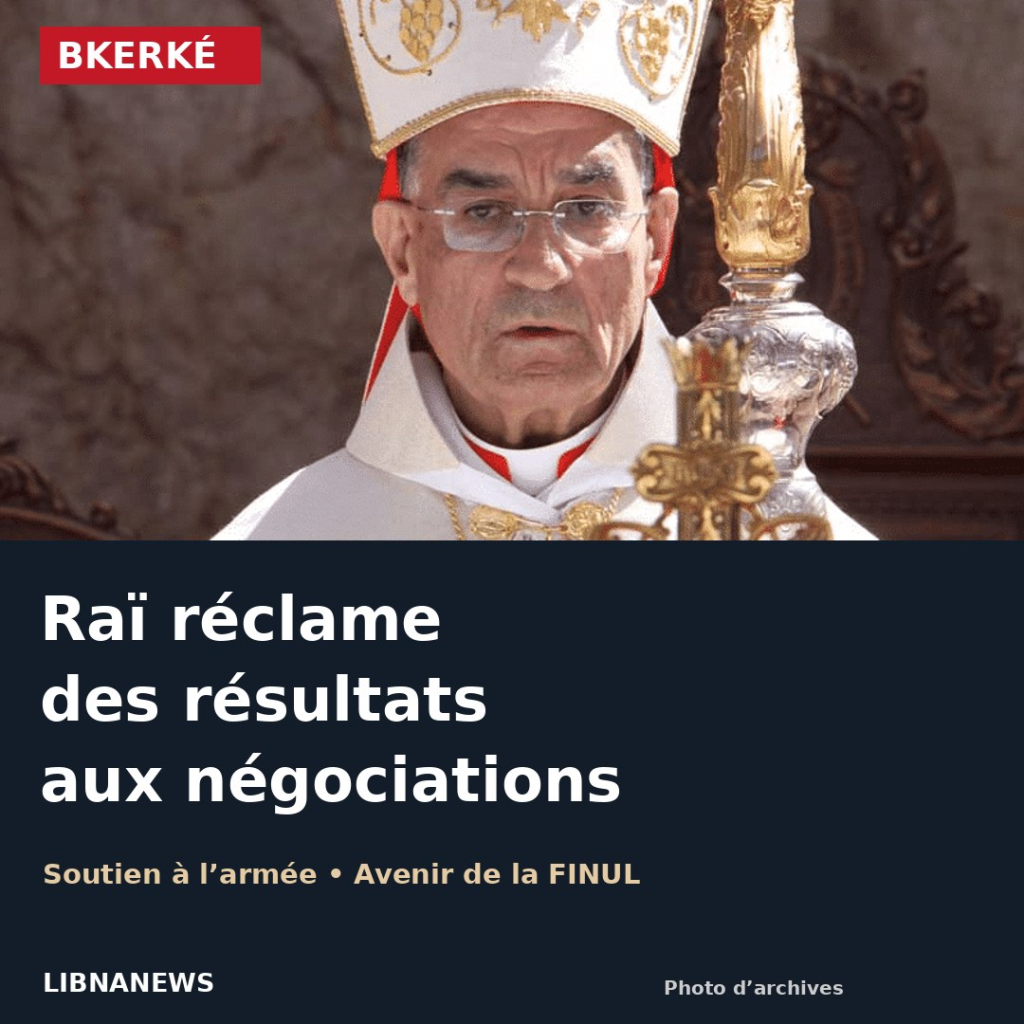
Maronite Patriarch Béchara Rai asked Bkerké on Sunday 15 November that the negotiations produce concrete results for southern Lebanon. In his homily, he associated the search for lasting peace with support for the army and a single national authority. He also defended the rights of applicants and called for preserving the functioning of the institutions.
Rai asks for results from the negotiations
The cardinal feared an extended Israeli settlement in certain areas of the South. It expresses its concern at the continuing Israeli military strikes and movements. His speech describes a political fear; It does not announce a new territorial agreement.
For Rai, the succession of diplomatic meetings is not enough. Their record must be measured by the cessation of attacks, the protection of the South and a stability that permanently distances the country from war. He refused to allow the Lebanese to remain between periods of crisis and fear of a new conflict.
The patriarch linked this requirement to the control of arms and the decision of war and peace. In his view, only one security authority should replace the dispersal of decisions that committed national destiny.
Army facing the risk of emptiness in the South
Rai is concerned about the consequences of a security vacuum related to the withdrawal of UNIFIL. It calls for a national rally around the army and calls on the actors concerned to strengthen its capabilities. His appeal concerns the means necessary to fulfil his missions, without announcing any new funding.
It also welcomes the role of the army, security forces and justice in protecting the country’s borders and interior. He cited smuggling attempts, irregular entry and the circulation of weapons as threats that required more control.
This intervention occurred two days after the final communiqué of the Council of Patriarchs and Catholic Bishops, meeting in Bkerké from November 9-13. The Council had supported the government’s negotiations, called for Israeli withdrawal and defended the monopoly of arms by legitimate forces. He had also announced an initiative to assist border villages, followed by a commission chaired by Bishop Elias Nassar.
Banking reform: protecting depositors
At the domestic level, the patriarch places financial and banking reform among national emergencies. He called for the transfer of promises to their implementation in order to restore confidence and preserve the rights of applicants. He refused to allow citizens to bear again the cost of crises for which they were not responsible.
Rai also insists on the continuity of the state. The diversity of opinions is legitimate, but it must not lead to institutional deadlock. It distinguishes between political cases, which must be dealt with in institutions, and judicial cases, which are the responsibility of the judiciary. His homily does not detail any bank repayment arrangements or new court decisions.





Comments