

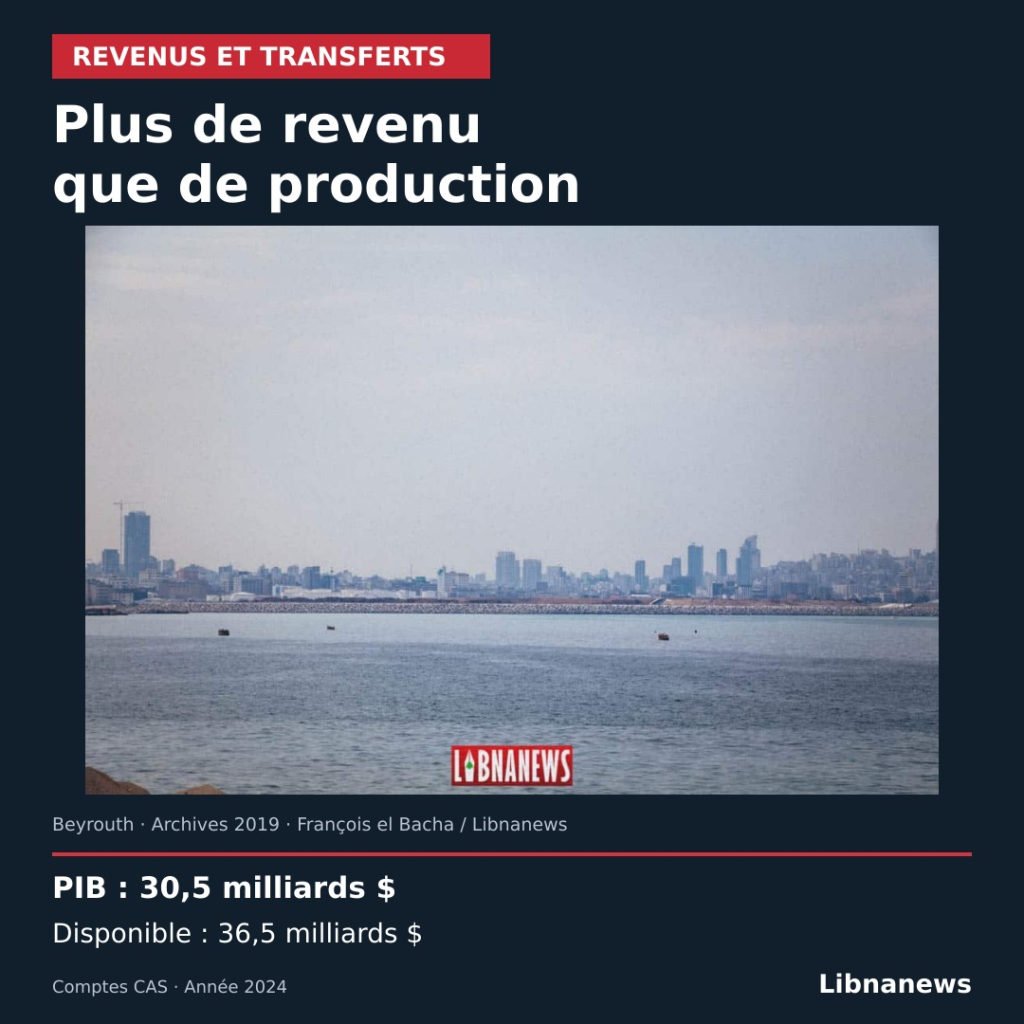
Lebanese domestic disposable income reached $36.5 billion in 2024, while GDP stood at $30.5 billion. The revised accounts of the Central Statistical Office (CAS) show a gap of approximately $6 billion between available resources and domestic production. Current transfers received from abroad, minus those paid abroad, account for most of this difference.
This result does not mean that the country has produced $36.5 billion in goods and services. Nor does it represent income directly received by households alone. Three aggregates must be distinguished: gross domestic product, gross national income and gross national disposable income. Each adds a different stage to the economic circuit.
Lebanese National Disposable Income: The Transition from GDP to Income
GDP measures the value added created by resident producers, with the necessary adjustments to market prices. In 2024, it reached 2,728,402 billion pounds in the CAS accounts. The report converts it to $30.5 billion at this year’s weighted average annual rate.
Gross national income adds primary income received from non-residents and subtracts those paid to them. Such income includes interest, dividends and remuneration in economic relations with the rest of the world. The Lebanese balance was negative in 2024: £20,864 billion.
Gross national income is therefore slightly below GDP, at £2,707,538 billion, or $30.3 billion, according to the report. A country may produce a value in its territory that is not fully attributable to its residents. It can also receive income from production abroad.
| Aggregate or adjusted in 2024 | Billion pounds | Billion dollars, about |
|---|---|---|
| GDP | 2 728 402 | 30.5 |
| Net primary external income | -20 864 | -0.23 |
| Gross national income | 2,707,538 | 30.3 |
| Net external current transfers | 560 079 | 6.26 |
| Gross national disposable income | 3,267,617 | 36.5 |
The dollar amounts of both adjustments are calculated with the CAS rate of £89,474.5 per dollar. The aggregates are rounded to one decimal place in the publication. Accounting identity is verified with the amounts in books, before rounding.
Transfers add resources without local production
The final step adds to gross national income net current transfers from the rest of the world. By 2024, they reached £560,079 billion, or about $6.26 billion. Payments received are reduced by transfers sent by residents abroad.
The CAS underlines the role of shipments of Lebanese expatriates and other current transfers. However, the gap cannot be attributed in full to diaspora shipments. The position is wider, and it is net. It therefore does not correspond to the gross total of all amounts received by families.
The difference between disposable income and GDP is £539,215 billion, or about $6.03 billion. It is lower than net transfers, as the primary income balance is negative. National disposable income thus exceeds GDP by around 19.8 per cent.
Gross flows not to be added to net balances
A fund entry figure describes the amounts received. A net balance subtracts the corresponding outflows. Adding the gross amount of remittances to disposable income that already incorporates net transfers would result in a two-fold proportion of resources.
Transfer company statistics do not necessarily cover all channels. They may also use different categories and periods. The table of national accounts is therefore not replaced by the sum of some commercial data on transfer operators.
The CAS states that primary income and current external transfers are derived from the Bank of Lebanon balance of payments statistics. Coherence of perimeters is as important as amounts. An annual series must not be compared directly with a total of nine months.
Disposable income is not that of each household
The aggregate covers the whole economy. It measures the resources available for final consumption and gross savings. It does not provide information on their distribution between households, businesses and administrations, or on the differences between families receiving or not receiving transfers.
An increase in the total can therefore coexist with strong individual difficulties. The standard of living of households would require sector accounts and surveys of income, consumption and distribution. The national amount is not sufficient to measure poverty or median income.
Divide this $36.5 billion by an unestablished current population figure would add another fragility. The reference population must correspond to the territory, economic residence and year studied. Without these conditions, an amount per capita would be misleading.
A nominal increase that does not measure purchasing power
National disposable income rose from £2,769,476 billion in 2023 to £3,267,617 billion in 2024, a nominal increase of 18.0%. Net transfers increased by 7.7% in current books. These variations are not real growth rates of purchasing power.
GDP fell by 5.2% in volume in 2024 despite its nominal increase. This coexistence reminds us that production, prices and transfers play different roles. The available accounts establish the external contribution to national resources; A measure of its effect on living conditions now requires appropriate price and distribution data.





Comments