

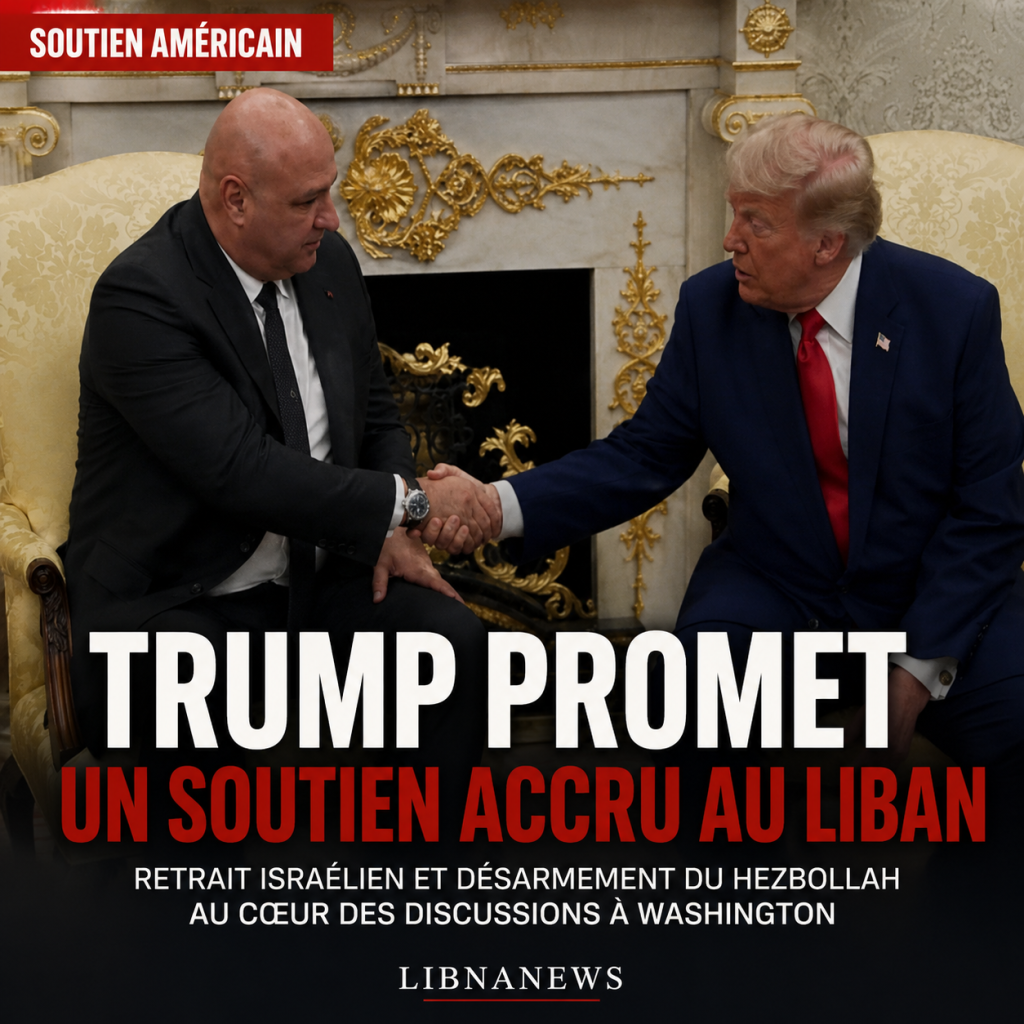
The meeting between Donald Trump and Joseph Aoun at the White House placed Lebanon at the heart of a diplomatic sequence dominated by the Israeli withdrawal from the South, the disarmament of Hezbollah and the strengthening of the Lebanese army. In welcoming his counterpart, the U.S. President promised that the United States would greatly assist Lebanon and treat it « in an appropriate and respectful manner. » He praised the quality of the bilateral relationship, described the Lebanese as « remarkable and educated », and then claimed that the country had been mistreated for a long time. Behind these favourable statements, however, Donald Trump set a clear political framework: Washington now considers the Lebanese issue through the reduction of Hezbollah’s military influence, the implementation of the agreement with Israel and the State’s ability to regain exclusive control of its territory.
Donald Trump promises to help Lebanon largely
Donald Trump assured that his administration had several plans to support the Lebanese army and that he would discuss with Joseph Aoun how to help the country. However, he did not announce in his public statements any specific amounts, timetable or new programme immediately released. The promise therefore remains political before being budgetary. It comes at a time when the Lebanese armed forces must expand their presence in the South, secure destroyed villages, inspect areas evacuated by Israel and regain control of areas where armed non-State actors have long maintained influence. For several months, Beirut has been seeking support in equipment, training, intelligence, demining and logistical capabilities. The White House presents this aid as one of the pillars of the new security order envisaged for Lebanon, but the details still need to be negotiated.
The U.S. President also insisted on the respect accorded to Joseph Aoun, former commander of the army who became Head of State. This focus is not secondary. Washington wants to build on a Lebanese presidency capable of presenting the army as the central institution of national sovereignty. The visit came as Joseph Aoun sought to transform American diplomatic support into concrete results: Israeli withdrawal, border stabilization, financing reconstruction and institution-building. Donald Trump said that several problems concerning Lebanon could be solved and that some had already been solved. This statement refers in particular to the launching of pilot zones in the South and the beginning of Lebanese redeployment. However, it does not mean that critical files are resolved. Israeli fire reported near Lebanese units in Zutr al-Gharbiyah shows, on the contrary, that the application on the ground remains fragile.
Israeli withdrawal presented as engaged
Donald Trump claimed that the Israeli army was « retiring from the South. » This statement is one of the most important messages of the meeting, as withdrawal is the main Lebanese demand. Beirut regards the Israeli presence as an occupation and calls for the complete departure of forces deployed in its territory. Washington supports a gradual process, based on pilot areas where the Lebanese army must enter after the Israeli redeployment. The mechanism started in Fron, Srifa and Zutr al-Gharbiyah, but has not yet produced a full withdrawal. Israel maintains positions, strike capacity and control over several axes. Donald Trump’s formulation therefore seeks to present the movement as engaged, without establishing that it is completed. For Joseph Aoun, the challenge is to obtain a verifiable timetable and prevent a partial withdrawal from becoming a lasting military presence in another form.
The visit took place as the Lebanese army began its deployment to Zutr al-Gharbiyah. On the same day, his command accused Israeli forces of having opened fire near his units. This incident gives a more concrete reading of the difficulties hidden behind the US presidential announcement. A withdrawal cannot be considered effective if Lebanese soldiers remain exposed to Israeli fire when they take up positions in an evacuated locality. Nor can it produce a safe return of the inhabitants if the neighbouring roads remain under threat. The contrast between the White House speech and the facts reported in South Lebanon places Washington in front of an obligation of result. The United States has sponsored the agreement and supports its implementation. They will therefore have to determine whether Israel really respects the agreed sequences and what guarantees will be imposed for the future.
Hezbollah at the centre of statements
Donald Trump presented Hezbollah as Lebanon’s main problem. He claimed that his administration had carried out an action whose effects the world would see, without publicly detailing the exact nature of the operation. This formulation is part of the American line: Washington classifies Hezbollah as a terrorist organization, considers its arsenal incompatible with the sovereignty of the Lebanese State and supports its disarmament. The US President also suggested that Joseph Aoun could act against the movement. He recalled the Lebanese President’s military past and compared it to Syrian President Ahmad al-Shareh, whom he credited with reuniting Syria. This comparison is politically sensitive in Lebanon, where any Syrian involvement in security matters awakens the memory of decades of guardianship and military presence.
The most unexpected statement concerns the possibility of direct contact with Hezbollah. Donald Trump said he would talk to the movement if Joseph Aoun asked him. Such an opening does not mean that a channel already exists or that Washington would change its classification of the group. It shows, however, that the US President wants to retain a personal margin of manoeuvre in the negotiations. For Beirut, a possible dialogue could be aimed at avoiding internal confrontation and achieving progressive disarmament. It could also provoke strong resistance in the United States, Israel and part of the Lebanese political class. No mechanism was announced. It is therefore impossible to know whether this sentence constitutes a real offer, a tactical message to Hezbollah or an improvised response to a press question.
Joseph Aoun expected on the weapons file
The Lebanese president arrived in Washington with a dossier focused on restoring state authority. According to a number of consistent press reports, he was to present a detailed proposal concerning the dismantling of the Hezbollah arsenal and the deployment of the army in areas taken over by Israel. The plan is based on a gradual logic. The Israeli army withdraws from an area, Lebanese forces enter, non-State military infrastructure is dismantled and civilians return and reconstruction begins. This sequence aims to avoid a general confrontation between the army and Hezbollah. It also seeks to convince Israel that its withdrawal will not be followed by a return of the movement to the same positions. However, its success depends on political guarantees, military resources and external financial support that Lebanon does not yet have.
Joseph Aoun’s position remains delicate. It must meet American expectations without appearing to be running a program dictated by Washington or Israel. It must also maintain the cohesion of the army, preserve internal stability and avoid denominational confrontation. Hezbollah maintains an important social, political and institutional base despite the military casualties. His disarmament cannot therefore be treated as a mere police operation. It involves negotiations on security in the South, political representation of the Shiite community, national defence and relations with Iran. The White House insists on the final result, but the method remains largely Lebanese. Joseph Aoun must obtain visible Israeli concessions in order to show that the strengthening of the State also produces the end of the occupation and not only new obligations imposed on Beirut.
Nabih Berri presented as a possible partner
When questioned about Nabih Berri, Donald Trump described the Speaker of Parliament as « good person » and felt that he would join the process when he saw the progress made. This declaration is aimed at a central player in the Lebanese political system. Nabih Berri leads the Amal movement, presides over Parliament since 1992 and maintains a decisive influence in the Shiite community. It regularly acts as an intermediary in sensitive negotiations related to Hezbollah, the border and institutional arrangements. By presenting him as a potential partner, Trump seems to seek to broaden the political base of the American project. It implicitly recognizes that no lasting agreement on arms and the South can be implemented without the participation, or at least neutrality, of the main Shiite representatives. Nabih Berri’s reaction to this statement will therefore be carefully followed.
However, the American formula remains ambiguous. It can be interpreted as an attempt to dissociate Nabih Berri from Hezbollah, or as an invitation to accompany a compromise before decisions are taken without him. The President of Parliament has often defended an approach based on internal consensus and Israel’s prior withdrawal. It could hardly support a timetable perceived as unilateral or as a threat to part of the population. On the other hand, concrete progress on withdrawal, prisoners, occupied villages and reconstruction could provide a negotiating space. Donald Trump seems to be betting on this dynamic. However, his statement does not prove that an agreement has already been reached. It reveals above all that Washington regards Nabih Berri as an indispensable interlocutor in any security transition.
Strong expectations around the Lebanese army
Support for the Lebanese army is one of the main concrete points raised by Donald Trump. The U.S. president spoke of « many plans, » without detailing the content. However, the needs are clearly identified. The army must deploy more soldiers south of the Litani, monitor borders, dismantle military infrastructure, secure villages and protect return routes. It must carry out those missions with limited resources, in a country always marked by the financial crisis. Wages, fuel, spare parts, armoured vehicles, communications and engineering equipment remain at the centre of Lebanese demands. Washington is already providing significant assistance to the military institution, but the new phase requires a broader effort. Without sustainable funding, the army may be given responsibilities that it cannot fully exercise.
American aid also raises the question of political conditions. The United States wants to ensure that sustained units respond to the official chain of command and participate in the reduction of Hezbollah’s influence. Some U.S. officials are considering enhanced selection, training and equipment for certain units. Such an approach may improve operational efficiency, but it may also create perceptions of foreign patronage or guardianship. The Lebanese army must preserve its unity and image as a national institution. Joseph Aoun personally knows these constraints for leading the institution before his election. He must convince Donald Trump that support must strengthen the entire army, without locking him in a mission exclusively directed against a Lebanese component, while it must also protect the territory against Israel and maintain internal stability.
Economic aid still without figures
Public statements focused on security, but the visit also concerned the economy and reconstruction. Lebanon continues to face a prolonged financial crisis, the collapse of its public services and the destruction caused by the fighting. Donald Trump promised significant aid without specifying whether it would take the form of military assistance, budget support, private investment or multilateral financing. The needs are considerable. Villages in the South must be cleared, water and electricity networks repaired, schools reopened and housing rebuilt. A general promise will not be enough to transform the situation. Beirut awaits quantified commitments, coordination with donors and guarantees to prevent projects from being interrupted by a new war. The absence of immediate figures requires careful consideration of advertisements.
Washington traditionally links its aid to political and institutional conditions. Banking sector reform, anti-corruption, judicial independence and border control are among the issues monitored by international partners. The announced support could therefore be combined with measurable progress. Joseph Aoun seeks to present Lebanon as a state capable of delivering on his commitments, but he depends on a government, a parliament and often divided administrations. Financing reconstruction will also raise the question of regional distribution and transparency. The settlements near Hezbollah have suffered heavy damage and will need assistance without political discrimination. The credibility of the American promise will be judged on the speed of early funding, the nature of the projects and their ability to improve daily life.
Abraham’s Accords in the background
Donald Trump took the opportunity to recall the success he attributes to the Abraham Accords and predict that new countries would join them. This reference places the Lebanese case in a broader regional strategy of standardization with Israel. However, Lebanon is not in the same position as Arab States that have already signed such agreements. He remains officially in a state of war with Israel, contests the occupation of his territory and brings a dispute related to the destruction, prisoners and violations of his sovereignty. No Lebanese officials announced that they would join soon. The official priority remains the application of withdrawal, border stabilization and reconstruction. The mention of the Abraham Accords can therefore be understood as a long-term American goal rather than as a commitment obtained during the visit.
This perspective raises major internal debates. Some Lebanese officials consider that no normalization can precede a complete solution to the conflict and respect for Palestinian rights. Others believe that a security agreement could gradually pave the way for different relations. The White House seeks to put the pilot zones and the current negotiations in a regional peace dynamic. The Lebanese government must, however, avoid this scoping distracting attention from Israel’s immediate obligations. A diplomatic agreement cannot replace withdrawal of forces, cessation of fire and recognition of Lebanese sovereignty. Beirut’s reaction to Donald Trump’s references will therefore probably be prudent, with priority given to concrete steps rather than to standardisation announcements.
Iran and the Houthis involved in the meeting
The US President has expanded his statements to include Iran, the Houthis and maritime security. He claimed that behind-the-scenes exchanges continued with Tehran, while adopting a very threatening tone. He also stated that the United States was prepared to act against the Houthis again in the event of a threat to Bab al-Mandeb. These comments place Lebanon in the regional confrontation between Washington and Iran-supported axis. Hezbollah is one of Tehran’s main allies and its future depends in part on the evolution of this balance of power. An American-Iranian negotiation could facilitate an arrangement in Lebanon. On the contrary, a further escalation could cause the movement to retain its weapons and expose the country to further confrontation. Joseph Aoun must therefore defend a Lebanese path in a case largely influenced by outside actors.
Some formulations attributed to Donald Trump, including the announcement of an upcoming strike against an Iranian area called « Axe Mountain », still require independent confirmation. They do not appear with the same level of accuracy in all available versions of its statements. Caution is therefore required before presenting them as a formal military commitment. The same principle applies to comments on a possible dialogue with Iran. Donald Trump often alternates threats and tactical openings. For Lebanon, the main question remains whether Washington seeks to isolate Hezbollah solely through pressure or to integrate its disarmament into a broader regional agreement. The meeting with Joseph Aoun did not provide a definitive answer, but it confirms that the Lebanese case can no longer be separated from the confrontation between the United States and Iran.
A visit now judged on results
Joseph Aoun’s visit is the first meeting in the White House of a Lebanese president in many years. It offers Beirut significant diplomatic visibility as the country seeks to emerge from a new war. Donald Trump has multiplied the marks of consideration, assured that Lebanon would be treated with respect and promised to solve several problems. These words create high expectations. They will have to be followed by real pressure on Israel, increased support for the army and resources for reconstruction. Without concrete results, the meeting could be seen as a sequence of communication. The first indicator will be the Israeli withdrawal to the pilot areas. The second will be the protection of Lebanese units. The third will be the financial translation of US commitments.
The next phase will also depend on the Lebanese response. Joseph Aoun will have to present to the institutions and political forces the commitments obtained in Washington. It will need to specify the envisaged timetable for arms control and the guarantees received on the Israeli withdrawal. The government will then have to transform these guidelines into applicable decisions. Donald Trump suggested that he was willing to speak to Hezbollah, associate Nabih Berri and support the army. None of these elements has yet taken the form of a formal mechanism. In the short term, the facts on the ground will therefore remain more important than the statements. Israeli movements in the South, the deployment of the army to Zutr al-Gharbiyah and the reaction of Shiite leaders will show whether the meeting opens a new stage or whether it remains suspended from negotiations that are still unfinished.




