





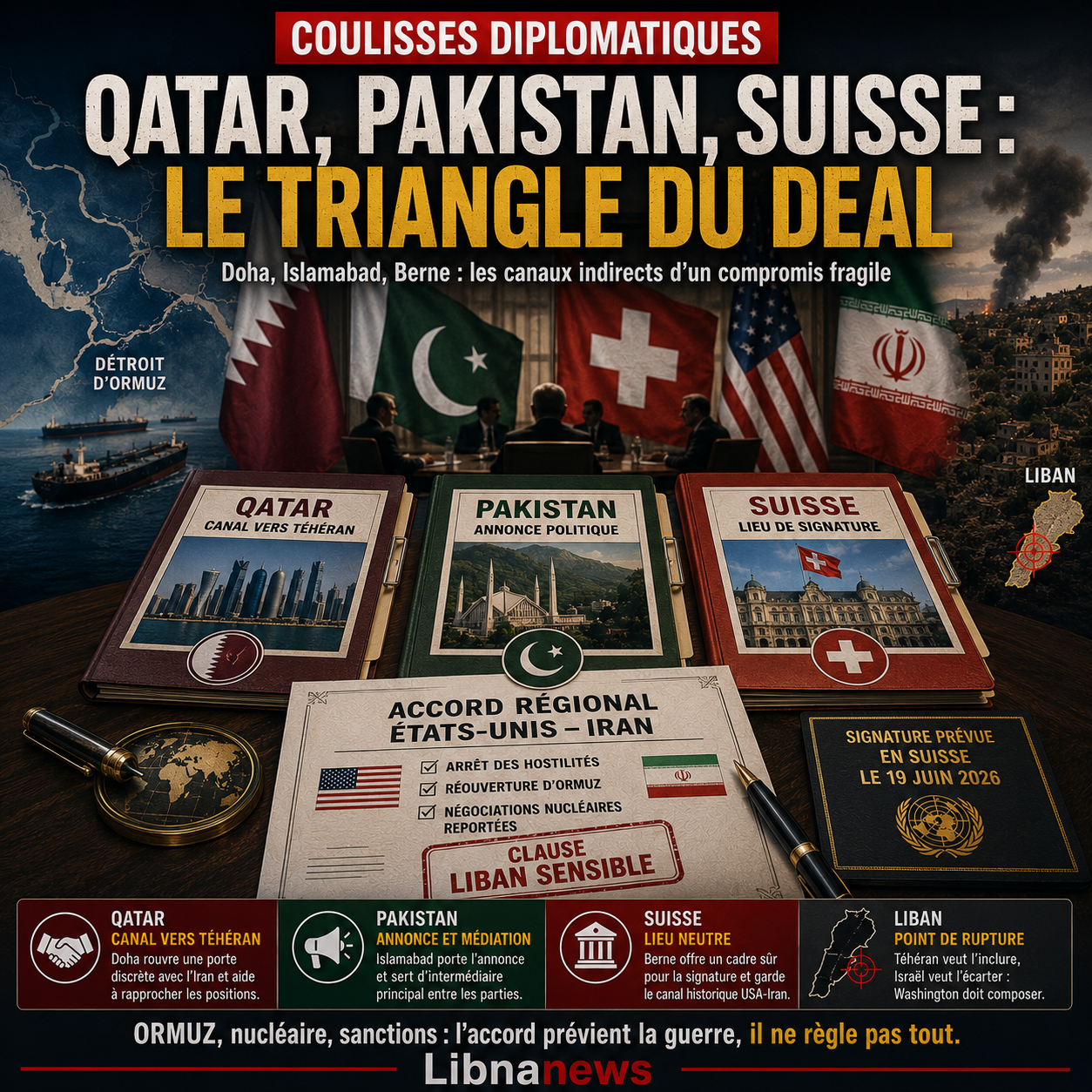
The diplomacy that led to the regional agreement between the United States and Iran did not follow a straight line. It has taken several channels, sometimes visible, often indirect, always fragile. Qatar reopened a door in Tehran. Pakistan assumed the role of advertiser and principal mediator. Switzerland must offer the place of signature, with a special status between Washington and Tehran for more than four decades. Behind these three capitals is a method: to avoid direct negotiation, to limit public humiliation, to preserve the margins of each and to push back the most explosive cases to a later stage. Lebanon remained the sensitive clause. Tehran wanted to include it. Israel wanted to remove it from all restraint. Washington had to deal with both readings.
Doha opens Tehran Gate
The Qatari delegation arrived in Tehran in the final days of the negotiations gave a clear signal. Doha no longer wanted to stay away from a case that directly threatened its energy interests, infrastructure and relationship with Washington. Qatar hosts a major US military presence. It also maintains useful channels with Iran. This dual position makes it valuable when direct trade becomes politically impossible. In the current sequence, it has not replaced Pakistan. He added a channel of proximity, capable of testing formulations, transmitting nuances and maintaining a discussion when the calendar tended.
The Qatari role has evolved in stages. At the beginning of the war, Doha had distanced itself from direct mediation, owing to security risks and attacks on Gulf infrastructure. But the closure of Ormuz, the pressure on liquefied natural gas and the extension of the strikes made this caution costly. A prolonged conflict between Washington and Tehran threatened not only ships and prices, but also Qatar’s regional model, based on the balance between American alliance, mediation diplomacy and autonomy in its contacts with opposing actors. Returning to mediation therefore became a strategic necessity.
Doha was primarily used to work in grey areas. The negotiators needed a formula that would allow Donald Trump to announce the end of the war, in Tehran to say that he did not surrender, and the mediators to avoid a collapse after the Israeli strike on Beirut. Qatar, accustomed to negotiations where every word counts, could help turn incompatible demands into delayed sequences. Stop hostilities first. Re-opening of Ormuz afterwards. Nuclear negotiation later. This architecture bears the mark of emergency diplomacy: it does not solve everything, it prevents the breakup.
Pakistan, Mediator and Advertiser
Pakistan has occupied a more official place. It was by Islamabad that the announcement of the agreement took on a public political form. This position is not accidental. Pakistan shares a border with Iran. He has complex relations with Washington, the Gulf monarchies and several Asian energy-dependent actors in the Middle East. It is also a nuclear power, giving it a special sensitivity to proliferation crises and the risks of military escalation. His mediation thus offered Tehran a less Western channel, and in Washington an intermediary able to speak to Iran without appearing as a mere American relay.
Pakistan’s announcement came out of a calendar problem. Donald Trump wanted a quick signature. Iran wanted to avoid the agreement being presented as a unilateral American victory. Israel was multiplying the signals of refusal, especially on Lebanon. By making known the existence of a text and a signature planned in Switzerland, Islamabad has frozen a dynamic. Once the agreement was announced, it became more difficult for the parties to go back without bearing responsibility. Pakistan’s mediation has turned a fragile project into a diplomatic meeting.
This role also has a regional interest in Islamabad. Pakistan seeks to remain present in the crises of the Middle East without letting itself be trapped in the rivalries between Iran, Saudi Arabia, the United States and Israel. Successful mediation reinforces his image as a Muslim power capable of speaking at several camps. It is also useful to Washington, as the United States seeks to act in areas where its credibility is contested. For Iran, the Pakistani channel offers less symbolically loaded mediation than that of a Western actor. For the Gulf countries, it helps to contain a crisis that directly threatened energy flows.
But Pakistan cannot guarantee the implementation of the text alone. It can announce, transmit and facilitate. It cannot force Israel to withdraw from Lebanon. It cannot impose on Iran a nuclear concession that Tehran refuses. It cannot secure Ormuz without the marines and the authorities directly concerned. His strength is diplomatic, not coercive. This explains why the agreement needs other pillars: Switzerland for the signature framework, the United States for guarantees towards Israel, Iran for its regional allies, and international forces for verification on certain fronts.
Switzerland as a neutral place and historic canal
Switzerland’s choice is based on an old logic. Since 1980, Bern has represented American interests in Iran in the absence of direct diplomatic relations between Washington and Tehran. This protective power mandate has made Switzerland a discreet channel in moments of tension. Even when its embassy in Tehran was forced to restrict or adjust its operation for security reasons, the diplomatic channel remained available. Switzerland therefore offers more than one signature room. It provides a language, procedures, recognized neutrality and administrative memory of Iran-US exchanges.
The place of signature counts because it allows everyone to save face. Washington can say he didn’t go to Tehran. Tehran can say that he did not sign under American tutelage. Ombudsmen can say that the text falls within an international framework, not a bilateral diktat. Switzerland also allows for technical presence, separate consultations, exchange of documents and guarantees of confidentiality. In a negotiation where the slightest public gesture can be exploited by internal oppositions, this neutral decor is not a detail. It protects the shape so that the shape does not cause the bottom to fail.
Switzerland also has an interest in preserving its good offices function. She doesn’t decide the content. It does not guarantee military application. But it gives the parties a known land. In a crisis where the United States hit Iran with Israel, where Iran used Ormuz as a lever, and where Israel refuses any clear limitation in Lebanon, a neutral space reduces the symbolic burden. It is useful to sign a memorandum that remains incomplete but must produce immediate effects. The Swiss signature must therefore be understood as a diplomatic stabilization mechanism, not as evidence that disputes are settled.
Why the United States and Iran go through other
Indirect mediation responds first to the lack of confidence. The United States and Iran do not have normal diplomatic relations. Their confrontation combines sanctions, nuclear, military threats, regional attacks, maritime pressures and ideological rivalries. A direct high-level meeting would have been politically costly for both sides. Trump was accused of legitimizing Tehran after a murderous war. Iranian leaders were reportedly accused of negotiating under pressure from the bombing and blockade. The mediators allow to test concessions without exposing them immediately.
This method also protects negotiators from internal contradictions. In the United States, part of the Republican coalition supports Israel and refuses too fast relief to Iran. Another side rejects long wars and is concerned about inflation. In Iran, hard currents denounce any concession in Washington, while pragmatic leaders want to lift the blockade, recover revenue and avoid a continuation of the war. The mediators then serve as buffers. They allow each party to say that it did not ced directly, but that it accepted a transmitted, adjusted and framed formula.
Indirect negotiation has also facilitated the postponement of the most difficult issues. Iranian nuclear, enriched uranium stockpiles, inspections, missiles and full sanctions are not addressed. They are referred to a later phase. This decision would have been more politically difficult to assume in direct and solemn negotiations. Through mediators, it becomes a sequence: stop the war, reopen Ormuz, and then discuss. The risk is obvious. What is pushed back can come back more violently. But the choice of mediators shows that the urgency was no longer to produce a perfect agreement. It was to prevent an Iranian response and a sustainable energy crisis.
Ormuz, fuel of the diplomatic emergency
The Strait of Ormuz gave this diplomacy its urgency. As long as the passage remained disturbed, the war threatened the world economy. Oil prices, maritime insurance, gas shipments, Asian markets and central banks followed each announcement. The reopening of Ormuz was therefore a shared objective, even by actors who did not share the same understanding of the conflict. The United States wanted to calm down prices. Iran wanted to get the naval blockade lifted and show that it controlled part of the maritime rhythm. The Gulf countries wanted to avoid their infrastructure becoming targets of prolonged war. Europeans demanded free movement without restrictions or tolls.
Qatar and Pakistan understood that the maritime issue could serve as a point of entry. Ormuz did not first require an ideological solution. He required a procedure. Demining, timing, ship security, role of naval forces, insurance, Iranian ports, cargo control. By treating this as a technical emergency, the mediators created a space for political agreement. The promise of reopening gives Trump an immediate benefit. It gives Iran a tangible counterpart. She reassures the markets. But it does not solve the fundamental question: who controls the security of Ormuz if nuclear discussions fail?
This uncertainty explains the prudence of maritime actors. A road does not reopen by press release. The ships are waiting for evidence, the insurers are waiting for a lasting reduction in risk and the shipowners want to know who is responding in case of an incident. The diplomacy of Qatar, Pakistan and Switzerland therefore produced a window. It has not yet restored complete normality. Early passages, demining operations and American decisions on the blockade of Iranian ports will serve as indicators. The success of the agreement will also be measured with real traffic, not only at the signature.
Lebanon as a sensitive clause and breaking point
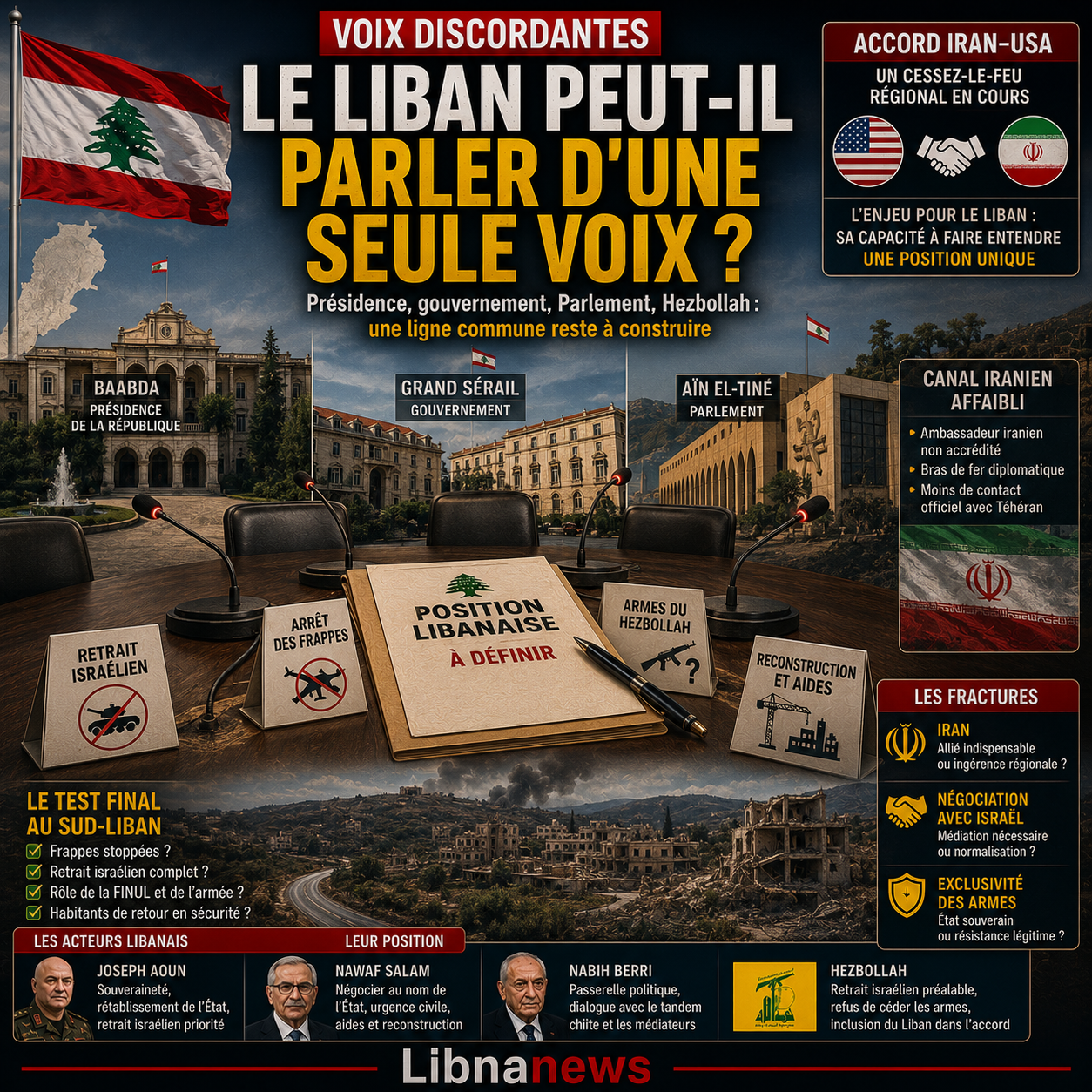
Lebanon remained the most sensitive issue because it hires actors absent from the main table. Iran wanted the Lebanese front to be included in the cessation of hostilities. Without this inclusion, Tehran would have given the impression of protecting Ormuz and its ports while allowing Israel to continue its operations against Hezbollah. Israel, on the contrary, refuses to consider Lebanon a binding part of the deal. His Government stated that it must maintain freedom of action against threats from Hezbollah. This opposition placed Washington in a difficult position. The United States must guarantee Iran a de-escalation large enough to save the deal, without causing a break with Israel.
The Israeli strike on Beirut made this contradiction visible. It showed that the Israeli military calendar could enter into direct conflict with the United States diplomatic calendar. It also gave Iran an argument to threaten to suspend or tighten negotiations. For the mediators, therefore, Lebanon has become a credibility clause. If the strikes continue, Tehran can say that Washington has not fulfilled its commitments. If Israel is forced, Netanyahu will denounce a limitation imposed by an agreement in which his country has not participated. Each formulation on Lebanon is therefore explosive.
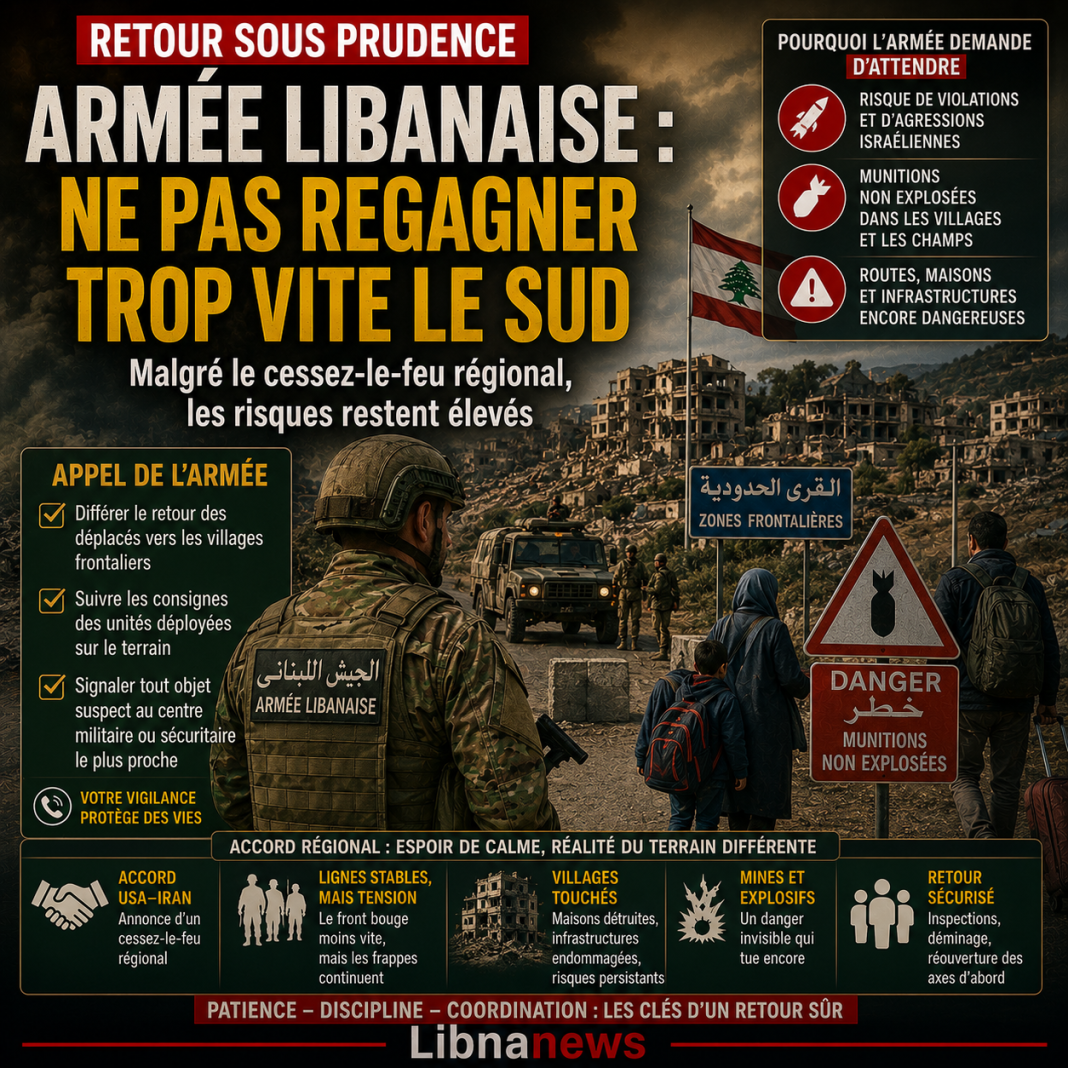
The mediators probably sought a formula broad enough to satisfy Tehran and vague enough not to lock Israel up immediately. This is the type of compromise that allows a signature, but that postpones the real test on the ground. The people of South Lebanon will not judge the role of Qatar, Pakistan or Switzerland in the quality of the text. They will judge him at the halt of the strikes, the Israeli withdrawal, the return of the displaced and the role of the Lebanese army. This is where multi-channel diplomacy becomes a concrete policy, or fails.
A useful diplomacy, but without a single arbitrator
The multiplication of channels has prevented collapse. It can also become a weakness. When several mediators participate, each solves part of the problem, but no one has the entire application. Qatar can speak in Tehran and Washington. Pakistan can carry the announcement. Switzerland can host the signature and transmit messages. Europeans can defend Ormuz, nuclear and Lebanese sovereignty. The United States can weigh on Israel. Iran can weigh on its allies. Lebanon can make its requests. But no actor controls the whole thing.
This absence of a single arbitrator explains why the agreement should be followed by an implementation mechanism. Committees, schedules, lists of violations, military contacts, financial channels and humanitarian channels will be required. Crisis diplomacy produced a text. Postwar diplomacy will have to produce routines. Without these routines, every incident will become a crisis again. A mine in Ormuz, a strike in southern Lebanon, a blockade on sanctions or an Israeli statement may be enough to cause the sequence to wave.
Thus, June 19 in Switzerland will not be the culmination of the diplomatic scenes. It will be their transformation into a public test. Qatar, Pakistan and Switzerland will have helped Washington and Tehran to cross the first door. The next one will be tougher: check that the agreement holds when it leaves the mediation halls for Iranian ports, Ormuz ships, Israeli positions in Lebanon and villages in the south that are still waiting to know if they can return.