

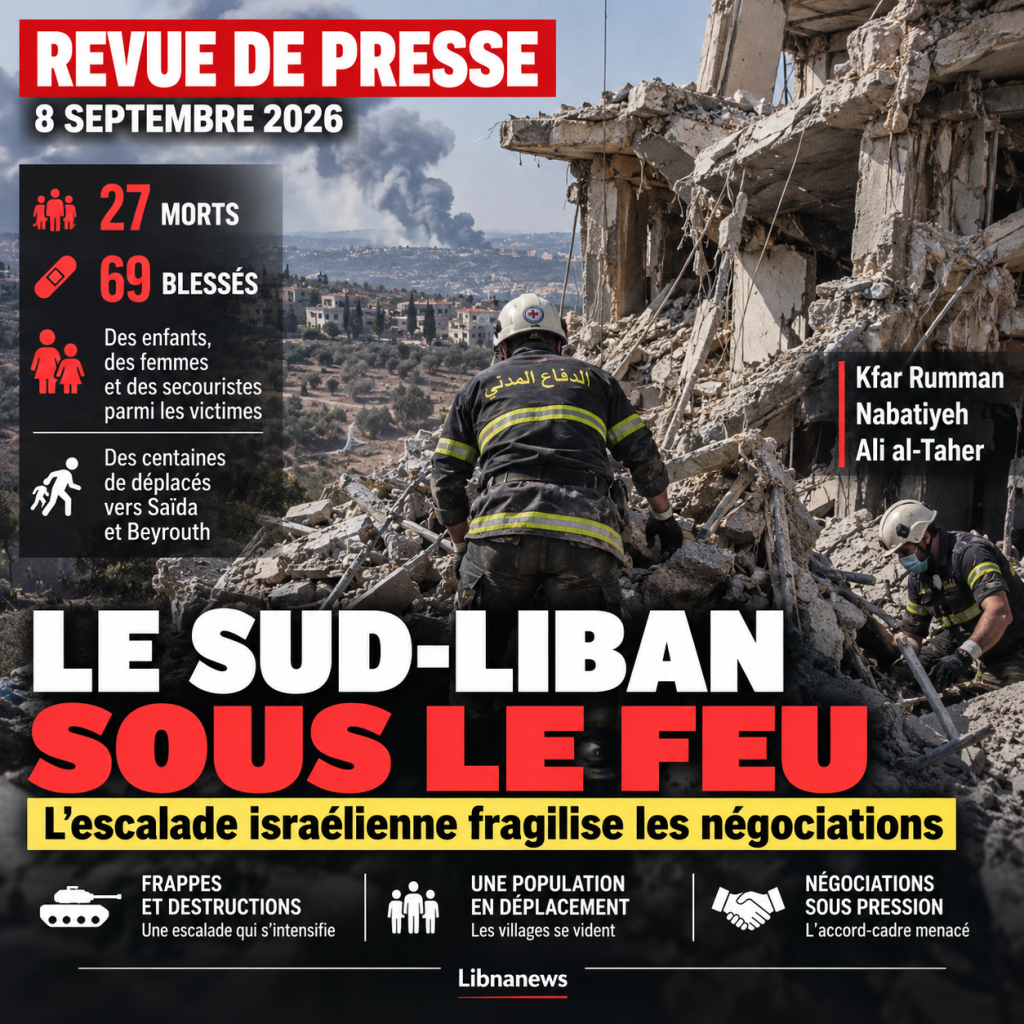
Kfar Rumman and Nabatiyeh in the centre of a new deadly sequence
Military escalation in southern Lebanon dominates the press releases of 8 September 2026. The newspapers converge on the gravity of the open sequence around Nabatiyeh and nearby localities. However, they differ on its causes, its objectives and the room for manoeuvre still available to the Lebanese State and Hezbollah. The human balance sheet is the first common element. Ad Diyar of 8 September 2026 reported 27 Lebanese deaths and 69 injuries in less than three days. Al Joumhouria of 8 September 2026 also recaptures 27 deaths and 69 injuries. The newspaper states that children, women and rescue workers are among the victims. Al Sharq of 8 September 2026 reports the same provisional balance sheet. The strike against Kfar Rumman is central to several titles. Annahar of 8 September 2026 places in a photograph showing a member of the Civil Defence seeking possible survivors in the rubble of a destroyed building. The newspaper describes an attack on a three-storey residential building and reports the deaths of several civilians, including infants. He also mentions the death of two Al Risala relief workers in another strike against a vehicle. Al Quds Al Arabi of 8 September 2026 also describes a « bloody night » and insists on strikes against residential buildings, rescue workers and children. Al Sharq of 8 September 2026 reports a series of bombings against Kfar Rumman, Nabatiyah al-Fawqa, Arabsalim and other parts of the South. Operations are not limited to air strikes. Several newspapers mention artillery fire, house destruction, ground explosions and evacuation warnings. Al Joumhouria of 8 September 2026 highlights the extent of population displacement to Saida and Beirut. Annahar of 8 September 2026 also evokes an important departure movement from the villages of Nabatiyah District. This evolution gives the crisis a dimension that now exceeds the military confrontation alone. It directly affects the inhabitants’ presence in their villages and feeds questions about the future of the entire border area.
After Ali al-Taher, fear of an extension to Nabatiyah
The heights of Ali al-Taher are the second leading thread of September 8, 2026. It is presented in several publications as a change in the nature of the balance of power in the South. Annahar of 8 September 2026 directly expresses the main concern: Nabatiyeh may experience a fate comparable to that of Ali al-Taher. The newspaper estimates that the operations carried out for several days resemble a low-intensity war that now focuses on Nabatiyeh, its caza and surrounding localities. He also reported discussions on a possible change in the Israeli regime in the South. A new area, called « grey », could replace the current arrangement. According to information reported by Annahar, this band is said to have a depth of two to four kilometres inside Lebanese territory. Such a configuration would prevent the inhabitants of several border villages from normally returning to their localities. Al Joumhouria of 8 September 2026 is also interested in this hypothesis. The newspaper notes that the multiplication of names does not change the substance of the problem. Whether it is a yellow, green or grey area, the subject remains that of maintaining an Israeli military presence on part of Lebanese territory. Al Liwaa of 8 September 2026 adopts a more severe reading of the loss of Ali al-Taher. The newspaper considers the height as a position of significant military value and considers that its loss is part of a series of setbacks recorded in the South. Al Akhbar of 8 September 2026 proposes a very different reading. The newspaper places Israeli operations in a strategy aimed at regaining a military freedom that the new regional rules would have limited. According to this analysis, Israel would seek less to occupy large territories immediately than to restore a principle: to be able to strike any objective it considers a threat. However, the different readings lead to a common question. The debate no longer concerns only a few military positions. It now concerns the depth of the Israeli system, the possibility of an extension of operations and the risk of a lasting transformation of the security geography of the South.
Hezbollah between military restraint and risk of erosion of deterrence
Hezbollah’s reaction is at the heart of the analysis. Ad Diyar of 8 September 2026 considers that the movement so far practiced a form of restraint calculated. According to the newspaper, this attitude aims to avoid providing Benjamin Netanyahu with the necessary pretext to expand the war. Ad Diyar reports that an officer close to Hezbollah presents this conduct as a form of strategic patience designed to protect the people of the South from massive displacement and further destruction. But the paper also highlights the risk inherent in this strategy. A prolonged lack of response could encourage Israel to increase pressure. Another article by Ad Diyar therefore raises the question of the moment, form and level of a possible response. Hezbollah should maintain a deterrent capacity without causing a general war. Al Akhbar of 8 September 2026 develops a similar analysis of the dilemma, while giving more weight to the regional dimension. The newspaper believes that Netanyahu could seek to provoke a Hezbollah reaction in order to create the conditions for a wider confrontation involving Iran. In this reading, Lebanon becomes a means of action in the confrontation between Israel, the United States and Iran. Al Jumhouria of 8 September 2026 reports the Israeli version that two drone bombs were allegedly launched against Israeli forces in the Ali al-Taher area. The Israeli army presented its subsequent strikes as a response to this operation. The newspaper also reports Israeli reports that Hezbollah would continue to collect information on Israeli military positions and methods. These claims are attributed by publications to the Israeli army and media and are not independently established in Lebanese sources. The essential question therefore remains that of the threshold. As Israeli strikes intensify, the political and military cost of restraint increases for Hezbollah. But a larger response could open up precisely the sequence that the movement seeks to avoid.
Netanyahu, the Israeli elections and the hypothesis of a calculated escalation
Several publications place Benjamin Netanyahu’s electoral calculations at the forefront of possible explanations for escalation. Ad Diyar of 8 September 2026 considers that the Israeli Prime Minister uses the war to strengthen his position before the elections. The newspaper believes that operations in the South can strengthen its image as a security leader and push Hezbollah into a response that would justify a broader campaign. Al Jumhouria of 8 September 2026 reported the concerns of a European diplomat about a possible link between military intensification and the Israeli elections scheduled for late October. According to this source quoted by the newspaper, the lack of real limits to climbing is the main cause of concern. The same daily newspaper recalls that the weeks preceding the election may be particularly sensitive for Lebanon. Annahar of 8 September 2026 also links the military sequence with Israeli calculations, but insists more on possible territorial consequences. Al Akhbar of 8 September 2026 pushes the analysis further. For the newspaper, Netanyahu faces two simultaneous constraints: a difficult electoral battle and the failure of the strategy to bring about regime change in Iran. He would therefore seek to recover a military margin of manoeuvre. The journal examines two possible objectives. The first would be to train Iran into a new confrontation through the Lebanese front. The second would be to obtain from the United States the lasting recognition of Israeli freedom of action in Lebanon. Ad Diyar of 8 September 2026 also refers to an Israeli military exercise simulating a conflict on several fronts, including Lebanon, Gaza and Iran. The newspaper sees this as an indication of the preparations for a possible extension of the war. None of these elements alone can establish that a general war is decided. They show, on the other hand, why the daily press considers the Israeli pre-election period as an additional factor of instability.
The framework agreement subject to field testing
The other major issue of this one concerns the survival of the diplomatic process. President Joseph Aoun is central to the proceedings. Ad Diyar of 8 September 2026 reports that he considers the Israeli attacks, the death of women and children, and the destruction of houses as condemnable acts that directly threaten the framework agreement. Al Joumhouria of 8 September 2026 takes up the same position. Joseph Aoun stated that Lebanon would continue to favour the diplomatic route and called on Israel to respect the agreement it had signed. Annahar of 8 September 2026, however, underlines the growing contradiction between this will and the situation on the ground. The newspaper believes that the waves of strikes raise new questions about the ability of negotiations to produce results. Al Sharq of 8 September 2026 reports that the Lebanese authorities continue to regard the negotiation as the only way currently available. Former Deputy Prime Minister Elias Murr said that Lebanon’s continued presence at the discussion table was essential for the preparation of future regional arrangements. But the information published by several newspapers shows that the next step remains uncertain. Al Joumhouria of 8 September 2026 indicates that no definitive confirmation has yet been given for a new meeting in Rome. The daily added that the attacks on Arabsalim and Kfar Rumman could themselves have an impact on the calendar. Annahar of 8 September 2026 nevertheless reports diplomatic reports of a possible new sequence of discussions after the Jewish holidays, with a separation between political and military aspects. The political side could be held in Rome or Jordan, while military discussions could take place in the United States. However, this information is not yet an official announcement common to the parties.
Washington under pressure and Paris mobilized on post-UNIFIL
The place of the United States is also contested in the newspapers. Ad Diyar of 8 September 2026 considers that Washington retains a capacity to limit Netanyahu’s ambitions, but wonders about the duration of this restraint. The newspaper also reports that American attention is absorbed by confrontation with Iran and the crisis around the Strait of Ormuz. This would reduce the pressure on Israel in the Lebanese case. Al Joumhouria of 8 September 2026 quotes a European diplomat who believes that Washington has the necessary means to stop the escalation. The problem would therefore be less one of its ability than of its willingness to use it. Al Akhbar of 8 September 2026 is much more critical of the strategy followed by the Lebanese authorities. The newspaper believes that the presidency and the government rely excessively on the United States to contain Israel. He also reported the discontent of the head of the Lebanese negotiating delegation with Israeli refusals to Lebanese proposals. At the same time, France is increasing its activity. Several newspapers on 8 September 2026 reported on the visit to Lebanon of French Justice Minister Gérald Darmanin. His meetings with Joseph Aoun, Nabih Berri, Nawaf Salam and the army command focused on judicial cooperation, reforms, the South and the future of the international presence. Joseph Aoun reaffirmed his support for maintaining an international presence and welcomed the Franco-Italian idea of a European force that could avoid a vacuum after UNIFIL. The preparation of a meeting in Paris to support the army and the Internal Security Forces is therefore of new importance. The military record, negotiations and the future of the international machinery are becoming three dimensions of the same crisis.
A military battle that becomes a battle over the future of the South
Beyond editorial differences, the September 8, 2026 editions show a transformation of the debate. The question is no longer just when the strikes will stop. It now focuses on the territorial and security configuration that could emerge. Al Binaa of 8 September 2026 insists on the need to question the choices of the State in the face of Israeli negotiations and demands. Al Liwaa of 8 September 2026 asks whether the loss of Ali al-Taher and the pressure on Nabatiyah will force the authorities to reconsider their approach. Annahar of 8 September 2026 looks at the consequences that a band of two to four kilometres would have on the border villages and their inhabitants. Al Joumhouria of 8 September 2026 warns against a situation in which names would change while the Israeli military presence would remain. Al Akhbar of 8 September 2026 finally believes that the Israeli objective could be to regain a permanent ability to strike throughout the territory once a threat is invoked. These readings are politically opposed, but they agree on one point: Ali al-Taher has moved the focus of the debate. The strikes of Kfar Rumman and Nabatiyeh reinforce this impression. The human balance, destruction, displacement and uncertainty surrounding the negotiations show that confrontation is now simultaneously taking place on the ground, at the table of discussions and around the definition of the future security arrangements in South Lebanon.
Local politics: the state under pressure between sovereignty, arms, negotiations and internal rivalries
Joseph Aoun defends state action against critics
The crisis in the South is at the heart of Lebanese domestic policy. It no longer only concerns the conduct of negotiations with Israel. It now has a broader debate about state authority, the role of Hezbollah and the ability of power to enforce its decisions. Ad Diyar of 8 September 2026 reports that President Joseph Aoun continues to defend the choice of institutional and diplomatic action. It considers the Israeli attacks as a direct threat to the process initiated by Lebanon. At the same time, it maintains several inner yards. During his meeting with a delegation from Transparency International, Joseph Aoun stated that the fight against corruption was a priority in the construction of the State. In particular, it proposes to include awareness-raising on probity and anti-corruption in school and university curricula. Al Liwaa of 8 September 2026 reports an even stronger statement by the Head of State. Joseph Aoun claims that Lebanon is waging a battle against corruption alongside the one he faces in the South. He believes that the former can be more difficult, as his opponent is not always visible or clearly identified. The President also pointed out that for almost forty years the institutions had suffered the effects of mismanagement and practices that had weakened them. It highlights digital government and justice reform as two instruments to reduce opportunities for corruption. The internal policy of power therefore appears to be organized around two parallel speeches. The first concerns sovereignty and security. The second concerns the reconstruction of institutions. But military developments make this articulation increasingly difficult. The government’s opponents are asking for immediate results in the South. Others ask him to go faster on the issue of weapons. Still others are challenging this direction. Joseph Aoun thus finds himself at the centre of conflicting pressures. Its choice remains that of the State, negotiations and institutional strengthening. However, the worsening military situation gives more weight to criticism of the effectiveness of this method.
Maarab raises the tone and asks the state to « cut »
The clearest political change comes from Maarab. Ad Diyar of 8 September 2026 devotes a long development to Samir Geagea’s speech at the commemoration of the dead of the Lebanese resistance. According to the newspaper, the president of the Lebanese Forces chose to shift the pressure exerted so far mainly on Hezbollah to the state institutions themselves. Political sources close to Maarab explain to Ad Diyar that the speech marks the beginning of a new stage. The aim would no longer be to obtain decisions from the State, but rather to require their application. Samir Geagea thus uses a strong vocabulary and asks the government to assume its responsibilities directly if Hezbollah does not resolve the issue of its weapons. For the Lebanese Forces, negotiations on this issue cannot remain open indefinitely. According to this reading, the State’s capacity to exercise its authority must now be tested in practice. The speech also includes a critique of what Samir Geagea describes as a « deep state. » By this expression, it refers to a set of interests established within administrations, services and public authorities, which would prevent the effective construction of the State. Criticism therefore exceeds Hezbollah alone. It affects the functioning of the political and administrative system. The sources cited by Ad Diyar also indicate that the Lebanese Forces fear the disappearance of a rare opportunity to restore the monopoly of the Lebanese official decision. In their view, this opportunity would be the result of new regional power relations and Arab and international support. Maarab fears that the hesitancy of power will eventually cause her to lose. Support for Joseph Aoun and the government of Nawaf Salam would therefore no longer be unconditional. It would depend on their ability to implement their sovereign decisions and reform commitments. The issue of arms must also become a political and electoral issue. According to Ad Diyar of 8 September 2026, the Lebanese Forces want to bring him to Parliament, in the public debate and in the next elections. Samir Geagea also directly links this issue to the economy. His reasoning is based on an equation: there can be no lasting economic stability without political stability, and it assumes that the State alone owns arms and decision-making.
Relations between Baabda and Maarab enter a more demanding phase
So Samir Geagea’s speech raises the question of his relationship with Joseph Aoun. Annahar of 8 September 2026 examines precisely this dimension. The newspaper reviews in particular the criticisms of the head of the Lebanese Forces regarding the institutional functioning and treatment of the Minister of Foreign Affairs Youssef Raggi. Samir Geagea noted that, in the normal functioning of a state, the Minister of Foreign Affairs accompanies the international travel of the President of the Republic and the Prime Minister. Lebanese Forces sources cited by Annahar, however, seek to avoid the interpretation of a break with Baabda. They emphasize the strategic nature of the relationship with Joseph Aoun and Nawaf Salam. In their view, Samir Geagea’s remarks must be understood as a request for correction of the functioning of the institutions and not as the announcement of a political confrontation. The same sources explain that the issue of Youssef Raggi is part of a broader set of comments concerning, among other things, the Rauché Rock affair, the Iranian ambassador’s behaviour and certain issues affecting the army. The formula used by these sources is revealing: some elements « do not work ». Political support no longer prevents public criticism. This development is important. Some of the forces that supported the new institutional configuration are beginning to measure power to its results. The Lebanese Forces want to preserve their relationship with the Presidency, but refuse to fully endorse all of its choices. Ad Diyar of 8 September 2026 observes the same evolution from another angle. The newspaper believes that Samir Geagea draws new limits to its support of the state. He saved the military command. The leader of the Lebanese Forces salutes the integrity of the army commander, General Rodolphe Haykal, which makes it possible to distinguish political responsibility from military responsibility. This distinction should remain important in future discussions on arms and on the implementation of State decisions.
Hezbollah refuses military power to dictate domestic political order
Faced with this pressure, Hezbollah remains committed to a radically different reading of the crisis. Sources of 8 September 2026 show that the movement still regards its weapons as linked to confrontation with Israel and not as a mere administrative file that the government could resolve independently of the regional situation. Criticisms of its political environment include the choice of direct negotiations and how the government manages Israeli pressure. Al Joumhouria of 8 September 2026 notes that the last speech of Hezbollah avoids publicly developing the military details of the loss of Ali al-Taher, while strongly attacking the choices of political authority. The movement believes that the negotiations expose Lebanon to a logic of humiliation without ensuring its results. It therefore reaffirms its commitment to its weapons. This position runs directly against that of the Lebanese Forces and part of the Government. Al Sharq of 8 September 2026 also reported the statements of the deputy president of the Shiite Higher Council, Sheikh Ali Al-Khatib. He criticizes the idea of making negotiations the only option for Lebanon as Israeli strikes continue. It deplores the absence of Arab or international measures capable of stopping operations in the South. The jaafarite mufti Ahmad Kabalan takes an even more severe position. Al Sharq of 8 September 2026 reports that he considers the current crisis management to be dangerous for the sovereignty and the very conception of the State. He affirms that the South remains a fundamental component of national legitimacy. These statements show that the political battle over weapons is not just between parties. It also concerns the political and religious representation of part of the Shiite community. The pressure on Hezbollah can therefore reinforce the divide if it is perceived as an attempt to impose a solution under the Israeli threat. On the other hand, opponents of the movement believe that the maintenance of arms is precisely preventing the state from regaining its full sovereignty. In this way, domestic policy is locked in two arguments that are almost in the end opposed.
Elias Murr defends the negotiation and recuses the accusations of renunciation
In this polarized climate, former Deputy Prime Minister Elias Murr intervenes to openly defend Joseph Aoun’s choice. Al Joumhouria of 8 September 2026 reports that he considers the negotiations as the best option currently available. In his view, Lebanon’s presence at the table of discussions allowed the country to participate in arrangements that could re-design the region. He criticizes accusations of treason and attacks that are not accompanied by any alternative solution. His argument is simple: those who reject the course followed by the state must explain what alternative method could produce better results. Al Sharq of 8 September 2026 also reports this defence of the process. However, Elias Murr distinguishes the different levels of negotiation. It considers that the military discussions with Israel constitute a technical dossier whose results remain uncertain. On the other hand, it attaches greater importance to maintaining Lebanon in trade with the United States, Western countries, the Gulf States, Egypt, Turkey and other regional actors. In his view, the developments expected after the Israeli and American elections could change the context. Lebanon must therefore remain politically present. This intervention supports Joseph Aoun at a time when the presidency is being criticized from opposite directions. It also reveals an essential element of the official line: the process is not presented as a guarantee of rapid results, but as a means of avoiding the isolation of Lebanon in the future regional recomposition. However, this argument can be undermined by continued attacks. As the human and material cost increases, the more the opponents of the negotiation can ask what concrete benefits the country derives from it.
Gebran Bassil tries to rebuild opposition to the new power
The political recomposition also concerns the free Patriotic Current. Al Liwaa of 8 September 2026 describes Gebran Bassil as engaged in an attempt to regain a central position since the end of Michel Aoun’s mandate and the installation of the new balance around Joseph Aoun and Nawaf Salam. The newspaper believes that the disappearance of the former balance of power, in which the Free Patriotic Movement benefited from its alliance with Hezbollah and its presence at the top of the state, obliges its president to search for new opposition grounds. The energy sector is one such land. However, Al Liwaa stresses the difficulty of this strategy in view of the record of the ministers of the Free Patriotic Movement in this sector. The newspaper also refers to the case of the amnesty law, on which Gebran Bassil took a critical position invoking justice, respect for victims and refusal to encourage crime. This offensive is part of a broader pre-electoral context. The relationship with Hezbollah, Christian competition with the Lebanese Forces and the need to stand out from Joseph Aoun should weigh on the Current’s strategy. Annahar of 8 September 2026 also reports that the draft challenge to the amnesty law arouses tension even in areas where the Free Patriotic Movement seeks to preserve its electorate. The debate therefore goes beyond the legal question. It affects electoral calculations and the reconstruction of political blocs before the next deadlines.
Institutions in the face of the real authority test
The political day of 8 September 2026 finally shows an acceleration of the internal recomposition. Joseph Aoun and Nawaf Salam continue to defend the strengthening of the state and the negotiation as tools for exiting the crisis. The Lebanese Forces support the objective but now call for faster action, especially on weapons. Hezbollah refuses to impose disarmament under Israeli military pressure and maintains its argument of resistance. The most critical Shiite religious authorities warn against a policy that would isolate the South or part of the population. Elias Murr supports the presidential strategy and asks opponents to present an alternative. Gebran Bassil, for his part, tries to rebuild a space of opposition around institutional, economic and judicial issues. These clashes add more structural questions. General Director of General Security, General Hassan Choucair, stated in Ad Diyar of 8 September 2026 that modernization must become a permanent method for public institutions. It focuses on training, human skills and technical tools. This statement joins Joseph Aoun’s speech on the fight against corruption in another register. In both cases, the challenge is the ability of institutions to regain confidence. But the crisis in the South gives this issue immediate scope. Sovereignty is no longer limited to decisions adopted by the Council of Ministers or statements by officials. It is now measuring their implementation, the capacity to protect the population and the effective control of the territory. It is precisely on this ground that the main domestic political confrontation in the coming weeks is being prepared.
Diplomacy: Paris, Washington and Arab capitals facing the risk of South Lebanon’s explosion
Paris strengthens its commitment to Lebanon and the post-UNIFIL era
France occupies a central place in the diplomatic activity reported by the press on 8 September 2026. The visit to Beirut by the French Minister of Justice Gérald Darmanin far exceeds the only judicial framework. Ad Diyar of 8 September 2026 reports that he meets successively with President Joseph Aoun, President of the Chamber Nabih Berri, Prime Minister Nawaf Salam and the army commander, General Rodolphe Haykal. Discussions focused on bilateral relations, judicial reforms, the situation in the South and especially the future of the international machinery after UNIFIL. In front of Joseph Aoun, Gérald Darmanin claims that Lebanon can « still rely on France. » He also assured that Paris would continue to support the country in its reform process, particularly in the area of justice. However, the security issue is an issue in all of its meetings. Joseph Aoun took advantage of the interview to reaffirm that Israeli strikes directly threaten the framework agreement and de-escalation efforts. He also announced his intention to work with President Emmanuel Macron to facilitate the renewal of the international presence. The Lebanese President welcomed the French and Italian initiative to establish a European force capable of preventing a vacuum after UNIFIL’s departure. Al Joumhouria of 8 September 2026 also reports that Joseph Aoun is to travel to Paris the following week. He is to participate, alongside Emmanuel Macron, in the opening of the preparatory meeting for the International Conference in Support of the Army and the Internal Security Forces. Al Sharq of 8 September 2026 states that preparations for this conference are already under way. According to news reports from the newspaper, more than 30 Chiefs of Staff could participate, alongside representatives of international organizations and financial institutions. Saudi Arabia is one of the countries with announced participation. French diplomacy seeks to articulate three dossiers: support for Lebanese regular forces, maintenance of an international mechanism in the South and support for state reforms. The intensification of strikes, however, gives this diplomatic architecture an urgent character.
After UNIFIL becomes a full diplomatic file
The UNIFIL question is no longer treated as a mere technical dossier. It is becoming one of Lebanon’s main diplomatic issues. Ad Diyar of 8 September 2026 stresses that the post-mission period of the international force is complicated by American and Israeli conditions that would limit Lebanese and European proposals. The problem is twofold. The creation of a security vacuum must be prevented while finding a formula acceptable to international and regional actors. During his meeting with Gérald Darmanin, Nawaf Salam directly addresses the future of the international presence in the South. Ad Diyar reports that discussions also focus on supporting the Lebanese army, which is expected to play an increased role. Al Binaa of 8 September 2026 also reports Joseph Aoun’s position in favour of the renewal of the international presence. The President welcomed the idea of a European force if UNIFIL were to withdraw. This approach is consistent with French and Italian concerns. The issue is particularly sensitive since the withdrawal or transformation of the international force would change the balance on the ground as Israeli operations intensify. Al Joumhouria of 8 September 2026 raised European concerns about the lack of clear limits to climbing. A European diplomat quoted by the newspaper believes that the United States has the means to curb Israel. European countries, and France in particular, are calling for respect for the ceasefire and seeking to prevent a return to a phase of widespread confrontation. The future of UNIFIL is therefore directly linked to the ability of Paris and its European partners to achieve a minimum of stability. In this perspective, the military support conference takes on a broader meaning. The strengthening of Lebanese forces must reduce the risk that a change in the international system will create an uncontrolled security space.
Washington remains indispensable but its commitment is disputed
The United States remains the main external player in the negotiation process, but the press of 8 September 2026 is strongly questioning their willingness to exert pressure on Israel. Al Jumhouria reports that the Lebanese authorities are continuing diplomatic and security contacts with Washington in order to limit escalation. A Lebanese official quoted by the newspaper claims that Beirut continues to rely on the American sponsor to exert pressure on Israel. Lebanon wants to maintain the framework agreement and accelerate its implementation. However, the same newspaper notes that Israeli strikes continue despite these efforts. So the question is not just whether Washington can intervene, but whether it really wants to do so with sufficient force. Ad Diyar of September 8, 2026 develops a close reading. The daily considers that the United States is heavily absorbed by its confrontation with Iran and the crisis in the Strait of Ormuz. According to its sources, this priority would reduce the attention given to Lebanon. Washington would not want to put decisive pressure on Benjamin Netanyahu immediately. Al Akhbar of 8 September 2026 goes much further in his criticism. The newspaper believes that Joseph Aoun and Nawaf Salam base an excessive portion of their strategy on the hypothesis of American irritation towards the Israeli Prime Minister. It considers this bet insufficient to protect Lebanon. Al Akhbar also reported that the head of the Lebanese negotiating delegation, Ambassador Simon Karam, would be very dissatisfied with the evolution of the discussions. According to the newspaper’s information, Lebanese proposals would systematically face the Israeli delegation’s refusal. International officials who had recently visited Israel also reportedly concluded that Tel Aviv did not attach the same importance to the negotiations as Beirut. These elements are presented by Al Akhbar from its own sources and are not independently confirmed by all publications. They nevertheless illustrate one of the main lines of diplomatic divide of the moment: should Washington continue to be placed at the centre of the scheme or should mediations be diversified?
The next round of negotiations remains surrounded by uncertainties
The holding of a new round of negotiations is subject to contradictory or incomplete information. Al Jumhouria of 8 September 2026 states that no final decision has yet been communicated to the Lebanese officials regarding the next meeting. The newspaper refers to the possibility of Rome, but states that no date is fixed. The attacks on Arabsalim and Kfar Rumman could themselves affect the timetable. Annahar of 8 September 2026, however, reports more precise diplomatic information. According to his sources, Israeli officials reportedly indicated that they were ready to participate in an eighth round after the Jewish holidays. The discussions could then be divided into two parts. A political delegation would meet in Rome or Jordan, while the military component would be dealt with separately at the headquarters of the United States Central Command in Florida. The Israeli official responsible for prisoners and missing persons could participate in the political process. Annahar also reports that United States efforts have contributed to the release of several detainees considered non-combatants. Al Sharq of 8 September 2026 also evokes a possible eighth round and the separation between the political and military dimensions. This information shows that the process is not officially broken. However, it now operates under direct pressure from the ground. Each strike, population displacement and territorial change reduces the political space available to Lebanese negotiators. Joseph Aoun therefore insists that the escalation is aimed not only at the inhabitants of the South, but at the process itself. Maintaining the discussions thus becomes a diplomatic objective in itself, even before discussing their results.
Abu Dhabi and Cairo consolidate their exchanges with Baabda
Presidential diplomacy is not limited to Western partners. Ad Diyar of 8 September 2026 reports a telephone interview between Joseph Aoun and the President of the United Arab Emirates, Mohammed bin Zayed Al Nahyane. Both leaders discuss the general situation in Lebanon and the region and the rapid development of events in the South. Joseph Aoun thanked the Emirates for their support for Lebanon’s needs. It also reviews recent economic exchanges between the two countries. An Emirati delegation visited Lebanon and met with officials and business representatives. A Lebanese delegation also visited Abu Dhabi. The President sees these exchanges as a sign of a deepening of economic, commercial and investment relations. Al Liwaa and Al Sharq of 8 September 2026 also report this interview and stress the desire to develop bilateral cooperation. Egypt also remains committed. Joseph Aoun received Egyptian Ambassador Alaa Moussa to discuss Lebanese and regional developments and the expansion of Israeli attacks. These contacts show that Baabda seeks to maintain Arab coverage around its diplomatic strategy. They also do not reduce Lebanese foreign policy to the Washington-Paris axis alone. The stakes are all the more important as the regional context deteriorates with the confrontation between the United States and Iran.
Youssef Raggi takes Beirut’s sovereignist line to the Arab League
The Arab League Council meeting in Cairo provides a forum for Foreign Minister Youssef Raggi to present the Lebanese official position. Al Sharq of 8 September 2026 reports that the Minister condemns Israeli attacks, the occupation of Lebanese territory and violations of international law. He claims that Lebanon is facing a decisive moment requiring decisions capable of restoring State authority throughout its territory. Youssef Raggi reaffirms the attachment to the diplomatic framework and the role of the regular forces. It also calls for sustained international support after the end of the UNIFIL mission. His intervention, however, contained another regional message. The Minister expresses Lebanon’s solidarity with the Gulf States and Jordan in the face of the Iranian attacks reported in the context of the regional confrontation. This position is important. It marks the will of Lebanese diplomacy to strengthen its relations with Arab countries while maintaining an internal policy very sensitive to the balance with Hezbollah and Iran. Al Liwaa of 8 September 2026 reports that Arab ministers meeting in Cairo condemn both the Iranian escalation against several Arab States and the continuation of Israeli operations in Palestine, Lebanon and Syria. The new Secretary General of the Arab League, Nabil Fahmy, insists that the security of the Gulf States is an integral part of Arab national security. It also affirms that maritime routes should not become instruments in the calculations of regional powers. For Beirut, this meeting thus allows the Lebanese file to be included in a broader discussion on Arab security.
Nabih Berri maintains Turkish and Pakistani channels
At the same time, Nabih Berri pursued separate diplomatic activities. Al Liwaa of 8 September 2026 reports that the Speaker of the Chamber receives the Turkish Ambassador in Beirut, Murat Lütem. He gave him an official invitation from his Turkish counterpart Numan Kurtulmuş to visit Turkey. The meeting also focused on developments in the South and the continuation of Israeli operations. The Turkish Ambassador reaffirms his country’s support for Lebanon and stresses the quality of relations with the various Lebanese political forces. Nabih Berri also received an invitation from the President of the Pakistan National Assembly, Sardar Ayaz Sadiq, to visit Pakistan. Al Sharq of 8 September 2026 reports the same steps. Both channels are of particular importance in the current context. Turkey and Pakistan each have specific relations with the different regional actors and have a margin of dialogue with parties that Western mediators find more difficult to reach. Al Akhbar of 8 September 2026 also reports that there are discussions about a more important Turkish role in Lebanon. According to the newspaper, Ankara offered military assistance to the Lebanese army and would be willing to contribute to a solution concerning Hezbollah weapons. Al Akhbar also claims that Turkey is working to bring Hezbollah and the new Syrian authorities closer together. This information is based on the newspaper’s own sources and should be presented as such. However, they show that part of the Lebanese political class is considering the diversification of mediation.
Lebanon seeks to increase support without a decisive lever
The Lebanese diplomacy of 8 September 2026 thus appears particularly active but faced with a fundamental difficulty. There are many channels: Washington for the framework agreement, Paris for UNIFIL and support to the army, Abu Dhabi and Cairo for the Arab environment, Ankara and Islamabad as partners that could broaden the regional margin. Yet none of these channels is yet able to stop operations in the South. The French statements support Lebanese sovereignty. The Arab States reaffirm their interest in stability. The United States remains at the centre of the negotiations. Turkey is showing its interest. But the strikes continue. This contradiction explains why the Lebanese diplomatic debate no longer focuses solely on negotiating and not negotiating. It focuses increasingly on how to negotiate, how many partners to mobilize and what guarantees to obtain. The post-UNIFIL initiatives, support for the army and a new round of discussions thus become complementary. However, their effectiveness will depend on the ability of Lebanon’s international partners to transform their political positions into mechanisms capable of influencing the military situation.
International policy: the Strait of Ormuz in the centre of a regional confrontation that extends from the Gulf to Yemen
Iran–United States: the Battle of Ormuz becomes a test of strength on energy and navigation
The confrontation between the United States and Iran largely dominates the international pages of 8 September 2026. Al Araby Al Jadeed of 8 September 2026 describes a further rise in the level of Iranian threats. Tehran no longer limits its speech to the Strait of Ormuz. The Secretary of the Supreme National Security Council, Mohsen Rezaei, announces the preparation of a new « prohibited zone » in the Gulf. According to the newspaper, this area would begin from the blockade line imposed by the United States naval forces and cover part of the Gulf waters. Any vessel entering it without coordination with Iran could be added to a list of Iranian sanctions. Mohammad Bagher Ghalibaf, President of the Iranian Parliament, is further expanding the threat. He claims that the facilities and interests of American oil and gas companies in the region could be hit if Washington attacked Iranian interests. Asharq Al-Awsat of 8 September 2026 reports the same development and believes that Tehran is extending its threats from ships to energy infrastructure. Al Quds Al Arabi of 8 September 2026 also underlines this logic of reciprocity. Ghalibaf warns that if Iranian installations are bombed, American interests will also be exposed. This verbal escalation occurred when negotiations with Oman were not interrupted. The spokesman of the Iranian Foreign Ministry Esmaïl Baghai claims that the discussions with Muscat have entered their final phase. They should allow for the creation of a temporary and secure marine passage through the Strait. Ad Diyar of 8 September 2026 repeats this announcement and indicates that an agreement could be reached in the following days. The text could even be registered with the International Maritime Organization. The contrast is therefore marked. On the one hand, Iran is preparing new restrictions and threatening American interests. On the other hand, he negotiates with Oman a secure passage. This duality shows that Tehran is trying to preserve the Strait as an instrument of pressure without completely closing the diplomatic channel.
The economic dimension of this confrontation is becoming increasingly visible. Al Binaa of 8 September 2026 places in the foreground the evolution of the price of oil. The newspaper reports that Brent’s barrel reached $98.06 before closing at $97.31, its highest level in six weeks. The increase comes after an increase of nearly 8% over one week. Al Binaa believes that the market does not believe a return to normal in the Strait of Ormuz. Transport and insurance companies continue to regard the area as dangerous. According to the newspaper, Goldman Sachs even envisages a Brent at $120 if the attacks on ships and energy installations intensify. Al Araby Al Jadeed of 8 September 2026 reports a drop in the number of vessels crossing the Strait. The average daily number of raw material vessels reached ten in the previous 10 days, the lowest since May. Only two ships crossed the crossing on Saturday and six on Sunday. Most reportedly used the Iranian-controlled route. Al Quds Al Arabi of 8 September 2026 provides a close picture and recalls that the uncertainty on the traffic pushed the Brent to almost 98 dollars before a slight decline. Annahar of 8 September 2026 brings another dimension to this crisis. The newspaper reports that, starting on 8 September, Iran doubles the price of non-subsidized fuel from the third tranche. He’s up from 5,000 to 10,000 tomans a liter. The government wants to limit consumption that exceeds domestic production by 14 to 15 million litres per day. But this increase awakens the memory of the events of 2019. It intervenes as the country undergoes war, the naval blockade and the reduction of its currency. The crisis in Ormuz is therefore no longer confined to military strategy. It directly affects global markets and Iran’s internal social stability.
Gulf diplomacy, nuclear concerns and the search for de-escalation mechanisms
The increase in threats does not eliminate attempts to mediate. Al Araby Al Jadeed of 8 September 2026 reports that a Qatari delegation visited Iran to help reduce tensions. At the same time, Qatar’s Prime Minister and Foreign Minister, Mohammed bin Abdelrahmane Al Thani, is visiting China for two days. His discussions with Chinese leaders focused on diplomatic efforts to reduce escalation and strengthen regional security. Qatar also seeks to preserve freedom of navigation in the Strait of Ormuz. The newspaper highlights the economic importance of the link between Doha and Beijing. China became Qatar’s largest trading partner, with trade valued at approximately $23.8 billion in 2025. Liquefied natural gas occupies a central place in this relationship. The strait crisis therefore directly affects Chinese energy interests. Al Araby Al Jadeed also reported the statements of Majed Al Ansari, spokesman for the Qatari Ministry of Foreign Affairs. He considered the strategic alliance with the United States to be very important but insufficient for the security of the Gulf alone. In his view, the States of the region must build a more autonomous collective security capacity. Al Quds Al Arabi of 8 September 2026 takes up this position. The newspaper reports that Qatar views regional security autonomy as the only sustainable way forward. Doha does not question Western alliances. However, it considers that they cannot replace a Gulf-specific architecture. The Emir of Qatar Tamim ben Hamad Al Thani also talks with British Prime Minister Andy Burnham about the situation in the Strait and the need to focus on dialogue. Egyptian Foreign Minister Badr Abdelatty and his Turkish counterpart Hakan Fidan also call for increased efforts to de-escalate. The proliferation of these initiatives shows that the crisis is now beyond the bilateral relationship between Washington and Tehran.
Iran’s nuclear record adds a second source of tension. Al Araby Al Jadeed of 8 September 2026 reports the words of the Director General of the International Atomic Energy Agency Rafael Grossi. He states that the Agency has recently not received sufficient information on the status of the nuclear materials and facilities declared by Iran. Nor was it able to resume normal on-site verification. Grossi recalls that the Agency lost the continuity of its information on uranium stocks after the US and Israeli strikes of June 2025. He therefore called on Tehran to cooperate again with the inspectors. Asharq Al-Awsat of 8 September 2026 describes this lack of information as a « serious concern » for nuclear proliferation. Iran warns that it will respond to any international resolution directed against it. Al Araby Al Jadeed reports that Esmaïl Baghai considers illogical a new European initiative against Tehran while attacks on the facilities have made their control more difficult. Al Liwaa of 8 September 2026 adds that Washington is considering increasing diplomatic pressure by calling for the Iranian case to be brought before the Security Council again. However, the newspaper believes that Chinese and Russian support for such an initiative is unlikely. The nuclear issue therefore returns to the forefront at a time when the military and maritime crisis remains open. Three levels of confrontation are now superimposed: the control of Ormuz, the military power relationship with Washington and nuclear litigation. This increases the risk of misinterpretation or uncontrolled incident. It also explains the increasing number of mediations in Qatar, Oman, Egypt and Turkey. Regional capitals seek to prevent the conflict over navigation from becoming a general war.
Yemen, Palestine and Europe: Several hotbeds of crisis evolve simultaneously
Yemen became the second major international theatre of confrontation in the newspapers of 8 September 2026. Al Araby Al Jadeed reports an increase in government forces in Al Jawf province, east of the country. They are said to have crossed the strategic camp of Al Labnat and to move towards Al Hazm, the capital of the province. Fighting is also reported in Al Bayda Province. The government forces opened a new front there while aviation struck positions assigned to the Houthis. Asharq Al-Awsat of 8 September 2026 describes the same evolution and considers that a significant change is under way. Government forces are no longer content to absorb the houtie attacks. They move on to a winback logic on several fronts. Fighting also continues in the Taez region and on the western coast. Hodeida Governor Al Hassan Taher told Asharq Al-Awsat that government forces were advancing in several areas. He accuses Iran of pushing the Houthis towards an offensive towards Bab Al Mandeb. According to him, Tehran would seek to create a second maritime pressure zone after Ormuz. Al Binaa of 8 September 2026 develops a similar analysis. The newspaper considers that the pressure on Ormuz makes Saudi Red Sea ports even more important for oil exports. In this context, progress from the Houthis to the coast and Bab Al Mandeb takes on an international energy dimension. The Houthis accused Saudi Arabia of conducting air strikes and using cruise missiles in several provinces. Their military spokesman Yahya Saree claims that his movement has shot down several Saudi reconnaissance aircraft. The United Nations is concerned about this expansion of the fighting. Their special envoy Hans Grundberg warned that the resumption of a wider war would make any political solution even more difficult.
Finally, Palestine remains another major source of the international press, while Europe is experiencing a significant political upheaval. Al Quds Al Arabi of 8 September 2026 reports that Israeli Defense Minister Yisrael Katz is threatening a « total war » in the West Bank. He referred to measures that could target Palestinian Authority leaders, its security forces and entire communities in case of further escalation. The newspaper notes that a knife operation near Nablus reinforced this tension. Al Binaa of 8 September 2026 believes that Katz’s statements can herald a much deeper transformation of the situation in the West Bank. If Palestinian Authority structures are weakened or dismantled, the Israeli army could exercise direct control over certain areas. The newspaper sees this as a risk of gradual questioning of the latest structures resulting from the Oslo agreements. In the Gaza Strip, Al Quds Al Arabi reported five more deaths in Israeli strikes and stressed the continuing violations of the ceasefire. In another register, Asharq Al-Awsat of 8 September 2026 and Al Quds Al Arabi devote great importance to the electoral result in Saxony-Anhalt, Germany. The Alternative Party for Germany gets about 44% of the vote, far ahead of the Christian Democratic Union. Chancellor Friedrich Merz described the result as an extremely heavy defeat for his side. Asharq Al-Awsat points out that Donald Trump’s relatives in the United States hailed the progress of the far right. The German election thus shows that international tensions are accompanied by a European political recomposition. Between Ormuz, Yemen, Palestine and the rise of the far right in Germany, the 8 September newspapers describe an international environment marked by the simultaneous proliferation of military, energy and political crises.
Economy: parallel economy, budget 2027 and financial discipline under the pressure of war
The informal economy deprives the state of revenue and increases competition with declared enterprises
Ad Diyar of 8 September 2026 places at the forefront a structural problem that far exceeds the immediate economic situation: the scale of the parallel economy in Lebanon. The newspaper estimates that this undeclared economy now accounts for more than 60% of total economic activity. This would deprive the Treasury of significant resources at a time when public finances remain under heavy pressure. The problem is not just taxation. It also covers customs duties, social security contributions, administrative authorisations and all the obligations to which formal undertakings are subject. Ad Diyar’s article therefore highlights a growing distortion between two categories of actors. On the one hand, declared companies pay their taxes, duties and contributions. On the other hand, an increasing part of the activity escapes these burdens and thus benefits from an immediate cost advantage. The newspaper cites economic leader Mohammed Choucair and the president of the Beirut and Mount Lebanon Chamber of Commerce, who have been alerting the effects of this situation for several years. Ad Diyar reports that the number of members of the Beirut Chamber of Commerce has increased from about 14,000 to 8,000. This decline is presented as one of the signs of the decline of the organised economy in the face of competition considered unfair. The newspaper also stresses the importance of imports in the Lebanese economy. They would account for more than 90% of part of its business cycle. In a country also dependent on imported goods, the lack of control over trade channels creates considerable tax losses. It also weakens the state’s ability to measure activity effectively. Ad Diyar of 8 September 2026 finally establishes a link with Lebanon’s placement on the Financial Action Task Force’s grey list. A largely informal economy complicates the traceability of financial flows and reduces the chances of a rapid exit from this list. According to the newspaper, the risk is that some actors in the formal private sector will conclude that it becomes economically more advantageous to reduce their own level of compliance. The problem therefore takes on a systemic dimension: the more the informal economy progresses, the more it weakens the incentives to remain in the declared economy. Ad Diyar thus calls on the government to draw up a serious plan against illegal economic circuits. It is no longer just about increasing tax revenues. The tax base must be prevented from continuing to be reduced by competition from sectors outside the rules.
Draft budget 2027 revives debate on public spending priorities
Draft budget 2027 opens up a second economic front. Al Sharq of 8 September 2026 states that the Council of Ministers should begin the review of the project on the basis of estimates prepared by the Ministry of Finance. The meeting at the Grand Sérail will allow the Minister of Finance to present the main assumptions before the detailed study of the text. Al Akhbar of 8 September 2026 is already interested in one of the most disputed budget lines: contributions made by the Treasury to non-profit organizations and associations. The newspaper states that the proposed budget provides approximately $118 million in contributions to these structures. Compared to the 2026 budget, these appropriations would increase by £529.5 billion, or about 5.3%. Al Akhbar states that comparable contributions amounted to approximately £10,070 billion in the previous budget. The newspaper does not only dispute the increase. He questioned the very principle of certain assignments. His argument is that the State claims that it lacks the means to finance essential infrastructure, while maintaining substantial funding for private or semi-public bodies. Al Akhbar thus asks a series of questions about the hierarchy of expenditures. Are these sums more priority than investments in electricity, water or renewable energy? In a context where the government seeks to strengthen revenues and reduce deficits, the newspaper believes that the logic of distributing funds to a multitude of organizations needs to be reviewed. This criticism refers to a broader debate on the functioning of the Lebanese budget. Part of the expenditure remains inherited from old mechanisms linked to political or institutional networks. At the same time, the government seeks to present public finances as entering a phase of increased discipline. Draft budget 2027 is therefore becoming a test. It must show whether the authorities are able to redirect spending towards essential infrastructure and services, or whether the old financing structures will continue to influence public choices. The context makes this arbitration even more sensitive. The strikes in the South announce new reconstruction expenses. Social needs are increasing. Armed forces and public services are demanding more resources. In these circumstances, each line of the budget is likely to be examined in terms of its actual usefulness.
Bank of Lebanon: Empowering banks on the use of funds and imposing exit plans
Al Sharq of 8 September 2026 devotes an important part of its economic page to a new approach by the Bank of Lebanon aimed at strengthening the financial accountability of banks. The newspaper reports that a new mechanism requires the banks concerned to provide the Central Bank with a complete statement of the investments made with certain funds made available to them. Institutions must detail the current status of these investments, their value, governance and management. They must also present serious plans, with specific deadlines, to gradually exit these investments and repay the sums owed to the Bank of Lebanon in US dollars. The stated objective is to restore principles of accountability and financial discipline. The measure is therefore not limited to a reporting obligation. It is intended to require institutions to explain what they have done with the funds, determine their present value and establish a recovery schedule. This approach is of particular importance in the Lebanese banking context. After several years of financial crisis, public debate remains dominated by the issue of responsibilities between the State, the Bank of Lebanon and commercial banks. The new direction seeks to reduce the opacity of some past operations. It may also prepare a reassessment of the actual heritage status of the institutions. Al Joumhouria of 8 September 2026, for its part, refers to the issue of deposits and stresses that the future distinction between new and old deposits will be one of the most sensitive elements of any future banking legislation. This distinction could determine how losses are distributed, the priority of repayments and the treatment of accounts opened after the crisis began. The Bank of Lebanon, headed by Karim Suaid, is therefore faced with a double requirement. It must restore prudential rules while participating in the settlement of liabilities inherited from years of crisis. Transparency measures on investment are a technical step, but they have a clear political significance. They directly address the issue of bank accountability and fund recovery.
Wages, transport and cost of living: the Index Commission seeks a more automatic formula
The issue of purchasing power appears in Al Sharq and Al Binaa of 8 September 2026 through the work of the Index Commission. The Minister of Labour Mohammad Haidar chairs a meeting on minimum wage, transport costs, family allowances and relations with the National Social Security Fund. The Minister recognizes that both workers and employers are simultaneously affected by the economic and safety situation. Consideration of a further increase in the minimum wage should be continued from a specific study. The Commission wants to take into account the evolution of the cost of living, economic conditions and the effects of the security environment. The transport dossier is the subject of a more precise approach. A specialised commission must develop a method for linking transport allowance to fuel prices on a sustainable basis. The amount could thus increase when gasoline becomes more expensive and decreases as its price declines. The minister wants to leave a system based on ad hoc decisions. The aim is to create a transparent and predictable rule. This approach addresses an old problem in the Lebanese labour market. Travel costs represent a significant part of the daily cost for employees. As fuel increases rapidly, administrative adjustments often arrive late. A more automatic indexation would therefore reduce this gap. Al Binaa of 8 September 2026 also reports that the Commission is examining an increase in family allowances. The precise figures should be discussed at the next meeting in October. Minister Mohammad Haidar insists on the need to assess available resources before any decision is made. The issue of financing remains central. Any increase in allowances improves household income, but it also increases the burden borne by social organizations and employers. The same debate concerns the minimum wage. Too small an increase does not compensate for the cost of living. Too fast a rise may weaken some companies, especially small structures already facing competition from the informal economy. The Commission’s work thus illustrates one of the country’s main economic dilemmas: protecting purchasing power without accelerating the closure or the informalisation of already fragile enterprises.
Social protection and hospitals become another economic issue
Al Sharq of 8 September 2026 extended this debate to include relations between hospitals and the National Social Security Fund. The Minister of Labour warns contracted establishments that they must honour their commitments to insured persons. A hospital cannot refuse to receive a patient covered by the Fund or impose additional amounts not provided for in the agreements. The Minister announced that inspection services will follow the reported violations. An institution that fails to comply with its contract could be subject to legal measures up to the termination of the agreement. This issue has a direct economic dimension. When official tariffs do not cover actual costs, some hospitals seek to transfer some of the burden on patients. Conversely, if public refunds remain insufficient or too slow, institutions may face financial difficulties. The crisis in the hospital sector is therefore at the crossroads of social finance and health financing. The Director General of the National Social Security Fund, Mohammad Karaki, is cited as playing a central role in monitoring these practices. The pressure on hospitals is intended to protect insured persons in a time when health spending is becoming increasingly difficult to bear. The security environment adds an additional constraint. Operations in the South increase medical needs and disrupt the functioning of some facilities. Social spending can no longer be separated from the military situation. They are part of the direct economic costs of instability.
Gas, electricity and housing finance: several files seek to find a normal trajectory
The energy sector benefits from a positive development reported by Al Binaa on 8 September 2026. The Jordanian Government approves the agreements necessary to supply Lebanon with natural gas through Jordanian and Syrian infrastructure. The gas is expected to flow from a floating facility in the port of Aqaba before continuing through Syria. The aim is to help Lebanon generate more electricity. The project would also enable Jordan to strengthen its position as a regional energy trading platform. This decision comes as the electricity sector remains one of the main weaknesses of the Lebanese economy. Improved gas supply could reduce some production costs, improve the operation of power plants and limit the use of more expensive private solutions. However, the project remains dependent on the political, security and technical conditions for transit through Syria. In such an unstable regional context, the existence of an agreement does not yet guarantee rapid implementation. However, it is one of the few new developments that can directly improve an essential infrastructure.
Al Sharq of 8 September 2026 also notes the distinction granted to the Habitat Bank by the International Union of Arab Bankers. The institution must receive a prize for its role in developing housing finance in Lebanon. Its President and CEO Antoine Habib is to receive this award at a ceremony in Turkey. The award recognizes the development of residential financing mechanisms and the expansion of their accessibility. In a real estate market marked by the banking crisis and the almost total disappearance of conventional credit for several years, the revival of housing finance is an interesting indicator. It does not mean that the real estate credit has regained its previous functioning. However, it shows that some institutions are trying to rebuild targeted funding mechanisms. Housing remains a social as well as economic issue. The ability of households to finance the purchase or renovation of housing depends directly on wage developments, financing rates, the banking sector and the stability of the country.
War strengthens all the fragility already present in the Lebanese economy
The economic information of 8 September 2026 thus shows an economy facing simultaneously structural problems and a new security deterioration. The informal economy reduces tax revenues and weakens declared businesses. Draft budget 2027 must balance inherited expenditures, infrastructure requirements and new reconstruction costs. The Bank of Lebanon is seeking to impose greater transparency on financial institutions. The Index Commission is trying to adapt income to the cost of living. Social organizations seek to defend the rights of insured persons. The energy issue remains dependent on regional partnerships. All these reforms, however, take place at a time when strikes in the South destroy housing, move people and disrupt local economic activity. Every day of conflict increases the need for public and private funding. At the same time, it reduces the ability of the economy to generate revenue. The central problem therefore becomes that of the budgetary margin. The longer the war lasts, the more difficult it becomes to implement financial reforms. Without these reforms, the state has fewer means to absorb the economic and social cost of war.
Justice: drug network, amnesty law and judicial reform put institutions face to face with enforcement
An extensive network of narcotics under investigation and threats against magistrates
Ad Diyar of 8 September 2026 devotes an important development to an investigation into a vast network of narcotics with, according to the judicial and security information gathered by the newspaper, ramifications in Lebanon and abroad. The case takes on a particular dimension because investigations are no longer limited to performers or intermediaries. They would have identified key managers and people with a real weight in the operation of the network. Ad Diyar states that the investigation is being followed by the Attorney General at the Mount Lebanon Court of Appeal, Judge Sami Sader. The latter reportedly gave the necessary authorizations for several searches and arrests, including when certain operations had to be carried out outside the usual geographical area of Mount Lebanon. The case was then forwarded to the Central Counter-Narcotics Bureau in order to continue the interrogations and broaden the investigations. The newspaper insists on this transfer, as it shows that the judicial authorities consider the case to be a case beyond a local structure. The aim is now to determine the overall relationship of the network, its distribution channels, its supporters and the people involved in its activities in Lebanon and abroad. The seriousness of the case appears mainly in the events following the arrests. Ad Diyar of 8 September 2026 reports that Judge Sami Sader and investigative officers began receiving threatening communications. These calls would come from unidentified foreign numbers. Investigators seek to determine the identity of the perpetrators and the possible link between these threats and those affected by police operations. The timetable attracts particular attention from the authorities: appeals would have started as investigations progressed and the number of persons targeted increased. It is therefore not established in the published information that the threats come directly from the network. However, this hypothesis is one of the avenues studied. The legal issue then goes beyond drug trafficking itself. It affects the capacity of a magistrate and specialized services to pursue an investigation when it begins reaching individuals with sufficient means to exert pressure. Threats against prosecutors and officers are an indicator of the difficulty of some organized crime cases. They also raise the question of the protection of investigators and the real independence of legal action. Ad Diyar points out that investigations continue despite these attempts to intimidate. The authorities seek to identify all the actors involved, but also to determine whether the appeals constitute an organised attempt to alter or slow down the procedure. In a court regularly criticized for the slowness of some investigations, this case is therefore followed as a test of the capacity of institutions to maintain a procedure when it becomes politically or safely sensitive.
The new amnesty law raises difficulties in applying the law to the judiciary
Al Joumhouria of 8 September 2026 places a great deal of emphasis on the new amnesty law and, above all, on the legal difficulties it could create upon its entry into force. The Attorney General of the Court of Cassation, Judge Ahmad Rami Al Hajj, explains to the newspaper that several provisions of the text are ambiguous enough to require prompt clarification by the judicial authorities. His intervention is particularly important, as it does not only challenge the political opportunity of the law. It is interested in its practical implementation by prosecutors, investigating judges and trial courts. Ahmad Rami Al Hajj first notes the lack of precision of certain expressions. In particular, he cites the term « financial corruption », which can be interpreted in several ways. Depending on the meaning adopted, the concept could cover a multitude of different behaviours, ranging from obtaining a public service benefit to other forms of material benefits. The magistrate therefore considers that an amnesty text must be sufficiently precise to allow all courts to apply the same rules. He also raised the issue of murder offences. The law excludes certain forms of intentional homicide, but the treatment of attempted murders, homicides committed without direct intent or certain offences leading to death does not appear with the same clarity. The risk is that courts will adopt different interpretations for comparable situations. Al Joumhouria of 8 September 2026 also reports the questions of Ahmad Rami Al Hajj on the notion of recidivism. The magistrate recalls that, legally, recidivism normally presupposes the existence of a conviction that has become final. However, some formulations of the text might allow different readings on this point. Another challenge is falsification and counterfeiting. The prosecutor points out that certain words used by the legislator do not always correspond exactly to the usual categories of criminal law. This may seem technical, but amnesty has immediate consequences for the situation of detained or convicted persons. An ambiguity of vocabulary can therefore determine whether an inmate is released or remains in prison.
The problem becomes even more complex when the law addresses « depositors’ money crimes ». Ahmad Rami Al Hajj told Al Jumhouria of 8 September 2026 that this term did not correspond to a criminal category clearly defined in the relevant codes. The magistrate would have preferred to have the legislator specifically cite the offences and articles concerned. The issue is not secondary in a country where the banking crisis and depositor losses remain at the centre of political and judicial debate. An overly general formula may lead to the inclusion or exclusion of facts in an unpredictable manner. The judge also decides on the part of the text devoted to the reduction of sentences. According to him, the law mixes to some extent two different mechanisms: general amnesty and reduction of sentence. However, the authorities responsible for implementing the reduction are not clearly identified. It is not sufficiently clear whether the calculation should be carried out by the public prosecutor ‘ s offices, by a specialized commission, by the registries of detention centres or by another body. It also does not clearly define the procedure to be followed by convicted persons in order to benefit from the measure. For the prosecutor, these shortcomings make it necessary for the superior judiciary to intervene. He indicated that he should submit his reading to the Supreme Council of the Judiciary and planned a meeting with prosecutors to unify the modalities of implementation. The aim is to prevent each court from interpreting the provisions alone and different treatment for persons in similar situations. Al Joumhouria summed up the criticism by referring to such obscure provisions that they would almost have to « decrypt » the text before they could be applied. Behind this formula, the problem is institutional: a law passed to resolve a prison crisis and correct certain judicial situations can produce new legal uncertainty if its mechanisms are not clearly defined.
Politically consensual but legally fragile amnesty
The amnesty law, however, is not limited to its drafting shortcomings. Al Joumhouria of 8 September 2026 recalls that she intervenes after a very long period without comparable text and that she has several important political and social objectives. One of these concerns prison overcrowding. Lebanese prisons have been facing a very high level of occupation for years. An amnesty can therefore rapidly reduce the number of detainees and relieve institutions unable to carry out their duties properly. The newspaper also points out that the text can put an end to certain situations that are considered unjust, particularly when convictions or detentions have continued in a political context that has changed profoundly since the events. The law has thus achieved a significant level of political agreement. It is precisely this consensus that explains, according to Al Joumhouria’s analysis, why the legal control of certain provisions may not have been sufficiently strict before the vote. The political compromise allowed the text to be adopted, but it also allowed general, sometimes contradictory, formulations to remain. This tension between political objective and legal certainty is the core of the case. An amnesty must produce rapid effects. However, if courts have to interpret each term of the text for several weeks, the releases themselves can become a source of litigation. It should also be avoided that persons convicted of serious offences benefit from a measure that was not envisaged by the legislator. Conversely, prisoners clearly corresponding to the political objective of the law must not remain in prison because of a particularly restrictive interpretation. Ahmad Rami Al Hajj therefore insists on the need to unify judicial practice. This work must be carried out by the Supreme Council of the Judiciary and the Public Prosecutor ‘ s Office at the Court of Cassation. The case illustrates a recurrent difficulty for Lebanese justice: legislation can be profoundly influenced by political compromises, while the courts must then turn these compromises into rules applicable to individual situations. The debate on amnesty thus becomes a debate on the quality of legislative production itself.
Annahar of 8 September 2026 notes that the draft challenge of the text also causes political tensions. The Free Patriotic Current is exploring the possibility of a remedy, while some voices in the North warn that this could have an electoral cost. The judicial question therefore immediately regains its political dimension. Amnesty advocates invoke the need to end detentions they consider unjust and to reduce pressure on prisons. Opponents are concerned that certain provisions may lead to the removal of serious criminal responsibility. The debate is thus between three imperatives: relieving the prison system, guaranteeing equality before the law and protecting the rights of victims. The text voted must now demonstrate that it can satisfy these three requirements without producing any further contradictions.
Judicial reform and fight against corruption: Paris supports Lebanese construction project
The visit to Beirut by the French Minister of Justice Gérald Darmanin introduces another aspect into the judicial section. Ad Diyar of 8 September 2026 reports that the French official meets Joseph Aoun, Nabih Berri, Nawaf Salam and the army commander. The judicial heart of his trip is cooperation between the French and Lebanese Ministries of Justice, support for reforms and the independence of the judiciary. Gerald Darmanin says that Lebanon can count on France to support the process. It considers that the implementation of reforms is an important condition for strengthening the sovereignty and independence of the country. Al Binaa of 8 September 2026 also reports that the French Minister welcomes several judicial reforms in Lebanon and reaffirms Paris’ readiness to continue cooperation. More specifically, the meeting with Nawaf Salam focused on strengthening judicial independence and working together between the two ministries. These exchanges give an international dimension to a project which remains essentially internal. Justice reforms are now linked to the general credibility of the State and its ability to obtain external support. An independent judicial system is presented as a condition for institutional reconstruction, but also for financial and political confidence.
President Joseph Aoun himself directly links justice to the fight against corruption. Ad Diyar of 8 September 2026 reports that he makes this struggle a priority in the construction of the state. Al Liwaa of 8 September 2026 cites a statement in which the Head of State compares the fight against corruption with a war waged in parallel with that of the South. He stressed, however, that the opponent was more difficult to identify when he was within administrative institutions or mechanisms. Joseph Aoun highlighted the digital government and the development of the judicial system as two essential means of reducing opportunities for corruption. Digitalisation would reduce opaque interactions, while a more independent judiciary needs to improve accountability and prosecution. The meeting with Transparency International reinforces this orientation. The president also proposed introducing probity awareness into educational programmes. This approach goes beyond criminal prosecution alone. It seeks to make prevention and transparency permanent elements of public policy.
Justice in the face of organised crime, legislative ambiguities and state reform
The judicial files of 8 September 2026 thus draw a coherent picture of the difficulties encountered by the system. In the case of the narcotics network, the problem is that of the capacity of magistrates and investigators to prosecute when they are threatened. In the amnesty law, the difficulty lies in the quality of the adopted text and the need to prevent conflicting interpretations. In the reform process, the challenge is wider: ensuring the independence of judges and making justice a central instrument in the fight against corruption. These three levels overlap around the same question, that of the real authority of the State. A criminal investigation cannot succeed if the threats reduce institutions. A law cannot achieve its objective if its terms are not sufficiently precise to be applied consistently. A strategy against corruption cannot be credible unless the courts have the necessary independence, means and procedures. The press on 8 September therefore shows a series of concrete trials of justice. The drug network is testing its ability to withstand pressure. Amnesty tests its ability to interpret and coordinate. The reforms finally test the political will to transform the judicial system in a sustainable manner.
Society: public school, travel to the South and social protection under increasing pressure
The public school reorganizes its network with financial constraints
The school year opens up a sensitive debate on the future of public education. Al Akhbar of 8 September 2026 devotes a detailed survey to the reorganization of several public schools and high schools. The Ministry of Education rejects the terms of closure or general merger. Rather, he describes his intervention as a reorganization to better allocate human and financial resources. Several schools operate with a very small number of pupils. Others occupy buildings rented at high prices, while a public establishment with reception capacity exists nearby. In some cases, several schools are a few kilometres away or even in the same area. The department believes that the maintenance of all these structures in their current configuration no longer corresponds to actual needs. However, the issue is very sensitive. Behind an operation presented as budgetary rationalisation is the fear of a further decline in public schools. Al Akhbar of 8 September 2026 reports the reservations raised by the project. Some fear that the search for savings will gradually become a means of reducing the public network without a parallel strategy to strengthen it. However, the Department states that it does not use the number of students as the sole criterion. The schools examined were distributed among those with 30 or less pupils and those with between 30 and 50 pupils. Each situation is then studied separately. The cost of the building, operating costs, the number of teachers required, the presence of other public schools nearby and their capacity to receive them are taken into account. The educational structure itself intervenes in the decision. A school can maintain certain cycles that work properly while reorganizing those whose numbers have collapsed. The director of primary education in the ministry, Georges Daoud, explains that work on this issue began about two years earlier. So this is not an improvised decision as it approaches the re-entry 2026-2027. The department seeks to correct imbalances accumulated over time.
The situation of some buildings, however, illustrates the contradictions in public administration. Al Akhbar of 8 September 2026 cites the case of a school whose rent had been reduced to $18,000, but whose pupils must eventually be transferred to a nearby school in a State-owned building. The newspaper notes that approximately $400,000 had previously been spent on the renovation of the rented building. The question therefore goes beyond the principle of reorganization. It focuses on how public investment has been decided and its consistency over time. In Beirut, reorganization takes another form. The Kuwaiti educational complex, owned by the State and built with Kuwaiti funds, brings together several institutions. Al Akhbar reports that six schools, including Basta, Tariq Al Jadida, Malik Saud and Ras Al Nabeh, were transferred to this group. They are now divided under two administrations, one for schools using mainly English and the other for schools using French. This reduces the number of administrative structures while maintaining education. However, it shows how the public school crisis has become a matter of managing scarce resources. The downsizing of some schools, the economic crisis, the cost of rents and the availability of teachers forced the ministry to review a school map that had been established over several decades. The difficulty will be to prevent this rationalization from reducing access to school in areas where families have few alternatives.
In the South, population displacement is gaining ground again
The situation in the South is the other major social issue of the day. The multiplication of strikes not only causes death and material destruction. It causes new population displacements and challenges the sustainable return of residents to several localities. Al Jumhouria of 8 September 2026 reports an important departure movement from the areas hit towards Saida and Beirut. The bombings of Nabatiyeh, Kfar Rumman, Arabsalim and surrounding areas create new uncertainty for families already confronted with the consequences of the previous phases of the conflict. Annahar of 8 September 2026 also reported a strong movement of families leaving the villages of Nabatiyah District after Israeli warnings and intensified bombings. This mobility is not always a permanent move. Some families leave their homes for a few hours or days, waiting for an improvement. But the repetition of alerts gradually transforms these temporary departures into an unstable lifestyle. The inhabitants must decide every day whether they can stay, return or send their children elsewhere. The impact therefore exceeds the only areas directly bombed. The host communities must absorb new families. Travel increases transport and housing costs. They disrupt professional activity and education. They also increase dependency on family networks and support mechanisms.
Al Sharq of 8 September 2026 gives a particularly concrete measure of destruction in the town of Mansouri. According to the newspaper, about two thirds of the houses have now been destroyed, while the remaining third has become uninhabitable. This data shows why the issue of displacement cannot be treated solely as a temporary consequence of military operations. When habitat is destroyed on this scale, the return of the inhabitants requires considerable work and funding that is not yet guaranteed. Strikes also affect rescue workers. In Kfar Rumman, several newspapers reported the deaths of relief workers. Al Binaa of 8 September 2026 recalls in particular the death of Hiba Ali Sabbah, an employee of the Ministry of Labour in Nabatiyeh, who was killed with family members. Minister of Labour Mohammad Haidar pays tribute to him and condemns the attack on civilians. The ministry also decides on a symbolic stoppage of work at the time of its funeral. Beyond the institutional dimension, this episode illustrates how losses are now going through local society. The victims are families, government employees, first aid workers and children. The border between the military front and civilian life is becoming increasingly tenuous.
The prospect of a safe area threatens sustainable return to border villages
The social issue of displacement takes on an even deeper dimension with information about a possible new Israeli security zone. Annahar of 8 September 2026 examines the consequences of a band of up to two to four kilometres deep inside Lebanese territory. Such a configuration would directly affect more than a dozen villages or parts of villages. The newspaper cites in particular Naqoura, Dhayra, Alma Al Chaab, Aita Al Chaab, Yaroun, Maroun Al Ras, Bint Jbeil, Aitarun, Blida, Mais Al Jabal, Houla, Markaba, Adaisseh, Kfar Kila, Wazzani, Khiam, Kfar Shuba and Chebaa among sectors likely to be affected to different degrees. The social stake is considerable. A permanent occupation or denial of access does not only mean a territorial loss. It prevents families from finding their homes, farmland, shops and neighbourhood networks. It can also transform temporary displacement into long-term uprooting. The populations of the South have already experienced several waves of departure and return. The creation of an inaccessible area would change this cycle. It would create a category of inhabitants whose village exists legally but would no longer be accessible in everyday life.
This perspective directly affects agriculture. Much of the land in the border villages is used for olive trees, tobacco or other crops. The inability to access the fields deprives families of income even when their house is not destroyed. The destruction of roads and infrastructure further exacerbates this situation. The social dimension of the conflict cannot therefore be separated from its economic cost. Displaced families often lose their housing, part of their income and access to certain services simultaneously. Discussions on reconstruction then become central. However, the sources of 8 September show that the issue of financing remains largely suspended from the evolution of negotiations and the military situation. As long as the boundaries of the future safe area remain uncertain, it is difficult to engage in sustainable work. The population is thus caught between an immediate emergency and an impossible reconstruction to plan.
Wages and transport: households expect new protection mechanisms
Living conditions are not only affected by war. Al Binaa of 8 September 2026 reports that the Index Commission is examining several cases directly related to purchasing power. Minister of Labour Mohammad Haidar said that the minimum wage would be the subject of a new study taking into account economic, security and social conditions as well as the rising cost of living. Therefore, the government is not yet presenting a specific amount. However, it recognizes that the current level of income needs to be reviewed. The situation of employees is complicated by rising transport costs. The Commission thus decided to set up a specialised group to develop a permanent method linking the transport allowance to fuel prices. The aim is for this benefit to increase as the price of gasoline increases and decreases as it declines. This mechanism would avoid the long periods during which the amount paid to employees no longer corresponds to the actual cost of travel. In a country where public transport remains limited, fuel prices have a direct impact on the ability to get to work.
The Commission is also examining a possible increase in family allowances. Available figures should be presented at the next meeting, scheduled for October. Mohammad Haidar stressed that the decision should take into account available resources. This caution shows the limits of current social policy. The authorities recognise the increase in needs, but have to deal with the financial capacity of enterprises and social organizations. Employers are also facing rising costs. The challenge is therefore to improve incomes without creating new difficulties for formal enterprises. This tension is reinforced by the importance of the informal economy. Registered employees and their employers are covered by social security contributions to which a large part of the activity escapes. However, social protection depends precisely on these contributions. The increase in informality therefore weakens the mechanisms to help households.
Social insurance in the centre of an arm with certain hospitals
Health is another aspect of social pressure. Al Sharq of 8 September 2026 reports that the Minister of Labour intervenes on the relations between the contracted hospitals and the National Social Security Fund. Mohammad Haidar recalls that an institution bound by agreement to the Fund must respect the rights of insured persons. It may not arbitrarily refuse to receive a covered patient or impose additional payments contrary to existing agreements. The Department announces that inspection services will monitor complaints and that facilities in violation will be subject to measures up to the termination of their agreement. This response responds to a persistent difficulty since the financial crisis. Differences in rates, hospital costs and reimbursements have regularly led to tensions between institutions, patients and public bodies. Families may find themselves forced to pay large sums of money before obtaining care which is theoretically covered.
The issue therefore goes beyond the administrative functioning of the Fund. It concerns effective access to care. For an employee whose income remains low, an additional payment may be sufficient to delay hospitalization. The Minister seeks to reaffirm the principle that social insurance must provide access to the service provided by the Convention. But the sustainability of this policy also depends on the financial situation of the institutions and the Fund. War in the South adds additional pressure to the health system. The bombardment casualties must be addressed while some local infrastructure operates in a dangerous environment. The death of first aid workers also recalls that aid actors are not themselves protected from military operations. Public health and safety are thus directly linked.
The human cost of conflict exceeds victim statistics
The newspapers of 8 September 2026 finally measure the destruction of a social and cultural heritage that accompanies the loss of life. Annahar reports the destruction by an Israeli strike of the house of the former deputy and president of the South Lebanon Cultural Council Habib Sadek, in Kfour, Nabatiyah District. The building was not just a residence. It contained manuscripts, archives, paintings and sculptures accumulated for several decades. It had become a meeting place for writers, artists and musicians. Annahar cites a work by the painter Nazem Irani and recalls Habib Sadek’s ties with Marcel Khalifé and Oumeima Khalil. Destruction therefore takes on a collective dimension. It erases part of the cultural memory of the South as the villages lose their homes and inhabitants.
This situation illustrates the gradual widening of the social cost of war. Daily reports show deaths and injuries. They do not measure the loss of a job, the interruption of a school year, the removal of a family from their village, the disappearance of archives or the impossibility of exploiting agricultural land. At the same time, Lebanese society faces the difficulties that existed before the new escalation: fragility of the public school, reduced purchasing power, uncertain financing of social protection and unequal access to care. The strikes do not replace these crises. They add to it. For the most exposed inhabitants, especially in the South, they transform them into the same daily reality: finding safe housing, keeping children in school, maintaining income and accessing care while ignoring when sustainable return is possible.




