

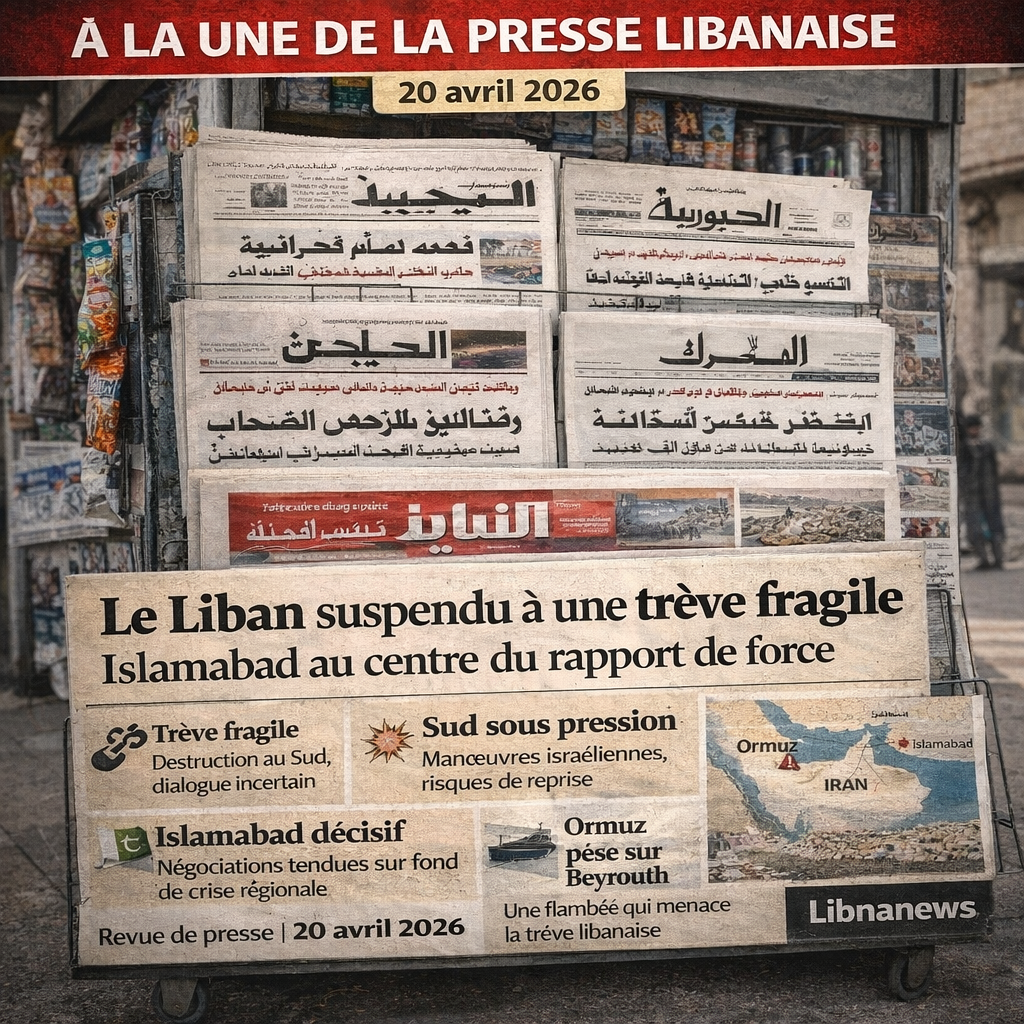
A cease-fire proclaimed, a land always moving
Most newspapers on 20 April describe the same scene, with different nuances but the same conclusion: the truce announced in Lebanon did not transform the South into a stabilized zone. Ad Diyar of 20 April 2026 stresses that Israeli operations continue despite the general truce, with an extension of the destruction to the south of the country and the opening of replacement roads by the Lebanese army to bypass the destroyed axes. Asharq Al-Awsat of 19 April 2026 speaks of a new displacement of families from the South and of a climate of return and departure, a sign of a population that does not yet know whether it will last. Al Joumhouria of 20 April 2026 sums up this moment with a cautious formula, that of vigilant calm under a ceiling of deterrence, which amounts to saying that the total war has receded without the threat having disappeared. Even when the word ceasefire is used, it remains associated with the idea of fragility, surveillance and immediate reversibility.
This precariousness is also fuelled by the Israeli discourse reported in several headlines. Ad Diyar of 20 April 2026 highlights the threats of the Israeli Defense Minister, who claims that the Israeli army will use its full force in Lebanon if its soldiers are threatened, including during the truce. Al Arabi Al Jadid of 20 April 2026 writes that Israel destroyed nearly one third of the area south of the Litani and that at the same time two Israeli soldiers were killed by explosive devices. This combination is essential to understand the sequence: on one side, Israel continues to impose a military fact on the ground; On the other hand, the existence of murderous incidents reminds us that the front is not neutralized. Ad Diyar of 20 April 2026 also insists that the proliferation of destruction south of the Litani does not resemble a step towards calming down, but rather a pressure on the future negotiating framework. Annahar of 20 April 2026 also describes a very heavy occupation of the border ribbon and a reality of villages taken over and then lost by their inhabitants, following warnings, cut roads and conflicting instructions.
The Lebanese State wants to convert the truce into a political framework
Faced with this instability, the most focused newspapers in Beirut show a Lebanese State trying to turn a suspension of hostilities into a political process. Asharq Al-Awsat of 19 April 2026 states that Joseph Aoun and Nawaf Salam worked on a unified Lebanese framework for direct negotiations with Israel, with a road map articulated around four main points: the consolidation of the ceasefire, the withdrawal of Israeli forces from the occupied areas, the return of prisoners and the treatment of the 13 disputed Blue Line issues. The same newspaper adds that the option of a meeting between Joseph Aoun and Benyamin Netanyahu is not envisaged at this stage. In the same vein, Al Joumhouria of 20 April 2026 describes a transition from simple crisis management to an attempt at a more lasting solution, while Ad Diyar of 20 April 2026 evokes the latest adjustments around the composition of the future negotiating group. Part of the press refers to the name of Ambassador Simon Karam to lead a small delegation, supported by a military representative, reflecting the desire to limit the format, clarify the mandate and avoid the image of an open political conference.
This choice is not limited to diplomacy. It also affects internal sovereignty. Asharq Al-Awsat of 19 April 2026 reports that the meeting between Joseph Aoun and Nawaf Salam also focused on the implementation of the Government’s decision to strengthen State authority in Beirut and to limit weapons outside the State framework in the capital. Al Sharq of 20 April 2026 insists on the same line by presenting the presidential approach as a specific negotiating path desired by the Lebanese State. Annahar of 20 April 2026 adds that France is following this phase carefully, both because of the ceasefire and after the attack on a French patrol of the Finul, an attack condemned by several Lebanese officials. This is politically important because it reinforces the idea that the Southern dossier can no longer be isolated from the public authority file. The truce thus opened two construction sites at the same time: an external construction site, linked to the Israeli border and withdrawal, and an internal construction site, linked to the monopoly of security decision.
Hezbollah refuses the wear and tear scenario and maintains pressure
At the same time, titles close to the line of resistance and more critical newspapers converge on one point: Hezbollah does not consider the truce as a lasting normalization. Ad Diyar of 20 April 2026 reports that the party prepared its cadres, its fighters and part of the inhabitants of the South and the southern suburbs for a possible resumption of the fighting. Asharq Al-Awsat of 19 April 2026 quotes Naim Kassem, who claims that there is no question of accepting another fifteen months of waiting under Israeli blows in the name of ineffective diplomacy, and also cites Mahmoud Qomati asking the displaced to stay in their communities for a long time. Al Akhbar of 20 April 2026, in a more committed tone, presents the truce as a mere stop in a war that has not yet been resolved. Even when they differ completely on political interpretation, these newspapers thus describe the same material state: the party keeps its options open, refuses to consider the front closed and maintains a rhetoric of preparation.
The contrast between the state’s approach and that of Hezbollah is the central hub of the press day. On the one hand, Joseph Aoun and Nawaf Salam are trying to secure a consolidated cessation of hostilities through negotiation. On the other hand, Naim Kassem refused that the same judgment should serve to endorse a balance of power which he considered humiliating. Annahar of 20 April 2026 highlights the violence of threats to the President of the Republic and the head of government by several party officials, and then links this climate to a French fear of loss of control on the ground. Asharq Al-Awsat of 19 April 2026 also presents a political campaign directed against Joseph Aoun because he maintains the option of dialogue. This tension illuminates the entire sequence. The debate no longer opposes only two military fronts. He opposes two readings of the Lebanese moment. The first considers that the truce must be exploited in order to restore the State. The second considers that it is only valid if it protects the ability to respond and does not transform Lebanon into a space of imposed concessions.
Islamabad becomes the true centre of gravity of the crisis
While the front page of the Lebanese newspapers appears first and foremost local, it is actually dominated by Islamabad and the face-to-face between Washington and Tehran. Al Arabi Al Jadid of 20 April 2026 describes a second round of talks prepared in the Pakistani capital, with an exceptional security component, reinforced checkpoints and the arrival of an American preparatory group. The paper states that the composition of the American camp remains focused on J.D. Vance, Steve Witkoff and Jared Kushner, while Iranian participation remains floating until the last few hours. Al Quds Al Arabi of 20 April 2026 publishes the same uncertainty and reports, based on American and Pakistani sources, that the American team would be the same as the first cycle. Ad Diyar of 20 April 2026 talks about a decisive session, much more important than the previous one, because a failure would mechanically open the way for a resumption of fighting. The newspapers therefore do not differ on the essential: Islamabad is no longer a simple mediation. It is the place where the regional ceiling is maintained or collapsed that made the Lebanese truce possible.
American pressure is described everywhere as very high. Al Arabi Al Jadid of 20 April 2026 reports that Donald Trump presents this sequence as a last chance and threatens Iran with a general destruction of its energy infrastructure and bridges if no agreement is reached. Al Quds Al Arabi of 20 April 2026 resumes the same line by insisting on Trump’s public threats after the challenge of the maritime truce. Asharq Al-Awsat of 19 April 2026 adds a major element: according to his reports, Washington maintains the maritime blockade against Iran even when the Strait of Ormuz is partially reopened, putting the negotiations under a logic of permanent coercion. Al Akhbar of 20 April 2026, for its part, describes very heavy American demands, ranging from a prolonged halt to uranium enrichment, to the redefinition of the rules of the sea passage, to a framework for the regional role of Tehran’s allies. At this stage, therefore, the press does not show a conventional dialogue, but a threatened negotiation, with a risk of disruption in the very short term.
Ormuz, oil and Lebanon in the same table
The second central element of this sequence is the Ormuz Strait. Asharq Al-Awsat of 19 April 2026 explains that Iran again closed the Strait after a limited reopening, linking a return to normal at the end of the American blockade of its ports. The newspaper adds that ships have been targeted in the area, while commercial vessels have been forced to turn back from the start of the US operation. Al Arabi Al Jadid of 20 April 2026, Al Quds Al Arabi of 20 April 2026 and Al Jumhouria of 20 April 2026 all present Ormuz as the other front of the negotiations, at the same level as nuclear. In Al Jumhouria of 20 April 2026, the idea comes back with insistence: Iran may have lost part of its freedom of military action, but it retains a decisive ability to damage the world’s energy flow. This explains why the Lebanese truce cannot be read only from Naqoura, Bint Jbeil or Beirut. It also depends on what is happening on the Gulf sea routes.
This link between Lebanon and Ormuz has immediate economic effects. Al Arabi Al Jadid of 20 April 2026 talks about a war spectrum that continues Arab investments. Al Akhbar of 20 April 2026 devotes its one to the billion dollars that Lebanon would ask the International Monetary Fund to meet the war charges. Annahar of 20 April 2026 reports another crisis marker with his title on gold without taxes and the search for revenue by the state. On 20 April 2026, in one, Al Watan projected a « South after peace », putting forward the expectation of economic, tourism and development projects capable of reopening the horizon. That contrast is telling. The press sees both a country struggling in the financial emergency and a South that can only stabilize if there is a real civil dividend of the truce. Without roads, reconstruction, financing and security, the ceasefire will remain an administrative word. With a start of return, work and guarantees, it could become a political moment.
Wider Israeli hardening beyond Lebanon alone
The Arab press on 20 April finally included the Lebanese file in a more general Israeli tightening. Al Quds Al Arabi of 20 April 2026 reported the reopening by Israeli ministers of the Sanour settlement, evacuated in 2005, and stressed that, in parallel, Israeli officials called for a return of settlement to Gaza. On the same day, Al Arabi Al Jadid of 20 April 2026 puts forward Pedro Sánchez’s decision to propose to the European Union that the association agreement with Israel be terminated in the name of respect for international law. In between, there is one thread. Israeli military pressure is not limited to southern Lebanon; It is part of a broader regional policy. And the international response, even if still limited, is beginning to structure itself more in the European diplomatic field. For Lebanon, this changes the atmosphere, but not yet the immediate facts. The people of the South continue to wait for the opening of roads, the repair of bridges, demining, Israeli withdrawal and the possibility of returning without having to leave the next day. That’s why the front page, in almost every headline, does not speak of an acquired peace or a completed war. She talks about a country suspended between a real diplomatic window and a possible return from the explosion.
Local policy: the state tries to impose its framework against negotiation, partisan pressure and the risk of internal rupture
Joseph Aoun sets a line of sovereignty and framed negotiation
After the ceasefire came into force, a first political line was imposed around Joseph Aoun. Ad Diyar of 20 April 2026 explains that the president drew up a road map that reflects the principles of his speech of inauguration. The newspaper writes that the State must once again become the holder of the decision, ensure its presence throughout the territory and make the exit from war the top priority. The same newspaper states that Joseph Aoun does not present negotiation as a step backwards, but as a means of stopping the war, provided that it is based on sovereignty, on the refusal to yield one inch of territory and on the requirement of a prior Israeli withdrawal. Ad Diyar of 20 April 2026 also insists on a central point in the presidential speech: the desire to separate the Lebanese path from the Iranian path in order to restore an autonomous Lebanese decision.
This line is taken in other forms by several titles. Asharq Al-Awsat of 19 April 2026 writes that Joseph Aoun, in coordination with Nawaf Salam, seeks to build a unified Lebanese position before the opening of the next round of discussions. The newspaper presents the meeting between the two heads of the executive as a scoping step. He sees it as an attempt to transform a military truce into a lasting political process. Al Sharq of 20 April 2026 also highlights the desire of the State to follow a « specific negotiating path », reflecting the search for a separate, narrower and better controlled Lebanese framework. In the same vein, Annahar of 20 April 2026 points out that the presidential speech was perceived as a turning point, because he claims that the Presidency is ready to go to the end in defence of a state choice, even at the price of a political confrontation with the actors who refuse this course.
The political meaning of this approach goes beyond the border issue alone. In Ad Diyar of 20 April 2026, sources close to the presidential follow-up claim that the aim is to remove Lebanon from the wars of others and to recover a national decision lost for decades. The newspaper also said that the head of state would have received reassuring signals from Washington, which would explain the firmness of his tone. This reading is reinforced by Annahar of 20 April 2026, who notes that intense diplomatic contacts are continuing to prepare for the next phase and prevent Lebanon from being caught up either by an imposed summit logic or by internal destabilization. In this context, the Presidency seeks to speak to several audiences at once. It wants to reassure the displaced, contain foreign partners, and show inside that it will not negotiate the territory or institutional dignity of the country.
Nawaf Salam supports centrality of the state and links security to government action
Nawaf Salam’s position complements that of the Presidency by giving a government translation to this heading. Asharq Al-Awsat of 19 April 2026 reports that after his meeting with Joseph Aoun, the Prime Minister linked the preparation of the negotiations to the implementation of the decisions of the Council of Ministers. The most sensitive point concerns Beirut. The newspaper explains that the government is following the execution of the decision to strengthen state authority in the capital and to limit weapons outside the official framework. This link is politically important. It shows that the government does not want to treat the border as a separate matter from the issue of public authority within. The return to state order must therefore begin both in the South and in Beirut.
The same article by Asharq Al-Awsat of 19 April 2026 adds that Nawaf Salam insisted on the concrete conditions for the return of the displaced. The Prime Minister refers to the opening of roads, the repair of bridges and the logistical facilities necessary for the return of the inhabitants. Again, the stake is political. This is not just about administration. The Head of Government seeks to prove that the State is no longer limited to diplomatic discourse. It must be visible in infrastructure, in access, in assistance and in accompanying the return. Ad Diyar of 20 April 2026 also reports that the Lebanese army has begun to create alternative roads in the southern areas where the roads were destroyed. This technical detail gives a practical dimension to the official discourse. It allows the executive to argue that it acts, even in a still unstable environment.
The international dimension of Nawaf Salam’s role also counts in local reading. Ad Diyar of 20 April 2026 announces his visit to Paris and his planned interview with Emmanuel Macron. The daily said that the meeting should focus on the ceasefire, support for the territorial unity of Lebanon, sovereignty, the issue of the unity of arms, and economic and financial reforms. Annahar of 20 April 2026 recalls, for his part, that Nawaf Salam must also meet with the foreign ministers of the European Union. This gives the Prime Minister a dual role. He remains the man of internal government leadership, but he also becomes the relay of an external plea to protect the Lebanese position, obtain diplomatic coverage and prevent the country from being locked in a purely security discussion written by others.
Hezbollah contests the presidential cape and refuses the truce to become a reorientation of Lebanon
The main resistance to this line comes from Hezbollah and its allies. Annahar of 20 April 2026 describes a sequence of strong political tension after Joseph Aoun’s speech. The newspaper refers to threats against the President of the Republic and the Government. He reports that Naim Qassem continued to portray the ceasefire as a precarious step, while giving the impression that the real decision to wage war and peace was not just an institutional one. The same newspaper also cites even harsher comments from party officials, in a climate of fear of an attempt to discourage the executive’s choice of negotiation.
Asharq Al-Awsat of 19 April 2026 puts this conflict in even clearer terms. The newspaper writes that MPs and Hezbollah officials conducted a violent campaign against Joseph Aoun, criticizing him for his commitment to negotiation and his refusal to place Iran and the resistance at the centre of the official narrative. The same article also points out that the party has asked displaced persons not to settle permanently in their communities. This choice is very meaningful. It reflects both a military reading of the truce and a political will to keep open the hypothesis of a resumption of confrontation. In this context, the state strategy appears to the party as an attempt to take advantage of the lull in changing the internal power ratio.
Annahar of 20 April 2026 goes further in the analysis and writes that Hezbollah now considers the presidency to be committed to an option that aims to close the cycle of open confrontation with Israel, regardless of the final form of the text. The newspaper talks about a political breakup since Joseph Aoun referred to direct negotiation. According to this reading, the party no longer believes in an easy margin of compromise with Baabda. He feared that the government would try to translate the truce into a new national architecture, not simply a suspension of fighting. On the other hand, Al Akhbar of 20 April 2026 defends the idea that the truce is only a temporary station in a war that did not deliver its strategic verdict. The newspaper opposes a « confrontation camp » to a « solution camp » and refuses the idea that a dialogue can close the conflict without major political cost to the resistance. The gap between the two readings summarizes the inner confrontation of the moment.
Other local actors seek a method compromise rather than a frontal shock
Between the executive and Hezbollah, other voices seek to avoid the internal explosion. Ad Diyar of 20 April 2026 devotes a large place to a « road map » attributed to Walid Jumblatt. The newspaper explains that the former leader of the Progressive Socialist Party defends a gradual approach. Negotiations should, according to this vision, begin with the technical and military components. The policy would come later, once concrete results had been achieved. Ad Diyar of 20 April 2026 adds that Walid Jumblatt rejects the idea of early direct contact between the Lebanese President and the Israeli Prime Minister. It also called for a clear agenda, American guarantees, the involvement of France and other partners, as well as careful consideration of Hezbollah’s position in order to avoid an agreement remaining ineffective. It’s not a breaking line. It’s a containment line. It seeks to prevent external negotiations from turning into a cold civil war.
The role of Nabih Berri also appears watermarked in several texts. Annahar of 20 April 2026 notes that the Speaker of the House had given signs of support to the Presidency, before reticence reappeared around direct negotiation. The paper describes a movement more cautious than frontal. Berri does not want to appear as one who opens a major institutional conflict in full truce. But he also does not want to endorse a path that could weaken the Shiite axis as a whole. This ambiguity weighs heavily on the entire local scene. It maintains open the possibility of adjustment, while preventing the emergence of a clear consensus.
Other local actors also appear on a more socio-political register. Ad Diyar of 20 April 2026 reports popular preparations in Tripoli against the negotiations, which shows that the debate is not limited to central institutions or parties directly involved in the southern front. The file recomposes the old divisions. It reacts to ideological, denominational and geopolitical reflexes. In some cities, the simple word of negotiation is enough to rekindle the fractures. In others, the exhaustion of the war rather pushes to support any option that might open up a return to ordinary life. This polarization explains the caution of institutional leaders when using words of dialogue, negotiation or contact.
Internal political risk grows around the street, the Finul and the monopoly of decision-making
The crisis is not limited to the debate on the method. It also affects the State’s ability to enforce its choices. Annahar of 20 April 2026 links political tension to the climate created after the attack on members of the Finul. The newspaper believes that the incident, attributed in the daily analysis to a very tense partisan environment, reinforced French concerns and brutally raised the question of control of the ground. If the State wants to convince that it can negotiate on behalf of the country, it must also show that it can protect international forces, preserve order and prevent armed slippage. Without that, his outer word will lose its reach.
Asharq Al-Awsat of 19 April 2026 confirms, in another tone, that the whole issue is now to convert the truce into lasting stability. The newspaper talks about diplomatic preparations, possible formation of a small negotiating delegation, and a concentration of institutional work around a reduced framework. This desire to reduce the format is not neutral. It aims to avoid parallel decision-making centres and to prevent the file from diluting into internal rivalries. Al Sharq of 20 April 2026 reinforces this reading by putting the popular and state refusal of an imposed war on the front page. The basic message is clear: the local battle is as much about sovereignty vis-à-vis Israel as it is about the sovereignty of the political centre vis-à-vis partisans who claim to speak in its place.
In total, Lebanese local policy of 20 April is structured around a scoping struggle. Joseph Aoun and Nawaf Salam want to make the truce a sequence of state restoration. Hezbollah wants to prevent it from being used to reduce its decision-making capacity. Around them, Walid Jumblatt, Nabih Berri and other actors are mainly trying to contain the shock and avoid the internal explosion. Ad Diyar of 20 April 2026, Asharq Al-Awsat of 19 April 2026, Annahar of 20 April 2026, Al Sharq of 20 April 2026 and Al Akhbar of 20 April 2026 show each in their own way that no camp has yet locked the exit. But all describe the same fact: the debate is no longer only military. It has become a confrontation on the right to define the Lebanese national interest, on the role of the State, and on the border between public decision and partisan decision.
Quote and speech by political figures: a battle of words between sovereignty, deterrence and ultimatum
Joseph Aoun and Nawaf Salam install state language
In the press of 20 April, the first battlefield is not only military. It’s verbal. Political leaders speak to set a framework, reassure their camp, influence negotiations and prevent the adversary from imposing his words. In this register, Joseph Aoun occupies a central place. Several newspapers show that the president is trying to get the debate into a state vocabulary. In Ad Diyar of 20 April 2026, his approach is presented as fidelity to his speech of inauguration. The newspaper explains that it insists on sovereignty, on the refusal to yield one inch of territory, on the rejection of a prolonged war, but also on the need to separate the Lebanese path from regional calculations. In this sense, the words used are not those of revenge or surrender. These are those of the institutional framework. Joseph Aoun wants to make negotiation a tool for national protection, not a sign of weakness. This is also why several headlines show that he refuses the idea of improvised diplomacy or political staging that would give the outside world the feeling that Lebanon is negotiating under guardianship.
This presidential line is relayed by Nawaf Salam with a more administrative but also political register. In Asharq Al-Awsat of 19 April 2026, the Prime Minister attaches the current phase to state action on the ground. The newspaper shows him attached to the preparation of a negotiating framework, but also to the opening of roads, the repair of bridges and the concrete conditions for the return of displaced persons. The scope of this speech is clear. Nawaf Salam tries to get the country out of an exclusively warrior language. He talks about infrastructure, government decisions, institutional centrality. He tries to impose the idea that the state is not a spectator, but an actor who can act both on the border and inside. In Al Sharq of 20 April 2026, this orientation is summarized by the idea of a « specific negotiation path ». The formula is important. It means that official Lebanon wants to speak on its own behalf, with its method and priorities, without falling into the broader rhetoric of regional power relations.
This lexical choice also has an inner function. In Annahar of 20 April 2026, the presidential speech is presented as a turning point because it introduces a new hierarchy of words. The vocabulary of the « decision of the State », the « ceasefire », the « sovereignty » and the « Lebanese framework » takes precedence over the formulations of the permanent confrontation. That does not mean that the Presidency denies the danger. On the contrary. But it tries to ensure that the gravity of the moment is expressed by institutions and not by partisan apparatus. The language of Joseph Aoun and Nawaf Salam is therefore used to establish legitimacy. It is not just about describing the crisis. It is about occupying the centre of the national narrative.
Naim Qassem, Mahmoud Qomati and Mohammad Raad defend a language of firmness
In the face of this lexicon, the leaders of Hezbollah and its political environment use a very different register. Their purpose is to recall that the truce is not worth abandoning, that diplomacy is not worth trust, and that the ability to respond remains intact. In Asharq Al-Awsat of 19 April 2026, Naim Qassem states that the fighters will remain on the ground « hands on relaxation » and that there is no longer a question of accepting « 15 months of patience » pending a diplomacy that would have obtained nothing. These two formulations are central. The first is to reassure the partisan camp by saying that the force is still there. The second is a frontal critique of any waiting strategy. Naim Qassem’s speech did not close the door to truce, but he refused to allow it to become a language of normalization. He speaks like a leader who wants to keep the moral initiative of his camp, even if the military decision-making space is forced.
On the same day, Asharq Al-Awsat of 19 April 2026 quotes Mahmoud Qomati, who calls on internally displaced persons not to settle permanently in the villages of the South or in the southern suburbs. Again, the sentence goes beyond the simple practical instructions. It is a political message. She said at the base of the party that the sequence was not closed and that a massive return to normality would be premature. Qomati’s language is a language of vigilance. It maintains the community in a state of psychological mobilization. Ad Diyar of 20 April 2026 also relays this idea by explaining that the party asked the inhabitants to be ready for a possible return to the accommodation centres. The implicit slogan is clear: not to believe too quickly in stability, not to turn the truce into a release, and not to let the opposing side own the vocabulary of the future alone.
In Al Akhbar of 20 April 2026, MP Mohammad Raad adopts a more condensed but very revealing tone when he says that « our rights are clear » and « do not need negotiation ». The sentence is brief. But it contains an entire program. It means that the legitimacy of the resistance camp does not depend on diplomatic validation. It also suggests that the essential in the spirit of this current is not to discuss rights, but to impose their recognition. Through such a short formula, Al Akhbar of 20 April 2026 shows a rhetoric of principle, almost doctrine. We don’t negotiate evidence. We can discuss the mechanisms, but not the substance. It is a direct way to challenge presidential language without entering into institutional technicality.
This family of speeches is based on the same architecture. It refuses the word compromise when it seems synonymous with hindsight. It accepts the word of negotiation only if it is separated from any idea of humiliation. It maintains the centrality of the word resistance, even when the state speaks of sovereignty. In between, it is not just a difference in style. These are two concepts of political legitimacy. The first is through the institution. The second is the ability to hold, respond and not to yield symbolic ground.
Donald Trump makes speech an instrument of restraint
The third major registry is Washington, dominated by Donald Trump. In today’s newspapers, his statements are reported almost everywhere as ultimatums. Al Arabi Al Jadid of 20 April 2026 presents him as giving Tehran a « last chance ». The daily reports that he threatens to « destroy Iran completely » if this opportunity is not seized. Al Quds Al Arabi of 20 April 2026 echoes this brutal tone by pointing out that it threatens to hit energy infrastructure and bridges if no agreement is reached. Asharq Al-Awsat of 19 April 2026 quotes a shorter but equally harsh formula: « they cannot blackmail us ». Donald Trump’s speech works here as a weapon of pressure. It does not serve to open an atmosphere of compromise. It is used to install the idea that he speaks in a position of strength, that he fixes the red lines and that he has the power to decide whether the truce lives or dies.
The political significance of this language is reinforced by the details given on American content. Al Arabi Al Jadid of 20 April 2026 explains that an American official poses as a red line the cessation of uranium enrichment and the conclusion of an agreement that is not limited to nuclear, but also affects the Tehran regional allies. Al Akhbar of 20 April 2026 says the same with an even more accusatory level of detail. The newspaper states that Washington wants a 20-year end to enrichment, a transfer of enriched stocks and a overhaul of the programme under full supervision. Even when titles differ ideologically, they describe the same American way of saying things: setting broad conditions, demanding, threatening, expanding the scope and treating negotiation as a space for regional reorganization. Donald Trump’s speech is not isolated. It is supported by a broader official discourse aimed at giving military and maritime pressure a diplomatic translation.
It should also be noted that this American word acts on the Lebanese scene without even naming Lebanon. When Donald Trump talks about last chance, when his relatives talk about Iran’s allies, everyone hears that the Lebanese issue is included in the background. That is why Lebanese officials read his words with extreme attention. It is not only the fate of Islamabad that is played in these formulas. It is also the question of whether Lebanon will remain a theatre of regional pressure or whether it will be able to regain its own political margin.
Iran responds with a speech of dignity, right and threshold
Iranian officials, as they appear in the newspapers of 20 April, respond to this pressure with a threshold language. They don’t say they refuse any discussion. They say they refuse to discuss under humiliation. Asharq Al-Awsat of 19 April 2026 thus reports a sentence of Mohammad Reza Aref: « they either grant us our rights at the negotiating table or we enter the battlefield ». This formula summarizes the Iranian position as perceived in the Arab press. It articulates right and force, table and forehead, discussion and breakup. The message is simple: negotiation remains possible, but it does not replace the principle of national dignity.
Al Akhbar of 20 April 2026 illuminates this logic in a more technical register. The daily explains that Tehran says it is ready to examine a temporary halt to high enrichment and to strengthen control mechanisms, but refuses the idea of a 20-year freeze. He added that Iran was more flexible about transferring stocks to a friendly country, in the form of a deposit, not confiscation. Behind these nuances, we find the same battle of words. The Iranian camp seeks to avoid the terms that would mean surrender. He can accept accommodations, but he wants to put them in the vocabulary of deposit, right, guarantee and reciprocity. The form of the speech counts almost as much as the content, as it outlines how each side can sell a possible agreement to its opinion.
Even in Ad Diyar of 20 April 2026, which takes up the idea of an American offer presented as « just », the general tone remains marked by caution. The newspaper shows that the deterrence messages from Tehran constantly accompany the dialogue phase. In other words, Iran does not want to appear as an actor negotiating because it is at the end. He wants to appear as an actor who accepts dialogue because he still keeps levers. This way of speaking matters for Lebanon. It means that any local relaxation will also depend on how Tehran chooses to tell its allies and its own audience.
Other political voices seek to move the moral center of the debate
Apart from this main axis, other politicians use speech to move debate towards international law or public morality. In Al Arabi Al Jadid of 20 April 2026, Pedro Sánchez states that « a government that violates international law cannot be a partner of Europe ». The sentence refers to Israel, but its effect goes beyond the European framework. It offers a part of the Arab press a clear, legal and political formulation that contrasts with the language of pure force. This type of declaration does not change the military report immediately. But it changes the discursive environment. It gives those who denounce Israeli politics a more institutional and internationally acceptable vocabulary.
In Al Quds Al Arabi of 20 April 2026, Hakan Fidan said that Israel’s fundamental intention in Gaza was to empty the territory of its inhabitants, either by targeting them or by pushing them to leave. Again, the sentence is important in its structure. She doesn’t describe an accident. She describes a project. This shift from the language of the event to the language of intention gives the Turkish discourse a more accusatory scope. Similarly, the daily reports the words of Bezalel Smotrich describing the return to the Sanour colony as a « historical correction ». The political violence of this expression alone illuminates the Israeli hardening. It shows how words can be used to make a policy of fait accompli legitimate.
Annahar of 20 April 2026 finally reports the appeal of Pope Leo XIV, who salutes the ceasefire in Lebanon as a source of hope and encourages those who pursue a diplomatic solution to continue their dialogues of peace. This word is a completely different register. It does not threaten, it does not set a red line, it does not set a strategic requirement. It tries to create a moral space for further dialogue. In the cacophony of ultimatums, warnings and defiance postures, this voice recalls that the battle of words is not only a battle of power. It is also a battle about the possibility of even imagining an exit.
Diplomacy: Islamabad becomes the center of the game, while Paris, Brussels and Ankara try to prevent regional relapse
Lebanon enters a sequence dominated by mediation and external channels
In the press of 20 April, diplomacy no longer appears as a mere setting around the war. It becomes the main venue for the subsequent events. Asharq Al-Awsat of 19 April 2026 writes that Lebanon is now ready to launch a negotiation process with Israel, pending a specific date. The newspaper adds that a meeting was held between Joseph Aoun and Nawaf Salam to outline the Lebanese position. This line is based on the consolidation of the ceasefire, the Israeli withdrawal from the occupied areas, the return of prisoners and the treatment of disputed points along the Blue Line. Al Joumhouria of 20 April 2026 describes the same moment as a transition from crisis management to an attempt at a solution. In both cases, the central idea is the same: Lebanon seeks to convert a military break into a diplomatic one. The novelty is that this approach is no longer merely technical. It becomes a matter of sovereignty, method and political representation.
Ad Diyar of 20 April 2026 supplements this reading by explaining that the Lebanese authorities want to arrive at the next phase with a small delegation, a strict mandate and a defined agenda. The newspaper presents this option as a way of protecting the Lebanese character of the negotiation. He added that the Presidency refused to allow the dialogue to shift to an overly broad political scene or to an early summit meeting. Al Sharq of 20 April 2026 also insists on this point by referring to the State’s willingness to follow a « specific negotiating path ». This vocabulary reveals a very diplomatic concern. Beirut doesn’t just want to talk. Beirut wants to control the format, hierarchy and symbolic scope of each step. In a sequence where everything can be interpreted as a political gesture, the form of diplomacy becomes almost as important as the substance.
However, this Lebanese diplomacy remains suspended from a broader external power relationship. Most daily newspapers show that the Lebanese front depends first on what is being played between Washington and Tehran. That is why Islamabad appears in almost all titles as the true centre of gravity of the moment. Al Arabi Al Jadid of 20 April 2026 talks about a new round of negotiations prepared in the Pakistani capital, with a strengthened security mechanism and the arrival of an American preparatory team. Al Quds Al Arabi of 20 April 2026 also writes that the same American personalities should participate in the new cycle, while Iranian participation remains uncertain until the last hours. Ad Diyar of 20 April 2026 finally presents Islamabad as the decisive scene where can be played either a cautious stabilization or a rapid resumption of escalation. Lebanon, in this reading, is no longer the sole master of the calendar. It awaits the outcome of regional mediation that directly weighs on its own diplomatic margin.
Islamabad confirms Pakistan’s role as central mediator
Pakistan’s role is strongly reflected in the coverage of newspapers. Al Arabi Al Jadid of 20 April 2026 shows that Islamabad is not content to host the meeting. Pakistan’s capital became a place of forced passage between the two camps. The newspaper discusses the enhanced security, logistical preparations and political importance of the Pakistani framework. Asharq Al-Awsat of 19 April 2026 goes further explaining that proposals were transmitted to Tehran by the leader of the Pakistani army, following a visit to Tehran. This gives Pakistan a dual role. It serves as a forum for discussion. But he also serves as a messenger, thus as an active mediator. This Pakistani centrality is one of the major diplomatic events of the day, as it shows that a non-Arab regional actor succeeds in establishing a centrality between Washington and Tehran, even as the crisis directly affects the Gulf, Iraq, Syria, Gaza and Lebanon.
This mediation is not presented as neutral or simple. Al Akhbar of 20 April 2026 suggests that the framework of Islamabad is crossed by very heavy fundamental differences. The daily highlights American demands on uranium enrichment, international oversight and the regional role of Iran’s allies. Al Arabi Al Jadid of 20 April 2026 reports that Washington is laying red lines that go beyond the nuclear issue alone. In this context, Pakistani mediation is not a comfort diplomacy. It is a threshold diplomacy, in which it is a matter of preventing the breakup while knowing that each camp continues to speak under pressure. Pakistan therefore becomes a guarantor of the proceedings more than an agreed producer. Its immediate success already consists in keeping both parties in the same space of discussion.
The fact that this mediation directly influences Lebanon is visible in several titles. Asharq Al-Awsat of 19 April 2026 explicitly links the preparation of a third round of discussions to the fate of the truce on the Lebanese front. Al Joumhouria of 20 April 2026 also writes that the extension of the ceasefire to the South depends in part on an international, especially American, will to contain the explosion. The message is clear. Islamabad is not just about Iran. Islamabad also determines the chances of maintaining calm in Lebanon. Pakistani diplomacy therefore acts, indirectly but concretely, on the immediate future of the Lebanese scene.
France and Europe seek to lock a political framework for Lebanon
French diplomacy also occupies an important place in the newspapers of 20 April. Ad Diyar of 20 April 2026 announces Nawaf Salam’s visit to Paris and specifies that he should talk to Emmanuel Macron. The topics discussed are broad: ceasefire, territorial unity of Lebanon, sovereignty, the unity of arms, financial reforms and economic support. This programme shows that Paris does not treat the Lebanese crisis as a mere military issue. France is trying to link security, institutions and recovery. Annahar of 20 April 2026 adds that Nawaf Salam must also meet with the foreign ministers of the European Union. Again, the approach is significant. Lebanon is seeking collective coverage. He doesn’t want to depend on one sponsor. It wants to broaden the diplomatic circle capable of supporting its position and ensuring that the ceasefire will not be reduced to a fragile arrangement between the military.
The French square is also strengthened because of the Finul. Annahar of 20 April 2026 recalls that Paris closely follows developments in the South after the attack on a French patrol of the international force. The daily presents this incident as a disturbing signal for the credibility of the international machinery. France is therefore not only engaged because of its traditional role in Lebanon. It is also because one of its detachments was targeted in an area purported to be protected by existing arrangements. This data weighs on the French diplomatic tone. It pushes Paris to defend both the stability of the South, the authority of the Lebanese state and the security of international forces. French diplomacy is thus at the crossroads of three logics: the protection of a ceasefire, the defence of an international military presence, and the attempt to rebuild a Lebanese political framework.
On the broader European level, Al Arabi Al Jadid of 20 April 2026 puts forward a Spanish initiative that goes beyond the Lebanese case alone but affects the regional diplomatic atmosphere. The newspaper reports that Pedro Sánchez wants to ask the European Union to put an end to the association agreement with Israel, saying that a government that violates international law cannot be a partner of Europe. This position does not directly change the terms of the negotiations in Lebanon. But it helps to strengthen the European diplomatic language towards Israel. It also gives Lebanese officials a slightly less unfavourable environment, as European criticism is more clearly expressed. In a phase where each word counts, this change changes the climate without changing the terrain yet.
Ankara, Cairo and Arab capitals are trying to prevent the general explosion
Regional diplomacy is not limited to Pakistan and Europe. Al Quds Al Arabi of 20 April 2026 gives a visible place to Turkey by reporting the statements of Foreign Minister Hakan Fidan in Antalya. According to the newspaper, he claims that the war in Gaza is not over and that the Israeli goal remains to empty the territory of its inhabitants. The same article states that he warns against the military rapprochement between Israel, Greece and Greek Cyprus, and insists on the mobilization of the Islamic countries concerned by Gaza. Even though the statement focuses on Palestine, it sheds light on the Turkish diplomatic posture throughout the region. Ankara seeks to appear as an actor linking Gaza, the eastern Mediterranean and regional balance. In this reading, Lebanon is not an isolated issue. It is part of a single diplomatic space, which is crossed by the same concerns about Israeli expansion and the absence of international safeguards.
Cairo also appears in several blankets. Al Quds Al Arabi of 20 April 2026 explains that Egypt has proposed an alternative path for further discussions on Gaza, based on the progressive implementation of previous commitments. Al Sharq of 20 April 2026 mentions Egypt’s support for the Lebanese President’s negotiating initiative. Although the details are less developed in the available excerpts, the diplomatic signal is important. Egypt is trying to remain an actor of moderation, both on the Palestinian side and on the Lebanese side. It does not lead the Islamabad process. But she works to preserve the idea that a political exit remains possible.
Asharq Al-Awsat of 19 April 2026 further expands the framework by showing that the Ormuz crisis, the firing of ships and the continued US maritime blockade make regional diplomacy much more nervous. In such a context, Arab capitals are not only trying to support a camp. Above all, they seek to avoid an open war that would blow up both markets, maritime routes and internal political balances. This explains the increasingly pressing tone of mediation, visits and consultations. The diplomacy of the moment is not a diplomacy of lasting rapprochement. First, it’s a hard diplomacy.
A dense diplomacy, but still without guarantee of results
Despite this density of contacts, daily newspapers remain cautious about the outcome. Al Joumhouria of 20 April 2026 writes that the truce in the South is likely to be extended, but stresses that the process will be neither quick nor simple. Asharq Al-Awsat of 19 April 2026 shows that Iran still refuses to yield on several points, while Washington maintains maximum pressure. Al Arabi Al Jadid of 20 April 2026 speaks of a « last chance », a formula that alone says how narrow the diplomatic window is. In this context, diplomacy does not erase war. It only imposes a period of suspension.
For Lebanon, this situation produces a clear paradox. On the one hand, the country never seemed so dependent on external diplomatic architecture, from Paris to Islamabad, to Brussels, Cairo and Ankara. On the other hand, he has never stressed in his own messages so much the need for a strictly Lebanese framework, a small delegation and a sovereign mandate. It is this tension that dominates the diplomatic section of the day. Diplomacy is everywhere. But it only applies to Beirut if it allows Lebanon to find a voice of its own instead of being a mere theatre for others.
International policy: from the American ultimatum to the Israeli crisis, a regional order under tension
Washington and Tehran meet in Islamabad under threat of a resumption of war
The international scene of 20 April is dominated by a simple fact: the regional centre of gravity moved to Islamabad. Al Arabi Al Jadid of 20 April 2026 describes a second round of talks between the United States and Iran in the Pakistani capital, with enhanced security arrangements and the arrival of an American preparatory group the day before. The paper states that the US delegation expected includes J.D. Vance, Steve Witkoff and Jared Kushner, while Iranian participation remains surrounded by uncertainty until the last few hours. Al Quds Al Arabi of 20 April 2026 reports the same hesitation on the Iranian side and insists on the confusion created by the contradictory statements of the White House about the actual presence of J.D. Vance. This sequence reveals less soothing than a moment of suspension. Both sides return to the table, but each maintains doubt about its real intentions.
In Al Joumhouria of 20 April 2026, the formula chosen is even more direct: the American-Iranian negotiations are placed « to the point of the solution or explosion ». The title sums up the general atmosphere of newspapers. We don’t describe a diplomacy of trust. A dialogue is described at the edge of the rupture. Ad Diyar of 20 April 2026 also speaks of an American-Iranian confrontation which the Islamabad discussions must decide. Al Bina In these three readings, Islamabad is not used to normalize the crisis. Islamabad serves to avoid its immediate overflow. It’s already a lot, but it remains fragile.
The American language as it appears in the daily press is that of coercion. Al Arabi Al Jadid of 20 April 2026 reports that Donald Trump presents the negotiation as a « last chance » and threatens Iran with total destruction if he misses this opportunity. Al Quds Al Arabi of 20 April 2026 repeats this logic by stressing that it threatens Iranian bridges and power stations if no lasting agreement is reached. Asharq Al-Awsat of 19 April 2026 finally quotes Trump saying that Iranians cannot « blackmail » in the United States through Ormuz. These words have a very clear political function. Washington wants to negotiate from a position of displayed superiority, without suggesting that he needs the discussion as much as his opponent. American diplomacy is thus expressed in the language of the ultimatum.
In response, the newspapers show an Iran that does not exclude dialogue but refuses verbal surrender. Asharq Al-Awsat of 19 April 2026 quotes the first Vice-President Mohammad Reza Aref stating in substance that his country must obtain its rights at the negotiating table, failing which he will return to the battlefield. Al Akhbar of 20 April 2026 states that Tehran would be prepared to consider a temporary halt to high enrichment and a strengthening of control mechanisms, but not a 20-year freeze as Washington would like. The same newspaper adds that Iran could accept a transfer of the enriched stock in the form of a deposit to a friendly country, such as Russia or China, rather than a surrender to the United States. Behind these technical nuances, the political logic is clear. Iran wants to appear as an actor who negotiates without denying himself.
Ormuz becomes a global lever and raises economic risk
The second broad line of international policy today is the Ormuz Strait crisis. Asharq Al-Awsat of 19 April 2026 claims that Iran again closed the Strait after having reopened it in a limited manner, linking a lasting reopening to the end of the US blockade against its ports. The newspaper adds that boats from the Revolutionary Guard Corps fired at ships and that commercial vessels were targeted during their attempted passage. Al Quds Al Arabi of 20 April 2026 confirms that the Strait remained closed in a context of persistent disagreement with Washington. Al Arabi Al Jadid of 20 April 2026 even devotes part of its one to suspicions of fraud and suspicious operations around the announcements of opening and closing the passage. This shows that the Ormuz crisis is not just an appendix to the nuclear issue. It has become a full political and financial front.
This centrality of Ormuz gives Iran a strategic lever that several newspapers insist on. Al Jumhouria of 20 April 2026 speaks of a new Iranian « weapon of deterrence » based on the control of the sea passage. The newspaper also raises a serious question of meaning: who is the biggest economic loser after 45 days of regional war. The mere fact of formulating the question in this way shows that one no longer looks only at military fronts. We also look at costs on trade, energy, financial flows and market confidence. Al Arabi Al Jadid of 20 April 2026 makes the same link when he evokes a spectre of war that continues Arab investments. The international policy of the moment is therefore not only between States and armies. It is also about the ability of a strait to disrupt an already tense global economy.
Al Binas of 20 April 2026 gives this picture a more ideological dimension. The newspaper believes that the United States is seeking to impose the rules of the game, but that they are facing a lasting reality: the next day will be decided not only by the Washington communiqués but by the real balance of forces on the ground and on the sea. Even when one moves away from the more factual tone of other daily newspapers, the idea remains the same. The closure of Ormuz recalls that Iran can still disrupt the regional economic order even when it is under maximum military and diplomatic pressure. It is this nuisance capacity that explains why Washington negotiates while threatening.
Israel hardens its line from Gaza to the West Bank and feeds diplomatic isolation
The other major international front of the day concerns Israel and the Palestinian territories. Al Quds Al Arabi of 20 April 2026 devotes its one to a particularly strong signal: Israeli ministers revived the Sanour settlement, evacuated in 2005 as part of the disengagement of the West Bank, while increasing calls for a return of settlement to Gaza. The newspaper quotes Bezall Smotrich, who presents this reopening as a « historical correction » and assumes the idea of a return to settlement. The same article emphasizes that Palestinian sources have rejected an international proposal that emphasized the disarmament of resistance without serious guarantees on the implementation of Israeli commitments. The dynamics described are clear: Israel advances by fact, while Palestinians and mediators sink into discussions where confidence has almost disappeared.
This Israeli policy feeds a sharper European reaction than before. Al Arabi Al Jadid of 20 April 2026 reports that Pedro Sánchez must propose to the European Union the termination of the Association Agreement with Israel. The Spanish Head of Government justifies this initiative with a simple legal argument: a government that violates international law cannot be Europe’s partner. This position, as repeated in the newspaper, is not merely a gesture of communication. It marks a hardening of European political vocabulary. We are no longer talking only about concern or regret. There is talk of a challenge to a fundamental institutional framework between the European Union and Israel. In the current regional context, this change in your mind counts a lot. It does not stop Israeli policy, but it increases its diplomatic cost.
Al Quds Al Arabi of 20 April 2026 also highlights the Turkish position. When questioned in Antalya, Hakan Fidan claims that the war in Gaza is not over and that Israel’s main intention is to empty the territory of its population, either through direct violence or displacement. The newspaper adds that it warns against the military rapprochement between Israel, Greece and Greek Cyprus. This point broadens the reading of the crisis. It is no longer just Gaza or the West Bank. Turkey now presents Israeli policy as a broader disorder in the eastern Mediterranean. This reading gives Ankara a special place in the international landscape: neither central mediator like Pakistan, nor European actor like Spain, but regional power trying to link the Palestinian cause to a broader geopolitical balance.
US policy in the Middle East goes beyond nuclear power and targets all the regions
Several newspapers insist on one often decisive point: for Washington, the Iranian issue is not limited to nuclear. Al Arabi Al Jadid of 20 April 2026 reports that an American official fixed as a red line not only the cessation of uranium enrichment, but also the conclusion of an agreement including Tehran’s allies in the region. Al Akhbar of 20 April 2026 develops the same idea by showing that the Lebanese side is included in the negotiation of Islamabad, through discussions on regional allies, border control, security balances and the management of the « day after ». In other words, the White House is not only looking for technical text on the atom. It is seeking a recomposition of the regional power ratio. Lebanon, Iraq, the Red Sea and Gaza appear in the background of the same pressure.
Asharq Al-Awsat of 19 April 2026 further reinforces this reading when he explains that the American maritime blockade continues even when Tehran partially reopens Ormuz. The American message is therefore twofold. On one side, Washington accepts the negotiation. On the other hand, it maintains the instruments of pressure during the negotiation. This method reflects a very special conception of international diplomacy. Dialogue is not presented as an exit from coercion. It is presented as an extension of coercion by other means. This strategy can produce concessions. But it can also convince the adversary that he has nothing to gain from yielding without heavy and verifiable compensation. This is precisely what the press of the day suggests.
Mediations multiply, but no stable architecture still emerges
The international policy of 20 April is also characterized by a proliferation of mediation. Pakistan welcomes. Turkey speaks. Egypt continues to propose alternative routes on Gaza, as Al Quds Al Arabi of 20 April 2026 recalls, referring to an Egyptian option based on the gradual resumption of the commitments of the first phase. Spain pushes Europe to tighten its tone against Israel, according to Al Arabi Al Jadid of 20 April 2026. France and the European Union reposition themselves on the Lebanese scene, after Annahar of 20 April 2026 and Ad Diyar of 20 April 2026. This density of initiatives can give the impression of a return to diplomacy. But the newspapers actually show another picture. There are many channels, many visits and many messages, but not yet clear and shared architecture. Each actor tries to prevent the worst on his own file.
Al Joumhouria of 20 April 2026 expresses this impasse when he speaks of a relative regional calm maintained under a « ceiling of deterrence ». The formula is transferable to the entire region. Nothing is stabilized by mutual trust. Everything is temporarily held back by fear of costs. As long as this ceiling stands, total war is avoided. But no solid text yet guarantees that it will last for a long time. That’s why newspapers remain cautious, even when they talk about progress. The same basic idea is read everywhere: diplomacy has prevented the immediate collapse, but it has not yet produced any new order.
Global recomposition emerging behind regional crises
Beyond the visible fronts, several indications suggest a deeper international recomposition. Al Arabi Al Jadid of 20 April 2026 puts forward suspicions of financial manipulations around the ads on Ormuz. Al Joumhouria of 20 April 2026 questions the great economic losers of the regional war. Al Akhbar of 20 April 2026 insists on the possible involvement of Russia or China in the Iranian uranium deposition scheme. Each in its own way, these newspapers indicate that the crisis is not just Washington against Tehran or Israel against the Palestinians. It also reveals a more fragmented world order, where maritime routes, control institutions, intermediate powers and markets are once again becoming areas of political confrontation.
In this perspective, the international policy of the day cannot be reduced to a mere succession of events. She’s talking about a rocking moment. The United States still wants to dictate the parameters. Iran wants to prove that it retains levers. Israel continues its policy of force. Europe hesitates, but some of its states speak harder. Pakistan becomes a mediator. Turkey is trying to expand the theatre. And the Arab world is concerned about a crisis that simultaneously affects the security, economy, energy and legitimacy of international law. The newspapers of 20 April do not therefore describe only a Middle East in crisis. They describe an international space where each local crisis now refers to a broader recomposition of power.
Economy: Lebanon counts its losses, seeks emergency financing and fears the prolonged effect of Ormuz on the entire region
A Lebanese economy first treated as a war economy
In the newspapers of 20 April, the economy is never separated from the war. It appears as its direct consequence, its administrative extension and sometimes its most concrete political revealer. According toAl Akhbaron 20 April 2026, Lebanon requested a billion dollars from the International Monetary Fund to meet the costs of the war. This one number gives the tone of the sequence. The economy is not described as an immediate stimulus. It is first described as a space for survival, compensation and management of accumulated damage. At the same time,Annaharof 20 April 2026 puts the question of gold without taxes and that of a State seeking new resources. Juxtaposition is revealing. On the one hand, the government is seeking external financing to cushion the effects of the conflict. On the other hand, it seeks to expand or secure its domestic revenues in a country where tax margins remain narrow, contested and socially explosive.
This vision of an economy in an emergency is reinforced by the question of returning to the South. According toAsharq Al-Awsatof 19 April 2026, Nawaf Salam insists on the opening of roads, the repair of bridges and the logistical facilities necessary for the return of displaced persons. These elements are prima facie administrative matters. In reality, they are also economic. A reopened road is a village that can start trading again. A repaired bridge is agricultural, artisanal or school traffic which becomes possible again. An accessible community is a minimum activity that can restart. According toAd Diyaron 20 April 2026, the Lebanese army also began to create alternative roads to bypass the destroyed roads in the South. This detail shows that the economic urgency is first and foremost in the simplest materiality: movement, delivery, return, work.
In this perspective, the war has moved the country’s economic centre of gravity. The debate is not yet about growth, productive investment or structural reform in the classical sense. It focuses first on Lebanon’s ability to absorb losses, avoid fiscal suffocation and prevent the destruction of the South from producing a new wave of social disintegration. According toNidaof 20 April 2026, the one already projects the « South after peace » by associating it with economic, tourism and development projects. This projection is important because it reveals that a part of the press already wants to shift the look at the immediate cost towards future reconstruction. But this reconstruction remains suspended on a simple condition: that the cease-fire hold long enough to allow minimum planning.
The billion requested from the Monetary Fund becomes the symbol of Lebanese fragility
So the most salient point of the economic day is this $1 billion demand. According toAl Akhbarof 20 April 2026, this sum is sought in order to meet the charges imposed by the war. The paper does not present this approach as a miracle solution. He presents it as an immediate need. This shows that the Lebanese state is reasoning in a logic of crisis cash. It is not a question of financing model transformation. It is about going through a phase of shock without even more serious collapse of public services and capacities. The very choice of the International Monetary Fund is politically significant. He points out that, despite recurring tensions over reforms, conditionalities and economic sovereignty, Beirut remains obliged to turn to donors and international institutions when a major crisis occurs.
This remedy is all the more revealing as it intervenes in a country already fragile before the last military sequence. War does not fall on a healthy economy. It strikes a structure already weakened by the banking crisis, the contraction of purchasing power, weak investment and chronic political uncertainty. This gives the requested billion a wider scope than its amount. This is not just a one-off aid. This is an indicator of dependency. At this stage, Lebanon does not have sufficient internal cushion to absorb the cost of a new cycle of destruction alone. According toAd Diyaron 20 April 2026, the planned trip from Nawaf Salam to Paris must also cover economic and financial reforms, which shows that the search for external support goes beyond the military issue.
According toAsharq Al-Awsatof 19 April 2026, the work led by Joseph Aoun and Nawaf Salam on the ceasefire is accompanied by a desire to consolidate the sovereignty and authority of the State. This political line also has an economic dimension. Donors, international partners and multilateral institutions do not only fund needs. They also read the state’s ability to decide, control and execute. In other words, institutional credibility weighs on financial credibility. The more consistent the power appears, the more it can defend a case of help or support. The more fragmented the internal scene seems, the more likely the demand for assistance is to be read as a rustine on a system unable to stabilize.
Tax, revenue and search for fresh money: the state tries to reopen all drawers
The front pageAnnaharof 20 April 2026 on gold without taxes and on a state seeking resources allows to open a second part: that of the quest for revenue. The editorial choice is talking. It refers both to heritage security, to commercial channels and to the temptation to capture a small or insufficiently supervised share of activity. In a country where confidence in the national currency remains weak and where the assets of refuge remain a strong symbolic burden, the question of gold goes beyond the tax technique. It relates to the relationship between the state and wealth holders, between regulation and escape, between budgetary need and private preservation strategies. Even without going into the full details of the measures, the simple fact thatAnnaharplace this subject in one on April 20, 2026 shows that war pushes the state to look wherever money can be captured.
However, this search for resources cannot be understood as merely an accounting reflex. It intervenes in a country where every new levy comes up against a political question: who really pays, who escapes, and on what basis of legitimacy. In the current context, poorly targeted fiscal tightening could fuel social rejection. Conversely, fiscal inaction would increase external dependence. The Lebanese economy is thus caught between two constraints. She needs quick money. But it lacks a strong political contract to redistribute the effort without reviving existing fractures. This is why tax initiatives, even if they appear to be technical, immediately take on a very political dimension.
According toAd Diyaron 20 April 2026, Nawaf Salam’s visit to Paris must also address reforms. Again, the word reform does not refer to abstraction. It refers to the central question of economic credibility. Lebanon’s partners want to know whether emergency assistance will be used to stabilize the country or to postpone, once again, the expected adjustments. Today’s press shows a Lebanon facing a double test. It must obtain resources quickly. But he must at the same time convince that he is not just dealing with the moment. He must show that he wants to reorder the very foundations of his public economy.
Ormuz places a regional risk on prices, flows and confidence
The economic section of the day cannot be limited to Lebanon. The crisis of Ormuz returns in almost all newspapers as a major factor of tension for the entire region. According toAsharq Al-Awsatof 19 April 2026, Iran again closed the Strait after a limited reopening, linking a return to normal at the end of the American blockade against its ports. The daily reports that vessels have been targeted and commercial traffic has been disrupted. According toAl Quds Al Arabion 20 April 2026, the Strait remained closed in a context of continuing disagreement with Washington. Economically, the meaning is immediate. As Ormuz becomes unstable, energy, freight, marine insurance and market expectations are directly affected.
According toAl Arabi Al Jadidof 20 April 2026, the spectre of the war continues Arab investments. The newspaper also devotes part of its one to suspicions of suspicious financial transactions around announcements of opening and closing the strait. These two angles come together. On the one hand, investors are hesitant about geopolitical uncertainty. On the other hand, markets become more sensitive to announcements, rumours and speculative movements. International politics and the economy are then mixed in a very concrete way. A military or diplomatic declaration no longer has a political effect. It can move flows, raise costs and change financial behaviour within hours.
Al Jumhouria20 April 2026 explicitly raises the question of the greatest economic losers after 45 days of regional war. The newspaper also refers to the Strait as a new deterrent tool in Iran. This way of dealing with the subject is important. It recalls that the economy is not a passive domain that would simply suffer geopolitical. It itself becomes a field of pressure. Maritime passage, exports, imports and energy routes are part of the balance of power. For a country like Lebanon, which is highly dependent on the outside world, this development is particularly heavy. It means that local stabilisation can be weakened at any time by a regional break in flows.
Arab investment slows down and the region rediscovers the cost of risk
One of the clearest economic messages of the day comes fromAl Arabi Al Jadid20 April 2026: the war continues to haunt Arab investment. The formula is strong, because it does not speak of a simple statistical slowdown. She’s talking about a climate. In economics, however, the climate counts as much as the gross figures when it comes to investment. A region can have real capital, opportunities and needs. If the perception of risk remains high, decisions are delayed, fragmented or moved to areas deemed safer. The regional conflict therefore has a freezing effect, even when infrastructure is not directly destroyed.
For Lebanon, this effect is doubly penalizing. First, because he needs investments to rebuild, revive and retain his skills. Secondly, because it is more vulnerable than other countries in the region. Where some Gulf economies can absorb episodes of tension due to their financial depth, Lebanon immediately undergoes a hardening of arbitration. Any doubt about security, governance or institutional continuity becomes a powerful obstacle. This makes the diplomatic work mentioned by several newspapers strategic. The negotiation does not only have a military function. It also has an economic function. It must restore a minimum of predictability.
According toNidaof 20 April 2026, the projection of a « South after peace » brings into the debate the idea of tourism and development projects. Even if the full text of the dossier is not fully exploitable at this stage, the editorial line shows that a part of the press is already reasoning in terms of a peace dividend. This means that the editorial staff understood one essential thing: stopping the fighting will not be enough. It will have to produce visible signs of economic return. Without this, the people of the South risk seeing in the truce only an unstable pause, without any concrete benefit on their daily lives.
Reconstruction, return and daily economy: the real test will be local
The economy of conflict is not only literate through large financial masses or regional markets. It also reads through the economy of everyday life. According toAsharq Al-Awsatof 19 April 2026, the return of the inhabitants presupposes open roads, repaired bridges and concrete facilities. This means that reconstruction, in its first phase, will not be a great abstract narrative. It will be a sum of material gestures. Unlock, reconnect, transport, secure, return to service. According toAd Diyar20 April 2026, the army is already opening alternative roads. This suggests that the first level of reconstruction may be carried out less by large, spectacular projects than by pragmatic work to restore basic functions.
This local dimension is politically decisive. If the people of the South return and find roads cut off, services absent and income impossible, confidence in the state will quickly erode. Conversely, every visible improvement will reinforce the idea that central power can produce something other than a ceasefire speech. In this sense, the economy becomes the real test of political credibility. A State that negotiates but does not rebuild will remain fragile. A State that succeeds in moving a territory will gain an effective beginning of authority. The press of the day, even when it focuses on high politics, already reveals this simple truth. The success of the moment will be measured as much by the price of a passage, the opening of a road or the return of a trade as by the diplomatic texts themselves.
Between external aid, regional risk and social pressure, the economy remains the most decisive ground
In total, the newspapers of 20 April show a Lebanese economy stuck between three pressures. The first is immediate: to finance war costs, as shown byAl Akhbarof 20 April 2026 with the request of one billion from the International Monetary Fund. The second is structural: regaining revenue and budgetary credibility, as suggested byAnnahar20 April 2026 with the debate on gold and state resources. The third is regional: to suffer the repercussions of Ormuz, the energy risk and the fear of investors, as exposedAsharq Al-Awsatof 19 april 2026,Al Arabi Al Jadidof 20 april 2026 andAl Jumhouriaof 20 april 2026.
In this picture, an idea dominates. The ceasefire will have lasting meaning only if it also becomes an economic ceasefire. It will require money, roads, guarantees, activity and concrete signs of a return to life. Otherwise, politics will remain suspended from a fragile truce, and the economy will continue to be the most cruel mirror of Lebanese weakness.
Society: suspension in the South, mental fatigue and new forms of vulnerability
The ceasefire does not yet make life normal
InAsharq Al-Awsatof 19 April 2026, the description of the Lebanese South is not only military. It goes mainly through the social state of a population that still hesitates between return and expectation. The daily reports a new displacement of families, round trips between villages and places of reception, and dense traffic on the South-Beirut axis after very short returns. The truce has therefore not yet produced social stability. It has only opened a window where everyone tries to check what remains of their home, property and landmarks. InAd Diyarof 20 April 2026, this uncertainty appears in another form, with instructions to prepare people from the south and the southern suburbs for a possible return to the accommodation centres if the fighting resumes. The same day,Al Jumhouria20 April 2026 speaks of a cautious calm, interrupted by incidents that recall the fragility of balance. At the social level, this means a simple thing: the end of the fed fire is not yet worth returning to normal life. A family who comes back without knowing if they will have to leave has not returned. She lives in an in-between, with a house sometimes damaged, an uncertain journey, a disorganized school and a horizon that nobody dares to declare safe.
This suspension of daily life is also visible in the vocabulary of the return. InAsharq Al-Awsatof 19 April 2026, Nawaf Salam insists on the opening of roads, the repair of bridges and the facilities necessary for the return of the displaced. This type of detail is social before being technical. Without a road, there is no return to school, no delivery, no work, no regular family visit. InAd Diyarof 20 April 2026, the Lebanese Army opens alternative routes to bypass the destroyed routes. Again, the gesture is concrete. It’s not just military genius. It affects the possibility of re-engineering. A replacement road allows a doctor to join a clinic, a family to return to see his land, a small business to reopen, a municipality to resume a minimum activity. Several newspapers show that the social crisis is not only measured by the number of internally displaced persons. It is measured at the thickness of the provisional. As long as a village is accessible only at the price of detours, alerts and hesitations, its collective life remains suspended. The South is thus presented, in the daily press, as a territory where the population has not yet regained the ordinary right to project itself at a week, a month, or a whole season.
Moving, housing and tomorrow’s fear re-design social ties
InAsharq Al-Awsaton 19 April 2026, Mahmoud Qomati’s statement calling on internally displaced persons not to settle permanently in their localities shows how the social fabric remains governed by the assumption of a relapse. This word has a concrete effect on the lives of families. It maintains thousands of people in a logic of temporary accommodation, dotted presence, remote guarded property, split stays between several places. The home then ceases to be a stable point. It becomes an object of verification, sometimes of nostalgia, sometimes of anxiety. InAnnaharof 20 April 2026, the general atmosphere of the country is also seized through subjects of daily life, including a dossier on the forgotten ways to regain some inner calm. Even when he does not speak directly of the South, this editorial choice speaks of the social state of the country. The need for mental rest, relaxation and techniques to hold itself becomes a collective symptom.
Temporary housing, waiting and uncertainty also affect family relationships. An unstable truce obliges families to organize everything day by day. Who returns to the village and stays in town. Who keeps the kids. Watching the property. Who dares to reopen a business. Who’s waiting. This improvised distribution uses links and redefines roles. The burden often weighs more heavily on women, the elderly and modest households, even when newspapers do not go into statistical detail. InAd Diyarof 20 April 2026, the insistence on the destruction of the axes and on the preparation for a possible resumption of the conflict suggests that the society of the South still lives under the regime of the bag ready, the possible departure and the chamber which is never completely resettled. To this is added the effect of destruction on local memory. When a familiar journey disappears, when a bridge is cut off, when a house is only used to be inspected and closed, social life also loses its rhythms. This is not just a material question. It is a matter of habit, neighbourhood, ordinary rituals and feeling of belonging. The war, even interrupted, then continued to work in the interior society.
Mental health is a major social issue in the Arab press
The theme of psychic wear and tear also crosses several daily newspapers beyond Lebanon alone. In one,Al Arabi Al Jadidof 20 April 2026 announces a dossier on the suicide of a Jordanian medical student, presented as a reflection of the psychological pressures faced by health workers and future practitioners. The choice of putting this topic forward is revealing. It indicates that mental health is no longer treated as a secondary or shameful subject. It enters the public space as a structural social problem. On the contrary, medicine, often seen as a means of prestige and success, appears to be a place of overload, isolation and extreme demand. The case referred to byAl Arabi Al Jadid20 April 2026 is thus worth as a regional symptom. It refers to a generation taken between ambition, fatigue, competition and lack of real support.
This subject resonates with other clues scattered in the press.Annahar20 April 2026 devotes an article to the need to regain a form of inner tranquillity, through simple gestures of daily life. From a lighter angle, however, the newspaper captures a deep malaise. When the press starts to value practices of calm, slowness or breathing, it is often that it records a tense, dispersed and exhausted society. Similarly, inAl Arabi Al Jadidof 20 April 2026, the mention of « digital delirium » and of a society leaning on its screens reflects another dimension of the same problem. Mental fatigue comes not only from political crises or high-pressure occupations. It also comes from a way of life saturated by stresses, by permanent comparison, by continuous images and by the difficulty of getting out of the flow. These themes, put side by side in today’s press, form a coherent social picture: a region where geopolitical violence combines with psychic exhaustion, and where the question of holding up becomes almost as important as the question of success.
This development is also important for Lebanon, even when the examples cited come from elsewhere. The country has been living in a cumulative anxiety regime for years. Financial crisis, war, displacement, breakdown of services, fear of the next day. In this context, mental health themes identified inAl Arabi Al Jadidof 20 april 2026 and inAnnaharof 20 April 2026 resonate strongly with Lebanese society. The press does not provide here a large unified Lebanese inquiry on the subject. But she gives the outline. Pressure on caregivers, need for psychic rest, numerical saturation, difficulty finding soothing routines. All these elements draw a social landscape where fragility is no longer marginal. It becomes a collective fact, almost ordinary.
Digitals transform relationships, mourning and intimate life
The society of 20 April is also described through the transformations of the relationship to digital. InAnnaharon 20 April 2026, an article on China explains that the authorities are seeking to regulate the dissemination of « digital humans » generated by artificial intelligence. The text includes the case of a woman who has recreated a figure of her father after her death, in a context where these avatars serve both for mourning, simulated presence and commerce. This passage is socially very rich. It shows that digital is no longer just a communication or work tool. It penetrates the emotional bonds, the memory of the dead and the very construction of the presence. When a person interacts with an artificial version of a missing relative, mourning changes shape. When a company uses a synthetic face to sell, the boundary between relationship and staging becomes blurred.Annahar20 April 2026 also stresses that the authorities want to prevent damage to the reputation, manipulation and exposure of children to disturbing virtual relationships. The subject is dealt with from China, but it speaks to much wider societies.
This type of evolution joins the theme, reported in one byAl Arabi Al Jadidof 20 April 2026, from a society literally leaning towards the screen. Between avatars, networks, continuous flows and the commercialization of attention, social life is recomposed. Relationships are densified at a distance and sometimes become impoverished in real presence. Time is fragmented. Silence is receding. Emotion becomes monetizable. In a regional context already full of fears and emergencies, this digitisation of daily life has not only technical effects. It acts on nerves, on family rhythms, on the ability to concentrate and on the border between intimate space and public space. Today’s press does not block this development. But it shows the risks with increasing sharpness. This gives society a particular depth: it speaks not only of events, but of slow transformations that change the way of life, love, remembering and even suffering.
Diasporas, local initiatives and the need for collective re-integration
Another social thread appears inAl Arabi Al Jadidof 20 April 2026 with the mention of an initiative launched by residents around the formula » Qatar minna wa nahnu minha ». Even from this indication of one, the meaning is clear: in a regional moment marked by mobility, installation abroad and the plurality of belongings, part of the press is interested in initiatives that seek to make social bond and a feeling of integration. The subject is not directly Lebanese, but it speaks to the entire region, and in particular to a society such as that of Lebanon, deeply crossed by emigration, dual belonging and communities settled outside the country. The question is not just to leave or stay. It is to know how to live in a place, how to be recognized, how to weave a belonging without erasing the origin.
In the Lebanese case, this dimension is essential. A dispersed society is constantly looking for re-entry points, whether they are family, community, municipal or professional. The displaced South, the cities under economic tension and the youth taken between desire elsewhere and local attachment share this need for a link. This is why collective initiatives, even modest ones, take on special value in the social pages. They point to an effort to rebuild the common in fragmented contexts. They also show that social life is not simply a crisis. It also involves inventing forms of neighbourhood, solidarity and identification. In the press of 20 April, this effort does not occupy the political front. But it looks enough to recall that the social survival of a country or region also depends on these microstructures of belonging.
Between collective fatigue, screens and displacement, society lives under prolonged stress
The social picture that emerges from the newspapers of 20 April 2026 is therefore crossed by the same logic of lasting tension. InAsharq Al-Awsatof 19 April 2026, the South still lives under the sign of possible displacement. InAd Diyarof 20 April 2026, the replaced roads say the difficulty to resume an ordinary rhythm. InAl Arabi Al Jadidof 20 April 2026, the mental health of medical students, digital saturation and cohesion initiatives show societies that try to hold in spite of wear and tear. InAnnahar20 april 2026, the need for inner calm and the regulation of digital presences reveal another battle, more discreet but equally profound, around the psychic balance and the quality of the human bond.
The society described by these newspapers is neither motionless nor restored. It advances through partial repetitions, careful adaptations, mental protection strategies and attempts to recompose the collective. The ceasefire is not enough to restore its past form. Screens are not enough to fill losses. Local initiatives are not enough to remove fatigue. But all these elements show a region where social has become a central topic. Not as a backdrop behind politics, but as a ground where the reality of the crisis is established.




