

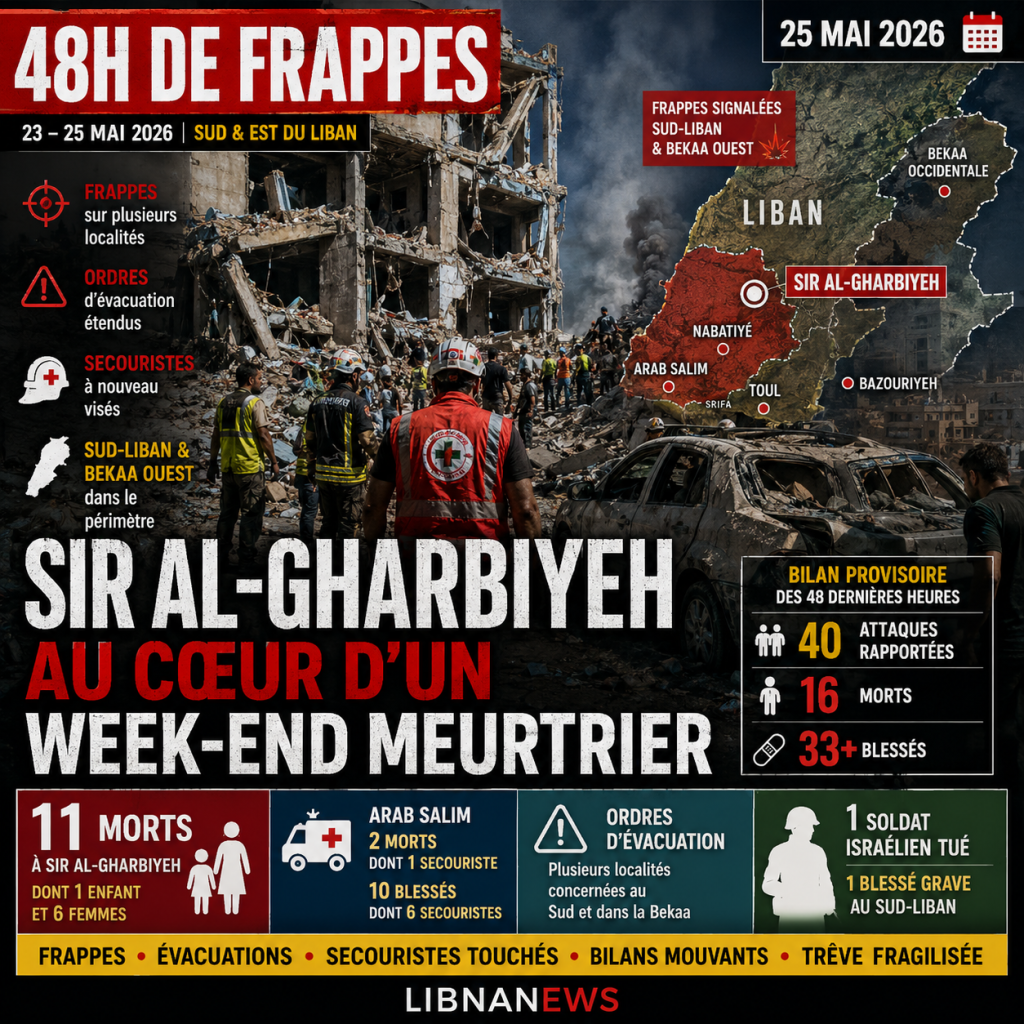
Between Saturday, 23 and Monday, 25 May, Lebanon crossed a new sequence of strikes, evacuation orders and interim balances, with Sir al-Gharbiyeh as the heaviest point of the weekend. In the Nabatiyah district, a strike killed 11 people, including one child and six women, and injured nine others, according to a report from the health authorities. Around this episode, the attacks spread to Arab Salim, al-Namiriya, al-Duweir, Toul, Bazouriyeh, Toura, Srifa, Nabatiyah and several localities in the western Bekaa. The figures available remain scalable, as relief workers have worked under pressure, sometimes in areas hit several times.
Main balance sheets
| Date | Location | Reported review | Details |
|---|---|---|---|
| 22 may | Hanuiyeh | 4 dead, 2 injured | Four Islamic Health Association first aid workers killed |
| 22 may | Deir Qanoun al-Nahr | 6 dead, 6 injured | Of which two rescue workers and one Syrian child |
| 23 may | South and East Lebanon | 16 dead, at least 33 injured | 40 reported attacks |
| 23-24 may | Sir al-Gharbiyeh | 11 dead, 9 injured | One child and six women killed |
| 24 may | Arab Salim | 2 dead, 10 injured | Of which one rescue worker killed and six rescue workers injured |
| 24 may | al-Namiriya | 2 dead, 1 injured | Three strikes against two motorcycles |
| 24 may | Toul | 1 death | Motorbike targeted near the hospital Sheikh Ragheb Harb |
| 24 may | Bazouriyeh | 1 dead, 2 injured | Hit in Tyre District |
| 24 may | Toura | 1 dead, 2 injured | Target house |
| 24 may | Srifa | 3 bodies removed | House hit in Taffahiya area |
| 25 may | South Lebanon | 1 israeli soldier killed, 1 seriously injured | Sergeant Nehoray Leizer, 19 |
A sequence dominated by Sir al-Gharbiyeh
The centrality of the last 48 hours remains Sir al-Gharbiyeh’s strike. The village, located in the Nabatiyah District, was hit on Saturday by a raid on a three-storey residential building in the Zouhour District. The balance sheet first circulated in a partial form, before being revised upwards after the rubble searches. The health authorities finally announced 11 deaths and 9 injuries. Among the deaths are one child and six women. Four children and one woman were identified as injured.
This strike concentrates the elements that explain the gravity of the sequence. The building was a dwelling. The victims include several civilians. Relief must have been in a still unstable environment. Families waited to identify the bodies, while hospitals in the area received the injured. As a result, progress has been made in stages, as often after strikes that completely destroy a building. This is not just a figure. It is the heart of the human balance of the weekend in South Lebanon.
Around Sir al-Gharbiyeh, other localities in Nabatiyah District were subjected to Israeli strikes or warnings. Jebchit, Harouf, Kfar Rummane, Habush, Toul, Zebdine, Kfar Jouz and Arab Salim were cited in the field reports, evacuation orders or health records. This concentration of incidents has given the Nabatiyah area a central role in the events of the last 48 hours. The city of Nabatiyah itself was also affected, including the destruction of the regional civil defence centre.
Saturday: 40 attacks and heavy payload
Saturday was one of the most dense of the sequence. A regional count refers to 40 Israeli attacks in southern and eastern Lebanon, including 37 airstrikes, one artillery fire and two destruction or explosion operations. At least 16 people were killed and 33 injured. These figures aggregate several sectors and should be read with caution, as some local balance sheets were updated later. However, they provide a clear indication of the pace of attacks.
In the Tyre area, several strikes were reported during the weekend. In Srifa, three bodies were removed from the rubble of a house hit in the Taffahiya area. In Bazouriyeh, one strike resulted in one death and two injuries. In Toura, a woman was killed and two other people were injured when a house was targeted. These estimates are less heavy than that of Sir al-Gharbiyeh, but they show the dispersion of strikes on several villages and roads.
Arab Salim and affected relief
The impact of Arab Salim added a particularly sensitive dimension to the balance sheet. On Sunday, two people were killed, including an Islamic Health Authority first aid worker, and ten others were injured. The injured included six rescue workers. The village had already been mentioned in Israeli warnings and in reports of attacks. The information available indicates that rescue teams were involved in an area already affected. This reinforces concerns about the safety of the extraction and evacuation of injured persons.
Arab Salim is part of a wider series of attacks on rescue personnel. On Friday, 22 May, just before the main reporting period, strikes on Hanouiyeh and Deir Qanoun al-Nahr had killed 10 people, including six relief workers and one Syrian child. In Hanuiyeh, four relief workers from the Islamic Health Association had been killed. In Deir Qanun al-Nahr, six people had died, including two rescue workers affiliated with Scouts al-Rissala and one child. These immediate precedents weigh on the reading of the weekend.
The destruction of the regional civil defence centre in Nabatiyah also illustrates the pressure on local relief capabilities. The building was hit in the night from Saturday to Sunday. It collapsed, and several vehicles and equipment were damaged. No operatives were reported killed in this strike, the teams having been displaced before. But the loss of such a support point reduces the response capacity in an area where attacks multiply.
Motorbikes, vehicles and roads under threat
On Sunday, several drone strikes targeted motorcycles or vehicles. In al-Namiriyah, two young men were killed and another person injured after three successive strikes against two motorcycles in the al-Ghabrah neighbourhood. In al-Duweir, a motorcycle was targeted, and residents who came to inspect an affected site were beaten according to local reports. In Toul, a motorcycle was shot near Sheikh Ragheb Harb Hospital, killing a young man. These targeted attacks rhythmized the day and complicated the distinction between isolated incidents and coordinated sequence.
On the Nabatiyah-Zefta axis, a municipal vehicle was hit. Mohammad al-Jawad Fadi Bitar, presented as a municipal official, was killed. His father, Fadi Bitar, was seriously wounded. The attack shows that the victims are not limited to the occupants of homes affected by air strikes. Movements on local roads have also become dangerous, especially for motorcycles, municipal vehicles and cars travelling between villages already under drone surveillance.
Western Bekaa in the perimeter of the strikes
Western Bekaa has also been affected, marking an important geographical extension. The areas of Sohmor, Klaia and Labbaya were mentioned after evacuation orders. Strikes also targeted the area between Sohmor and Labbaya. This region is at a distance from the immediate border line, which reinforces the feeling of expansion of the theatre of operations. For residents, the distance from the border no longer guarantees relative security.
The evacuation orders accompanied this intensification. On Saturday, the Israeli army asked the inhabitants of several localities to leave their homes and move at least 1,000 metres away to open spaces. On Sunday, new warnings targeted Kfar Sir, Sir al-Gharbiyeh, Zrariyeh, Ansar, Mazraat Kouthariyet al-Riz and Kharayeb. Another message mentioned Machghara, Deir al-Zahrani, al-Sharqiyah, al-Duweir, Qlaia, Sohmor, Zebdine, Nabatiyah al-Tahta, Arab Salim and Kfar Jouz. On Monday morning, other southern localities were still mentioned in new opinions.
These warnings cause population movements that are difficult to measure. Families leave the threatened villages to Saida, Beirut or communities deemed safer. Others stay there to protect their homes, care for elderly relatives or for lack of immediate solution. Municipalities must then identify absent, injured, displaced and property damage. This work takes time. He explained some of the differences between the first balance sheets and the consolidated figures several hours later.
Damage to the local economy
Material damage also affects economic sectors. In the Nabatiyah area, shops, restaurants, galleries, a cooperative, a gas station and residential or mixed buildings were damaged or destroyed. In Habush, a strike destroyed a residential and commercial building near an international school. In Marj Harouf, commercial facilities suffered significant damage. These destructions disrupt local supply, while population displacement increases needs.
Hezbollah and the Israeli army continue operations
Hezbollah claimed several operations during the same period. The movement reported targeting Israeli military vehicle rallies in the Biyyada area, as well as positions in Rachaf and near Nahr Deir Siryan. He also claimed rocket fire, artillery fire and drone attacks against Israeli positions. These operations are part of a claimed response dynamics, while Israel claims to be targeting Hezbollah-related infrastructure, fighters or movements.
On the Israeli side, the army announced on Monday the death of 19-year-old Sergeant Nehoray Leizer of the 601st Combat Engineer Battalion in southern Lebanon. Another soldier was seriously injured in the same incident. Israeli media reported an explosive drone attack. This loss confirms that fighting is not limited to remote bombing. It also shows that ground operations or near the contact line remain costly for the Israeli army.
Political declarations and fragile truce
Political statements maintain tension. Israeli Prime Minister Benjamin Netanyahu told Donald Trump that Israel intended to maintain its freedom of action in the face of threats, including in Lebanon. This position weakens the practical scope of the truce, as it leaves the continuation of the strikes open. US Secretary of State Marco Rubio accused Hezbollah of seeking to plunge Lebanon back into chaos. He also defended Israel’s right to protect itself from the shooting or attacks prepared by the movement.
On the Hezbollah side, Naïm Qassem rejected the movement’s calls for disarmament. He presented this option as an attack on Lebanon’s defence capability. He also linked the Lebanese situation to the American-Iranian discussions, expressing the hope that a possible regional agreement would include a cessation of hostilities in Lebanon. This position maintains the Lebanese case in a broader regional context, where Washington, Tehran and Tel Aviv have a direct impact on Beirut’s policy space.
The truce therefore remains very fragile. Israel and Lebanon had accepted a 45-day extension of the United States-mediated ceasefire, but the strikes and responses continued. The talks planned in Washington must deal with the ceasefire, the Israeli withdrawal, the security of northern Israel and the disarmament of Hezbollah. The positions remain distant. Beirut calls for an end to the attacks and Israeli withdrawal. Israel calls for security assurances and the dismantling of Hezbollah’s military capabilities.
Washington, Tehran and the Lebanese file
The discussions between the United States and Iran add a second diplomatic level. Washington is seeking a broader agreement, which could include reopening the Strait of Ormuz, Iran’s nuclear issue, sanctions and regional fronts. Tehran wants Lebanon to be integrated into any arrangement. The available information suggests a possibility of de-escalation, but no concrete mechanism has yet stopped the bombing. On the ground, the inhabitants do not yet see a difference between the announced truce and the daily reality.
The human balance sheet must also be placed in a heavier national context. Since the resumption of hostilities on 2 March, the Lebanese authorities have reported more than 3,000 deaths and several thousand injuries. The figures published over the last few days vary according to the hour of consolidation and by integrated deaths after hospital transfer. This variation should not be interpreted as an automatic contradiction. It reflects a pressured health system where hospitals, morgues, municipalities and rescue teams transmit their data at different times.
Rescue workers also face a major operational difficulty. When a strike destroys a house or targets a vehicle, the first teams must check the absence of threatening drones before approaching. This expectation can waste a decisive time. It can also delay body extraction, especially when rubble is unstable or roads have been damaged. In several villages in the South, families do not immediately obtain full information on the fate of relatives who are absent.
The inhabitants describe a life suspended from warning messages, local sirens and information from municipalities. Shops close as a precaution. Schools and administrations adapt their schedules or interrupt their activities. The hospitals in Nabatiyah, Tyre and Saida receive wounded people from several villages at the same time, making it difficult to track the victims by locality. In this context, the publication of a final assessment often requires several overlaps, especially when victims belong to displaced families.
The balance sheet of the last 48 hours remains open. In Sir al-Gharbiyeh, Arab Salim, al-Namiriya, al-Duweir, Toul, Bazouriyeh, Toura, Srifa, Nabatiyé and in the western Bekaa, figures can still evolve after identification of victims, hospital transfers and municipal checks. This uncertainty does not contradict the balance sheets already published. It reflects the fragmentation of the terrain, the increasing number of strikes and the difficulty of intervening quickly in areas still overlying or threatened. On Monday, the day opened with new warnings, while families sought to recover the bodies and arrange evacuations.




