

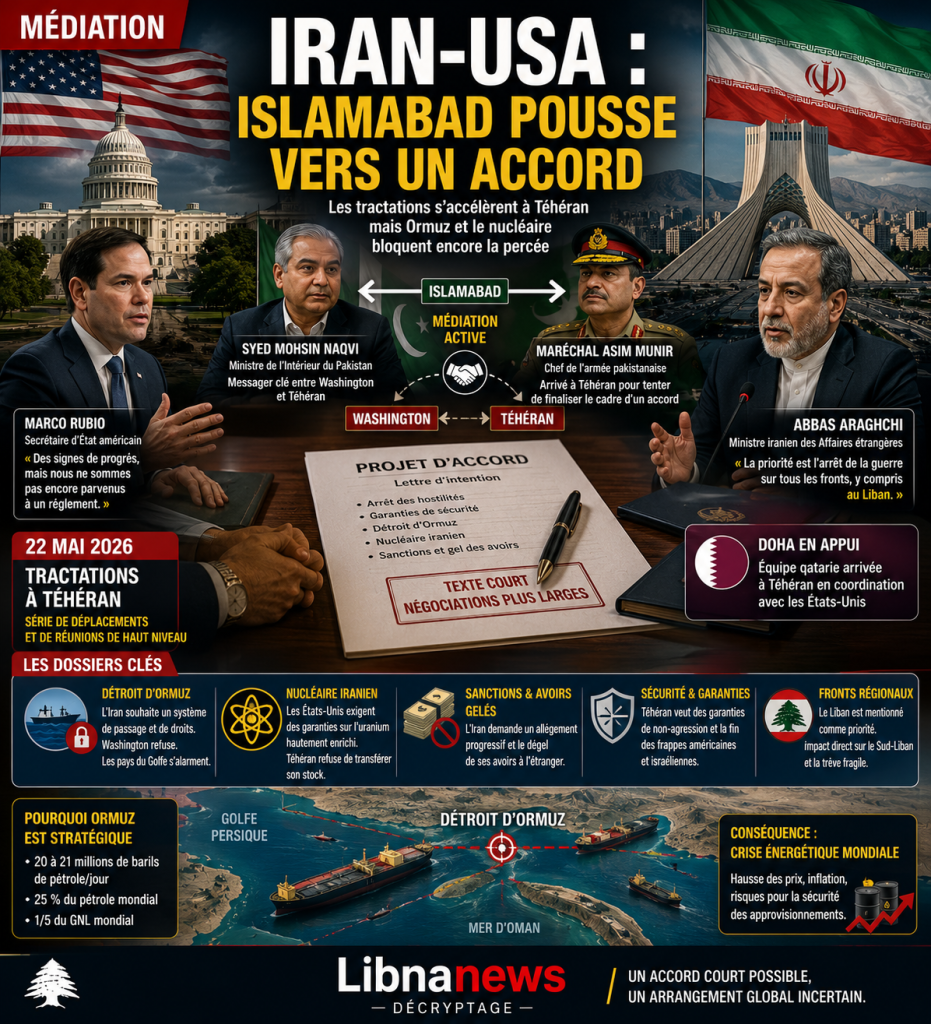
Mediation around a possible Iran-USA agreement accelerated on Friday 22 May 2026 with a series of trips to Tehran, against the backdrop of fragile truce and blockade around the Strait of Ormuz. Pakistan’s Minister of Interior, Syed Mohsin Naqvi, met again with the head of Iranian diplomacy, Abbas Araghchi, to discuss proposals to end the war between Washington, Israel and Tehran. At the same time, a Qatari negotiating team arrived in the Iranian capital in coordination with the United States. The leader of the Pakistani army, Marshal Asim Munir, was also reported in Tehran by media and security sources.
These diplomatic movements do not mean that an agreement is reached. However, they show that indirect exchanges have reached a more active stage. A senior Pakistani official quoted by CBS claimed that the meetings of the Pakistani Interior Minister in Iran had enabled the negotiations to move forward in a « important direction ». Diplomatic sources cited by the Arab press refer to a possible one-page document, conceived as a short political basis, and then a period of broader discussion within a defined time frame. Washington is careful. State Secretary Marco Rubio acknowledged signs of progress, but stressed that the parties had not yet reached a settlement.
The issue goes beyond the only relationship between the United States and Iran. The issue directly affects Gulf security, global energy trade, freedom of navigation in the Strait of Ormuz, Iran’s nuclear programme, US sanctions and regional fronts, including Lebanon. For Beirut, the sequence is followed carefully. A relaxation between Washington and Tehran could alter the balance of power in southern Lebanon, where the truce remains fragile and where Hezbollah links its military position to the regional context.
Iran-USA agreement: Pakistan mediation on the front line
Pakistan has established itself as the central intermediary of this sequence. Islamabad has long-standing relations with Iran, strategic dialogue with Washington and a capacity to speak to both military actors and diplomats. This double entry explains the role of Syed Mohsin Naqvi, but also that of Marshal Asim Munir. The former carried messages and proposals to Tehran. The second represents the Pakistani military institution, which is very influential in regional security issues.
According to semi-official Iranian media, Mohsin Naqvi delivered an American message to the Iranian authorities during a previous visit, before returning to Tehran for further consultations. His meeting with Abbas Araghchi focused on the ongoing indirect exchanges between the United States and Iran, as well as on the points still open. Media sources also reported the displacement of the head of Pakistani intelligence services to Tehran. This element has not been publicly confirmed by all parties, but it corresponds to the nature of the issue: negotiations combine diplomacy, security, intelligence, maritime control and military guarantees.
The presence or arrival of Marshal Asim Munir gives additional weight to mediation. Security sources quoted by the American press indicate that he landed in Tehran in an attempt to finalize a policy document. He was reportedly welcomed by the Iranian Minister of the Interior, Eskandar Momeni. His role is not new. He had already been involved in contacts with Iran and the United States in previous phases of discussion. But his displacement comes this time in a moment presented as more advanced, after several days of discussions conducted at a lower level.
Short document to open wider negotiations
The format mentioned by several sources is that of a short text. Diplomatic sources cited by the Arab press speak of a one-page agreement. Other media describe a letter of intent. The aim would not be to resolve all cases immediately, but to stop the conflict and lay down the principles of wider negotiation. A 30-day period is mentioned to address the most serious issues, including nuclear, sanctions, security assurances and management of the Strait of Ormuz.
This architecture responds to an obvious difficulty. The US wants specific commitments on highly enriched uranium, future enrichment and Iran’s regional capabilities. Tehran first wants a lasting cessation of hostilities, the gradual lifting of sanctions, the thawing of financial assets and guarantees against further strikes. Both sides do not place the same file at the beginning of the sequence. The short document would enable this orderly disagreement to be overcome without resolving it on the merits.
Iran seeks to postpone the detailed nuclear discussion to a later phase. Washington wants to avoid a ceasefire giving Tehran time to consolidate its positions without compensation. That is why the choice of words will be decisive. A single page text may seem modest. However, it can engage the parties on principles that are difficult to interpret afterwards. The terms « stopping hostilities », « guarantees », « enriched uranium », « navigation », « sanctions » or « foreign forces » may open different readings. Negotiators are therefore looking for a formula specific enough to be credible, but flexible enough to be accepted.
The Strait of Ormuz in the centre of the arm
The most urgent dispute concerns the Strait of Ormuz. Its closure or near closure since the beginning of the war has led to a global energy crisis. Prior to the conflict, a major part of the oil and liquefied natural gas transited through that passage. Disruptions have increased prices, reinforced inflationary fears and placed the Gulf countries in an extremely vulnerable position. Qatar is directly concerned because its liquefied gas exports depend on this sea route.
Iran wants to keep a lever on the strait. Recent information refers to an Iranian Gulf crossing authority project, with the possibility of imposing duties or conditions on ships. Washington rejects this option. Marco Rubio considered the idea of a toll system in an international waterway unacceptable. The United States does not want to give Tehran economic control over a vital passage for global energy.
Several Gulf States are also concerned about this prospect. Bahrain, Kuwait, Qatar, Saudi Arabia and the United Arab Emirates alerted international maritime authorities to the risk of precedent. Their fear is simple: if Iran imposes a road, permits or fees, it turns an international strait into a political instrument. Oman, whose geographical position is essential on the south shore, is also at the centre of the discussions, although its role is more cautious.
This case explains the return of Doha to mediation. Qatar had distanced itself from being hit by Iranian fire during the conflict. His return to Tehran shows that the economic cost of an Ormuz paralysis has become too high. Doha remains a major ally of the United States, host of the Al-Udeid base, but it also maintains effective channels with Iran. This position makes it a useful actor when the maritime file becomes the key to an arrangement.
Nuclear remains the political lock
The second lock is nuclear. The US demands that the agreement address Iran’s stock of highly enriched uranium and future enrichment policy. Washington says Tehran must never have a nuclear weapon. Iran claims that its program is civilian and refuses to return its stock abroad. Iranian sources cited by international media indicate that the Tehran line is not to transfer enriched materials out of the country, even in the context of a de-escalation.
The subject is politically explosive for both sides. For Donald Trump, accepting a text without visible nuclear safeguards would expose the White House to internal criticism. For the Iranian leaders, yielding to uranium under military pressure would seem defeated. Negotiators must therefore build a mechanism that allows Washington to claim a concrete limitation, and Tehran to say that it has not capitulated. Several options can be used in such situations: temporary freezing, enhanced monitoring, stock processing, controlled storage, or deferred engagement. No formula was announced as accepted.
The composition of the Iranian team adds uncertainty. Mohammad Bagher Ghalibaf, President of the Iranian Parliament, remains a central figure in the delegation. Information had referred to his withdrawal, but a communications officer of the Iranian Parliament denied and claimed that he remained at the head of the team. His profile is important. A former commander of the Revolutionary Guards and a conservative political figure, he offered Tehran legitimacy to the hard currents. Its presence can make a compromise more acceptable in Iran, but it can also tighten the formulation of requirements.
Tehran advances several conditions
Known Iranian demands are organized around several axes. The first is the complete cessation of hostilities. Tehran wants the war to cease on all fronts and the American or Israeli strikes not to resume. The second concerns sanctions. Iran calls for gradual relief, the freezing of assets and the possibility of resuming economic transactions. The third concerns war damage. Requests for compensation were raised by diplomatic and media sources.
The fourth axis concerns American forces in the region. Tehran seeks guarantees of non-aggression and wants to reduce the freedom of military action in Washington and Israel. The fifth directly affects Lebanon. The spokesman for Iranian diplomacy, Esmail Baghaei, said that the current priority was to stop the war on all fronts, mentioning Lebanon. This sentence is not anomaly. It links Iran-USA negotiations to regional fronts, including South Lebanon, where Hezbollah remains a central player.
Washington, for its part, does not want to separate the ceasefire from nuclear and maritime security. The United States is concerned that a limited agreement to end hostilities will enable Iran to maintain its levers: uranium, missiles, drones, allied networks and Ormuz control. The negotiation therefore involves transforming a military pause into a binding process. This is where the announced timetable, if confirmed, becomes essential. A short delay may reassure Washington. It can also give Tehran time to negotiate without undergoing another immediate offensive.
The role of Qatar, Oman and the Gulf countries
Mediation is not just Pakistani. Oman has long served as a discrete channel between Washington and Tehran. Qatar is now back in the game. Turkey, Saudi Arabia and Egypt were also cited as participants in mediation or support efforts. But the roles are not the same. Pakistan carries the main message between the two capitals. Doha can help build a formula on Ormuz and talk to both Americans and Iranians. Oman remains indispensable on the geography of the Strait and on the historic canals.
Qatar has a direct motivation. The strikes and closure of Ormuz affected his energy interests. The return of its negotiators to Tehran is therefore not only a diplomatic tradition. It responds to an economic emergency. A partial resumption of maritime traffic would reduce pressure on markets and importing countries. It would also provide Washington with a political argument, showing that negotiations produce concrete results.
The Gulf monarchies, however, remain cautious. They do not want an agreement that would give Iran a form of right of control over navigation. They also do not want a general resumption of war, which would expose their energy infrastructure and cities. Their position is to support de-escalation, but without accepting that Tehran emerges from conflict with increased power on the sea. This tension will weigh on any final formula.
U.S. reactions remain cautious
The American line mixes opening and pressure. Marco Rubio recognizes progress, but insists on blockages. He claims that Pakistan remains Washington’s main interlocutor in this sequence. He also pointed out that the United States had other options if Iran did not change its position. This language targets several audiences: Iranians, Gulf allies, Israel, the American Congress and markets.
Donald Trump is also under duress. Higher energy prices are affecting the US economy. The November mid-term elections are approaching. An open resumption of war could result in high military, economic and political costs. Conversely, an agreement perceived as weak on the nuclear or on Ormuz could be attacked by its opponents and part of its own camp. The White House therefore had an interest in getting a short text, presentable as a first victory, without abandoning the substantive requirements.
This caution explains why no American officials are talking about breakthroughs yet. The words used remain measured: progress, movement, encouraging signs, work remaining. Diplomacy seeks to maintain pressure without failing the current phase. It also wants to avoid excessive expectations. A text of a page can be apparently ready and fail on a sentence. In this type of negotiation, the last line can sometimes be the most difficult.
Possible consequences for Lebanon
Lebanon observes this sequence with particular attention. The southern front remains linked to the regional power ratio. Hezbollah claims that its weapons and operations are part of the confrontation with Israel and in the defence of Lebanon. Israel requires guarantees on the removal or disarmament of the movement. The United States wants to strengthen the role of the Lebanese army and enforce the principle of State monopoly on weapons. A relaxation between Washington and Tehran could thus open a diplomatic window, but it would not automatically settle the Lebanese case.
If the Iran-USA agreement includes a reference to the cessation of war on all fronts, South Lebanon could be affected indirectly. This would raise several questions: the reduction of Hezbollah attacks, the cessation of Israeli strikes, the Israeli withdrawal from the occupied areas, the deployment of the Lebanese army and the role of UNIFIL. A regional agreement can create a framework. It does not replace a local mechanism. Beirut will therefore have to monitor the exact drafting of the text, if it is to come into being.
The Lebanese situation remains all the more sensitive as Washington has just punished officials linked to Hezbollah, the Amal movement and Lebanese security institutions. This pressure aims to reduce Hezbollah’s influence on the state. But it can also complicate internal discussions. If regional détente opens, Lebanon will need to articulate two priorities: to stop Israeli strikes and to prevent the arms issue from causing an institutional crisis.
A rocking moment, not yet a chord
The current sequence looks like a rocking moment. Mediators are active. The names are known: Syed Mohsin Naqvi, Abbas Araghchi, Asim Munir, Mohammad Bagher Ghalibaf, Marco Rubio, Esmail Baghaei and Qatari teams. The subjects are identified: cessation of war, Ormuz, uranium, sanctions, guarantees, frozen assets, regional fronts. The formats are outlined: a page, a letter of intent, 30 days of discussions, and then a wider agreement.
But the obstacles remain heavy. Iran wants to preserve its levers. Washington wants to avoid a ceasefire without verifiable concessions. The Gulf countries want to reopen Ormuz without recognizing Iranian control. Israel will want to ensure that any arrangement does not strengthen Iran and its allies. Pakistan seeks to convert its role as a messenger into a diplomatic outcome. Qatar is trying to save a vital energy road. None of these objectives is impossible to reconcile, but none is perfectly superimposed on others.
The next step will depend on the Iranian response to the transmitted text, Pakistan’s ability to obtain an acceptable formulation and the place given to the nuclear issue in the first document. If a short agreement is announced, what it really contains will have to be examined. If he mentions only the cessation of hostilities, Washington will have to explain how he then obtains guarantees. If it already includes uranium and Ormuz, Tehran will have to justify these concessions in front of its toughest currents. Between these two lines, the mediators are still looking for the sentence that will allow the war to be suspended without ending the conflict.




