

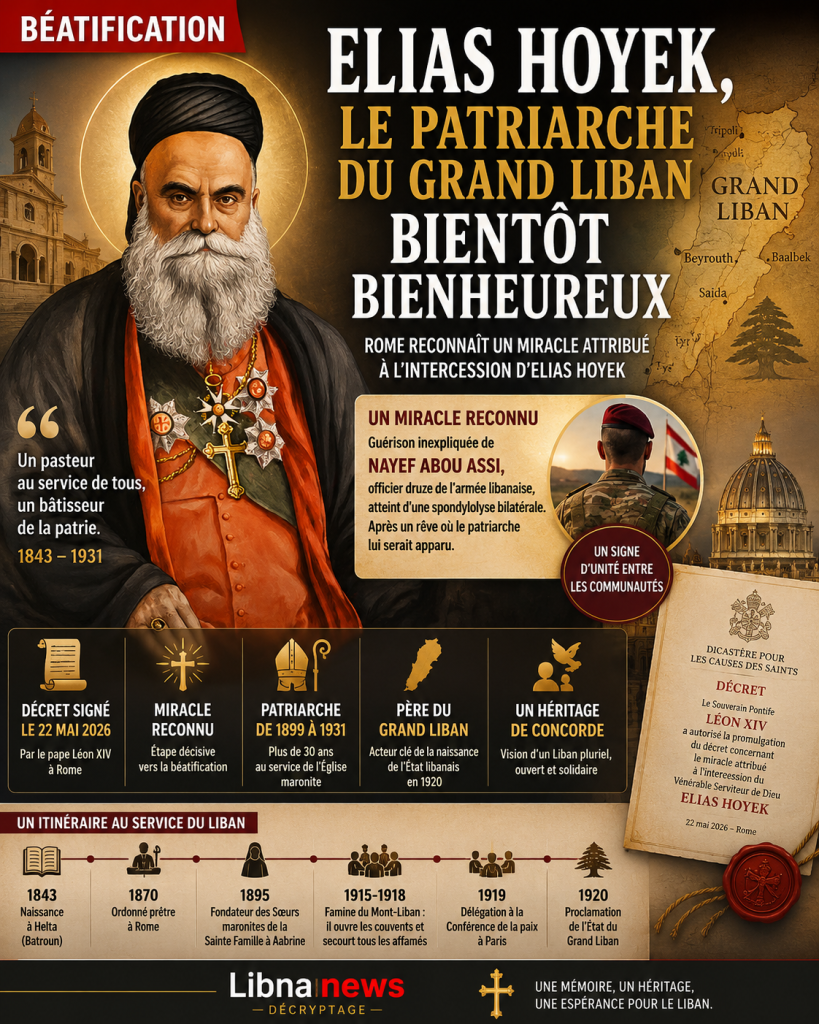
The decree signed in Rome opens a new stage for the Maronite Church and for Lebanon. On May 22, 2026, Pope Leo XIV authorized the promulgation of a decree recognizing a miracle attributed to the intercession of Elias Hoyek, former Patriarch of Antioch of the Maronites and founding figure of Greater Lebanon. This recognition makes its beatification possible, even if the date of the ceremony has not yet been officially announced. For the faithful, it enshrines in the spiritual calendar an already central personality in national memory.
The decision goes beyond the ecclesial framework. Elias Hoyek remains associated with two major legacies: the modern structure of the Maronite Church and the political birth of contemporary Lebanon. Patriarch from 1899 to 1931, he led his community during the last years of the Ottoman Empire, the First World War, the famine of Mount Lebanon, the 1919 peace negotiations and the proclamation of the State of Greater Lebanon in 1920. His name remains linked to a concept of Lebanon as a homeland of coexistence, rooted in an identity of its own and open to several communities.
The announcement comes in a heavy national context. Lebanon is facing a continuing political, economic and security crisis. The South remains under military pressure. Institutions are trying to regain their authority. Communities are looking for benchmarks in a period of uncertainty. In this climate, the future beatification of Elias Hoyek takes on a special symbolic significance. It recalls a period when a religious authority had carried a political vision of the country, while stressing the protection of the population and the defence of an expanded Lebanese territory.
Elias Hoyek soon beatified after a recognized miracle
The decree approved by Leo XIV recognizes a miracle attributed to the intercession of the venerable servant of God Elias Hoyek. The canonical procedure thus passes the necessary step before beatification. In the Catholic Church, the recognition of heroic virtues makes it possible to declare a person venerable. The recognition of a miracle opens the way to beatification. A second miracle is usually required for canonization, except in cases of martyrdom.
The miracle involved Nayef Abu Assi, an officer of the Lebanese army and a Druze Muslim. According to the media of the Holy See and taken up by the Catholic press, he suffered from chronic bilateral spondylolysis, a spinal condition that could cause persistent pain and mobility disorders. The healing, presented as scientifically unexplained in the context of the procedure, would have taken place after a dream in which the patriarch appeared to him. The element holds attention by its interfaith character: the recognized miracle concerns a Druze soldier who attributes his healing to a Maronite patriarch.
This detail gives a strong Lebanese resonance to the decision. In a country where political and religious memory is often fragmented, the fact that a miracle attributed to a Maronite figure concerns a Druze officer feeds a national reading of the event. He refers to the image of a patriarch presented as a defender of a plural Lebanon, not as a leader limited to his own community. The Maronite Church sees this as a spiritual sign. The political authorities also read a reminder of the idea of concord between the components of the country.
The decree of 22 May was announced after a hearing granted by Pope Leo XIV to Cardinal Marcello Semeraro, Prefect of the Dicastery for the Causes of Saints. A total of six decrees were authorized. They also concern the martyrs of Santander, killed during the Spanish civil war, as well as several servants and servants of God whose heroic virtues have been recognized. The Hoyek case is distinguished by its eastern, Lebanese and Maronite scope. He re-emphasizes Lebanon in the contemporary geography of Catholic holiness.
A Patriarch in the Heart of Modern Lebanese History
Elias Hoyek was born on 4 December 1843 in Helta, Batrun region, northern Lebanon. He entered the seminary at the age of sixteen, then continued his training in Rome. He studied theology and received priestly ordination in 1870. This Roman formation made its profile lasting. It is part of a Maronite tradition linked to Rome, while preparing it to act in an Ottoman, Eastern and multi-denominational environment.
After returning to Lebanon, he participated in the pastoral and institutional life of the Maronite Church. In 1895 he founded with Mother Rosalie Nasr the Congregation of the Maronite Sisters of the Holy Family in Aabrine, in the Batrun. This foundation is a major milestone. It is presented as the first Maronite female congregation of apostolic life. It combines education, social mission and Christian formation of families. The link between Hoyek and this congregation remains central today, since the nuns welcomed the announcement of his beatification as that of their founding father.
Elias Hoyek was elected patriarch in January 1899 and led the Maronite Church for more than three decades. His patriarchy covers a period of profound upheaval. He must manage the relationship with the Ottoman Empire, preserve religious institutions, support the faithful affected by poverty and maintain ties with Rome. He also works on the formation of the clergy, Christian education and pastoral expansion of the Maronite community in Lebanon and the diaspora.
His stature is not confined to his duties. Ecclesial accounts portray him as a man of piety, discipline and charity. His action during the First World War contributed to this reputation. Faced with the famine that ravaged Mount Lebanon between 1915 and 1918, he opened houses, convents and patriarchal structures to the hungry, without distinction of religious affiliation. This humanitarian dimension today feeds the spiritual record as well as national memory.
Famine, war and moral authority
The famine of Mount Lebanon deeply affected the generation of Elias Hoyek. The blockades, war, requisitions, economic disorganization and locust invasions have caused a major human catastrophe. Historical estimates vary, but the event remains one of the founding traumas of modern Lebanon. The patriarch then acts as a religious leader, but also as a social authority. It mobilizes Church networks, welcomes victims and seeks diplomatic support.
The Vatican sources recall that the Ottoman authorities had envisaged his exile, before diplomatic interventions spared him. This sequence reinforces the image of a religious leader exposed to political pressure but determined to defend his population. She also explains why her spiritual record is not limited to personal piety. Charity and the protection of the poor are central to the story of his life.
In Maronite memory, this period confirmed the role of patriarchy as a protective institution. But it also broadened Elias Hoyek’s perspective on the territorial issue. The famine showed the economic limits of historic Mount Lebanon, deprived of sufficient agricultural plains and dependent on external circuits. The idea of a Greater Lebanon is therefore not just a choice of identity. It also responds to a social and economic reading: a viable country must have agricultural land, access to ports and an area capable of feeding its people.
This reading remains debated by historians, particularly because of the demographic and political consequences of territorial enlargement. Greater Lebanon has brought together regions with different religious balances. It has changed the relative place of communities and opened up a complex institutional history. But the role of Elias Hoyek in the formulation of this request is not in doubt. It defended a wider territory than the moutasarifiyya of Mount Lebanon, with Beirut, Tripoli, Saida, Tyre, the Bekaa and other areas deemed necessary for the balance of the future state.
The Father of Greater Lebanon
In 1919, Elias Hoyek led a Lebanese delegation to the Peace Conference in Paris. He presented the Lebanese claims in the name of a Lebanon separate from internal Syria and placed under French mandate. The memorandum submitted by the delegation called for the restoration of so-called natural and historical borders. It claims a territorial package comprising coastal cities, their hinterland, the Bekaa and the areas attached to the future Greater Lebanon.
This approach is part of the recomposition of the Middle East after World War I. The Ottoman Empire collapses. Victorious powers discuss mandates. Arab, Syrian, Lebanese and community nationalisms cross and oppose each other. Hoyek then became one of the most visible figures of the trend favourable to an autonomous Lebanon, distinct from Damascus and linked to France. Its action does not represent all the sensitivities of the time, but it weighs heavily on the final result.
On 1 September 1920, General Henri Gouraud proclaimed the State of Greater Lebanon in Beirut. Elias Hoyek is present. The event marks the political birth of the territorial framework that will become the Lebanese Republic. It is this sequence that earned him the title of « Father of Greater Lebanon ». The word is not only honorary. It refers to a diplomatic role, a territorial vision and an ability to transform a community and institutional claim into a political project.
This legacy remains sensitive. For some Lebanese, Hoyek embodies the founding act of a pluralistic country, with its historical boundaries and its own vocation. For other readings, Greater Lebanon is also the beginning of a fragile balance, built under mandate and crossed by lasting denominational tensions. The future beatification does not regulate these debates. It places them in a spiritual memory that emphasizes charity, unity and public service rather than just institutional construction.
Reactions between religious joy and national message
The most immediate reaction came from the Maronite Church. Patriarch Béchara Boutros Rai congratulated the Catholic Church, Lebanon, the Maronite Church and the Congregation of Maronite Sisters of the Holy Family for announcing the beatification of Elias Hoyek. In the current context, this message goes beyond liturgical expression. He explicitly associates Lebanon with the event, as if the recognition of a patriarch also became a recognition of a national memory.
The Congregation of the Maronite Sisters of the Holy Family also welcomed the news with special emotion. She presented Hoyek as her founder, but also as an intercessor for the family, priests and Lebanon. This reaction was expected. The body of the patriarch rests in Aabrine, at the convent of the congregation he founded. The venue should become more important in the coming months, especially if the preparation of the ceremony attracts faithful, pilgrims and religious leaders.
President Joseph Aoun welcomed the announcement on behalf of official Lebanon. He thanked Pope Leo XIV for his attention to the country, especially in the delicate circumstances that he was going through. He linked the event to the centenary of the Lebanese Constitution and saw it as a sign of protection of Greater Lebanon as Hoyek wanted: a homeland of harmony between communities, within its historical and civilizational borders. The presidential formulation gives a clear political reading to the event, without removing its religious dimension.
This institutional reaction shows how much Hoyek remains an active name in the Lebanese imagination. It is not just a patriarch of the past. His legacy is being mobilized today in debates about sovereignty, borders, living together, the place of Eastern Christians and the role of the State. The fact that the announcement comes as Lebanon is under strong security and diplomatic pressure further reinforces this symbolic burden.
A figure for Eastern Christians
The announced beatification also affects all the Eastern Churches. Elias Hoyek belongs to Maronite history, but his itinerary joins a broader question: how to preserve ancient Christian communities in an unstable political environment, without engulfing them in fear or cutting them off from other national components. His life goes through the end of Ottoman order, war violence, famine, possible exile, European diplomacy and the birth of a state. This journey speaks to a region where Christians still seek to combine rooting, citizenship and security.
His work in favour of the hungry, without religious distinction, remains one of the most prominent elements of ecclesial sources. It makes it possible to present Hoyek as a pastor at the service of all, not as a community defender in the narrow sense. The recognized miracle accentuates this reading, since it concerns a Druze of the Lebanese army. The future beatification can thus be understood as a Maronite event, but also as a message addressed to a multi-faith Lebanon.
Lebanon already knows several great figures of holiness recognized or venerated in the Catholic Church, including St. Charbel, St. Rafqa, St. Nimatullah Kassab Al-Hardini, Blessed Estephan Douaihy and other ongoing causes. The progress of the Hoyek dossier adds a political and institutional dimension to this spiritual gallery. It is not a hermit removed from the world, but a patriarch engaged in public affairs, diplomacy and social relief.
This specificity may explain the particular echo of the announcement. The proposed holiness is not separated from history. It is read in the exercise of heavy responsibility, in a violent period, with choices that have shaped a country. Through Hoyek, the Church emphasizes a form of spiritual leadership capable of acting in the city, speaking to the powers and defending the vulnerable.
Next steps expected
The recognition of the miracle does not automatically set the date of the beatification ceremony. It must still be organized, in connection with the Holy See, the Maronite patriarchate and the congregation founded by Hoyek. The choice of location will be closely monitored. Bkerké, patriarchal seat where he died, and Aabrine, where his body rests, occupy a central place in this memory. Harissa, associated with Our Lady of Lebanon, can also enter into the symbolism of the event, even if no official decision has been announced.
Preparation should involve the Maronite dioceses, schools, parishes, religious orders and Lebanese diaspora communities. It could also give rise to historical publications, conferences, pilgrimages and celebrations around the life of the blessed future. The challenge will be to hold together the religious dimension and the national dimension, without reducing one to another. Hoyek belongs to the Church, but his name is inscribed in the founding act of modern Lebanon.
The timing is all the more sensitive as the country goes through a period when institutional benchmarks are challenged. To recall the path of the patriarch amounts to questioning the initial promise of Greater Lebanon: a viable, pluralistic, sovereign State capable of protecting all its components. This promise remains unfinished. It has been tested by wars, economic crises, occupations, migration and internal fractures. Future beatification does not provide a political solution. However, it puts in the foreground a figure who had linked faith, service, diplomacy and national construction.
The continuation will now depend on the Roman and patriarchal calendar. The Church will have to announce the date, place and modalities of the celebration. The Lebanese authorities are likely to try to make it a national gathering. The faithful will look to Aabrine, Bkerke and the Maronite shrines, where the name of Elias Hoyek enters a new stage of recognition, almost a century after his death.




