

Marine Le Pen leads, Jean-Luc Mélenchon second and a center whose scores change with the proposed offer: the Cluster17 poll of November 9 and 10 tests four configurations of the presidential of 2027. Christine Lagarde obtained 14% when she replaced Édouard Philippe in the list submitted to the respondents. But it falls to 8% in the event that several personalities from the same political space compete together. These scenarios are neither confirmed candidatures nor a forecast of the election.
Referred to on 11 November by the Polling Commission, the survey covers 1,164 registered voters. They come from a sample of 1,242 people representing the French population. Interviews were conducted via the Internet using the quota method. The notice publishes the results of four lists, the treatments applied to the answers and a table of uncertainty. The graphs below reproduce the published percentages, not the gross results before adjustment.
Cluster17 Survey: Le Pen and Mélenchon ahead in all four cases
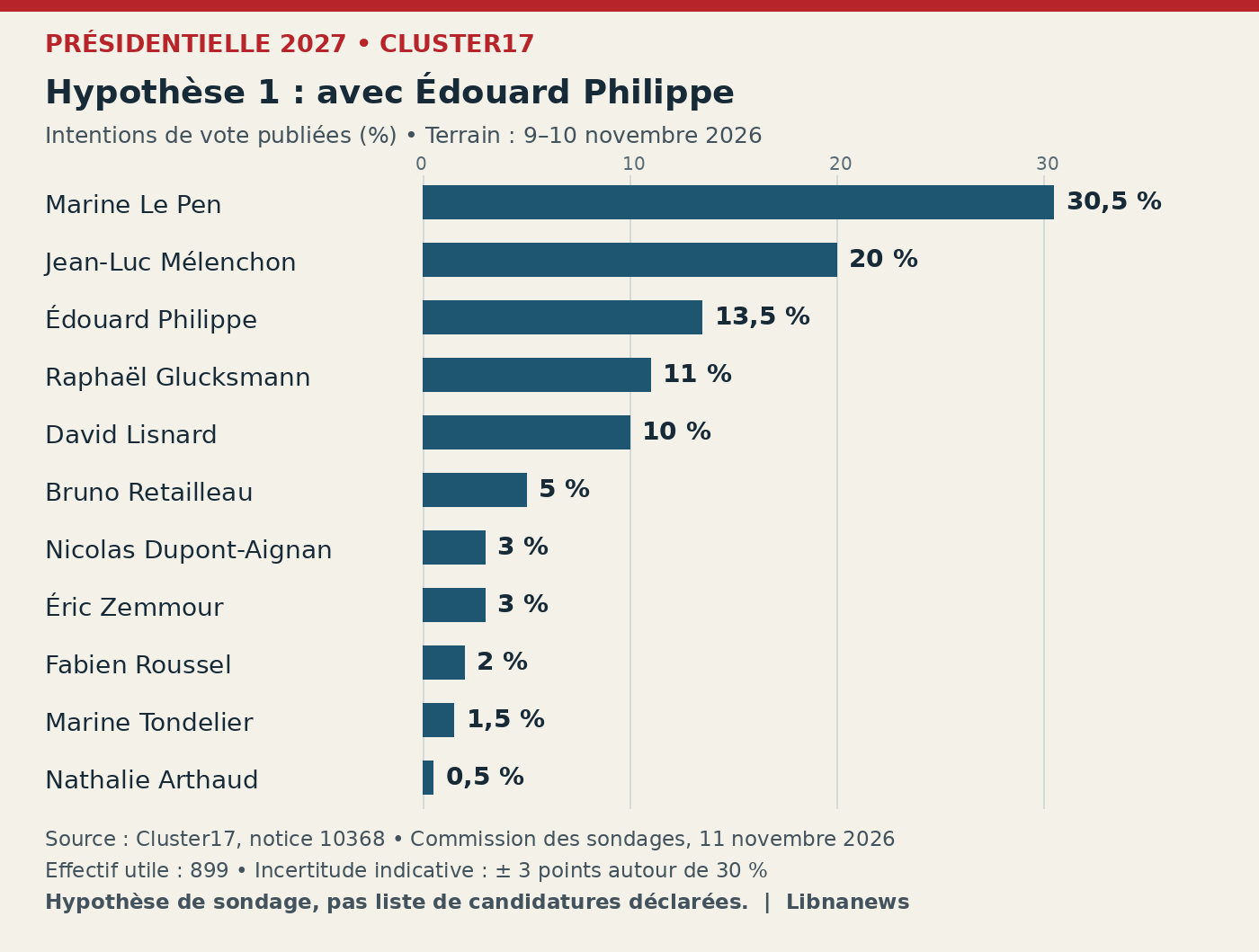
The first scenario includes eleven names. Marine Le Pen collected 30.5% of the voting intentions expressed, ahead of Jean-Luc Mélenchon at 20%. Édouard Philippe then reached 13.5%, Raphaël Glucksmann at 11% and David Lisnard at 10%. Bruno Retailleau is measured at 5%. Nicolas Dupont-Aignan and Éric Zemmour each received 3%, Fabien Roussel 2%, Marine Tondelier 1.5% and Nathalie Arthaud 0.5%.
This assumption does not bring all potential contenders into competition. Gabriel Attal and Christine Lagarde are absent. Édouard Philippe’s score thus describes a definite configuration, in which David Lisnard and Bruno Retailleau are among his opponents. This is not an internal competition at the centre alone.
Attal tested in a separate list
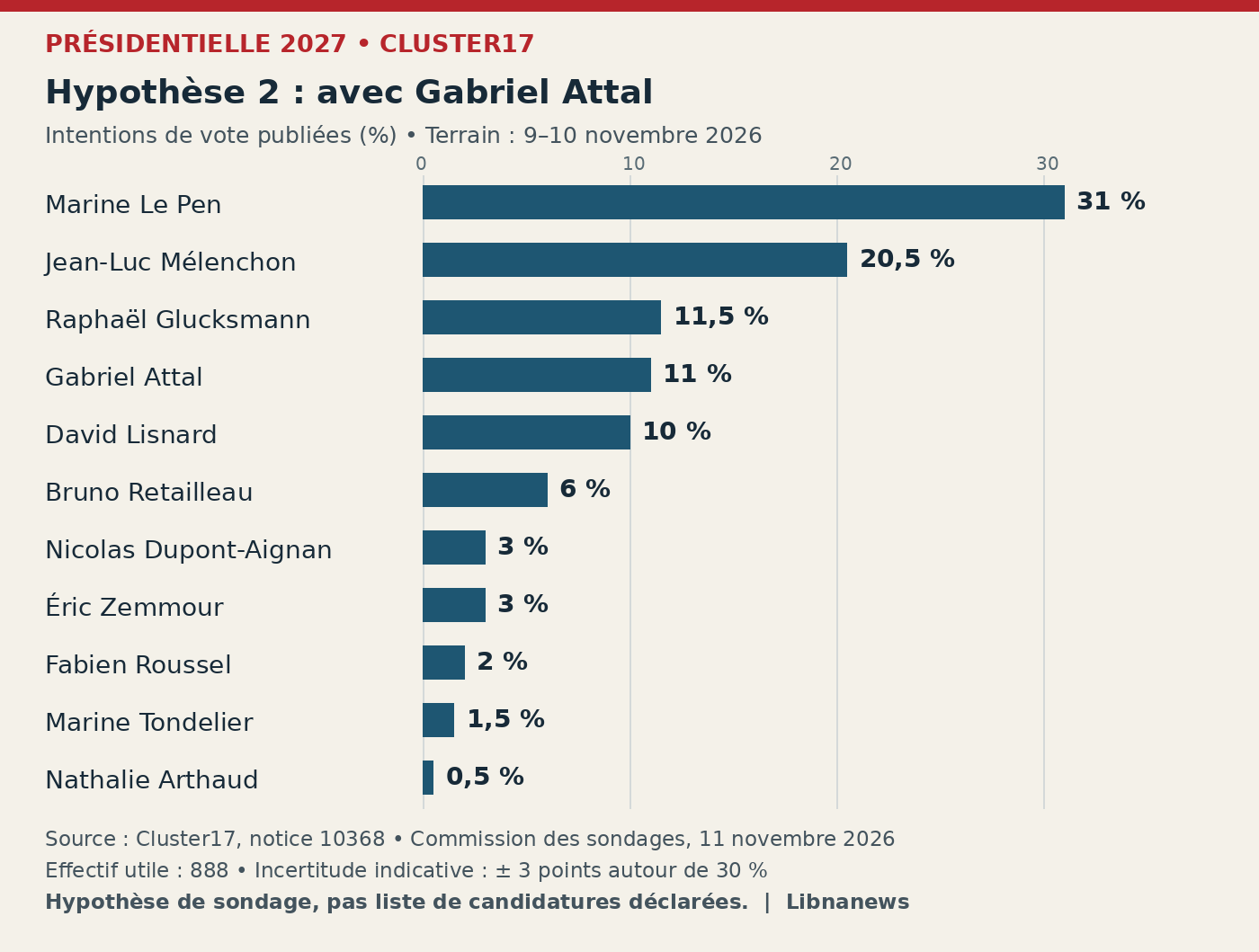
The second hypothesis replaces Édouard Philippe by Gabriel Attal. The other ten names remain the same. Marine Le Pen reached 31%, Jean-Luc Mélenchon 20.5% and Raphaël Glucksmann 11.5%. Gabriel Attal is credited 11%, ahead of David Lisnard 10% and Bruno Retailleau 6%. The bottom of the ranking remains close to the first scenario.
The comparison shows how the responses vary when the offer changes. It does not demonstrate an individual transfer of voters between two personalities. The published scores, for example, do not allow us to say that the 2.5 points separating Philippe in the first hypothesis and Attal in the second would come from a specific group of respondents.
Lagarde at 14%, but not a demonstrated advance on Philippe
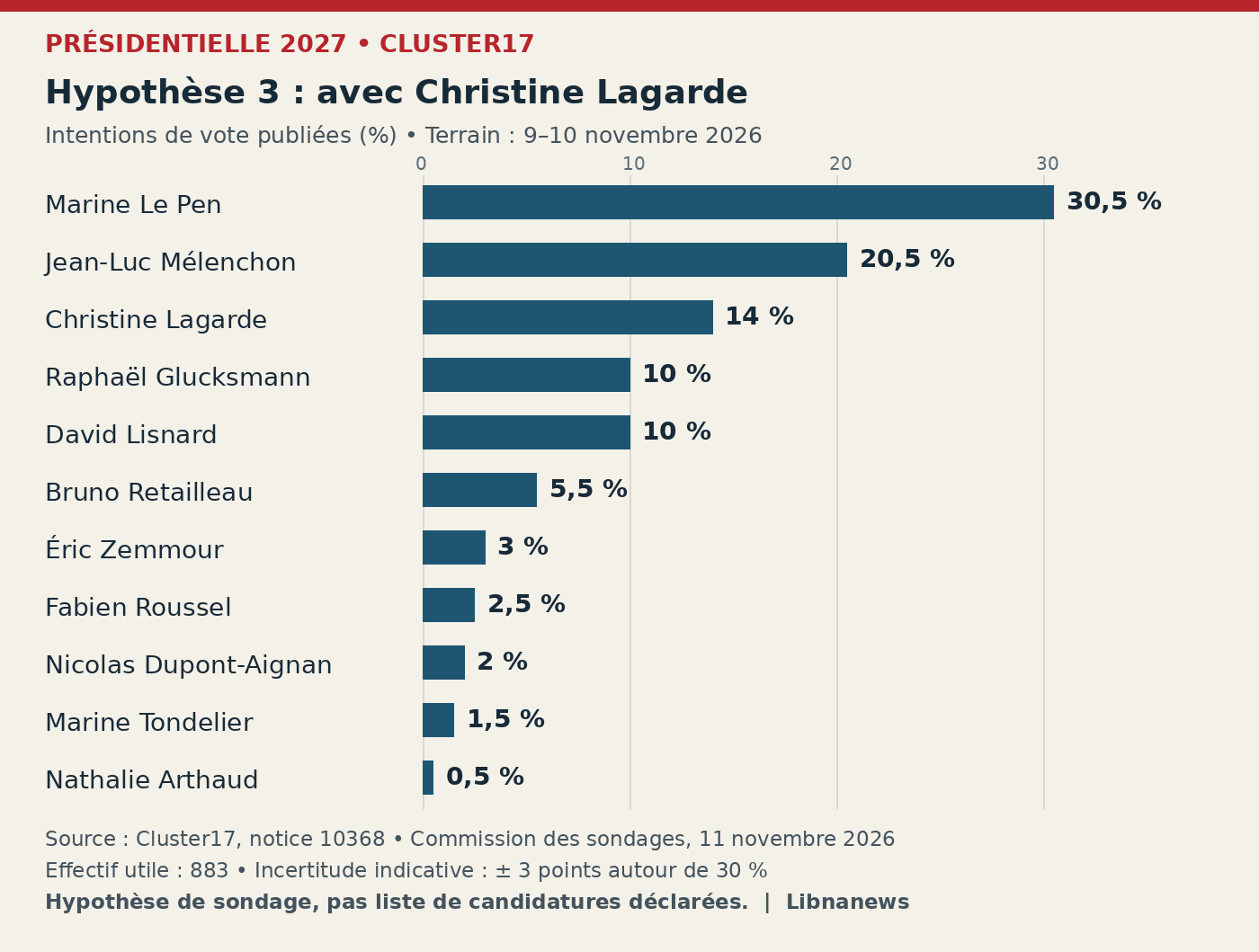
In the third scenario, Christine Lagarde took the place occupied by Philippe or Attal in the two previous lists. It collects 14%. Marine Le Pen remained at 30.5% and Jean-Luc Mélenchon reached 20.5%. Raphaël Glucksmann and David Lisnard are each 10%, Bruno Retailleau 5.5%. The presence of Lagarde’s name in the questionnaire does not, in itself, constitute an announcement of application.
Its result exceeds Philippe’s in the first list by 0.5 points. This gap is too small to be presented as proof of electoral superiority. Both personalities are not opposed in these assumptions and the estimates are uncertain. The useful result is more limited: Lagarde is measured at a level close to Philippe when each is listed separately in a comparable list.
The differences also concern the other candidates. Glucksmann is 10% in this third configuration, compared to 11% in the first; Melenchon increased from 20% to 20.5%. These variations are not sufficient to attribute a precise political origin to the intentions of Lagarde.
Eighteen names: a very different fourth hypothesis
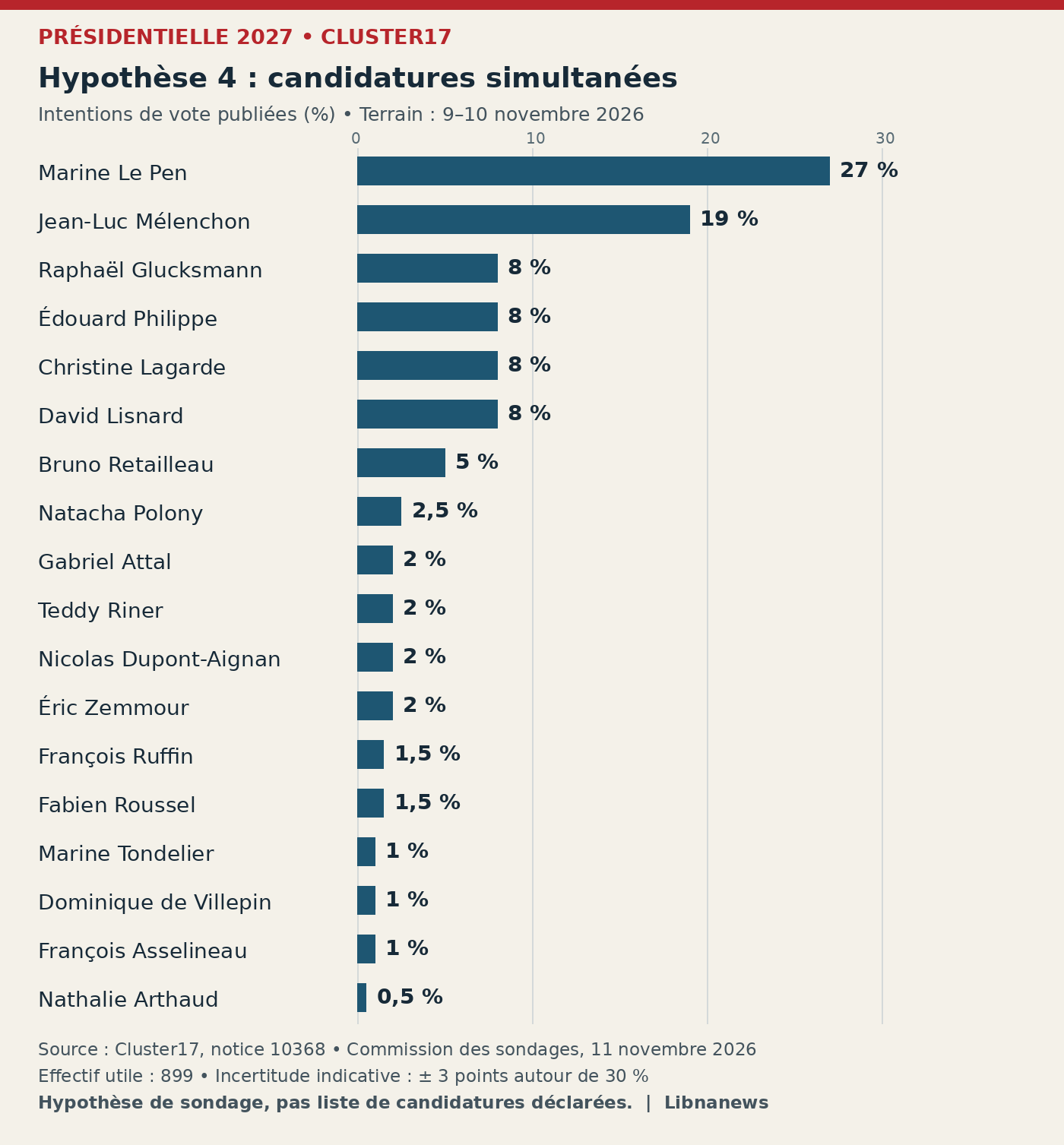
The last configuration greatly expands the choice. It includes Philippe, Attal and Lagarde, while adding François Ruffin, Dominique de Villepin, Natacha Polony, Teddy Riner and François Asselineau. Eighteen personalities are included in the list. Marine Le Pen remains first at 27%, ahead of Jean-Luc Mélenchon at 19%.
Four names were then measured at 8%: Raphaël Glucksmann, Édouard Philippe, Christine Lagarde and David Lisnard. Bruno Retailleau gets 5%, Natacha Polony 2.5%. Gabriel Attal, Teddy Riner, Nicolas Dupont-Aignan and Éric Zemmour are each 2%. All results, including those below this level, are shown in the graph.
The difference with the first three lists shows how important the composition of the hypothetical bulletin is. It does not measure a decline between two dates: the four scenarios belong to the same survey field. Neither can we add up the scores of Philippe, Attal and Lagarde to announce the results of a joint application. The questionnaire does not test this and the reports are not automatic.
Different calculation bases according to the scenarios
The initial sample size does not correspond to the useful number for each estimate. The notice indicates 1,081 respondents expressing an intention in Scenarios 1 and 3, 1,078 in the second and 1,142 in the fourth. After adjustment and weighting according to the characteristics of the respondents and their probability of voting, the useful numbers are 899, 888, 883 and 899 respectively.
For these bases, the published table indicates in particular an indicative uncertainty of ± 2 points around a score of 10%, ± 2.6 points around 20% and ± 3 points around 30%. Therefore, each half-point should not be read as an established political gap. Nor do these benchmarks summarize all the limits of a quota survey.
Cluster17 adjusts the sample by sex, age, occupation, size of commune and region. The political recovery is based on the memory of the first round of the presidential elections of 2022 and the Europeans of 2024. The declared participation shall also be included in the weighting. These treatments explain why published results sometimes differ significantly from raw responses.
Finally, the question relates to an immediate first round. It does not measure an acquired vote for 2027, nor the postponements of a second round. The actual candidates present, the participation and the choices of voters remain elements that this photograph of 9 and 10 November cannot stop.





Comments