


The price of coffee is not directly on a global quotation. After a sharp increase between 2023 and 2025, green coffee’s references were lower in October 2026. But the package purchased in store and the cup served at the counter include other expenses. Decomposing this chain helps to understand why a release of the raw material does not produce a drop identical to the body.
After memory, processors, electricity and the use of artificial intelligence, this price series turns to a daily purchase. Coffee offers a particularly telling example: two varieties can evolve differently, the weight changes during processing and the service becomes part of the product when one consumes outside.
Coffee price: three years measured with the same indicator
TheWorld Bank Pink Sheet November 3, 2026provides comparable annual averages, in current dollars per kilogram of green coffee. His Arabica reference went from $4.54 in 2023 to 5.62 in 2024, and then 8.47 in 2025. The robusta reference increased from 2.63 to 4.41 and then $4.86.
| Annual average | Arabica, $/kg | Robusta, $/kg |
|---|---|---|
| 2023 | 4.54 | 2.63 |
| 2024 | 5.62 | 4.41 |
| 2025 | 8.47 | 4.86 |
In both years, the calculated increases were 86.6% and 84.8% respectively. Their pace is different: the increase in robusta is more concentrated in 2024, that of arabica in 2025. These international series do not measure the price of a specific package or the income received by a farmer.
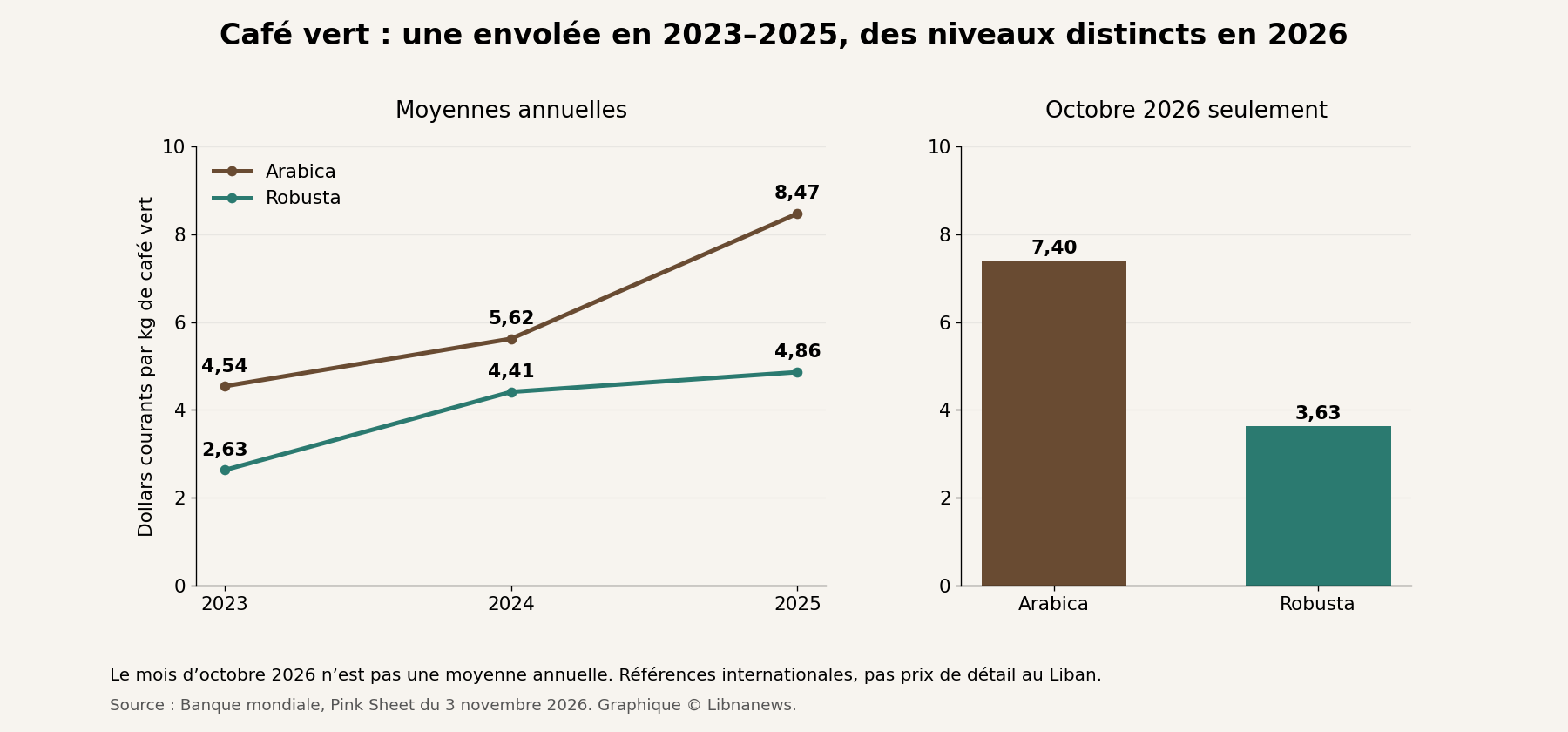
In October 2026, references reached $7.40 and $3.63 per kilogram. This monthly point must remain separate from the annual averages. It does not give the balance sheet of 2026, which is still incomplete, and does not make it possible to announce an equivalent decrease in Lebanese businesses.
Weather and supply concentration make prices sensitive
In itsanalysis published on 14 july 2026FAO recalls that Brazil and Vietnam account for almost half of world coffee production. A shock in a few regions can therefore rapidly change international supply. The organisation links recent outbreaks to droughts, frosts and production losses in several supplier countries.
FAO also points out that these variations are transmitted incompletely and unevenly along the chain. Producers and consumers do not experience the same movement at the same time. Transport, processing and distribution separate the international price from the final expenditure.
This concentration explains a vulnerability, but does not allow to attribute each daily variation to an isolated weather event. A harvest announcement, available stocks and expectations may change trade before new grains arrive at a roaster.
A green kilogram does not become a roasted kilogram
The comparison first requires that the same material be retained. Green coffee is processed before its usual sale to the consumer. In particular, roasting changes its weight. Divide the price of the package by the price of a green kilogram does not therefore give a direct margin.
Oneinternational Coffee Organization methodological study, 2011, used a coefficient of 1.19 to convert roasted weight into green equivalent. This old statistical convention serves only as an illustration here. It does not measure the actual yield of each roast.
With this convention, a package of 250 grams corresponds to 297.5 grams of green coffee. For a raw material assumption of $6 per kilogram, its green component would be approximately $1.79. At $9, it would reach $2.68. These hypothetical prices are neither import quotations nor prices observed in Lebanon.
The calculation isolates a mechanism: a 50% increase in the price of raw material here increases its cost of $0.89 per package. It does not demonstrate that the final price must increase by 50%. Transport, roasting, packaging and other items must still be accounted for.
From grain to package, several invoices add up
The purchase of coffee is a first line. According to the contracts, it adds freight, insurance, customs clearance and domestic transport. You have to check what the invoice price already includes: adding twice an insurance or transport would overestimate the cost.
The transformation then involves a machine, energy, personnel, maintenance and premises. Packing includes the bag, closure, labelling and handling. Distribution also adds storage and commercial expenses. In the ICO study, the difference between import value and retail price covered precisely several of these functions, taxes and business results, not just profit.
The unit cost also depends on the volume actually sold. A fixed expenditure of $600 spread over 1,000 packages represents $0.60 per package. Out of 500 packages, it is $1.20. This purely arithmetic example does not describe any business: it shows why a seller can be pressured on its costs even when green coffee drops.
The net margin requires the removal of all relevant costs from turnover. A difference between the purchase price of the grain and the selling price of the package is not sufficient to calculate it. In order to measure a possible increase in profitability, comparable accounts would be required over several periods.
The displayed price may hide a change in quantity
For the consumer, the comparison starts with net weight. A package sold $5 for 250 grams is $20 per kilogram. If its content increases to 200 grams at the same price, the kilogram costs $25, or 25% more. The values are fictitious, but the calculation applies to two actual tickets.
A comparable product must also be maintained. A different assembly, origin, certification or presentation may change the cost. A change in revenue does not allow an unchanged reference to measure inflation properly. The price per kilogram improves reading, without rendering all coffees equivalent.
The comparison of promotions requires the same discipline. A one-time discount, a batch purchase or a subscriber benefit does not necessarily represent the price available to each customer. The amount paid, the quantity actually obtained and any delivery costs must be reconciled.
At the counter, the customer also buys a service
A cup served in an establishment includes preparation and service. The space, equipment, washing, water, energy and working time do not disappear when the grain flows back. A coffee at the counter cannot therefore be compared to the cost of a prepared dose at home.
A second calculation allows to isolate the order of magnitude. With a hypothetical dose of 8 grams of roasted coffee and the statistical coefficient of 1.19, an increase of 3 dollars of the green kilogram adds about 2.86 cents to the raw material of the cup. This result changes with dose and yield. It is neither a recommended tariff nor an estimate of the margin of a coffee.
A much stronger increase in the cup may have other causes. It must be examined on the basis of the actual costs and commercial policy of the establishment. The evolution of grain alone is not sufficient to justify it, just as its decline alone does not automatically fix the new price of the service.
What these figures tell Lebanon
The sources consulted do not provide a consistent set of Lebanese prices, with constant brand, weight and composition, over several years. It would therefore be abusive to turn global developments into national coffee inflation rates. International references illuminate the invoice; Local tickets and invoices are required to measure downstream.
A useful follow-up would keep the same references in the same sellers, with dates, weights and purchase conditions. For one facility, it would bring the cost of coffee closer to other expenses and the number of beverages sold. This would distinguish between a more expensive raw material, a reduced quantity and an increased cost of service.
The next relaxation of the courses should therefore not be judged only on the label of a day. To determine whether it actually reaches the budget, the test will be that of an unchanged product, in the same quantity, purchased under comparable conditions. It is this rapprochement that makes it possible to move from the world price of grain to the concrete price of coffee.
Actual illustration : Maria Orlova, coffee table, 2020,Pexels, used underpexels license. It does not represent an identified Lebanese trade.





Comments