

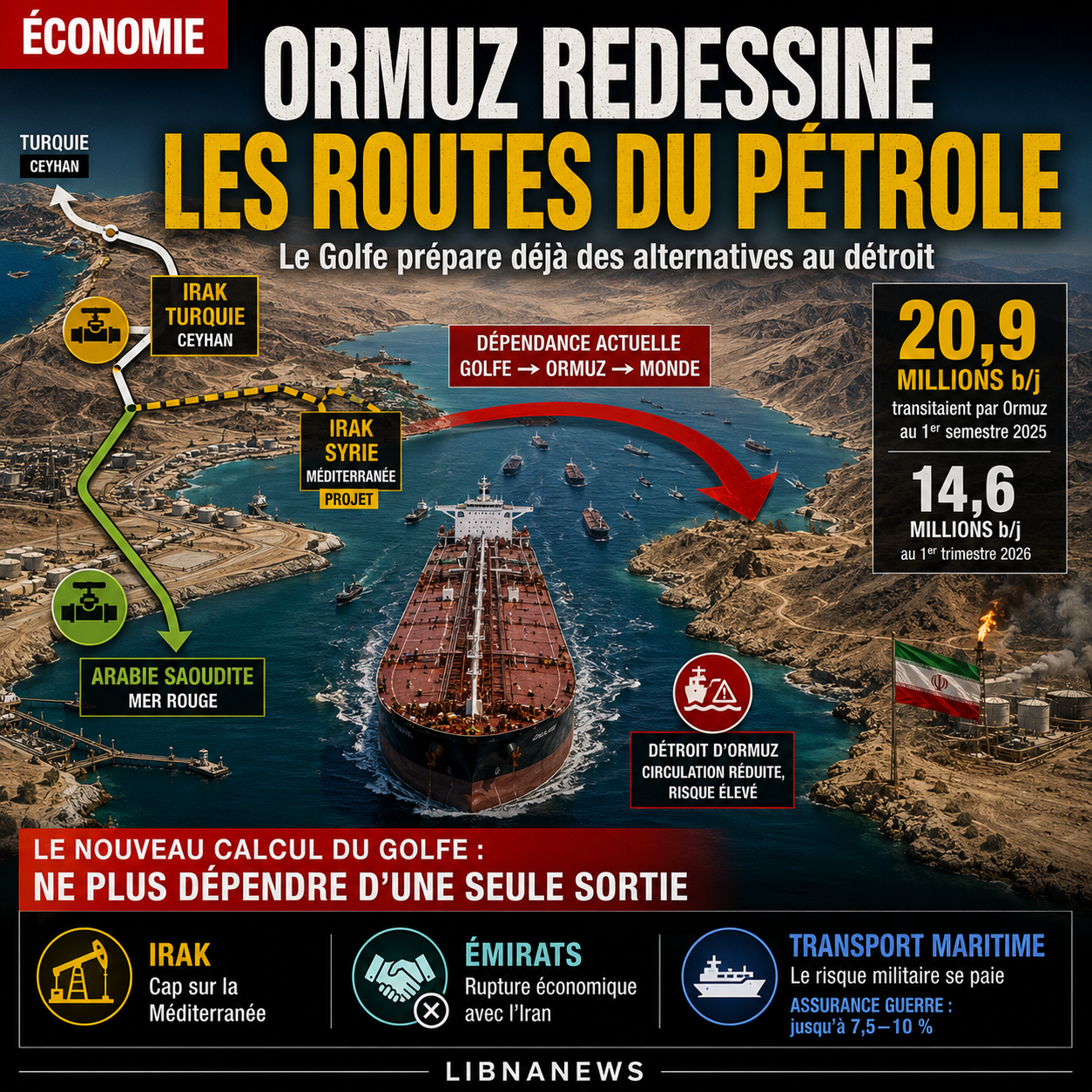
The crisis in the Strait of Ormuz is no longer limited to the number of oil tankers crossing the crossing or at the Brent barrel. After several months of disruption, the Gulf States are beginning to change their trade channels, export strategies and security choices. Iraq is accelerating the search for markets for the Mediterranean, the United Arab Emirates has suspended its economic trade with Iran and shipowners are now charging directly for the military risk. If the crisis continues, it could permanently reduce regional dependence on a maritime route that remains one of the world’s main energy infrastructures.
The Strait of Ormuz remains open to reduced traffic, but its operation is no longer normal. Political statements contradict each other, the number of ships remains below pre-war levels and some buyers are still reluctant to send tankers to Gulf terminals. This uncertainty is beginning to produce effects far beyond the oil market.
It now affects the way producer states think about their relations with their neighbours, military alliances and infrastructure investments. Iraq is seeking to reduce its dependence on its southern terminals. Saudi Arabia benefits from its capacity to the Red Sea. Abu Dhabi adapts its fleet and export circuits. Qatar remains exposed due to the weight of the strait in its shipments of liquefied natural gas.
The crisis thus acts as a life-size test of a long-standing problem: many of the world’s richest hydrocarbon economies continue to depend on a narrow maritime passage in the immediate vicinity of Iran.
Ormuz remains a global economic infrastructure
Prior to the current disturbances, about one-fifth of the world’s oil and petroleum consumption went through the Strait of Ormuz. In the first half of 2025, flows reached about20.9 million barrels per dayof which 14.7 million barrels of crude oil and condensates and 6.1 million petroleum products.
Dependence also concerns gas. More than 20% of the world’s liquefied natural gas trade crossed Ormuz in the first half of 2025, mainly from Qatar. The latter does not have a genuine alternative maritime route to bypass the Strait to export most of its LNG.
The disturbances triggered in 2026 have already shown the extent of this vulnerability. In the first quarter, oil flows through the Strait had fallen to about14.6 million barrels per day, compared with over 20 million in the previous quarter. LNG volumes were also declining sharply.
| Indicator | Documented order of magnitude |
|---|---|
| Oil and petroleum products via Ormuz in the first half of 2025 | 20.9 million b/d |
| Crude and condensates | 14.7 million b/d |
| Petroleum products | 6.1 million b/d |
| Share of Ormuz in world LNG trade | More than 20 % |
| Oil flows via Ormuz in the 1st quarter 2026 | 14.6 million b/d |
| Brent 20 August 2026 | About $93 |
The comparison explains why an Ormuz disturbance immediately produces effects far beyond the Gulf. It affects Asian refineries, the European gas market, London insurers, international shipowners and energy-importing governments.
But it also changes the calculations of the producers themselves. The longer the partial closure or the threat of a further interruption continues, the more a terrestrial infrastructure that can bypass Ormuz acquires strategic value far beyond its immediate profitability.
Iraq seeks to break out of its Gulf dependence
Iraq provides the most visible example of this development. Most of its oil is normally exported from the southern terminals around Bassora. This organization works as long as oil tankers can enter and leave the Gulf. The Ormuz crisis has brutally reminded Baghdad that a large production capacity only has a limited value if its access to the world market can be interrupted downstream.
The Iraqi authorities sought special arrangements for the passage of their cargoes. At the same time, traders tried to convince buyers to accept the risk of the trip. At the beginning of August, the Iraqi public group responsible for marketing the crude oil proposed significant discounts on certain cargoes of Basrah Heavy and Basrah Medium, while several shipowners were reluctant to send their ships to the Gulf.
This situation produces an economic paradox. Physically available oil may have to be sold cheaper precisely because the buyer has to bear an additional logistical and security cost to get it.
Another response is to move the delivery point. In mid-August, TotalEnergies’ trading branch offered Iraqi crude oil delivered outside the Strait, with a significant premium. The product remains the same; what changes is the economic value of the place where oil becomes accessible.
Baghdad is accelerating its alternative roads. An agreement with Turkey provides for an increased use of the pipeline linking Kirkuk to the Mediterranean port of Ceyhan, with a minimum announced capacity of750,000 barrels per day. This corridor offers Iraq an exit to the Mediterranean without passing through Ormuz.
From Turkey to Syria, the Mediterranean is becoming strategic again
The Turkish option is only part of a broader strategy. Iraq is also studying a new link through Syria to the Mediterranean port of Banias. The proposed project would go through Haditha and link the fields in the north and south of the country to the Syrian coast.
However, the project is still far from commissioning. Old infrastructure is too degraded to allow simple rehabilitation, and available estimates refer to several years of work and a multi-billion dollar investment. Technical and financial studies are therefore not yet a new export capacity.
The change is elsewhere: a project that could have been treated primarily as an industrial investment is now considered an element of national security.
The same reasoning appears in the discussions concerning a link to Aqaba, Jordan, and in the transit projects through Syria and Lebanon. In Beirut, the Nawaf Salam government convened the relevant ministries on 10 August to discuss the conditions for the return of Iraqi products or crude oil to Lebanon. A first step could be land transport and storage before re-export.
These routes offer no quick solution to the current crisis. They require investments, agreements between several governments and securing land routes in Syria. Their return to the discussions nevertheless shows that the geopolitical value of the Mediterranean facade increases as that of Ormuz becomes more uncertain.
Emirates Breaks Major Economic Link with Iran
The second transformation appears in the United Arab Emirates. Abu Dhabi announced this week the suspension of its economic and financial relations with Iran after accusing Tehran of being at the origin of missile fire directed towards the Emirati maritime zone. Iran rejected this accusation.
The decision is of particular significance because economic relations between the two countries have long survived political crises.
Dubai has been one of Iran’s main trading interfaces with the outside world for decades. Iranian and trade-related companies used the port infrastructure, re-export channels, logistics services and financial networks of the emirate. This function had become even more important with the strengthening of United States sanctions against Tehran.
The suspension announced by the Emirates can therefore close a way far more important than a mere bilateral flow of goods. If applied sustainably and strictly, it would complicate Iranian access to foreign exchange, commercial financing, certain imported goods and re-export channels.
It also obliges Dubai to arbitrate between several interests. Lemirat wants to maintain its status as an open trading platform and an international financial centre. At the same time, however, the federal authorities must protect the country from military risks and respond to American pressure against Iranian financial channels.
The duration and above all the actual application of the suspension will therefore be important indicators. A lasting break would mean that the security crisis had succeeded in changing a trade relationship that had resisted decades of rivalry between Iran and the Arab monarchies in the Gulf.
American bases also become an economic risk
At the same time, the crisis is transforming the value of security alliances. For decades, the American military presence has been an essential assurance for several Gulf monarchies. It must protect maritime routes, deter an attack and guarantee Western access to the region.
But this same presence can now increase the exposure of host countries.
In early August, Tehran warned several states in the region that further US attacks against Iran could result in reprisals against energy and strategic infrastructure in the Gulf. The message included Washington partners hosting US forces or facilities.
This threat poses a dilemma for the governments concerned. They need US military protection, especially when shipping routes and oil facilities are threatened. At the same time, however, they seek to prevent their territories from serving as a starting point for operations likely to provoke an Iranian response.
Qatar, Bahrain, the United Arab Emirates, Kuwait and Saudi Arabia do not all have the same relationship with Washington or the same level of exposure. Their common problem is, however, geographical proximity. An escalation between the United States and Iran can affect their ports, airports, oil facilities and desalination infrastructure, even when they wish to remain outside the conflict.
Security and economy can no longer be treated as two separate files. For a Gulf State, determining the degree of military cooperation with Washington also amounts to calculating its economic exposure to a possible Iranian response.
Insurance and transport: the invisible price of the crisis
The price of the barrel remains the most visible indicator. On 20 August, the Brent operated around$93, at its highest level in several weeks. But this course only represents part of the bill created by Ormuz.
To transport oil, one must find a ship, a crew, an insurance and a shipowner willing to accept the risk.
Additional premiums covering the war risk for ships crossing Ormuz have increased sharply. At the end of July, they reached about7.5 per cent to 10 per cent of the shell value, compared with 1% to 3% a few weeks earlier.
Such an evolution transforms the economy of a cargo. Some owners prefer not to enter the area. Those who accept demand much higher pay. Charter rates for some major tankers have reached exceptionally high levels, with reported rates of up to hundreds of thousands of dollars per day for the most risky trips.
This mechanism explains why a theoretical reopening of the Strait is not necessarily sufficient to immediately normalize trade. A channel can be navigable while remaining economically difficult to use.
Insurers must consider risk acceptable. Shipowners must agree to expose their ships. The ports must work. Crews must be able to be recruited and buyers must be willing to pay the extra cost.
It is also for this reason that traffic statistics have become as important as political declarations. In early August, only 33 vessels had crossed the strait between Monday and Thursday of the same week, compared with 50 vessels in the comparable period of the previous week. Before the crisis, traffic volumes were significantly higher.
Alternative roads become strategic assets
Not all Gulf producers are equal at this risk. Saudi Arabia has a major advantage with its East-West pipeline, which transports crude oil from east of the kingdom to Yanbu, on the Red Sea. Saudi Aramco states that this infrastructure has a capacity of around7 million barrels a day, even if part is used for refineries and port capacity is itself a limit.
The Emirates also has the means to ship part of their production without dependent entirely on Ormuz. At the same time, ADNOC has strengthened its tanker fleet and organized shuttle systems to maintain its exports despite the risks.
Iraq is in a much more vulnerable position and is precisely trying to catch up with this delay. Qatar, for its part, remains heavily dependent on the Strait for its LNG exports.
The crisis thus creates a new economic hierarchy between producers. The ability to extract oil or gas remains fundamental, but the ability to export through several roads acquires a comparable value.
This may change investment decisions in the coming years. Trans-Arab pipelines, Mediterranean terminals, Red Sea ports and storage capacity outside the Gulf are no longer just logistical infrastructures. They become geopolitical assurances.
A crisis that can alter relations between neighbours
Ormuz is also transforming regional interdependence. A new Iraqi pipeline through Syria would increase the economic value of relations between Baghdad and Damascus. A link using Lebanese facilities would create an additional interest in the stability of roads crossing Syria. The use of Ceyhan strengthens the relationship between Baghdad and Ankara.
Energy diversification can therefore produce new dependencies at the same time as it reduces another.
Avoiding Ormuz sometimes means becoming more dependent on Turkey, Syria, Jordan or the Red Sea infrastructure. Each corridor has its own political, security and commercial risks. None is a totally neutral solution.
The economic lesson of the crisis is precisely this: diversification does not remove geopolitical risk. It avoids that a single risk can immobilise the essential of an export capacity.
For Gulf governments, therefore, the question becomes less of how to replace Ormuz than of how to ensure that Ormuz is no longer irreplaceable.
Sustainable transformation or temporary adaptation?
The crisis has not yet lasted long enough to conclude a definitive overhaul of the Gulf political economy. Some changes can quickly disappear if the traffic returns to its previous levels and relations between Iran and its neighbours stabilize.
Other decisions are harder to reverse. Once built, an oil pipeline to the Mediterranean retains its value even after a complete reopening of Ormuz. A fleet of tankers purchased to respond to the crisis remains available. Terminals developed on the Red Sea are becoming new commercial assets. Companies that move their financial circuits out of a country on a sustainable basis may not restore them immediately after diplomatic relaxation.
Five indicators will therefore be used to determine whether the crisis of 2026 is a break or only a parenthesis: the duration of restrictions in the Strait, the actual level of maritime traffic, the resumption or not of trade between the United Arab Emirates and Iran, the decisions to invest in alternative corridors and the ability of regional mediators to re-establish navigation rules accepted by the various actors.
For now, perhaps the most important signal is not from oil prices. It comes from Baghdad, Abu Dhabi and projects that reappear between Mesopotamia, Syria, Turkey, Jordan and the Mediterranean. States that had built their energy trade around Ormuz are beginning to calculate the cost of a future in which they should be able to pass.




