

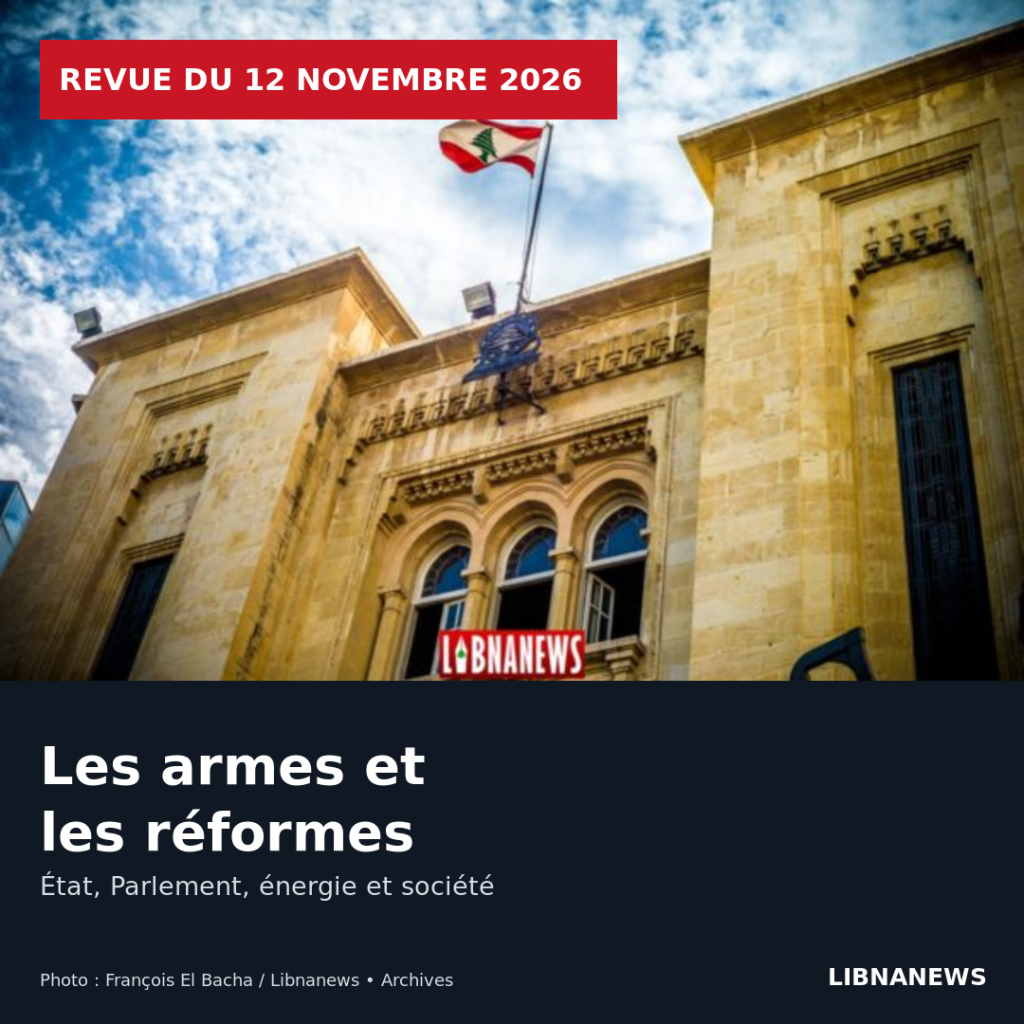
On the front page: weapons, state and security at the heart of the day
Naïm Kassem’s November 11 speech dominates Lebanese editions of November 12, 2026. Al Bina, Al Akhbar and Ad Diyar highlight Hizbullah’s refusal to surrender weapons under the current conditions. His intervention also includes a conditional opening to discussion. He subordinates it to Israeli withdrawal and to the end of what he calls foreign guardianship. No disarmament dates, surrender procedures and monitoring mechanisms are announced.
This distinction makes it possible to read together two often separate formulations: refusal to disarm under occupation and readiness to discuss later. One does not cancel the other. Kassem defends the maintenance of weapons while leaving open a future negotiation, under conditions that he himself sets. The 12 November reports thus describe a disagreement on the order of commitments, not a new decision to transfer the arsenal to the army.
Israeli withdrawal and State authority: two obligations to be distinguished
In its November 12 edition, Ad Diyar puts this position in perspective with Joseph Aoun’s affirmation of state sovereignty. The President of the Republic defends the authority of the institutions and the search for an agreement to protect the country. The disagreement, therefore, is not just about border security. It also concerns the institution empowered to decide on war, peace and the use of weapons in Lebanese territory.
Kassem invokes Resolution 1701, Armistice and the Arrangement of 27 November 2024. However, these texts are not limited to Israeli withdrawal. The cessation of hostilities arrangement combines this withdrawal with the deployment of the Lebanese army and the treatment of unauthorized weapons. Waiting for the withdrawal to start discussing is the sequence defended by Hezbollah. It does not in itself summarize all the obligations mentioned in the documents.
Al Akhbar and Al Bina, dated 12 November, place great emphasis on rejecting the framework agreement and defending indirect negotiations. This position is part of the balance of power. It does not prove the abandonment of the diplomatic framework or the agreement of the other parties to another procedure. Similarly, Kassem’s assessment of the political difficulties of Donald Trump and Benjamin Netanyahu is part of his argument. They are not an American or Israeli decision.
In the South, do not confuse political narrative with operational review
The 12 November editions place these speeches in the continuation of tensions in South Lebanon. Shots and shots were reported on Wednesday night. It is not possible to establish a consolidated human balance sheet. The locations, hours of operations and relief must remain separate from the political statements that accompany them. A lack of published record does not mean that no victim exists.
Post-FINUL scenarios also occupy newspapers. On 12 November, Al Bina referred to a formula based on truce observers. Ad Diyar reports on discussions on military support and international cooperation. These assumptions cannot be merged into a device that has already been discontinued. No replacement format, final strength or common operational schedule emerges from the audited elements for this review.
Local politics: the parliamentary session in the face of still separate texts
The 12 November editions announce a legislative session at 11 a.m. Beirut time. Several cases combine international agreements, public services and professional rules. Their inclusion in the agenda is not valid for adoption. Texts transmitted by committees may still be discussed, amended, postponed or rejected at the sitting. This review therefore distinguishes the proposals examined from the laws actually passed.
An Nahar, in its national edition of 12 November, examines the issue of irregular constructions. The discussion is about an amendment to the 2019 Act. The period covered by the original scheme and the scope of the amendment must be distinguished. The text under review does not make it possible to announce a general amnesty for all new constructions. Nor does it transform the payment of a sum into a building security certificate.
Documentary and technical obligations remain central. Administrative regularization does not necessarily resolve property disputes. Nor does it remove third-party rights. The occupation procedure and the stability controls have their own purpose. The exact scope of the amendment will depend on the text chosen by the Members and the steps necessary for its entry into force.
Quotes and speeches: political conditions, not results
In the 12 November editions of Al Akhbar and d’Al Bina, the words of Naïm Kassem are built around a condition: to discuss weapons after withdrawal and the end of guardianship. The word « discussion » is essential. It does not mean immediate abandonment or accepted timetable. The discourse maintains a capacity for confrontation, without alone announcing a date or an operational order for a new war.
The place given to the army is just as precise. Kassem welcomes his role and contribution to civil peace. But this recognition is not accompanied by immediate acceptance of its arms monopoly. Support for the military institution and the rejection of disarmament policy coexist in its reasoning. The tension between these two positions remains an internal issue, not just a question of foreign pressure.
Nida Al Watan, on 12 November, reported on energy minister Joe Saddi’s comments on the financing of electricity production. The Minister insists on the impossibility for the state to invest alone. Discussions with Qatar took place among the solutions envisaged. However, an advanced negotiation is neither a signed contract nor a delivered power station nor a guaranteed feeding period for households.
Al Sharq of November 12 finally reports the announcements of the Minister of Labour Mohammad Haidar and the Director General of the CNSS Mohammad Karaki. The payment of contributions by transfer companies was launched in practice. On the other hand, enlargements to other categories and reforms concerning allowances or medicines remain to be distinguished from this first stage. The declarations on future measures do not automatically create new duties that apply today.
Diplomacy: regional cooperation awaits concrete translation
Damascus and Amman, from signatures to projects
Al Akhbar of 12 November 2026 recalls the eleven cooperation documents concluded between Syria and Jordan. The meeting was held in Damascus on 8 and 9 November. It brought together delegations led by Foreign Ministers Asaad al-Shaibani and Ayman Safadi. The rapprochement concerns transport, water, agriculture and trade. It is therefore not limited to a political declaration. However, it is still necessary to distinguish between signed and actual investments.
The official records of the two countries specify the composition of this package: eight memoranda, two executive programmes and one protocol. Educational and academic cooperation includes programmes for 2027–29. The rail component concerns a connection between the two countries. The regional discussions also envisage a link between Saudi Arabia and Turkey. Technical studies, costs and funding opportunities need to be further developed. There is no such thing as an already open service.
Lebanon is directly involved in energy discussions. The Syrian-Jordanian coordination council examined the transit of gas to Lebanese territory. He also mentioned another possibility: to produce electricity in Syrian power plants with gas supplied from Jordan and then export to Lebanon. The communiqué calls for the completion of technical, commercial and contractual arrangements. This precision prohibits confusing an option discussed with guaranteed deliveries.
Ad Diyar of 12 November 2026 addresses the same problem through trade between Beirut, Doha and Damascus. The daily reports on transit costs, guarantees and operating conditions. Not all legal and financial agreements are finalized. The difficulties cannot therefore be reduced to a single Syrian political decision. For Beirut, the challenge remains the transformation of diplomatic support into enforceable contracts and then into real supplies.
Cyprus, passages to revive confidence
Asharq Al Awsat of 12 November 2026 follows Cypriot discussions around two new crossing points. The sites mentioned are Mia Milia, also called Haspolat, and Louroujina, or Akincilar. The file refers to the meeting in Nicosia on 9 November between Nikos Christodoulides, Tufan Erhürman and the UN envoy María Ángela Holguín. The meeting is confirmed in the United Nations public communications.
The daily presents these passages as a means of supporting dialogue. However, a political agreement on their principle should not be transformed into an immediate announcement of openness. Traffic arrangements and commissioning remain separate steps. The diplomatic significance lies precisely in this articulation: practical measures can create confidence, without in themselves resolving disagreements on the settlement of the Cyprus question.
International policy: limited actions in the face of major disagreements
Iran maintains line on enriched materials
Al Arabi Al Jadid of 12 November 2026 places in one the Iranian refusal to transfer foreign enriched nuclear materials. The daily reports Mohsen Rezaei’s statements of 11 November. He claims that these materials will remain in the country and that Moscow has been informed of them. In particular, it invokes nuclear-powered buildings. This is the justification put forward by the Iranian official, not a demonstration of already operational naval capabilities.
The same intervention contained threats against U.S. facilities involved in new strikes. The distinction between conditional threat and attack remains central. The word expands the places that Tehran says it can target. It does not prove that an operation was launched against these bases. Similarly, the refusal to move stocks alone does not constitute the text of an agreement or the announcement of the official breakdown of any negotiations.
Al Bina and Al Akhbar of 12 November 2026 link this confrontation with maritime incidents around Ormuz. The narratives do not fully agree on the vessels concerned, the nature of the incidents and their circumstances. Iranian statements on unauthorized mines or roads must remain attributed. They are not sufficient to establish all responsibilities. The traffic figures published on the various pages also cover poorly harmonised perimeters. They do not permit the simultaneous conclusion of full closure and almost normal movement of the strait.
Ukraine, an exchange announced without peace settlement
Al Arabi Al Jadid of 12 November 2026 describes an outcome limited to the two days of Abu Dhabi’s discussions. The humanitarian side is progressing, with an agreement announced on an important prisoner exchange. Territorial issues, security guarantees and the conditions for a ceasefire remain disputed. The report therefore distinguishes a concrete result to be implemented from a political settlement which remains out of reach.
Russian negotiator Vladimir Medinski refers to partial convergences. American emissary Jared Kushner, for his part, presents the discussions as a basis for further contacts. Both assessments do not agree on all issues. The encrypted exchange formats mentioned during the talks should not be presented as releases already achieved. Confirmation of an effective return of prisoners is a separate step.
Ad Diyar and Al Akhbar of 12 November 2026 also highlight the dispute over the place of Europeans. Kyiv wishes to participate in the discussions on guarantees. Moscow challenges the conditions under which this presence could be organized. The choice of participants thus touches on the substance of the negotiation: who would offer the guarantees, who would accept them and how would they be applied? Humanitarian progress does not resolve these disagreements.
In Mali, Washington resumes contact without new alliance announced
Asharq Al Awsat of 12 November 2026 notes the visit of the American commander for Africa to Bamako. The Malian government confirms that Assimi Goïta received General Dagvin Anderson on Tuesday, November 10. He led the US delegation to the Bamako Defence and Security Fair. The discussions focused on the situation in the Sahel and the fight against terrorism.
Mali’s report reflects the American readiness to continue the dialogue on regional security. It does not mention any new military treaty or replacement of Mali’s current partners. The interest of the visit therefore lies in the resumption of high-level contact. A planned audience and cooperation is not sufficient to establish a change of alliance.
Economy: Government revenue and investment tested for implementation
Electricity, between negotiations and recovery
Nida Al Watan of 12 November 2026 puts the electrical file in the foreground. It remains divided between two emergencies: financing the facilities and collecting invoices. The Ministry of Energy confirms the opening of a fifth round of technical discussions with Qatar on 9 November in Beirut. This release does not contain any signed contract, guaranteed power or date of commissioning. Investment proposals should therefore not be presented as an additional feed already acquired.
In the proceedings of Nida Al Watan and d’Al Liwa of 12 November 2026, Joe Saddi also defended the interest of investing in production on state-owned land. Its interventions also place the network and recovery at the centre of the reform. The expected role of the regulator concerns the organisation of the sector and its rules. It does not confuse itself with that of a funder. Funding difficulties, technical losses and unpaid invoices remain separate problems, even when they affect cash flow together.
A press release dated 12 November from the Electricity of Lebanon specifies the conditions for the restoration of the current to public debtors. The institution requires a first payment, a written commitment on the settlement of amounts due and the regular payment of new invoices. He claims that he did not grant any reconnection outside of these conditions. He also warns that a default will result in a new cut. On the other hand, it recuses the informal lists of debtors and circulating amounts. No costed balance sheet of receipts shall accompany this text.
Qlayaat: three appointments, not a single opening
Al Sharq of 12 November 2026 returns to the calendar of Qlayaat airport. It now distinguishes commercial advertising, testing and scheduled flights. In a press release published on November 10, after a meeting held the previous day, Nawaf Salam announced the presentation of destinations and schedules on November 15. Reservations must be open on the same day. Trial flights are announced for 22 November and scheduled commercial flights for 14 December 2026.
This sequence differs from earlier announcements of a first start to Cairo on November 15. However, it does not allow reservations to be considered already open. The Government communiqué describes a technical and operational preparation that is still under way. For northern travellers, the decisive elements will remain the routes actually offered, their frequencies and the conditions of sale. The political timetable does not replace this practical information.
Control expenditure and preserve revenue
Ad Diyar of 12 November 2026 reports on the work of the Finance Committee. The review of the 2027 budget also highlights the means of the oversight bodies. In committee, Ibrahim Kanaan requests written proposals to strengthen their functioning. The discussions include the Central Inspectorate, the Court of Auditors and the authorities responsible for combating corruption and public procurement. The approval of appropriations at this stage does not constitute the adoption of the budget by the Assembly.
The analyses of Nida Al Watan and d’Al Akhbar of 12 November 2026 address the banking debate. It covers the definition of losses as well as their financing. Presenting the crisis as only banking or as a crisis of the whole system involves different readings of the role of the state, central bank and private institutions. But a qualifier does not set their legal responsibility alone. Repayment assumptions and scenarios for public assets remain to be distinguished from actual provisions. No final agreement can be inferred from the discussions with the International Monetary Fund alone.
Justice: sensitive investigations and professional guarantees in debate
Security files are not verdicts
An Nahar and Nida Al Watan of 12 November 2026 give a large place to the investigations of Bcharré and Batrun. The available accounts refer to arrests, documents and verifications of alleged activities. They do not establish the guilt of the persons concerned. Political affiliations, intentions given to suspects and supposed links with organizations must remain attributed, without being transformed into judicial conclusions.
Nawaf Salam asks that the investigation be conducted without political protection. Ahmad Hajjar insists on further investigation. These institutional positions do not validate every detail on the file. The conflicting versions concerning belongings and objects seized require that priority be given to material made public by the competent authorities.
Al Bina, Ad Diyar, Al Quds Al Arabi and Asharq Al Awsat of 12 November 2026 are also following the investigation into the death of Ahmad al-Alwani. Cooperation between the Lebanese and Iraqi authorities is an identified part of the case. On the other hand, the accounts differ on the number of people questioned and the assumed responsibilities. The political positions of the former Iraqi MP are not enough to establish a motive. The determination of perpetrators and circumstances is a matter of investigation, not of competing charges.
Protection of doctors from the rights of patients
Al Akhbar of 12 November 2026 examines the versions debated in Parliament concerning doctors. The proposed reform of Article 44 governing the orders of doctors raises a different question: what guarantees should be provided before a procedure involving a practitioner? Parliamentary work reveals several formulations. Prior authorisation and scientific advice are preferred. Another is intended to preserve the non-binding nature of this opinion for the judge, while regulating pretrial detention. These versions should not be merged into a supposed final text.
The debate is less about protection than about lack of protection than about different distributions of powers between justice and professional bodies. Medical expertise can inform an investigation without replacing the judicial decision. The response times and consequences of order silence are therefore essential. Until the vote and the chosen version were established, it would be premature to announce a new immunity in force.
Company: simplified approaches, but still partial arrangements
CNSS extends means of payment
An Nahar and Al Sharq of 12 November 2026 report the launch of a new service of the National Social Security Fund. On 11 November, the Commission launched the payment of certain contributions from four transfer networks: OMT, Bob Finance, Whish Money and Cash Plus. The first phase concerns pensioners, mukhtars, doctors and voluntary insured persons. The Fund estimates the target audience of approximately 65,000 people. It is a contribution payment scheme, not a new benefit payment system.
Mohammad Karaki reported 115 successful transactions at the time of the ceremony. This figure does not represent the total number of insured persons registered or an annual balance sheet. The enlargement to include students, drivers and businesses remains announced for a later stage. Any costs and arrangements specific to each situation must be verified before any action is taken. The existence of new payment points does not mean that all transactions are already available in each agency.
Berlin and digitisation of approaches
An Nahar of November 12, 2026 relays a consular announcement from the General Security. The Lebanese Embassy in Berlin has been receiving requests for biometric collection since 11 November. Personal appearance and appointments are still required. The collection of fingerprints in Germany does not transfer the manufacture of the passport to the embassy: its issuance is still the responsibility of the competent authorities in Lebanon. Therefore, the possible use of express transport alone does not guarantee accelerated administrative treatment.
Al Sharq and Asharq Al Awsat of 12 November 2026 report on the reception of the Leaders Club in Baabda. Joseph Aoun referred to the objective of an electronic identity card before the end of 2026. This ambition is part of the digitisation of administrative and banking processes. It is not worth opening a service accessible today. The conditions of the application, the detailed timetable and the data protection arrangements remain to be documented before proposing a guide to users.
Social protection and user rights
Al Bina, Al Sharq and Al Liwa of 12 November 2026 reported on a meeting on the protection of journalists. Professional organizations are also considering a mutual coverage project. Discussions include Joseph Kossaifi and Ghassan Daou. The scheme envisaged first goes through accession to an existing structure, before the possible establishment of a own fund. The agreement in principle does not mean that a new mutual is already working. The advantages mentioned by its promoters do not replace a published contract, nor do they replace conditions of accession which are enforceable.
Al Sharq and Al Liwa of 12 November 2026 discuss the preparation of a citizens’ charter. Another logic is to clarify rights and obligations in relations with the administration. Fadi Makki presents this work as an approach to consultation. A charter submitted to comments should not be confused with an already applicable law. Its practical relevance will also depend on the procedures for appeal, the time limits and the actual responsibilities.
Al Liwa of 12 November 2026 follows Hanine Sayed in the Akkar. Hanine Sayed’s tour focuses on the role of social centres and the reopening of the Tekrit centre after work. The Minister defends the shift from assistance to a social development approach. This guidance does not make it possible to announce a new universal benefit. The services available, their schedules and conditions of access must remain distinguished from the broader objectives set out during the visit.
Culture: circulating works and rereading Lebanese memories
In its edition of November 12, 2026, Asharq Al Awsat returns to the Monnot outside the walls. The theatre is looking for new audiences beyond its usual rooms. The initiative is based on partnerships with cultural venues and on performances whose circulation remains possible without heavy mechanisms. Josiane Boulos describes a dissemination approach in the regions, rather than a simple one-off shift. The representation of « Aman Tarallali » in Saida, announced on November 16, is in line with this logic. The places and times of the following appointments, however, must be confirmed before constituting a practical agenda.
This organization puts at the forefront the concrete conditions of the tour. A production must be able to find a reception, transport its elements and adapt its installation. The choice of light works meets these constraints. Contacts with other cities and institutions are not the only way to achieve this. Similarly, support requested from the public authorities is not a grant obtained.
The cultural agenda can be supplemented by the indications of the Kalim Bechara gallery. In Beirut, Mireille Goguikian presents « A walk in the Middle East », the opening of which is announced on November 12. The exhibition gathers twenty paintings, made between 2023 and 2026. The city provides their common matter. Beirut and the Saïfi district are also home to other urban landscapes in the region. The supports alternate canvas and jute. These are pictorial compositions, not photographic surveys to document the current state of the sites represented.
The catalogue announces an exhibition until 24 November, in the building Noor Gardens 1, Omar Daouk Street. The hours indicated are 11 a.m. to 7 p.m. from Monday to Friday and 10 a.m. to 2 p.m. on Saturdays. The gallery is closed on Sundays. This information is part of the organiser’s programme, not a visit by the editor.
Asharq Al Awsat and Al Joumhouria, dated 12 November 2026, also give a place to the accounts of the past. Literature and documentary continue the work on Lebanese memory. The memoirs of Boutros Harb address decades of power. Their interest lies in the point of view of an actor involved in the events he tells. His interpretations and accusations are therefore not confused with judicial findings or independently established facts. The stories around Taef call the same distinction between archives, memories of the protagonists and reconstruction.
Al Joumhouria of 12 November presents the new work of Nabil Mouqaddam, which also belongs to this exploration of the faces of war. Its publication is dated October, not November 12. It should not be automatically assigned the characteristics of the previous 2016 volume. Al Quds Al Arabi of 12 November goes back to Khaled Ziyada’s book on the 1960s. It was already published in August. His return to the cultural debate offers an opportunity to reread Tripoli and the transformations of a decade, without turning this reading into an out-of-day announcement.
Technology: Digital interfaces become a protection issue
An Nahar and Al Quds Al Arabi of 12 November 2026 address the European proposal on digital equity. It moves the look towards how services are designed. Presented on 11 November by the European Commission, the project aims in particular at deceptive interfaces, repeated solicitations and hard-to-resile subscriptions. It is not yet an applicable law. Its examination by the European Parliament and the Council must determine the final obligations and their timetable.
The transition from a free trial to a paid formula is one of the situations covered. The draft provides for prior information and explicit consent. It also deals with renewal reminders and access to a termination function. It should not be confused with the right of withdrawal, which meets other conditions. The objective is to narrow the gap between easy to subscribe and difficult to leave a service.
Mechanisms promoting excessive use are also concerned: automatic reading, demands unrelated to user action or rewards encouraging permanent attendance. The text seeks to make their deactivation accessible. The proposed provisions on minors and virtual purchases address specific situations. They do not constitute a general ban on online gambling or any notification.
Finally, the draft provides for clearer information on the evolving prices of banknotes and on the commercial intent of communications of influence. The penalty ceiling of 6% of the world turnover referred to in the same package is part of a separate reform of cooperation between consumer protection authorities. This is neither a fine already imposed nor a rate automatically applicable to each digital service.





Comments