

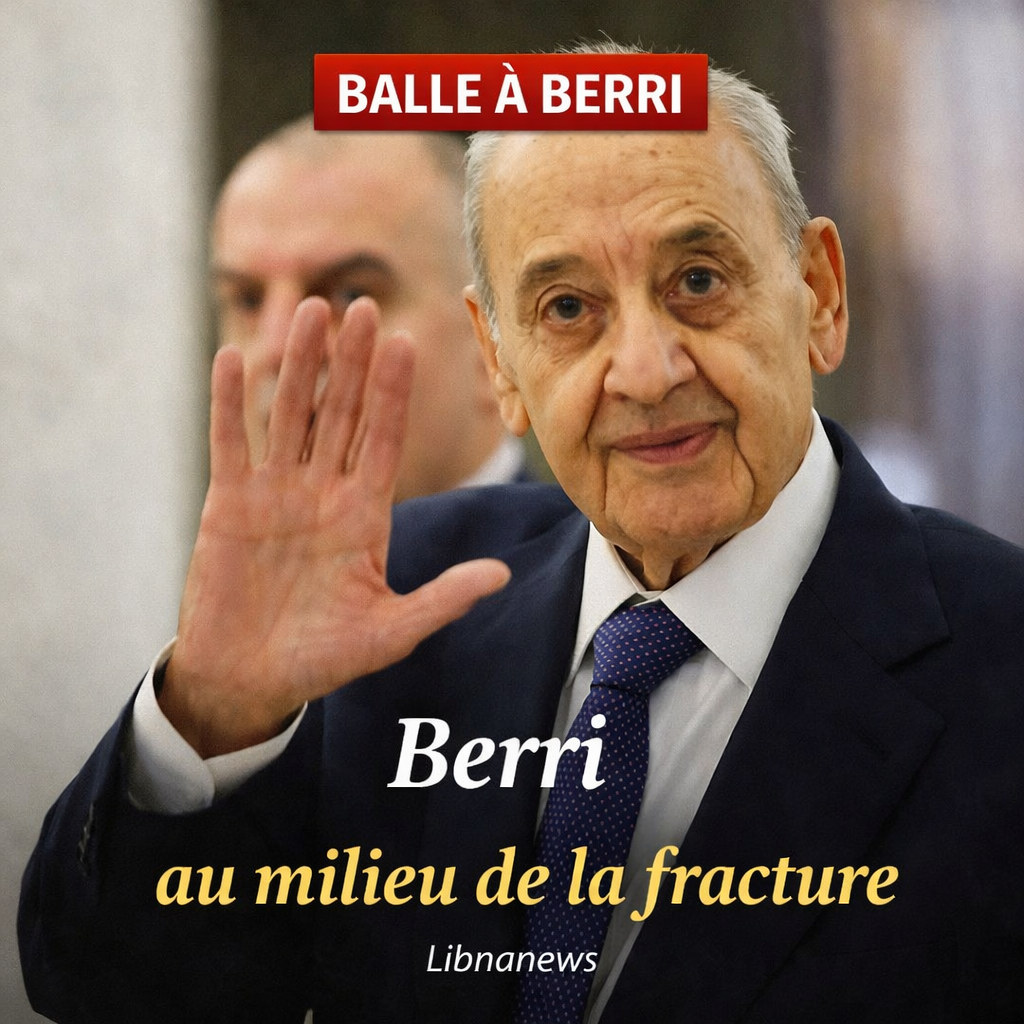
A man in the middle of a crisis he doesn’t fully control
On 16 April, a long-standing reality of Lebanese policy was confirmed: when the country entered a zone of severe turbulence, Nabih Berri returned almost mechanically to one of the required crossing points between the blocs, institutions and external mediations. This centrality does not mean that it controls the situation. It means that no serious reading of the crisis can rule it out. At the present time, this position takes a particular form. The President of the House is neither in the simple adherence to the line defended by the President of the Republic and the Head of Government, nor in a logic of frontal rupture with the institutional order. It is held in between, in an area of alert, brake and intermediation.
That is precisely what makes his position so important. The open sequence around a possible ceasefire and US-sponsored discussions has caused Lebanon an immediate political shock. Part of the power presents this sequence as a necessary attempt to get the country out of the war, to stop the bombings and to put the state back in the center. Another part of the political landscape sees this as, at least, a risky process, and at worst, an attempt to move the confrontation from the southern front to the interior of the country, particularly towards Hezbollah. In such a climate, Nabih Berri appears as a man who measures both institutionally and partisanly the danger of a derailment.
His word, in this moment, is not that of a neutral arbitrator. It bears the memory of alliances, relations of strength, fidelities and old rivalries. But it retains a particular function: to prevent the disagreement over war and negotiation from turning into an uncontrollable rupture of the system. Berri knows that Lebanon can withstand a high tension. He also knows that he bears much less than an assumed fracture between his power centers, especially when the external pressure remains strong and the southern front continues to burn.
A deep mistrust of the diplomatic sequence
The first feature of Nabih Berri’s position is a clear mistrust of the momentum of negotiation. This mistrust is not limited to a reserve of methods. It affects the intention of the whole process. In his political circles, an idea was imposed: the current sequence would not only aim at stopping the war. It could also open a new stage in which the issue of Hezbollah, its weapons and its internal status would be transferred to the centre under external pressure.
It is this suspicion that gives Berri’s word its hardness. When he suggests that some have come back from discussions not to get a halt to the fighting but to direct pressure against Hezbollah, he does not only formulate a tactical critique. It points to a strategic risk. He says in substance that the battle could change in nature without actually ending. The front with Israel would remain the general setting, but the central issue would then become the relationship between the state, institutions and resistance.
This reading is not secondary. It already forms part of the Lebanese debate. It allows the Shiite camp to present its vigilance not as an automatic refusal of any discussion, but as a reaction to an alleged attempt at internal reconfiguration. In this perspective, the ceasefire is not rejected as such. What is feared is its subsequent political use. A truce could pave the way for something other than a simple suspension of hostilities. It could become the beginning of a battle over legitimacy, the monopoly of force and the place of Hezbollah in Lebanese order.
Berri therefore expresses a fundamental mistrust. But this mistrust does not translate into a strategy of total rupture. This is the singularity of his position. He warns, criticizes, raises symbolic pressure, but he avoids going to the point where criticism would make any political management impossible.
A guardian of the system as much as a camp representative
This dual role explains much of his behaviour. Nabih Berri never speaks only as the leader of a current or ally of a party. He also speaks as one of the last major managers of the Lebanese system. He knows the voltage thresholds that must not be crossed. He knows that, in a fragmented country, the ability to contain is often as valuable as the ability to decide.
This system guardian function appears forcefully in the current moment. On the one hand, he must show his base and allies that he does not let a diplomatic sequence perceived as potentially dangerous pass without reaction. On the other hand, it must prevent this reaction from leading to an open institutional crisis or a street confrontation. It’s a demanding position. It implies holding together the firmness of the discourse and restraint in action.
This restraint is one of the most decisive aspects of its role. In an atmosphere where words can quickly produce polarization effects, Berri acts as a slower. He doesn’t dissipate anger. He doesn’t turn it off. But he works to prevent him from turning into an uncontrollable dynamic. This requires instructions, maintaining contacts, a permanent presence behind the scenes and a capacity to remind people that any internal explosion would benefit those who want to further weaken Lebanon.
In this, his position is not contradictory. It is structured by the same logic. The more he suspects the diplomatic sequence to carry an internal risk, the more he considers it necessary to avoid any false steps that would accelerate destabilization. It can therefore, at the same time, denounce a danger and work to ensure that the reaction to that danger remains politically contained.
An essential link between the institutions and the Shiite camp
In the current crisis, Berri also occupies a place that no one else can fill in an equivalent way: it serves as a link between the official institutions and the Shiite camp organized around the tandem he forms with Hezbollah. This function is all the more valuable as the open sequence around negotiation has aggravated mistrust between the centres of the system. The President of the Republic and the Head of Government defend the line of a pre-ceasefire and a return from the State to the centre. Part of the Shiite camp fears that such a line will be used to prepare a political confrontation against it. In between, Berri remains one of the few actors to be able to speak to the two universes without being totally rejected by one or the other.
This pivotal role does not give him absolute power. He can’t clear the differences. It cannot turn deep mistrust into agreement. But it can prevent the blocks from closing completely. He can hold a wire. And, in Lebanese politics, maintaining a thread is often worth much more than getting an immediate compromise.
This centrality also explains its interest in regional mediation. When a message is to be transmitted, when a concern is to be reported, when a channel is to remain open to the Shiite camp without going directly through Hezbollah, Berri becomes an almost natural interlocutor. Its weight is therefore not only due to its institutional position. It comes from its ability to articulate three levels at a time: the state level, the level of the internal power ratio and the level of external contacts.
This makes him an indispensable and exposed actor. Indispensable, because its withdrawal would create a dangerous gap between institutions and Shia political base. Presentation, because this intermediate position obliges it to meet conflicting expectations. He is asked to be firm without breaking up, to be careful without yielding, to be loyal to his camp without precipitating the national crisis.
Riyadh, Tehran and the regional game in its shadow
The place of Nabih Berri in the Lebanese crisis is not fully understood without looking at the surrounding regional game. The day of 16 April showed that several capitals continue to view Lebanon as an area to be stabilized not only for itself, but also for what it represents in the wider balance between the United States, Iran, Saudi Arabia and intermediate regional actors.
In this arrangement, Berri retains a specific advantage. He can be approached by Arab capitals who do not wish to deal directly with Hezbollah, while remaining a credible interlocutor for the Shiite camp. This position is particularly visible in moments of extreme tension. When it comes to preventing an inner explosion, conveying a warning or exploring the margins of a compromise, its name quickly returns to the center of the game.
This external utility reinforces its inner centrality. She reminds all Lebanese actors that he is not just the Speaker of the House or the leader of a movement. It is also a piece of mediation for regional partners. This quality is important when Lebanon enters sequences where the local balance of power is closely mixed with capitals.
However, this regional dimension does not make it free of its movements. She can also compel him. The more useful it becomes, the more it must measure each of its words. The more he receives or relays external signals, the more he must be careful not to appear as the mere instrument of an agenda coming elsewhere. Its indirect regional influence is therefore not comfort. It’s an extra charge.
The street as a constant threat, and as a red line
One of the most important elements of Berri’s position is his relationship to the street. Lebanon has enough experience of crises to know that political polarization can quickly produce more difficult-to-control spillovers. At this moment, this threat is particularly present. A diplomatic sequence deemed suspicious by part of the Shiite camp, a heated debate on weapons, an ongoing war in the South and massive social fatigue are a dangerous mix.
Berri seems to be fully aware of this risk. This is why it is working to maintain a clear distinction between political alert and uncontrolled popular escalation. It can raise the tone, express distrust, make a severe warning sound. But it also seeks to prevent this tension from becoming an implicit call to inner confrontation. This red line is at the heart of its current role.
The calculation is lucid. A street explosion would not help his camp or the country. On the contrary, it would provide clear evidence to those who consider that Lebanon can only manage its crises by tearing itself apart. It would also weaken any external negotiating position by showing a fractured power, unable to contain its own fault lines. By preventing this scenario, Berri protects both the balance of his camp, the minimum stability of the institutions and the possibility of political management of the crisis.
This restraint function does not always make the headlines. It is often played in instructions, in discreet gestures, in the decision to calm down rather than push. But it is perhaps, at this moment, its most decisive contribution.
An actor of the blockage, but also of the non-collapse
It would be too simple to describe Nabih Berri as a pure obstacle or, conversely, as a simple stabilizer. It is both at a time, depending on the angle from which it is observed. For those who want to speed up institutional recovery and make negotiation the beginning of a strengthening of the state, it represents a brake, a man who slows down, who suspects, who prevents membership. For those who fear that such a takeover will conceal an offensive against Hezbollah, it is on the contrary a protection, a bulwark against too fast a swing.
But the political truth of the moment lies precisely in this ambiguity. Berri blocks certain developments. At the same time, it avoids the collapse of the framework that still allows actors to talk to each other. Its role is therefore not only to prevent. It also consists of keeping the minimum thickness of the policy in the middle of a sequence where everything could be tempted by force passage.
That’s what places him so clearly in the middle of the fracture. He doesn’t clear the fracture. He’s not leaving. He lives there. He’s going through her. He’s trying to stop her from turning into a gulf. In a country like Lebanon, this kind of role is rarely spectacular, but it is often decisive. It saves time, contains the packages and keeps open the possibility of a future adjustment.
A centrality that says the state of Lebanon
The place occupied by Nabih Berri on April 16 says something wider about the state of Lebanon. It shows that at the very moment when the country is discussing a ceasefire, where the United States is trying to impose a framework, where the President of the Republic and the head of government want to give the institutions more weight, the system is still suspended from a few figures able to prevent the worst without being able to produce the best.
This centrality is not a sign of institutional strength. Rather, it is the symptom of a political order that continues to function through human mediations, informal balances and pivots. Berri is one of the clearest incarnations. He reassures some, worries others, but he remains unavoidable because he knows both the language of the camp, that of the institution and that of the survival of the system.




