

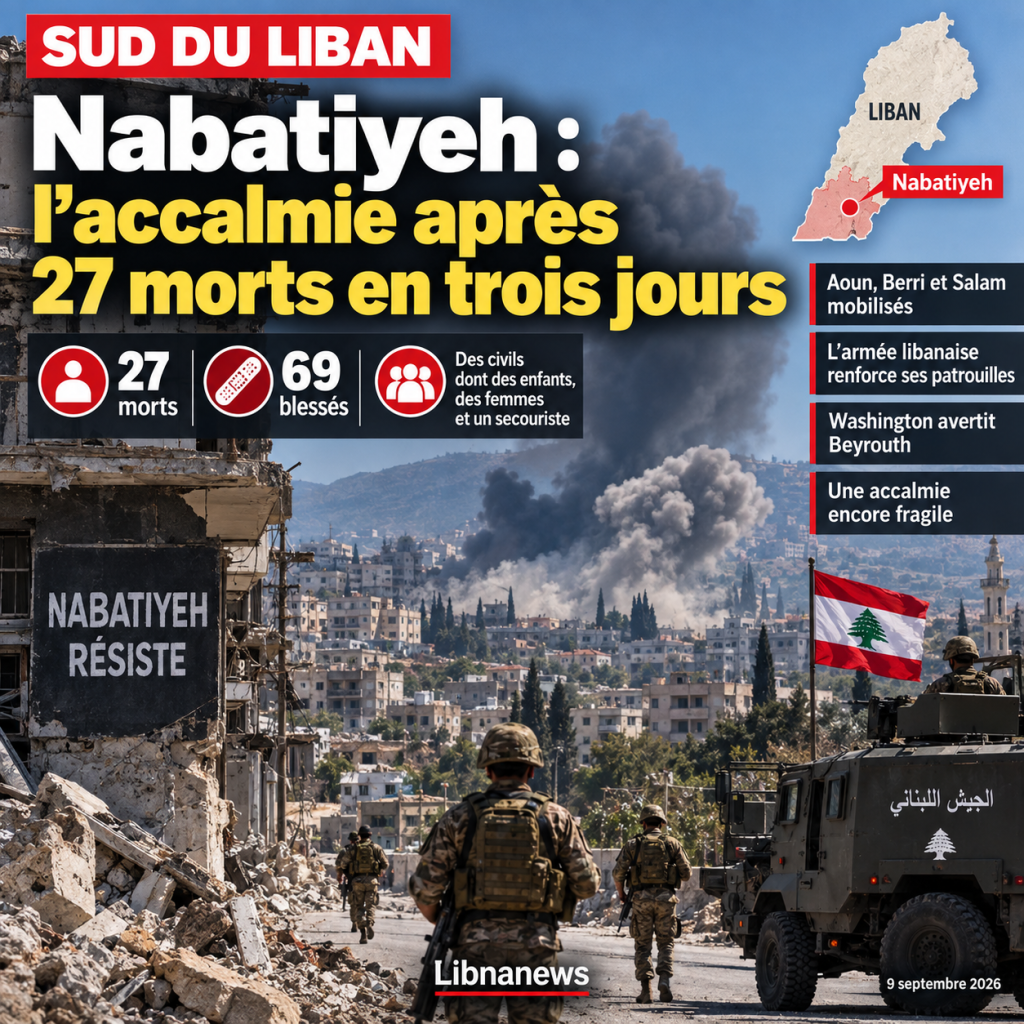
A fragile lull took place in Nabatiyah after three days of Israeli attacks, resulting in 27 deaths and 69 injuries in the area. The contacts initiated by President Joseph Aoun, Speaker Nabih Berri and Prime Minister Nawaf Salam, along with Arab and international efforts, contributed on Tuesday 8 September to contain the escalation. On the ground, the Lebanese army began to intensify its patrols in the city. This mobilization must now prevent a resumption of clashes after one of the most deadly sequences of recent weeks in southern Lebanon.
Aoun, Berri and Salam mobilized for Nabatiyah
The Lebanese authorities’ priority is to prevent attacks around Nabatiyah from spreading to other parts of the South. The three main state authorities thus increased contacts during Tuesday’s day.
Joseph Aoun led part of the process with Lebanon’s Arab and international partners. According to reports from several Lebanese media, these exchanges focused on three objectives: to curb escalation, to stop Israeli attacks and to restore the parties to the framework agreed to stabilize the Lebanese front.
Nabih Berri and Nawaf Salam also participated in efforts to contain the situation. This mobilization comes as the strikes led to the displacement of inhabitants in Nabatiyah district, particularly to Saida and Beirut.
Lebanese Foreign Minister Youssef Rajji held parallel consultations with several of his Arab counterparts. These exchanges took place as he was attending an Arab ministerial meeting.
The main aim of diplomatic activity is to prevent the confrontation between Israel and Hezbollah from triggering a new phase of large-scale fighting. On Tuesday, the first signs of appeasement allowed the authorities to focus their efforts on consolidating this calm.
27 dead and 69 injured in three days
The human assessment explains the urgency of the procedures. The three-day Israeli attacks in the region resulted in 27 deaths and 69 injuries, according to reports in Lebanon.
Children, women and rescue workers are among the victims. Nabatiyah and several surrounding localities were affected.
Kfar Rummane suffered one of the most deadly attacks. On Monday, 7 September, there were 12 Israeli strikes. One residential building was affected. Two children and several women were among the victims.
A rescuer was also killed in a separate attack on a vehicle. These strikes followed a first deadly day on Sunday in several areas of the Nabatiyah region.
The Israeli army claims that its operations respond to Hezbollah actions. In particular, it accuses the movement of launching drones against its soldiers and continuing military activities in southern Lebanon.
Hezbollah did not provide a detailed response to all Israeli accusations regarding this sequence. The Lebanese authorities, for their part, denounced the strikes and their consequences for the civilian population.
Washington warns Beirut against further escalation
Lebanese efforts are also taking place under strong US pressure. According to reports from the Lebanese press on Tuesday, Washington transmitted to the government of Nawaf Salam a message concerning the events in Nabatiyah.
The United States reportedly explained to Lebanese officials that Israel had intensified its operations following a Hezbollah attack on the Israeli army, drone launches and activities in the region.
Washington reportedly warned Beirut that a new action by Hezbollah would provoke a particularly strong Israeli military response.
This message remains information reported by the Lebanese press. It was not presented in this form in an American public statement.
However, it sheds light on one of the main issues of current mediation. The Lebanese authorities are seeking to stop the Israeli strikes while preventing a new Hezbollah operation that could immediately revive hostilities.
Thus, Beirut’s margin of manoeuvre remains narrow. A new attack could call into question the accalmie obtained after the contacts of the last hours.
Lebanese Army strengthens patrols in Nabatiyah
Stabilization must now take place on the ground. On Tuesday, the Lebanese army conducted patrols in Nabatiyeh as the authorities discussed measures to strengthen security in the city.
Military personnel could be positioned on several points in parallel with patrols in the neighbourhoods. This increased presence would pave the way for a further step towards consolidating stability.
The role of the army is of particular importance. The Lebanese Government is seeking to strengthen the authority of State institutions in the South and to reduce the risk of incidents that could lead to further strikes.
This development does not mean that the army was absent from the region. Lebanese forces already have units in the South. The measures envisaged concern an operational strengthening around Nabatiyah after the attacks of the last days.
For the inhabitants, the central issue remains immediate security. The bombings caused great concern and caused families to temporarily leave certain localities. Repeated attacks also complicate returns to the most exposed villages.
A still very fragile lull in southern Lebanon
The fall in the intensity of attacks on Tuesday does not solve the causes of the crisis. Israel continues to accuse Hezbollah of carrying out military activities and violating arrangements to stabilize the border.
Hezbollah, for its part, denounces the continuation of Israeli operations in Lebanon. The Israeli military presence in certain areas of Lebanese territory and the operations beyond these positions maintain confrontation.
Recent developments around the strategic height of Ali al-Taher have also increased concerns. Israel has announced that it has taken control of this dominant position several axes close to Nabatiyah. This situation feeds the fears of increased military pressure on the city and surrounding localities.
The sequence of 6, 7 and 8 September put Nabatiyeh back at the centre of the security system in the South. For Beirut, the immediate goal is not only to get a few hours without strikes. It is to prevent a new incident from triggering a new series of attacks.
The contacts led by Joseph Aoun, Nabih Berri and Nawaf Salam allowed a first drop in tension, but they still offer no lasting guarantee. The message attributed to Washington, on the contrary, shows that the risk of a brutal recovery remains.
The next Lebanese army measures in Nabatiyah will therefore be particularly observed. Their magnitude, the positions it will strengthen and the continuation or not of the patrols will allow to measure whether the 8 September lull can be consolidated after three days with 27 dead and 69 wounded.




