

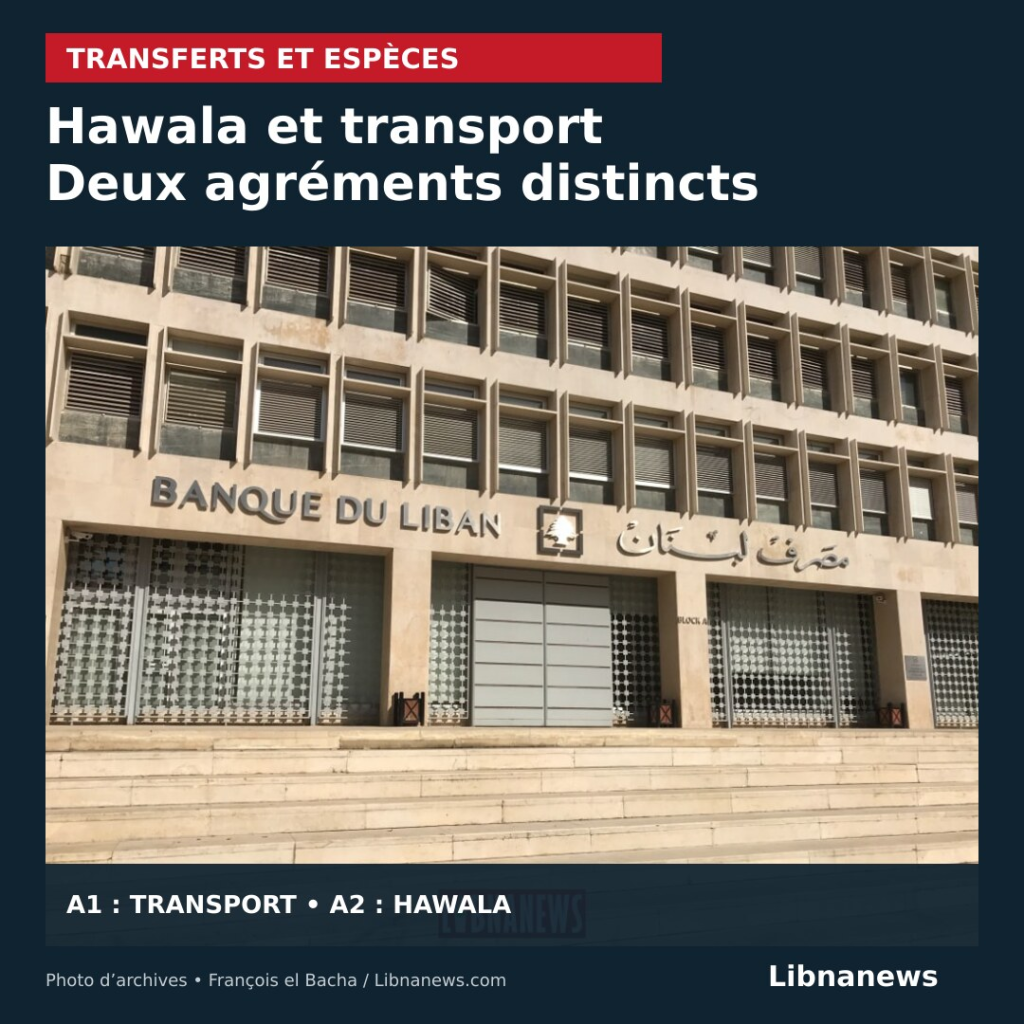
The Lebanese framework of foreign exchange institutions now separates two activities often combined: the transfer of hawala-type funds and the cross-border transport of banknotes or precious metals. Decision 13837 organises separate approvals, checks and declarations. For some already declared hawala operators, a deadline is approaching: their file must be submitted before November 30, 2026.
Adopted on 18 August 2026 and published in the Official Journal of 10 September, the decision reorganises the operating conditions of foreign exchange institutions. It repeals several previous decisions, including the September 2007 hawala cash transfer decision. The old references are no longer sufficient to describe the new system.
Intermediary Circular 772 of 31 August 2026 coordinated this change with the previous regulations for the carriage of banknotes and metals. The consolidated version of Decision 8024 now refers foreign exchange institutions to the operative part of Decision 13837. The reporting provisions that remain in this old text concern banks.
Hawala and transport: two different amenities
The term hawala here refers to the informal cash transfer service, called IMTS in the regulations. « Informal » describes a transfer made outside the formal banking and financial system. It does not mean that the claimant can act without a licence or without control.
Subcategory A2 corresponds to this service. Subcategory A1 concerns the cross-border transport of banknotes and precious metals. This second activity covers their import or export, as well as associated settlement, delivery and receipt operations. The definition of the text refers to a transaction carried out on behalf of the foreign exchange institution.
In both cases, the establishment must belong to category A and obtain additional authorization for the service concerned. It must also increase its capital and pay the applicable fee. A general exchange licence does not automatically provide access to these two activities. An A1 authorization is no more than A2 authorisation.
Correspondents identified and approved
For activity A2, the file must include a letter of intent or a contract with the foreign correspondent. It must include the valid licence issued to it by the competent authorities. Measures to combat money laundering and the identity of beneficial owners and beneficial owners must also be documented.
Transport A1 requires comparable checks on the foreign specialized partner. It also requires procedures for receiving, delivering and transporting banknotes or metals. The establishment must have a feasibility study and organise the continuity of its activity.
These requirements prevent the relationship from being reduced to mere commercial contact. They concern the legal capacity of the partner, its identity and the traceability of operations. The regulation also prohibits foreign exchange institutions from dealing with correspondents who are not registered according to the rules of their country.
Monthly ceilings for A2 transfers
Before a hawala-type transfer, the operator must verify the identity of the principal and the beneficiary. It must also establish the purpose of the operation and the origin of the funds. The identification requirements apply in the context of the KYC cash transaction regulation.
| Transfer A2 | Monthly ceiling per customer |
|---|---|
| Staff | $20,000 or equivalent |
| Commercial | $200,000 or equivalent |
These amounts relate to personal or commercial transfers, inward or outward, in the A2 system. They do not constitute thresholds for disclaimer. Nor should they be confused with a general authorization for the physical transport of species at a border.
The Regulation also regulates the delivery of money to the beneficiary. It excludes a payment by cheque, by transfer to its bank account or by swap transaction for its benefit. Settlement mechanisms between correspondents follow a logic distinct from that of final payment to the consignee.
Separate writings and preserved traces
An A1 operator must separate the accounts of its cross-border transport from that of its other operations. It must involve an external auditor from an internationally renowned firm. An internal audit officer must also produce monthly reports on controls, risks and vigilance.
The operator cannot perform a transport when the available parts are not sufficient to establish the origin, destination and purpose of the funds. Reporting obligations distinguish between the volumes transported, the number of transactions and the domestic movements concerned. They organise regular information for the BDL and the Banking Supervisory Commission.
For A2, transfer-specific records must be kept for at least 10 years. The institution must submit a monthly situation within 10 days of the end of the month. The documents must allow the authorities to reconstitute the operation, and not only to know the total.
Balances between professionals do not finance their activity
Transactions may generate settlement balances between foreign exchange institutions or with their correspondents. The text specifies their function: to regulate the rights and obligations arising from the trade or transfers concerned. These balances are neither deposits nor bank accounts.
They cannot finance an institution’s activity or fill its liquidity gap. They must be supported by supporting documents, regularly reconciled and documented. Their retention beyond five working days is prohibited.
The stakes are accounting and prudential. A sum due to a correspondent must remain linked to an identifiable transaction. It cannot become a sustainable resource that the professional would use freely for his needs.
Unremoved funds require follow-up
The Regulations impose a mechanism for transfers that the recipient did not receive 30 days after the shipment, despite a reminder. The principal must be clearly informed. The establishment shall coordinate with the correspondent the measures necessary for the recovery of the uncashed principal.
The customer must also be informed of his or her right to request such recovery within a maximum period of three months after dispatch. The text provides separately for the treatment of funds upon expiry of the statutory limitation period. The latter concept must not be equated with the three-month period.
Establishments already approved have a general compliance period. But those who have previously informed the BDL of their IMTS activity must submit the documents relating to their correspondents before 30 November 2026. This date relates to a particular file, without replacing other control obligations.





Comments