





The change in inflationary regime since 2019
To understand why life remains expensive in Lebanon in 2026, we must first avoid treating the last seven years as a single inflationary period. The country has gone through several successive regimes. The first was the monetary and financial collapse. The second was the abolition of subsidies and the correction of administered tariffs. The third is dollarization and exchange rate stabilization. The war of 2026 then added a new supply shock to an economy that had not yet repaired its banks, electricity and infrastructure.
In 2019, the economy was still officially operating around £1,507.5 per dollar. This rate could only be maintained through capital inflows, the Bank of Lebanon’s reserves and a banking system that recycled much of its resources to the central bank and the State. When capital inflows dried up, the balance of payments crisis became a banking crisis and then a monetary crisis. Informal restrictions on deposits destroyed confidence and demand for dollars exploded.
In 2020, annual inflation reached about 84.9%. In 2021, it exceeded 154 per cent. In 2022, it reached about 171 per cent, and 221% in 2023. During this phase, the exchange rate is the main channel of transmission. An economy that imports its fuel, much of its food, its medicines, its equipment and many inputs sees every depreciation pass quickly at prices.
But the increase is not just from the exchange rate. The subsidy system is beginning to be dismantled. Fuels, certain medicines and other products can no longer be financed on a sustainable basis from foreign exchange reserves. The disappearance of these mechanisms transfers to the consumer a cost that was previously borne by the Bank of Lebanon or the public sector. This can be called transition inflation: the price paid increases sharply even when the world cost of the product has not increased in the same proportions.
The same logic applies to public tariffs. When electricity, telecommunications or certain administrative rights remain fixed in pounds while the currency collapses, their real value disappears. Their subsequent improvement produces a very strong statistical increase. This increase is painful for the household, but it also corresponds to the recovery of a price that had stopped covering its cost.
From 2023 onwards, the exchange rate gradually stabilizes around LL 89,500 per dollar. Dollarization is accelerating. More and more private prices, rents, services and remuneration are expressed directly or indirectly in dollars. This transformation greatly reduces the classical price-change spiral mechanism: a company that already reasons in dollars no longer needs to change its prices daily to anticipate a new depreciation of the pound.
This is why 2026 is a particularly interesting test. If the exchange rate is stable and prices are broadly dollarized, inflation of 15 to 20 per cent can no longer be explained primarily by currency. We must look at oil, freight, insurance, war, domestic costs in dollars, taxation, private energy and especially the financial structure of the economy.
The July 2026 figure summarizes this transformation: inflation remains at 15.69 per cent over a year despite exchange rate stability. Before the regional escalation, the World Bank envisaged a one-digit return to inflation. After the shock in March, it projected an average of 17.5% over the year. The currency is no longer the single engine; the real cost of operating the economy becomes central.
A useful timeline to separate causes
| Period | Dominant mechanism | Impact on prices |
| 2019-2020 | Banking crisis and beginning of depreciation | Rapid exchange-rate transfer to imports |
| 2021-2022 | Depreciation + phasing out subsidies | Monetary inflation and transition inflation |
| 2023 | Inflation peak and gradual stabilization of the exchange rate | Progressive end of the cambial spiral |
| 2024-2025 | Dollarization and correction of domestic prices | Inflation in dollars and services |
| 2026 | War, oil, freight, insurance and structural costs | New supply shock despite stable exchange rate |
What to measure: nominal price, economic price and purchasing power
A price can be compared in three different ways and each answers a different question. The nominal price in books shows the magnitude of the monetary crisis. It is essential to understand what happened to an employee whose income was set in pounds. But he becomes deceptive when one wants to know if the good itself has become a hundred times more expensive economically.
The price in dollars helps neutralize much of the monetary shock. It is particularly useful for imported fuels, energy and goods. But subsidies still have to be taken into account. A 2019 price converted into dollars at the official rate is not necessarily a market price comparable to the unsubsidized price of 2026.
The third indicator is the real cost to the household. It not only asks how much the product costs, but what part of the disposable income it absorbs. It is this measure that makes it possible to seriously talk about purchasing power. A subscription, full gasoline or an electric bill of $100 does not have the same meaning for a household with $500 monthly and a household with $5,000.
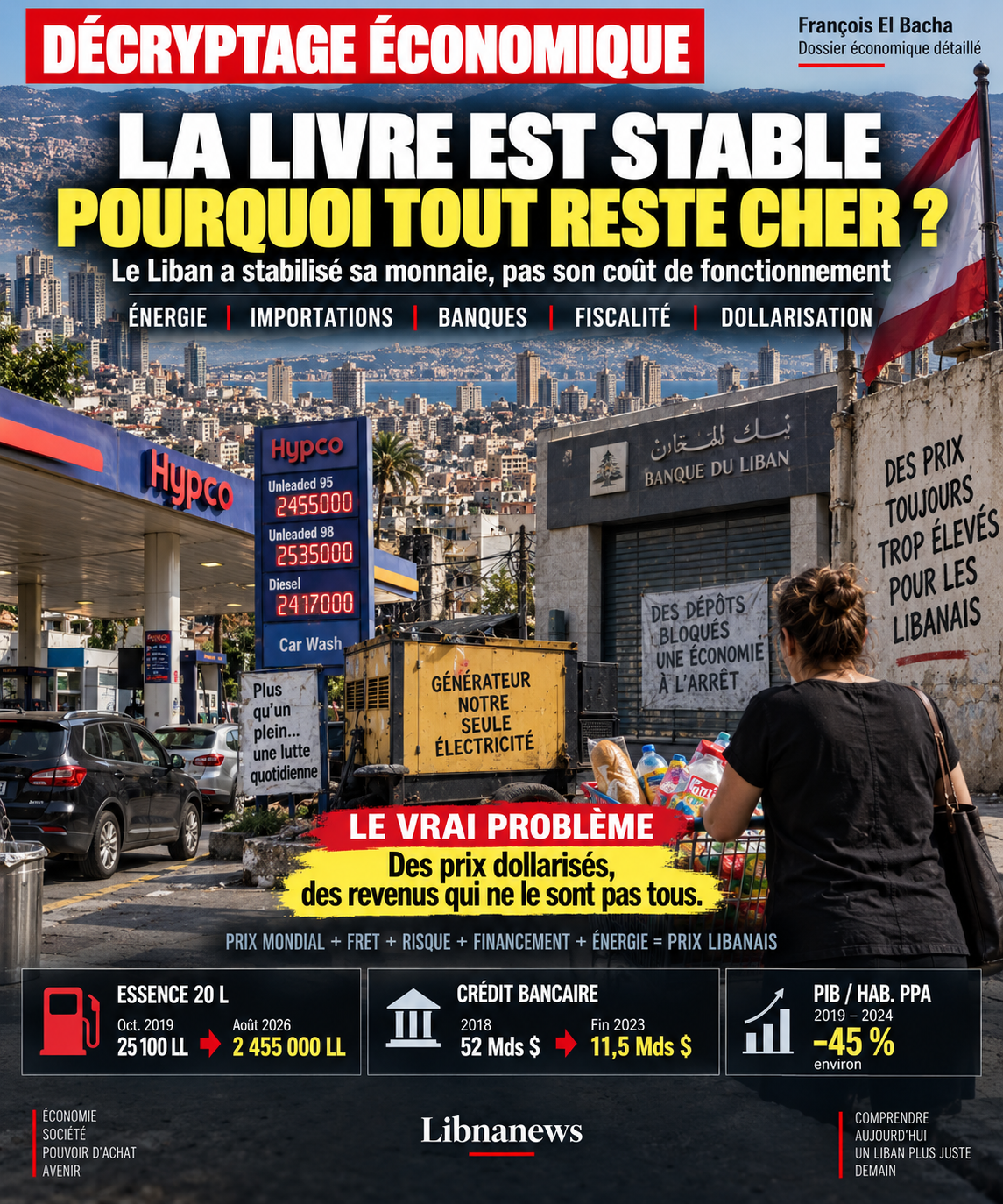
Purchasing power parity extends this logic to international comparison. Lebanon’s GDP per capita in PPP rose from about $21,710 in 2019 to about 11,918 in 2024, a decrease of almost 45%. Even by correcting differences in price levels between countries, the real economic decline remains massive.
This contraction is essential to understanding expensive life. Lebanon has gradually brought many prices closer to international references in dollars, while real per capita income has not recovered to its pre-crisis level. In other words, price standardization has been much faster than revenue standardization.
This average also masks large differences. A private employee paid in dollars, a household receiving diaspora transfers, a civil servant paid mainly in pounds, and a pensioner do not experience the same real inflation. Dollarization protects those whose income is itself dollarized; It exposes those whose income remains tied to local currency or public finances.
Therefore, the cost of living should never be summarized in the evolution of the ICC. The index measures an average basket. It does not measure the distribution of revenue or the share of incompressible expenditure in each budget. For a vulnerable household, energy, food, transport and telecommunications account for a much higher proportion of income. An increase in these items can therefore produce a much greater loss of well-being than average inflation suggests.
The stabilization of the exchange rate has profoundly changed the nature of the crisis without removing its consequences. As long as the pound depreciated rapidly, the diagnosis was relatively simple: an importing economy saw the price in local currency of almost all its inputs increase at the rate of depreciation, with anticipation effects that further accelerated the movement. Since the rate stabilized around LL 89,500 for one dollar, this explanation is no longer sufficient. The fact that inflation remains double-digit means that the rise in prices has shifted to other channels.
This distinction is essential to avoid confusing price levels with the pace of price increases. The general price level of 2026 still shows the monetary collapse and the abolition of subsidies. But inflation of 2026 measures what continues to increase after this transition. It is therefore much more informative about the current costs of the Lebanese economy than the spectacular multipliers calculated in pounds since 2019.
Lebanon now has an economy where much of the price is expressed or thought of in dollars, but where the dollar does not circulate in an institutional environment comparable to that of an officially dollarized and financially functional economy. The country imported the unit of account without automatically importing the institutions that make this unit of account stable and efficient: credit, infrastructure, competition, regulatory predictability and public capacity to provide essential services.
Dollarization prevents, in principle, uncontrolled domestic monetary creation from continuously devaluing foreign currency prices. However, it cannot prevent an increase in the real cost of energy, freight, insurance, financing, rent or services. Nor can it repair an electricity grid, recapitalize banks or reduce the risk of war. Monetary stability is a condition for normalisation, not a complete economic policy.
The persistence of an inflation rate of 15.69 % over a year in July 2026 must therefore be read as the result of an economy whose currency has stabilised faster than structures. Prior to the March escalation, the World Bank believed that near-collarization of prices and exchange rate stability could reduce inflation to one figure. The fact that this trajectory was interrupted by the war shows how sensitive the economy remains to external shocks. But the violence of transmission also reveals the weakness of its internal shock absorbers.
The war of 2026: from the oil shock to the destruction of productive capacity
War acts first by the price of imports. The March 2026 shock is visible in the statistics: the general price index increases by 4.91% in one month and the fuel index by 36.48 %. Year-on-year inflation rose from 12.27 per cent in February to 17.26 per cent in March and 20.02 per cent in April. The World Bank, which was still planning a 4 per cent growth in 2026 on a stable basis in January, projected a 6.4 per cent contraction and an average inflation rate of 17.5 per cent after the escalation.
The first channel is oil. In many economies, an increase in oil is passed on to transport and certain industrial costs. In Lebanon, it has an additional effect because diesel supplies a significant part of private electricity production. The same shock affects the motorist, the truck that transports the goods, the building generator, the supermarket, the hotel and the factory. The energy shock has several lives before reaching the consumer.
The second canal is maritime. A conflict zone increases insurance premiums, security requirements and sometimes detours. Longer deadlines require importers to hold more stocks. A stock is not free: it immobilizes capital, requires space, insurance and exposes the company to the risk of declining demand or deterioration of the product. In an economy where credit is scarce, this increase in stocks is financed mainly by the company’s own funds.
The third channel is demand. The World Bank estimates that the conflict reduces growth by 10.4 points compared to a war-free scenario. Tourism, consumption and investment are declining. A company can therefore sell less while paying more for its energy, transport and financing. Fixed costs must then be allocated to a lower volume, which can increase the unit cost. This is one reason why a recession does not automatically produce a general fall in prices.
The fourth channel is physical destruction. A damaged road, destroyed housing, closed workshop or affected electrical infrastructure reduce productive capacity. Reconstruction mobilizes resources that could have been invested elsewhere. Population movements change local needs, disrupt employment and create additional costs of accommodation, transport and services.
The fifth channel is human. Disruptions in education and health, prolonged travel and the departure of skilled workers can reduce future productivity. Thus, war not only produces a temporary peak of inflation. It can leave a legacy of higher costs and lower productive capacity. In an economy already weakened since 2019, this mechanism is particularly dangerous.
Banks: The deposit crisis is also a cost-of-living crisis
The failure of the banking system must be placed at the centre of the analysis. According to the World Bank, the system’s financial losses exceed $75 billion. At the end of 2023, 73 per cent of bank assets were exposed to the general sovereign, 88 per cent of which were with the Bank of Lebanon. The credit portfolio, which amounted to approximately $52 billion in 2018, had fallen to $11.5 billion at the end of 2023 and 78% of that portfolio was not performing well. These figures describe not only a solvency crisis but the disappearance of an economic function.
A bank is not only used to keep deposits. It transforms savings into credit, spreads risk over time and allows a company not to finance each transaction in full from its own liquidity. When this function disappears, the cost of capital increases even if no official interest rates are displayed.
Consider an importer. Before the crisis, he could open a letter of credit. The bank undertook, under certain documentary conditions, to pay the supplier. The foreign supplier therefore did not have to bear the full risk of the Lebanese company. The importer could also obtain a finance trade line or a cash flow facility. Today, these instruments are much more difficult to obtain and may require very large cash coverage.
The consequence is heavier pre-financing. A company that has to immobilize $5 million for three months has an opportunity cost of about $100,000 if its capital is valued at 8% per year, and about $150,000 at 12%. This cost exists even if no bank formally charges an interest. Fixed capital cannot finance any other stock, investment, recruitment or expansion.
The lack of credit also increases the need for margin. In a normal banking economy, a company can accept a lower margin and offset by a rapid rotation of credit-financed stocks. If it has to finance each shipment itself, it will naturally seek a higher return on each locked-in dollar. The cost of capital then becomes an invisible component of the price.
The failing system further penalizes SMEs. A large group may have foreign liquidity, international banking relationships or shareholders capable of providing capital. A small business is more dependent on local credit. The contraction of credit therefore favours players already having cash, reduces competition and increases barriers to entry. In the long run, less competition may mean higher margins.
Finally, the banking crisis increases the counterpart risk. A foreign supplier with Lebanese banking restrictions can request an advance payment rather than a 30-, 60- or 90-day payment. This change shortens the supplier credit and further increases the need for cash flow. The banking crisis is thus turning into a working capital crisis.
That’s why talking about an « invisible tax » of the banking crisis is not just an image. This tax is not levied by the State, but it corresponds to a systemic additional cost: cash immobilization, higher guarantees, longer deadlines, risk of counterpart, reduced competition and deferred investment. It is reflected in the final price of many imported goods and in the cost of locally produced services.
Cash economy: a survival solution that itself has a cost
Dollarization in cash enabled the economy to continue to operate despite banks. It has prevented part of the trade from being paralyzed by account restrictions. But it is not a cost-free alternative to a normal financial system.
Cash must be transported, counted, secured and stored. A company that cashes large sums in banknotes must organize the physical security of its revenues and payments. It faces a risk of theft and loss. Major payments become more logistically burdensome. Internal controls are more difficult and compliance costs are increasing for companies that want to maintain international relations.
The cash economy also reduces the capacity to finance investment. A functioning banking system converts thousands of deposits into loans to businesses and households. When savings remain in the form of banknotes, in safes or outside the banking system, it does not automatically finance a factory, hotel, accommodation or SME. The country can therefore have significant physical liquidity while suffering from a credit shortage.
This situation partly explains the Lebanese paradox: many transactions are made in dollars, but the financial depth is extremely low. An economy can be dollarized without being financially standardized. The dollar note solves the problem of unit of account; it does not replace the balance sheet of a solvent bank or the credit risk analysis.
Cash also reduces the transparency of the tax base. The more transactions escape formal channels, the more difficult it is to measure income and profits. The state is then tempted to turn to the easiest taxes to collect: VAT, customs, excise duties and tariffs. This can reinforce the regressive nature of the tax system, as consumption is easier to tax than poorly documented income or wealth.
Finally, the cash economy fragments households. Those receiving foreign transfers, dollar wages or tourism-related revenues have relative protection. Those whose incomes remain in books or depend on public benefits are more affected by rising dollarized prices. Dollarization can therefore stabilize the unit of account while increasing the gap in purchasing power.
Electricity: a private cost spread throughout the economy
The electricity sector is the best example of a structural cost that far exceeds the household bill. Prior to the crisis, EDL sold highly subsidized electricity. Tariff reform was needed to reduce losses and bring the price closer to economic cost. But the consumer did not receive a continuous supply in return.
It therefore pays for several systems. He pays EDL. He pays a private generator for the missing hours. He may have invested in solar panels, batteries and an inverter. Each of these systems has its own investment, maintenance and replacement costs. The actual energy expenditure is the sum of these items, not the only EDL bill.
For a company, the mechanism is even more important. The supermarket must maintain its cold chain, the hotel air conditioning its rooms, the hospital feeding its equipment, the restaurant keeping its food, the factory running its machines. Private energy is therefore incorporated into the price of almost all goods and services.
This creates a double payment for the consumer. He pays directly his own generator and indirectly pays the merchant’s generator in the price of his purchases. If gas oil increases, this increase appears in several lines of its budget without always being identifiable as an energy expenditure.
Electricity costs also reduce competitiveness. A Lebanese company that produces with expensive private energy faces foreign competitors powered by more reliable and sometimes less expensive networks. The real depreciation of the currency therefore did not produce the export boom that could have been expected: gains in foreign exchange competitiveness were offset by structural constraints.
War strengthens this mechanism. An oil shock increases the price of diesel, while damage to infrastructure can further reduce public supply. Energy then becomes both a direct source of inflation and a multiplier of other costs.
Taxation: restoring revenues without paying more for those who have already lost the most
Lebanon needs government revenue. Without revenue, it cannot finance electricity, water, roads, safety, education, health or social protection. The reconstruction of a functioning State therefore requires a sustainable increase in public resources after the real collapse of revenues during the crisis.
The problem is the composition of this tax system. In a highly importing economy, customs duties, VAT, excise duties and consumer taxes are easy to collect because they focus on points of entry and visible transactions. But they can be socially regressive.
A tax of 11% represents the same rate for a rich household and a poor household, but not the same sacrifice. A low-income household spends almost everything it earns on food, energy, transportation, housing, telecommunications and health. An affluent household can save a significant portion of its income. A consumption tax is therefore levied proportionally more on the capacity to live of the former.
The effect is even stronger in an importing country. Taxing an imported product can tax the consumer directly, but also an input used by a local company. A detached part, equipment, fuel or intermediate product taxed at entry increases the cost of domestic production. The border between import taxation and taxation of local production becomes blurred.
There are also cascade effects. An increase in fuel tax increases the price paid at the pump, but can also increase the cost of transporting goods and generators. These costs are then incorporated into the selling price on which VAT applies. The same tax decision can therefore have several indirect effects.
The question is not to say that no tax should increase. It is about who should finance the recovery. More tax based on contributory capacity, high incomes, certain annuities and assets can distribute the effort differently from consumption-dominated taxation. The World Bank and IMF also stress the need to strengthen revenues while developing more modern and progressive taxation.
In our analytical estimate, taxes, duties, administered tariffs and other levies could directly or indirectly contribute to about 0.7 to 1.5 points of current inflation. This range is not an official breakdown of the ICC. Above all, it underestimates the social importance of taxation: an additional point of inflation can be much more painful for a household that has no saving capacity than for an easy household.
Why Compare Lebanon to Panama, Ecuador, El Salvador and Montenegro
The international comparison answers a fundamental question: is a dollarized economy necessarily doomed to high inflation? The data clearly show that no. Panama has been using the dollar for over a century. Ecuador adopted El Salvador in 2000 in 2001. Montenegro unilaterally uses the euro. These economies have different structures, income levels and vulnerabilities, but they have a common lack of a conventional national monetary policy.
Projections 2026 are far removed from the Lebanese situation. IMF forecasts about 1.4 per cent of inflation in Panama, 2.9 per cent in Ecuador, 2.5 per cent in El Salvador and 3.2 per cent in Montenegro. The World Bank projects 17.5% in Lebanon. The gap is too large to be explained solely by the adoption of a foreign currency.
Panama is particularly instructive. The World Bank recalls that inflation has remained below 2 per cent for most of the period since the mid-2010s. Dollarization has contributed to monetary stability, but it operates with an open, competitive and deep financial sector. Banks must maintain significant liquidity buffers as there is no traditional lender of last resort. The country thus avoided a systemic banking crisis comparable to that of Lebanon.
The comparison does not mean that Panama is a replicable model. Its economy benefits from the canal, an international financial centre and a different institutional architecture. However, it shows that a dollarised economy can experience low inflation if its banking system operates, if payment channels are normal and if domestic costs do not destroy the monetary anchor.
Ecuador provides a second education. Its average inflation was only 0.7% in 2025 and the IMF projected a moderate increase in 2026, mainly due to oil and the reform of diesel subsidies. This is precisely the type of distinction that is useful for Lebanon: the removal of a subsidy can lead to transitional inflation without calling into question the general stability of the monetary system.
El Salvador shows that dollarization does not eliminate fiscal, social or productivity vulnerabilities. The IMF highlights high debt, significant financing needs and dollarization rigidities. Yet projected inflation remains around 2.5%. Thus, structural difficulties do not automatically translate into 15% or 20% inflation.
Montenegro is a European comparator. It uses the euro without having the ECB’s monetary policy. Its inflation may exceed that of the euro area as wages and domestic prices rise faster ; It reached 4.9% in September 2025. But even in this case, projections 2026 remain around 3.2 per cent, very far from Lebanon.
Finally, Zimbabwe serves as a counter example. Utilization of the dollar can reduce some monetary imbalances, but a multicurrency economy with fragile institutions, inconsistent policies and low confidence can maintain high price volatility. The lesson is important: the foreign currency can withdraw from the state part of its ability to create inflation by monetary issue, but it does not replace institutions.
Lebanon is in a hybrid situation. The dollar has become the dominant unit of account without missing the pound, the banking system is paralysed, the state remains underfunded, infrastructure is deficient and war adds a major risk. Dollarization has thus stabilized an inflation channel, but the other channels are exceptionally powerful.
What the international comparison really says about Lebanon
The comparison should not be used to state that Lebanon should mechanically have Panamanian inflation. The economic structures are different. It is used to isolate a mechanism: if several economies using a foreign currency experience low inflation, dollarization cannot be the sufficient cause of Lebanese inflation.
On the contrary, dollarization should normally eliminate part of the monetary risk. A company that fixes its price in dollars no longer needs to add a daily premium to anticipate the next depreciation of the pound. A household paid in dollars is less exposed to the collapse of the local currency. A foreign supplier can reason in the same unit of account as his client.
But Lebanon accumulates costs that not all of these comparators cumulate simultaneously. It pays for expensive private energy, equity financing, war risk, disrupted logistics, inadequate public infrastructure and a financial risk premium. It also supports a fragmentation of income between dollars, books, public pensions, transfers and informal income.
The inflation differential can therefore be read as an indirect indicator of the cost of malfunctions. It does not allow exactly 14 points to be allocated to a given cause, but it shows that the currency is no longer the dominant explanation. When Panama stands at 1.4% and Lebanon at 17.5% with the same international reference currency, the question becomes: what makes this difference in the Lebanese economy?
The answer is multiple: war, energy, freight, insurance, lack of credit, indirect taxation, domestic services and weak competition in certain markets. The cost of living therefore becomes a problem for the real economy and institutions as well as a monetary problem.
Nominal cost, real cost and purchasing power: price alone is not enough
To measure the social crisis, three concepts must be distinguished. The nominal cost is the price displayed. In books, it measures the extent of depreciation and monetary inflation. But it can produce spectacular figures that do not directly tell what the standard of living has become.
The cost in dollars helps neutralize much of the exchange effect. It answers a different question: has the product become more expensive in strong currency? This comparison is essential for gasoline, electricity, telecommunications and imported goods. But it can still be misleading when the starting price was subsidized.
The real cost is ultimately the most important for the household. It measures the amount of income, work or alternative consumption that must be sacrificed to buy the property. A $25 gas can can be inexpensive for a household earning $5,000 and extremely heavy for a household earning $500.
Therefore, the comparison with wages and disposable income must accompany any price comparison. Dollarization has fragmented situations. A person who earned $2,000 in 2019 and now maintains an income close to $2,000 did not experience the same crisis as a civil servant or pensioner whose real income was destroyed and then only partially upgraded.
Purchasing power parity makes it possible to go further for international comparison. It corrects the fact that one dollar does not allow the same amount of goods and services to be purchased in all countries. Per capita GDP in Lebanon’s PPP increased from approximately $21,710 in 2019 to 11,918 in 2024, a decrease of close to 45%. Even after adjusting for the general level of prices, impoverishment remains massive.
This decline shows that the crisis is not only a conversion artifact at the exchange rate. The real economic level per capita has declined. At the same time, some of the prices — fuels, energy, imported products and certain services — were close to international references. Lebanon therefore combines increasingly international prices with an actual purchasing capacity significantly lower than in 2019.
Poverty confirms this reading. The World Bank estimated that it had reached 44 per cent of the population in the areas studied in 2022, compared with 12 per cent a decade earlier according to a comparable methodology. Households without access to dollars are particularly vulnerable. Diaspora transfers, which play a major role, protect part of the population but also increase segmentation between households receiving currencies and households dependent on fragile household incomes.
Gasoline, Telecommunications and Imports: Three Illustrations of Model Change
Gasoline is probably the simplest example to understand why a gross comparison in pounds is insufficient. The 20-litre 95-Octan can cost around 25 100 LL in autumn 2019. In the last official grid available in August 2026, it was around £2.455 million. In nominal terms, the price was multiplied by almost one hundred.
This multiplier obviously does not mean that world oil has been multiplied by 100. At the official 2019 rate, LL 25,100 was approximately $16.65. At LL 89,500 for one dollar, $2,455 million represents approximately $27.43. The increase in dollars is significant, but it is in an entirely different order of magnitude.
This comparison must then be corrected for the subsidy scheme. In 2019, the Bank of Lebanon provided foreign exchange to finance fuel imports at a rate that did not reflect the economic rate that would then emerge. Part of the cost was therefore socialised by the use of reserves. Today, the consumer bears much more directly the international price of the refined product, freight, insurance, financing, storage, distribution, margins and levies.
Bank financing adds an additional difference. A cargo of hydrocarbons represents large amounts. If the importer has to immobilize more dollars before delivery because the letter of credit or the finance trade line is no longer available under the same conditions, its financial cost increases. The world price of the product is therefore only the first line of a cost chain.
Telecommunications illustrates another aspect of transitional inflation. Book prices had lost most of their real value during the crisis. Their upgrading was necessary to enable operators to pay for equipment, wages, energy and suppliers whose costs were largely in foreign currency. For the household, however, this increase appears to be a very strong increase in the bill.
It is therefore necessary to avoid comparing an old subscription with a current subscription only by their amount in books. Capacity, data volumes and service quality have also changed. The good comparison is to look for an equivalent service, convert prices into a stable unit and then measure the weight of the invoice in the household income.
These examples show that the crisis has moved Lebanon from a model where many domestic prices were decoupled from their international cost to a model where the dollar cost is passed on much more directly. Such transmission sometimes improves economic transparency, but it also makes consumers much more exposed to global shocks.
Can we break down the current 15 to 17.5% inflation?
There is no official breakdown to say that each point of inflation comes from a single cause. The categories overlap: an increase in oil is both imported inflation, an energy shock, an increase in the cost of transportation and an increase in the cost of generators. An increase in freight can be linked to war and increase the price of inputs used by domestic services.
However, analytical orders of magnitude can be proposed to understand the channels. Directly imported inflation could be about 2.5-3.5 points. Energy and its second turn effects could be about 2.5 to 4 points. Freight, insurance, supply disruption and conflict risk premium could be 1.5 to 3 points.
Domestic repricing in dollars — rent, education, catering, services and margins — could contribute in the range of 2 to 3 points. Financial failures and the cost of financing, including the lack of credit and normal letters of credit, could amount to about 1-2 points. Taxation, duties, administered tariffs and other levies could be about 0.7 to 1.5 points.
These ranges should not be added mechanically. They constitute a mapping of the mechanisms and not a formal accounting of the ICC. Their interest is to show that current inflation no longer has a single engine.
There must also be a separate category for transitional inflation. It explains a considerable share of the price level difference between 2019 and 2026, but much less the current annual variation. The abolition of a subsidy results in a change of level. Once the new price is reached, it cannot forever explain double-digit inflation.
The distinction between stocks and flows is important here. The legacy of monetary inflation and transition inflation determines the very high level of prices. Imported inflation, war and structural costs further determine the speed at which these prices continue to rise.
This grid also helps to understand why a drop in oil would not be enough to bring all prices down to their 2019 level. Some of the past increases have become permanent because they reflect the disappearance of subsidies, the dollarization of tariffs and structural costs that have not been corrected.
Lebanese cost multiplier
The most useful concept for summarising the current situation is a Lebanese cost multiplier. An imported product has an international price. But between this price and that paid by the consumer are transport, insurance, financing, storage, distribution, energy, taxation and margin. Each of these steps can be more costly in Lebanon than in a functioning economy.
Country risk increases the cost of insurance and supplier requirements. The banking crisis increases the cost of financing. Low energy costs increase the energy cost. War increases freight, risk and stocks. Indirect taxation adds levies on an already highly import dependent economy. Small market size and the contraction of purchasing power reduce economies of scale.
These costs do not necessarily produce the same inflation each year. Instead, they create a price floor and amplify each new shock. A 10% increase in the world price does not happen in a neutral economy: it arrives in an economy where the distributor already pays its generator, the importer immobilizes more cash and the insurer integrates a risk premium.
The economic formula can be summarized as follows: international price + freight + insurance + country risk + financing + private energy + logistics + taxation + margin = final Lebanese price. The consumer does not always see each of these components, but pays them all.
That is why expensive living in Lebanon is now as much a problem of productivity and institutions as a problem of money. Banking reform, sustainable improvement of electricity or reduced security risk can affect prices even if the exchange rate does not change. Conversely, maintaining stable exchange rates without reforming these structures leaves much of the additional cost intact.
International prices, still fragmented incomes and an economy that pays for its own failures
The cost-of-living crisis since 2019 cannot be summed up by a single curve. The first price explosion comes from currency. The second is the transition from a model of artificial subsidies and tariffs to a widely dollarized model. The third comes from world markets. The fourth comes from the war. And behind all these phases is a set of structural costs that amplify shocks.
The stabilization of the pound has been a major macroeconomic progress. It removed the daily spiral of the exchange rate and made prices more predictable. But it alone could not make banks solvent, restore credit, provide electricity 24 hours a day, reduce insurance premiums or rebuild infrastructure.
The comparison with Panama, Ecuador, El Salvador and Montenegro shows this clearly. An economy using a foreign currency can have low inflation. Lebanon therefore did not have an inflation problem because it was dollarized. It has a problem because its dollarization has occurred in a financially paralyzed, highly importing economy, exposed to war and forced to privatize part of its essential infrastructure.
The banking system is central here. As long as companies have to finance their own imports, stocks and investments, the cost of capital will remain high. As long as letters of credit and the finance trade do not work normally, suppliers will demand more guarantees and prepayments. As long as savings remain largely outside the banking system, it cannot effectively finance investment.
Energy is the second project. A household paying for EDL, a generator and possibly a solar installation cannot be compared to a household receiving continuous service from a single network. A company producing electricity cannot have the same cost structure as a competitor with a reliable grid.
Taxation is the third arbitration. The state must restore its revenues, but the way it does so determines who pays the adjustment. Taxes that are too dependent on consumption and imports can weigh more proportionally on vulnerable households, precisely those whose purchasing power has already been most destroyed.
Finally, the war recalls the fragility of any normalization scenario. It increases oil, freight, insurance and risk, destroys capital, reduces tourism and investment and can push skilled workers to leave. It turns a structural problem into a new inflationary shock.
The central question is no longer only: how much does a product cost in pounds? It is: how much does it cost in dollars, how much of this price corresponds to preventable malfunctions and what proportion of the real income of a household must be sacrificed to buy it?
It is this last measure that best summarizes the crisis. Lebanon has largely internationalized its prices without internationalizing the incomes of its entire population. It pays global prices, plus local crisis costs, with real purchasing power that remains much lower than in 2019.
Monetary stabilization stopped bleeding. She hasn’t cured the economy yet. In order to reduce the cost of living in a sustainable way, we must now act on what lies between the world price and the consumer: financing, energy, logistics, competition, taxation, infrastructure and risk. In other words, the next fight against Lebanese inflation will be less on the exchange rate table than on the reconstruction of the economic institutions themselves.
Central statistical administration (CAS): Consumer price indices 2025-2026, including January to July 2026.
World Bank: Lebanon Economic Monitor, 2025 and summer 2026; Poverty and Equity Assessment 2024; papers on the financial sector crisis; World Development Indicators for GDP per capita in PPP; Global Economic Prospects January 2026 for comparison with Panama.
International Monetary Fund: Article IV Lebanon 2023 and mission of February 2026; country data and reports 2025-2026 for Panama, Ecuador, Salvador and Montenegro.
Electricity in Lebanon and the Ministry of Energy and Water: tariffs and official energy prices.
The ranges of contributions to inflation presented in this dossier are analytical estimates designed to identify transmission channels. They do not constitute a formal breakdown of the ICC and should not be combined mechanically with several overlapping mechanisms.
Main sources and methodological precautions
Central Statistical Administration (CAS): Consumer price indices 2019-2026, including monthly publications from January to July 2026.
World Bank: Lebanon Economic Monitor; Poverty and Equity Assessment; Reports on the Lebanese financial sector; World Development Indicators for GDP per capita in purchasing power parity; January and August 2026 economic updates; Global Economic Prospects for International Comparisons.
International Monetary Fund: Article IV and Lebanon documents; consultations and projections 2025-2026 for Panama, Ecuador, El Salvador and Montenegro.
Electricity from Lebanon, Ministry of Energy and Water, Ogero and official tariffs for energy and telecommunications.
The ranges assigning orders of magnitude to the various inflation channels are analytical estimates. They do not constitute an official breakdown of the ICC and should not be combined mechanically, as energy, freight, war, financing and taxation overlap in part.