


The price of the Lebanese solar is not limited to the amount shown for a few panels. A household also buys an inverter, protections, an installation and often a battery. It sometimes seeks two different results: to pay less electricity and to have power during the cuts. A solution can meet the first objective without ensuring the second all night.
To compare offers in November 2026, the old market averages serve as benchmarks, not applicable tariffs. We must look at the expected production, the uses to be covered and the equipment actually included. The cost of self-sufficiency is measured over several years, whereas the estimate mainly presents an initial expenditure.
Lebanese solar price: what the historical series shows
The Lebanese Energy Conservation Centre, the LCEC, publishes in its 2023 report a series of average turnkey prices. The document, released in April 2025, indicates $806 per kilowatt-peak in 2020, 1,266 in 2021, 1,019 in 2022 and 1,003 in 2023. The latter amount remains higher than in 2020.
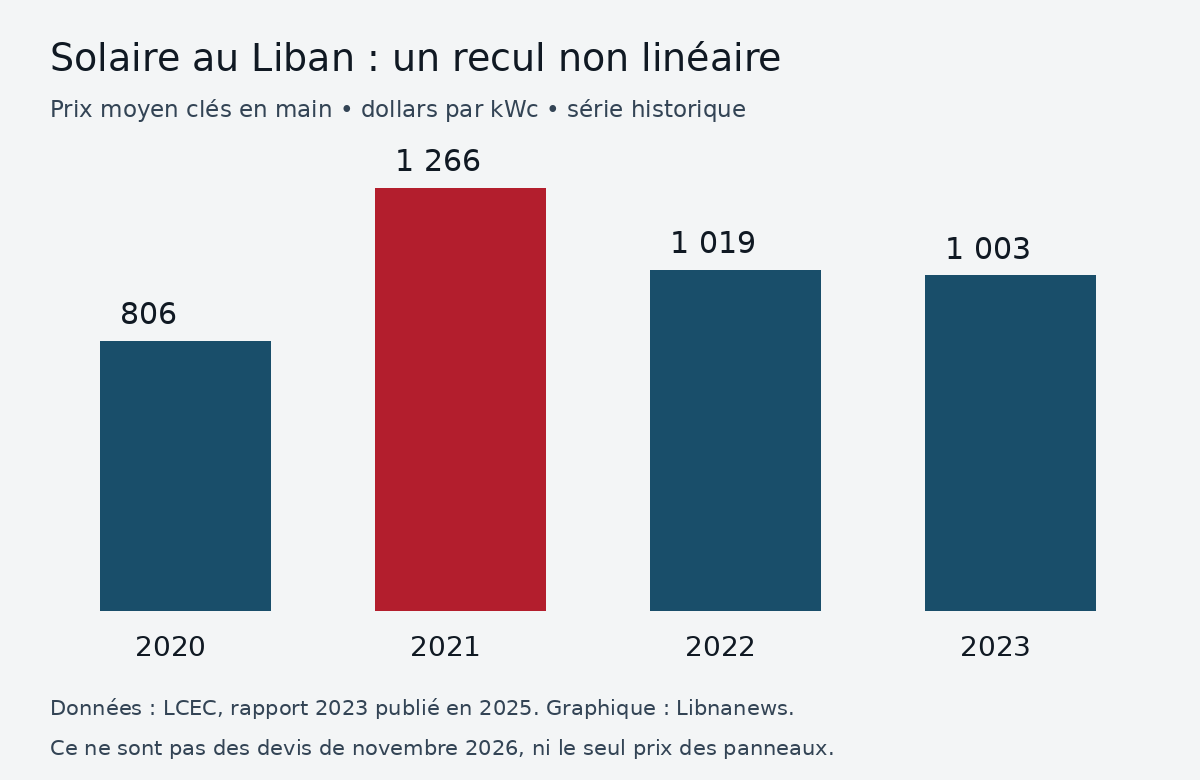
The kilowatt-peak measures a nominal power, not energy available every night. The average aggregates different projects. It does not give the price of a battery alone or that of standard domestic equipment. In particular, the report combines the increase of 2021 with supply disruptions and high demand.
These data show why a long-term industrial decline does not prevent temporary increases. They do not allow to set the right price for a current quote without knowing its configuration.
Cheaper sign does not reduce all posts
The US Department of Energy distinguishes the equipment from the costs associated with its sale and installation. These include installation, financing, procedures and commercial expenses. Their weight does not necessarily decrease at the rate of the components. This technical decomposition is useful in Lebanon, without transposing US tariffs or rules.
A legible estimate therefore separates modules, inverter, storage and other equipment. It also specifies the work and services included. A supply limited to the equipment is not directly comparable to a serviced facility. The lowest amount can simply cover fewer benefits.
The interest of a breakdown is not to impose a theoretical margin on each enterprise. It involves identifying what changes between two proposals. Adding storage, changing power or including electrical works makes the purchased service vary. Without a common perimeter, price classification may compare different equipment.
Battery provides a service, not free energy
The US technical benchmark ATB 2025 retains a return yield of 85% for its residential storage model. This means that 100 kWh entering the storage will return 85 useful in this case. This is neither a measurement of batteries installed in Lebanon nor a guarantee for all devices.
It is therefore necessary to count the energy lost in charge and in landfill. When the battery recharges on a pay source, these losses have a cost. When she receives a solar surplus, they reduce the amount available afterwards. Storage moves energy over time; He doesn’t create one.
The same benchmark integrates degradation into its operating costs and 15-year horizon. This modelling horizon is not worth a lifetime promise. The actual warranty, the conditions of use and the capacity retained over time must be examined separately.
A decrease in the price of cells does not disappear as a result of neither installation nor electronics nor possible renewal. Only estimate the purchase price of the battery underestimates the cost of the service rendered during its use.
Power, capacity and autonomy: three distinct issues
Power, expressed in kilowatts, indicates what the system can provide at a given moment. The useful capacity, expressed in kilowatt hours, indicates the energy available. The length of time that this reserve can supply the housing then depends on the equipment used. A large energy tank alone does not guarantee sufficient power for all simultaneous uses.
In its documentation of 26 June 2026, the manufacturer Tesla distinguishes three dimensioning criteria: housing consumption, appliances to be rescued and the desired duration of rescue. This distinction exceeds a particular mark. Maintaining a refrigerator, lighting and connection does not require the same equipment as covering all domestic uses.
The estimate must therefore specify the service promised, and not only display a capacity. A cut-off reserve may remain partially unused on a daily basis. This choice buys additional security, but does not automatically generate proportional savings on the invoice.
Good calculation begins with use and roof
The orientation, the shadows and the available surface alter the production. The U.S. Department of Energy’s guide recommends an estimate adapted to the building, rather than simply extrapolating installed capacity. A simulation tool can help, but does not replace the site study.
Schedules also count. Consumption during production hours allows direct use of part of the solar current. A concentrated need after sunset requires another organization: storage or additional supply. Moving a usage when possible may change the amount of batteries required.
First, reducing avoidable consumption can also limit the size of the installation. The issue is not to multiply the panels without considering the needs. It is to obtain the desired service with a usable production, rather than a power displayed which does not correspond to the hours of the household.
What the final price still needs to specify
Comparison of offers requires written commitments: equipment, installation, estimated production, guarantees and maintenance. The Federal Trade Commission, the US consumer authority, insists on these elements in its solar guide. Its legal rules do not automatically apply in Lebanon, but technical issues allow for a better comparison of benefits.
The cash price must also be distinguished from the total reimbursed with funding. A low monthly payment does not describe the full cost. Costs, duration and terms of repayment may affect the economic interest of the project.
Finally, producing part of its electricity does not necessarily remove the fixed charges of a retained supply. The correct comparison covers all remaining expenditures and purchases actually avoided. A promise of profitability must specify its future production and price assumptions, rather than presenting them as acquired.
For a Lebanese household, the next concrete step is therefore an estimate that combines a total cost and measurable service: expected energy, appliances powered during a shutdown, including maintenance and replacement conditions. Without these elements, two kits sold under the same « autonomy » label can meet very different needs.





Comments