The climate crisis is not just a temperature crisis. It is a crisis of civilization, responsibility and respect for the living.
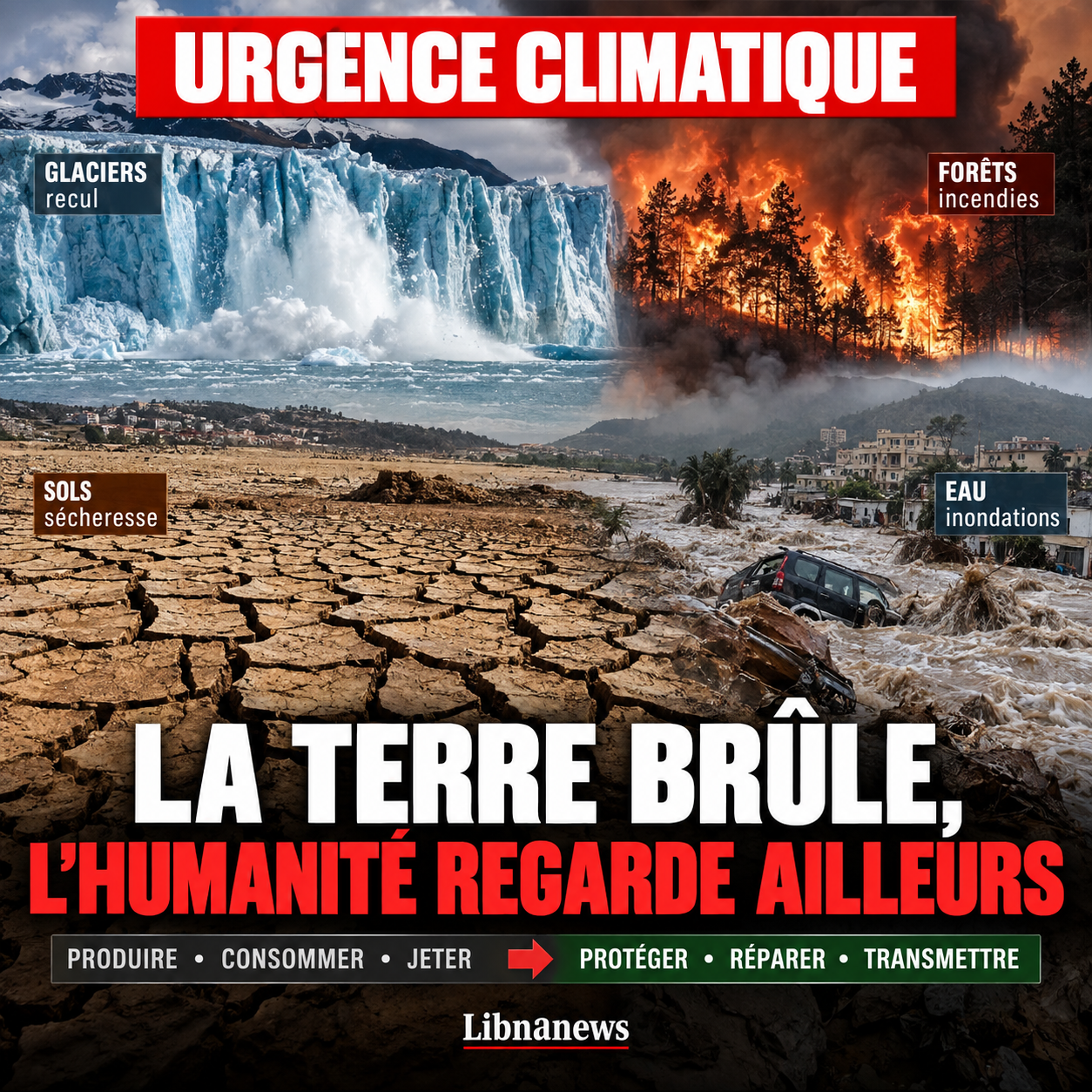
The North Pole is melting. Glaciers are retreating. The heat waves are settling down. The forests are burning. Dry soils become unable to hold water, then violent rains turn them into mud flows. Whole valleys can rock in a few hours from drought to flooding. And yet we continue to talk about these events as if they were separate accidents, successive bad luck, distant images that we look at a few seconds before moving on.
No. It’s not about looking elsewhere anymore.
The planet sends us a message of growing violence: our way of living the Earth has become incompatible with the balances on which our own life depends.
Perhaps the greatest catastrophe is our indifference
Of course, the Earth’s climate has always varied. Of course, fires, storms, droughts and landslides have always existed. But modern man has added enormous pressure to these phenomena: greenhouse gas emissions, destruction of forests, artificialisation of the soil, pollution of the oceans, overexploitation of resources, accumulation of waste, plastics scattered to the most remote parts of the world.
We believed that Nature could absorb everything. That it could receive our smokes, our dirty waters, our plastics, our chemicals, our landfills, our constructions, our excavations, our razed forests, and nevertheless continue to function as before.
We were wrong.
Nature is not an infinite trash. It is not an inexhaustible reserve of raw materials. It is not a decor that you drive through the weekend before returning to produce and consume more and more.
Nature is the living system on which we depend every second.
Nature is not external to man
Perhaps this is the most serious intellectual error of our civilization: we have placed the human being on one side and Nature on the other. As if we were his owners. As if a river existed only to be captured, a forest to be cut off, a mountain to be ripped off, a valley to be concreted and a sea to receive what we no longer want to see.
But we are not outside Nature.
We breathe thanks to her. We drink thanks to her. We eat thanks to her. Our flesh, blood, bones and brain are made up of matter from the same Earth. We belong to the life cycle that we claim to dominate.
Destroying Nature is therefore destroying ourselves — with a time lag of a few years or generations that gives us the illusion that the act is without consequence.
Ecological debt is a strange debt: those who contract it are not always the ones who will pay it. Today we can destroy a forest, poison a water table, degrade a coastline or permanently deregulate an ecosystem, and pass the bill on to children who are not yet born.
We must get out of the civilization of waste
Our economy has perfected the art of producing. She must now learn the art of no longer destroying.
Production without thinking about waste is no longer acceptable. Consumption without knowing where it comes from or where it will go is no longer acceptable. Designing objects for a few months of use and centuries of pollution is no longer acceptable.
Recycling should no longer be a supplement of good conscience. Waste reduction must no longer be an advertising campaign. The protection of soil, forests, rivers, coasts and oceans must become as fundamental a priority as energy, safety or health.
We have to reuse. Repair. Recycle. Clean up. Reforest. Restore soils. Protect watersheds. Prevent rivers from becoming sewers. Reduce unnecessary plastics. Build better. Produce better. Transport better. Eat less stupidly.
And above all, stop believing that a country can solve a problem that knows no borders alone.
The climate has no passport
Carbon does not stop at customs. The oceans have no borders. Major climate systems connect continents. A destroyed forest, a warmed ocean, a weakened ice cap or an atmosphere filled with more greenhouse gases affect all humanity.
Action must therefore be rapid and global.
Not in 50 years. Not when every government finds the time politically comfortable. Not when all companies amortize their old models. Not when the next generation inherits the damage.
Now.
We need more demanding international agreements, coherent energy policies, massive investment in efficiency and clean technologies, but also a profound change in behaviour.
For no international conference will save a river if the inhabitants continue to dump their waste there. No technology will protect a forest if everyone considers it still belongs to someone else. No law will be sufficient if respect for the living does not enter our consciousness.
The most urgent revolution begins with children
That’s where it all starts.
We have to teach a child that a river is alive.
Not alive as a man or animal, of course, but alive as a system: it is born, circulated, nourished, transported, connected, sheltered, transformed. It has a balance that can be protected or broken.
We have to teach him that a forest is not just a set of trees. That a mountain is not a pile of rocks. That a valley is not an empty space available for real estate. That a beach is not a place to leave leaving behind bottles, bags and butts.
Every child should get to know a real territory: a river, a forest, a mountain, a coastline, a valley. Observe his seasons. Understand his frailties. Pick up the garbage. Plant. See how water circulates. Understand what living soil is.
Environmental education should not be a secondary chapter in a school textbook. It should be a training in responsibility.
We teach children to respect a red light, the property of others and the rules of collective life. Why should we not teach them with the same strength as a stream, a forest or a mountain also have a dignity that imposes duties?
We drove the sacred out of Nature
Finally there is a deeper dimension, which our time hesitates to pronounce because it is measured neither in dollars nor in degrees: the spiritual dimension.
For millennia, man looked at mountains, forests, springs, sky, stars and oceans with a form of respect mixed with fear and wonder. He intuitively knew that he was in front of something that exceeded him.
Then we gradually turned the world into a commodity.
We gave a price to the wood, the square metre, the ore, the barrel, the kilowatt, the fish, the water, but we forgot to give a value to the very existence of the living.
For those who believe in God, the question becomes even more dizzying: how can we pretend to respect the Creator while scorning his Creation? How can we talk about the sanctity of life while treating the living world as a dump or a warehouse of raw materials?
Nature is not God. But the life of Nature can be received as a manifestation of Creation, as something entrusted to us and not delivered to our boundless predation.
We may have forgotten that respect for the living is also a form of humility.
And humility is precisely what is lacking in a civilization that thinks itself powerful enough to transform the whole planet without having to suffer the consequences.
We are the generation that knows
Our ancestors could say they didn’t know.
We don’t.
We see the glaciers retreat. We’re measuring the warming. We observe the oceans change. We know the role of greenhouse gases. We know what happens to plastics. We know that destroyed soils absorb less water. We know that some forests and ecosystems are not eternal.
We know.
That is why the inaction of our time poses a terrible moral question: what will be said of us if we have the knowledge, the technologies and the means to act, but nevertheless have chosen to preserve our habits?
What will a child of 2050 say in front of a dead river, a lost forest or an uninhabitable area?
He probably won’t ask us if the transition was politically difficult.
He will ask us:you knew. Why didn’t you do anything?
Earth will probably survive. The question is, what about us?
We often talk about saving the planet. The expression is almost too reassuring.
The planet does not need us to turn around the Sun. The Earth has undergone enormous upheavals long before the appearance of humanity and will experience others.
What we need to save is the extraordinary conditions that make possible our civilization and an immense diversity of life forms.
The issue is therefore not only ecological.
He’s human.
He’s moral.
He’s spiritual.
And it becomes urgent.
We must choose between two forms of civilization.
One will continue to measure its success at the volume of what it extracts, produces, consumes and discards.
The other will finally understand that power without responsibility leads to destruction, and that a truly advanced civilization also recognizes what it protects.
Protect a river. A forest. A mountain. A valley. Sea. A glacier. A species.
These are not marginal small gestures.
It’s rebuilding our place in the world.
We must relearn to look at Nature not as a stock of resources, but as a living community of which we are part.
And if we do not do so quickly, one day will come when we will no longer debate how to prevent degradation.
We’ll just look at the damage.
And it’ll be too late to fix a part of it.
« We are not the owners of Nature. We are a part of the living that we have a duty to transmit. »
Bernard Raymond JABER