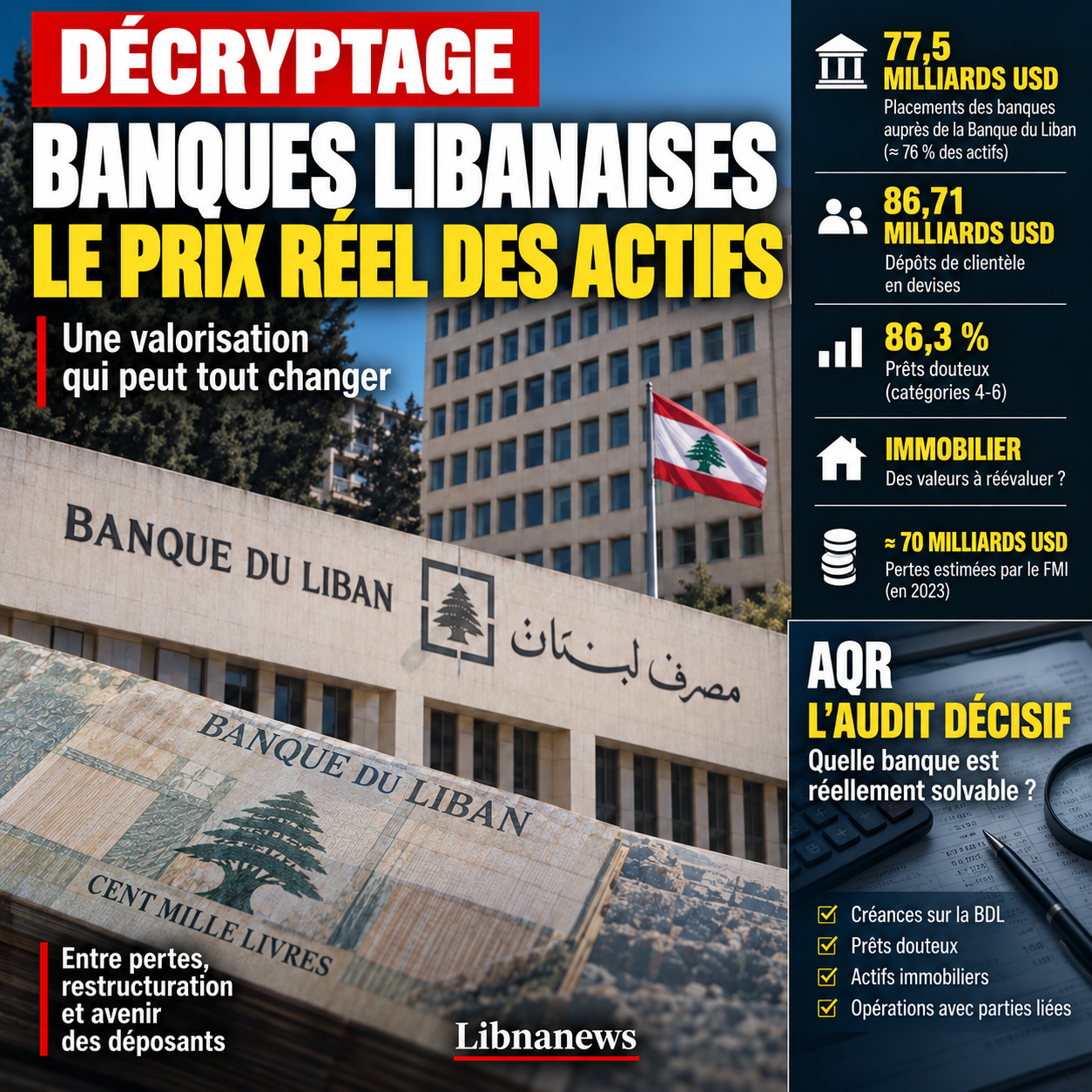
Six years after the financial collapse, the central question is no longer whether the Lebanese banking system has suffered losses, but who should absorb them and determine their bank amount per bank. A genuine asset quality review — debt owed to the Bank of Lebanon, sovereign debt, doubtful loans, seized real estate, equity and transactions with related parties — could wipe out some of the capital still posted. It could also reveal too optimistic under-provisions or valuations. On the other hand, referring to « misappropriation » requires transactional evidence that a simple accounting revaluation cannot provide.
The real subject: measuring loss before distributing it
In a bank, the asset represents what the institution owns or owes: cash, bonds, loans, deposits with other banks, buildings and equity. The liabilities include, inter alia, customer deposits. Capital absorbs losses first. If an asset in 100 is actually worth only 40, the difference must be recognized. As long as it is not, accounting capital can be more favourable than economic value.
Lebanon is focusing this problem on an exceptional scale. By the end of 2025, the Bank of Lebanon estimated the consolidated balance sheet of commercial banks at approximately $102 billion. Investments in the central bank accounted for 77.5 billion, or about 76% of the total. Foreign currency customer deposits amounted to $86.71 billion. Most of the debate therefore does not focus on a few buildings: it focuses on the real value of a huge bank debt to the Bank of Lebanon.
The IMF estimated in 2023 the losses of the financial system at around $70 billion, while noting that an exact figure required a comprehensive review of asset quality, bank by bank, and the parameters of public debt restructuring. An aggregate estimate describes the system hole; an individualised valuation determines which banks are still solvent.
Why a real recovery is explosive
An Asset Quality Review, or AQR, does not consist of repeating an accounting photograph with the same assumptions. It examines the quality of loans, guarantees, provisions, sovereign exposures, central bank debt and equity. Its objective is to estimate what is truly recoverable. In a restructuring exercise, it is clear whether own funds still exist economically.
For shareholders, the stake is immediate. Additional depreciation reduces equity. If losses exceed capital, the institution becomes economically insolvent even if it continues to operate. The Lebanese law on banking resolution places valuation and the hierarchy of loss absorption at the heart of the process. IMF insists on one principle: losses should not be transferred to depositors before shareholders and lower-ranking creditors.
Every dollar of recognized loss must be charged to someone. A lower valuation of a loan portfolio or a real estate asset reduces capital. A strong discount on debt to the Bank of Lebanon can erase. The technical battle over assumptions is therefore also a battle over future bank ownership and loss-sharing.
The number that dominates everything: 77.5 billion in the BDL
The bank balance sheet remains dominated by investments with the Bank of Lebanon. They amounted to $77.5 billion at the end of 2025, compared to $79.6 billion a year earlier. The Association of Banks of Lebanon reported that by the end of 2024 these investments represented 77.1 per cent of bank assets and that foreign currency deposits with BDL amounted to approximately 90 per cent of customer deposits in foreign currencies.
Accounting, a claim on the central bank is an asset. Economically, its value depends on BDL’s ability to repay it. However, it has accumulated a massive foreign exchange imbalance after years of state financing, exchange rate support and financial transactions with banks. The IMF considered that a consolidation of its balance sheet would require a significant reduction in its commitments to banks, as the State did not have the capacity to recapitalize it up to the hole.
This is why real estate, although important, is not the quantitative core of the problem. If several billion claims on the BDL are recoverable only partially or over a very long period, their economic value is lower than nominal. Without this estimate, one cannot seriously measure the capital of each bank.
Real estate: the risk of value on paper
The real estate stock is not the first item on the balance sheet in absolute terms, but it can be one of the places where an economic loss remains hidden behind a value of expertise. Banks have recovered land, apartments, offices, hotels, unfinished projects or real estate interests in settlement of doubtful debts. They also remain exposed by mortgages that guarantee loans.
The most sensitive mechanism appears when a doubtful debt is replaced by real property. Imagine a promoter who owes $30 million and can no longer repay. He transfers 30 million worth of expert buildings to the bank. If an independent expert concludes that they could be transferred only 16 million net, the economic loss of 14 million did not disappear: it only changed line in the balance sheet.
This difference between book value, expert value and market value is fundamental. A building presented as worth 20 million is not necessarily an asset of 20 million for a bank that must restore its solvency. It is necessary to determine how much an independent buyer would actually pay, in what currency, within what time and after what costs. The real cost, not the nominal cost, and above all on the basis of a possible sale and not artificial price maintenance.
Lebanon combines several factors that complicate this valuation. Real estate credit has collapsed since 2019, the market is largely in cash, statistics remain imperfect and prices do not necessarily correspond to negotiated prices. Political crises, war and destruction also affect certain territories. Expertise based on old references or prices may therefore be excessively favourable.
The problem does not date from 2019. In its 2017 assessment of the Lebanese financial sector, the IMF already identified weaknesses in the collateral valuation framework. It recommended strengthening the standards for evaluators and the rules for re-evaluation of security rights. Even before the crisis, the quality of real estate values used to measure credit coverage was therefore a prudential issue.
Overvaluation of the guarantee has a direct effect on the provisions. For a debt of 10 million on a debtor in difficulty, an estimated land of 9 million gives the impression that the risk remains broadly covered. If this land is actually worth only 5 million if it is realized, the economic deficit is much higher. Too optimistic expertise can delay recognition of a loss.
The date of the expert reports should also be examined. An asset valued before the crisis from a market supported by capital flows and credit cannot automatically retain the same value in 2026. An RQA should require recent expertise, actual sales comparables and a liquidity discount when an asset cannot be sold quickly without a sharp reduction in prices.
The most sensitive point concerns related parties. For each major asset, the audit should identify the previous owner, the debtor responsible for the transfer, the price chosen, the expert, any links with shareholders or managers and subsequent transactions. Buildings acquired at an abnormally high value from a related company could, according to the evidence, raise issues of governance, conflict of interest or warrant judicial investigation.
The same reasoning applies to interests in real estate companies. A bank may not own a building directly but may own a company whose value depends on land or buildings. If these assets are overvalued, bank participation is also. An RQA must therefore go back to the underlying assets.
Can we say today that the Lebanese banks’ housing stock is generally overvalued? No, lack of public data bank by bank and asset by asset. But this lack of evidence does not justify keeping existing values without control. On the contrary, it makes systematic independent expertise indispensable.
What a real estate test should measure
In the absence of a sufficiently detailed consolidated inventory of the housing stock held directly or indirectly by the banks, it would be misleading to estimate today the total loss. The relevant exercise is to apply several scenarios of market value, active per asset. A 20% drop would test a simply illiquid market; 40% would simulate a severe correction; 60% would correspond to a very difficult sale situation or to particularly optimistic initial expertise.
As an educational measure, if a bank held $500 million in real estate assets at their value of expertise, a 20% discount would create 100 million additional losses. At 40%, the loss would reach 200 million; at 60%, 300 million. If this bank had only 250 million economic own funds before the test, the third scenario would be enough to erase them. These figures are an example of accounting mechanics, not an estimate of the portfolio of a real Lebanese bank.
Above all, the test must compare the property loss to the capital of each establishment. A system-wide haircut that seems modest can be fatal to a bank whose own funds are already absorbed by losses on BDL and sovereign debt. Real estate can thus be the layer of additional losses that shifts an institution from undercapitalisation to insolvency.
Suspicious loans: an extremely degraded portfolio
The BDL reported in its December 2025 review that the loan ratio in risk categories 4, 5 and 6 was 86.3% by October 2025, as defined. This level reflects an extremely degraded portfolio. The credit contraction since 2019 has also changed the stock: loans have been repaid or reduced while a large part of difficult exposures remain.
To value a doubtful loan, it is necessary to estimate what the borrower can actually repay and what the guarantee is worth. If a company owes 10 million but no longer generates enough cash, the debt is not mechanically worth 10 million. If the bank counts on mortgaged land, it is necessary to integrate its realistic selling price, mortgage rank, legal deadlines, other creditors and costs.
IFRS 9 normally requires a logic of expected credit losses. The BDL adopted this framework in 2017 and changed it during the crisis. But a standard does not guarantee that all assumptions correctly reflect a systemic crisis. An independent RQA is used specifically to test classifications, provisions, guarantees and recovery scenarios.
Diversion of assets? Three phenomena to distinguish
The term « misappropriation » is tempting in a country where depositors have lost normal access to their accounts. However, an economic analysis must separate three phenomena. The first is the poor allocation of savings: banks have massively placed the funds with the BDL and the state. The second is poor valuation or under-provision: an asset remains above what can be recovered. The third is diversion in the legal sense: fraudulent transfer of an asset or unfair advantage to a specified person.
The first two may be identified by an accounting and prudential review. The third requires transaction records, identification of beneficial owners, review of transactions with related parties, cross-border transfers, advice decisions and transfer pricing. A bank can be insolvent without hijacking. Conversely, a fraudulent transaction may exist even if the balance sheet is properly evaluated.
However, the risk of dealing with related parties deserves special attention. In its diagnosis of governance and corruption published in 2026, the IMF identifies vulnerabilities such as the weight of family banks, a historically incomplete framework on related parties and a lack of transparency in supervision. Bank secrecy had also complicated the identification of certain relationships before its amendment in April 2025.
An investigation should therefore ask not only how much a building is worth, but who sold it to the bank, at what price, with what expertise, who was the original debtor and what links existed between the parties. Same logic for equity, credit to related companies and asset disposals. Thus, a general suspicion can become a verifiable fact and possibly a judicial issue.
Why the capital displayed can be misleading
BDL statistics still had 452,027 billion pounds of capital accounts for commercial banks in June 2026, about $5.05 billion at £89,500. This figure does not mean that the sector has $5 billion immediately available. It is an accounting aggregate whose strength depends on the value of the assets opposite.
Take a bank with 10 billion assets, 9 billion liabilities and 1 billion capital. If an audit concludes that the assets are worth only 8 billion, the billion capital disappears and there remains a deficit of 1 billion. In the Lebanese case, this mechanism is multiplied by the common exposure to the BDL: a decrease in the recoverable value of this debt affects several institutions at the same time.
However, two banks with the same nominal claim on the BDL may have different situations depending on their foreign assets, loans, guarantees, capital, shareholders and flows recorded since 2019. A uniform solution without a bank-by-bank diagnosis therefore risks saving insolvent institutions or sacrificing a bank that could be recapitalised.
Who better frame the evaluation?
It would be excessive to say that all Lebanese banks « refused a real estimate » as if there were an identical position of each institution. For years, however, the sector has been challenging several projects for the allocation of losses and their assumptions. A study commissioned by the Lebanese Banking Association in 2026 modelled scenarios in which only a handful of banks would survive certain restructuring modalities. This shows the scale of the issue.
Banks also have an acceptable argument: arbitrarily low valuation can unnecessarily destroy a viable institution. An RQA is credible only if the same rules apply to all, if the experts are independent and if the assumptions are documented. Valorizing a debt on the BDL at zero without analysis would be as unwise as keeping it at 100% of the nominal per convention.
However, the conflict of interest remains clear. Shareholders want to preserve their equity. The leaders want to preserve their establishment. The State is seeking to limit its contribution. The BDL must restore its balance sheet. Depositors want to recover their claims. Each actor may prefer a method that moves more losses to others. This is precisely the economic justification for independent expertise.
What a serious RQA should check
A credible review must first reconcile each debt and debt between banks and the BDL. It must then value sovereign debt with assumptions consistent with its restructuring, examine significant loans, recalculate provisions and verify guarantees. Real estate assets must be re-evaluated with comparable actual transactions and liquidity discounts when the market is narrow.
Control must also map the related parties: shareholders, directors, officers, families, controlled corporations and beneficial owners. The large loans granted before the crisis must be faced with guarantees, repayments and restructuring. Transfers and divestitures of assets around 2019 deserve special consideration when they have been able to favour an insider or alter the economic order between creditors.
Finally, the audit must distinguish between actual available dollars and claims denominated in dollars but not immediately convertible into external cash. The crisis showed that one dollar in an account was not always equivalent to a transferable dollar. A valuation that ignores liquidity, maturity and counterparty risk would recur one of the fundamental ambiguities of the crisis.
What the numbers still don’t say
The aggregates do not answer the decisive question: what is the net value of each bank after recognition of all losses? The bank balance sheet increased from about $256 billion in June 2019 to nearly $102 billion at the end of 2025, a contraction close to 60%. This contraction does not mean that depositors have recovered the difference in fresh dollars: it combines framed withdrawals, settlements, conversion changes, balance sheet reductions and loss of value.
The $77.5 billion concentration in the BDL shows the sensitivity of the system. For illustrative purposes, a 10% discount on this item would be $7.75 billion, more than the consolidated capital accounts posted in June 2026 converted at the rate of £89,500. This calculation does not prejudge the haircut that will be retained. It shows why a few valuation points can decide the solvency of many banks.
The same reasoning applies to loans and real estate, but on less systemic amounts. A bank that has better provided its loans, retained liquid assets abroad and limited transactions with related parties may emerge from an AQR in a very different situation from a bank of comparable size. It is precisely information that is lacking in public debate.
Recovery also decides the fate of applicants
The question seems to be an accounting question, but its consequences are concrete. If the assets are artificially held at a high value, the shareholders retain on paper a capital that may no longer exist economically. If, at the same time, depositors bear restrictions, spread refunds or implicit losses, the normal hierarchy of loss absorption is circumvented in practice.
Conversely, recognizing all assets at their immediate liquidation price can also destroy value. Some illiquid assets may produce future flows higher than their forced selling price today. Rational restructuring must distinguish between liquidation value, long-term economic value and immediately available liquidity. These concepts are not interchangeable.
The IMF recalled in February 2026 that the strategy must respect the debt hierarchy while remaining compatible with available liquidity and public debt sustainability. This closes the door to magic solutions. The state cannot promise tens of billions that it does not own. BDL cannot convert an accounting claim into fresh dollars without corresponding assets. Banks cannot return what they no longer have without recapitalisation, recovery or realization of assets.
Why transparency has become an economic condition
The Lebanese debate has long opposed global figures. Trust will not return with a new aggregated figure. It involves bank-by-bank results, a common methodology, independent auditors, conflict of interest rules and an explanation of how each major asset category has been valued. In international practice, RQAs are used specifically to clarify the situation of institutions and their capital needs.
The publication does not mean exposing the personal data of each borrower. It means making the results intelligible: capital before adjustment, additional losses, value of sovereign and BDL claims, provisions on credits, real estate discounts, recapitalisation needs and resolution decision. Without this transparency, each actor can continue to produce its own economic balance sheet.
The stakes go beyond the old deposits. A banking system that does not recognize its losses cannot normally resume credit. New investors are reluctant to bring capital if they ignore the liabilities they take back. New applicants avoid the system if they fear that their money will be used to fill old holes. Valuation is therefore a condition for restarting financial intermediation, not just an exercise of responsibility over the past.
What the real photograph might reveal
A complete RQA could result in several simultaneous results. Some banks could retain positive capital after adjustments and be recapitalized. Others could see their equity completely erased. Some real estate valuations could be adjusted downwards, others confirmed. Loans may require additional provisions. Transactions with related parties could be regular or, on the contrary, justify further investigations.
This diagnosis could also show that the public debate overestimates the relative importance of certain positions. Although buildings have been overvalued, the main systemic risk remains the debt to the Bank of Lebanon. A real estate correction of a few hundred million would not solve a financial imbalance of tens of billions. Real estate is therefore a possible indicator of accounting practices; It is not the unique explanation of the hole.
The question of « misappropriation » must follow the same discipline. An RQA may reveal an abnormal transaction, a related receivable, an overvalued security or a suspicious assignment. It cannot automatically turn these anomalies into criminal offences. The intention, the beneficiary, the prejudice and the applicable legal framework must then be established. It is the indispensable boundary between economic analysis and prosecution.
Why delay benefits the status quo
The longer the loss recognition is delayed, the more the system works in a grey area. Former banks remain legally present without fully exercising their financing function. Depositors are gradually recovering limited amounts according to the permitted mechanisms. Bank credit remains well below its pre-crisis level and a large part of the economy operates in cash or fresh dollars outside the traditional circuits.
This status quo has a macroeconomic cost. An economy without effective banking intermediation invests less, hardly finances small businesses and depends more on self-financing or external capital. The BDL itself stressed that credit collapse reduces private investment, capital formation and the efficiency of monetary transmission. The cost of delayed recovery is therefore not only borne by depositors: it weighs on future growth.
There is, however, a legitimate reason not to rush the exercise: a bad RQA would be almost as dangerous as the absence of RQA. If the evaluators depend on the evaluated actors, if the data are incomplete or if the rules change along the way, the result will be challenged before the courts and will lose its reference function. Speed must therefore come after independence, access to data and a public methodology.
The decisive question is no longer « how much is missing? »
After six years of crisis, Lebanon is already experiencing the magnitude of the problem. What is missing is a verifiable allocation of losses. It is necessary to know how much each bank is worth after discounting its claims on the BDL and the State, after realistic provisioning of loans, after revaluation of guarantees and real estate, and after review of transactions with related parties. Only then can we determine the capital to be erased, the new funds to be provided and the resources actually available for depositors.
The refusal or challenge of a valuation therefore need not be explained by a general theory of diversion. A much simpler economic motivation is enough: the value chosen decides who loses its capital, who retains control of a bank and what part of the bill can be moved to other players. This does not exclude individual abuse. This only means that these must be demonstrated per file.
The next decisive step will therefore be less a new global plan than an independent and opposable photograph of the balance sheets. If it is complete, it can confirm certain values, correct others and initiate investigations where anomalies occur. If it remains partial or negotiated around the interests of the actors, Lebanon will continue to discuss the sharing of a loss whose precise location it still refuses to measure.
Figures
| Indicator | Value | Reading |
| Banking balance sheet, June 2019 | USD 256 billion | Before collapse |
| Bank balance sheet, end 2025 | USD 102 billion | Contraction close to 60% |
| Placements at the BDL, end 2025 | USD 77.5 billion | 76% of assets |
| Customer deposits in foreign currency, end 2025 | USD 86.71 billion | Central liabilities |
| Loans risk categories 4-6, Oct 2025 | 86.3% | Very degraded portfolio |
| Capital accounts, June 2026 | 452,027 Bn LBP | USD 5.05 billion to USD 89,500 |
| Estimated losses by IMF, 2023 | US$ 70 billion | Before AQR bank by bank |
References and links
Bank of Lebanon, Macroeconomic Review, December 2025: https://www.bdl.gov.lb/CB%20Com/Publications/Publications/Annual%20Report 2 En%C2%A711651 3.pdf
Bank of Lebanon, consolidated balance sheet statistics of commercial banks and capital accounts: https://www.bdl.gov.lb/economicandfinancialdata.php
IMF, Lebanon: 2023 Article IV Consultation, annex on financial restructuring: https://www.elibrary.imf.org/view/journals/002/2023/237/article-A001-en.xml
IMF, mission to Lebanon, 13 February 2026: https://www.imf.org/en/news/articles/2026/02/13/pr-26050-lebanon-imf-staff-concludes-visit
IMF, Diagnostic Report on Governance and Corruption, April 2026: https://www.imf.org/-/media/files/publications/tar/2026/english/tarea2026047.pdf
IMF, Financial Sector Assessment Program, Lebanon, 2017: https://www.elibrary.imf.org/view/journals/002/2017/021/article-A001-en.xml
Association of Banks of Lebanon, Annual Report 2024: https://www.abl.org.lb/Library/Assets/Gallery/Documents/Annual%20Report%20%202024%20-%20Français%20-%20Final%20version.pdf
Bank of Lebanon, Law No. 23 of 14 August 2025 on Banking Resolution and Restructuring: https://www.bdl.gov.lb/laws.php
Educational scenario of real estate stress
| Hypothetical book value | Discount: | Value after stress | Recognized loss |
| USD 500m | 20 % | USD 400 MILLION | USD 100 MILLION |
| USD 500m | 40% | USD 300m | USD 200 MILLION |
| USD 500m | 60% | USD 200 MILLION | USD 300m |
Note: illustrative scenario to show the effect of a revaluation on equity. It is not an estimate of a bank or Lebanese sector.