

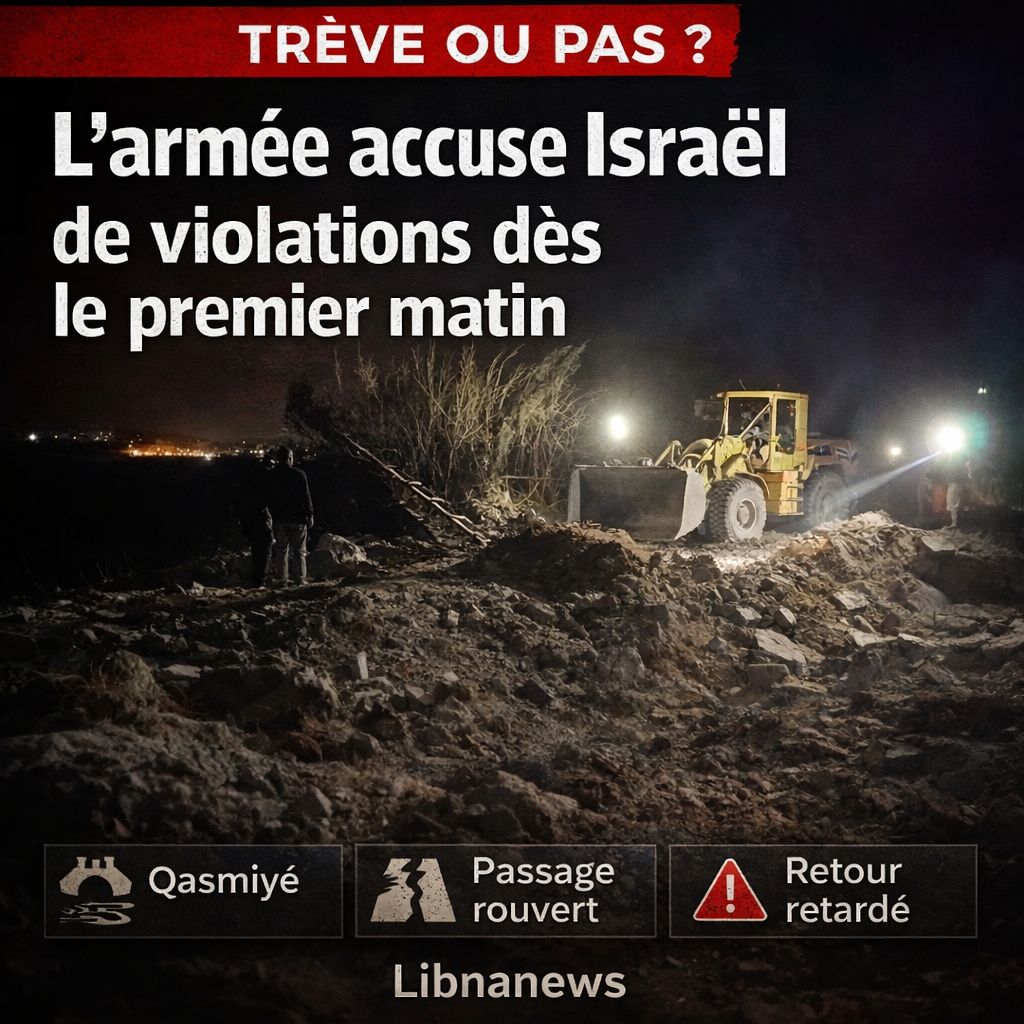
The truce in Lebanon, which entered into force on the night of Thursday 16th to Friday 17th April 2026 at midnight, began under a double image. In Beirut and on several axes of the country, people celebrated the announcement of a cessation of hostilities. But in the south, the Lebanese army quickly accused Israel of violating the agreement, citing intermittent attacks and bombings on several villages. The Lebanese official dispatches, Hezbollah’s reactions, the reading of the Israeli media and the regional diplomatic sequence describe the same reality: the truce exists on paper, but the ground has not yet turned towards a real calm.
A night of truce that does not look like a return to calm
In Lebanon, this Friday morning was not that of a return to normal. Early on, the army command renewed its call for prudence. The institution asked the inhabitants to delay their return to villages and localities in the South. It explained this by recording several violations of the agreement and continuing intermittent fire against several sectors.
The choice of words is important. The army does not speak of isolated incidents or mere floating in the application of the truce. It explicitly mentions Israeli attacks and bombings. It also links these facts to a concrete recommendation: not to rush to border areas, not to approach areas where the Israeli army has advanced and to follow the instructions of units deployed on the ground.
This caution is not from this morning. In the evening of Thursday, even before the truce came into effect at midnight, the Lebanese army had already asked civilians to wait. She recalled that the diplomatic announcement did not immediately make the South safe. Roads remained exposed. Israeli positions were still active. Unexploded ordnance and suspicious objects could be found in inhabited areas or on return routes.
This warning reveals the real state of the terrain. A truce in Lebanon does not mean that a normal civilian space reappears within a few hours. The return of the inhabitants depends first on the safety of the roads, the state of the bridges, the presence of troops, the demining and the verification of the villages. The Lebanese army therefore chose a language of protection before a language of relief.
The day before, the command had also announced the destruction of the Qasmiye Sea Bridge in the Tyre area. According to the communiqué, the Israeli strike aimed to isolate the area south of the Litani from the rest of the country. The army’s assessment reported one dead, two wounded civilians and one injured soldier among the unit stationed on the bridge. This episode illuminates the last hours before the truce: the sequence has not ended on a gradual de-escalation, but on a strike against a major infrastructure.
The same shift was seen in Beirut at midnight. Celebration shots were heard in several quarters. The army had to issue a warning against shooting in the air and using war projectiles. Again, the image of the country is revealing. Part of the population wants to believe in a respite. The State continues to manage an armed, unstable and dangerous environment.
What Lebanese news reports say
The dispatches of the National Information Agency confirmed this climate of fragility. After the truce came into force, the agency continued to report bombings on Khiam and Debbine. It also reported an intense overflight of drones over Rachaya and the western slope of Mount Hermon.
Other dispatches mentioned another strike on Debbine, another on Deir Qanoun Ras al-Ain, as well as artillery fire on the outskirts of Nabatiyah al-Fauqa. This table does not correspond to a silent front. Rather, it describes a front whose pace is decreasing without completely extinguishing.
These elements are all the more important as they come from the official Lebanese circuit. The army speaks from the point of view of national security. The National Information Agency, on the other hand, combines signals from the field. When the two channels converge, Beirut sends a clear message: the truce in Lebanon has begun, but violations are already alleged in the early hours of its application.
The geography of reports is not insignificant. Khiam, Debbine, Deir Qanun Ras al-Ain, Nabatiyah al-Faukah or the roads leading to Tyre are all in areas where the war has left deep traces. The destruction is heavy. Infrastructure is weakened. The movement of civilians is particularly risky. A strike or residual shot in these areas does not only have a military range. It also delays the return of the displaced and prolongs uncertainty about the real state of the villages.
This reading also dominates in several Lebanese media. Army prudence is interpreted as a response to recent experience. The previous ceasefire of November 2024 remains in all memory. Officially, he ended the previous war. In practice, according to the Lebanese authorities relayed by the local press, hundreds of people were killed again in the following months, before the fighting began on 2 March 2026. This brief explains why the announcement of a truce no longer produces an automatic reflex of confidence in Lebanon.
Another element reinforces this reserve. The U.S. text governing the cessation of hostilities allows Israel to act in the event of a planned, imminent or ongoing attack, while prohibiting offensive operations for ten days. In Beirut, there is clear vigilance about this formulation. In Lebanese experience, the boundary between defensive action invoked and offensive strike suffered can become very blurred as soon as the ground remains militarized.
The truce in Lebanon seen since Hezbollah
Conditions of movement
On the Hezbollah side, the official line has been clarified in several times. In a first political communiqué, the movement affirmed that any ceasefire must be comprehensive throughout Lebanese territory. He added that such an agreement should not give Israel freedom of movement in Lebanon. The text went even further: according to the party, the Israeli presence on Lebanese soil maintains the right of Lebanon and its people to resist, and the future will depend on the evolution of events.
This formulation is central. It means that Hezbollah does not adhere to a passive reading of the truce. It accepts the idea of a break if it is real, complete and territorialized throughout Lebanon. On the other hand, he rejects any interpretation that would allow Israel to retain a military margin of action in the country while demanding that Hezbollah remain motionless.
Prior to this statement, MP Ibrahim al-Musawi had already expressed a similar position. He stated that the movement would respect the ceasefire carefully if Israel stopped the attacks and did not use that period to carry out targeted assassinations. Here too, the condition is clear. Hezbollah does not speak of an unconditional commitment. He speaks of a controlled membership, subject to Israeli behavior.
Latest military communiqués
The latest messages in the party’s media also show that, until the last hours of Thursday night, the movement wanted to display an intact nuisance capacity. Its canals have published a series of demands for rocket fire against Yaara, the Nahariyah area, positions north of Acre, the outskirts of Ras al-Naqoura and several concentrations of Israeli soldiers or vehicles. Other press releases reported attacks on Merkava tanks and artillery positions recently established in southern Lebanon.
These military messages perform several functions. They first show that Hezbollah did not want to appear weakened in the last sequence before the truce. They then serve to remind its base that the movement does not enter into the cessation of hostilities in a position of political surrender. Finally, they prepare the ground for his speech this morning: if Israel continues to act in Lebanon, the party believes that it maintains a political and military base to respond.
At the same time, Hizbullah continued to denounce the broader political framework put in place by Washington. Officials of the movement criticized the direct contacts encouraged by the United States between Beirut and Tel Aviv. For them, priority should not be an accelerated political negotiation, but a complete halt to the strikes and an Israeli withdrawal from the occupied sectors. This line puts pressure on the Lebanese government. The executive wants to take advantage of the truce to open a diplomatic sequence. Hezbollah recalls that no lasting arrangement will be accepted if, in its view, it resembles political coverage of an Israeli military presence.
What Israeli media say
No withdrawal announced
In Israeli media, the story is significantly different. The common point between several titles is simple: the truce is presented as a diplomatic opportunity, but certainly not as a withdrawal. Benyamin Netanyahu spoke of a historic opportunity to move towards a broader agreement with Lebanon. At the same time, he reiterated that Israel did not accept Hezbollah’s condition for the immediate withdrawal of forces deployed in southern Lebanon.
A number of Israeli media thus resume the idea of a sustainable security zone. According to this reading, Israel considers it necessary to maintain a military depth in southern Lebanon in order to prevent the threat from returning as close to the border. In this account, the truce frames fire but does not change strategic logic. Priority remains the dismantling of Hezbollah and the protection of northern Israeli localities.
The Israeli press also insists on Israel’s right to act in self-defence. This point appears both in the political communication and in the reading of the American clauses. For part of the Israeli camp, therefore, the ceasefire does not eliminate the possibility of intervention if a threat is detected. It is precisely this point that today feeds Lebanese mistrust.
A front always presented as active
Another element emerging from the Israeli media consulted this morning is that the truce was presented as already weakened by warnings in northern Israel. An information site reported that a siren had been triggered in Western Galilee just over two hours after the ceasefire came into effect. Further information was provided on impacts in the Nahariya area and on vehicle fires. These elements, on the Israeli side, support the argument that the northern front remains unpredictable and that military prudence remains justified.
The Israeli press also relayed the army’s instructions calling on Lebanese residents to stay north of the Litani. This communication is not trivial. It means that, from the Israeli point of view, South Lebanon is not considered to be a return space to normality. It also confirms that the current truce does not, for Israel, immediately end the military apparatus installed in recent weeks.
Finally, a point of method should be noted. Following Lebanese reports of continued shooting or strikes, the Israeli army reported that it had examined certain reports. This answer is neither recognition nor global denial. However, it shows that the Israeli side knows that the first hours of the truce will be scrutinized as a credibility test.
A wider diplomatic sequence than the Lebanese front alone
Perhaps the major novelty of this day lies in the diplomatic function assigned to the truce. The American document released on Thursday is not just about suspending hostilities for ten days. It also provides a framework for direct negotiations, with United States facilitation, on the security, stability and delimitation of the land border between Lebanon and Israel.
The text further states that the Lebanese security forces are solely responsible for the sovereignty and national defence of the country. This formula strengthens the Lebanese state politically. But it also presents Beirut with a formidable challenge. To make the diplomatic sequence credible, the government will have to show that it effectively controls the territory and that it can prevent a resumption of fire from Lebanon.
At the political level, this dynamic remains sensitive. President Joseph Aoun has maintained his line of last days: cease-fire first, then discussions. News reports in the press also indicate that Beirut has not confirmed the idea of an immediate direct exchange with Benyamin Netanyahu, despite Donald Trump’s optimism. This detail counts. It shows that official Lebanon wants to benefit from American mediation without giving the feeling of improvised normalization under fire.
Prime Minister Nawaf Salam welcomed the announcement of the truce. For him, the cessation of hostilities corresponds to Lebanon’s central demand since the beginning of the war. This reaction reflects a line of continuity: the government wants first to stop the war, reopen the axes, secure the return of the displaced and take over the institutional hand before entering into a larger political discussion.
The European Union also welcomed the truce. Several European leaders stressed the need to respect Lebanon’s sovereignty and territorial integrity, while calling on both sides to turn this pause into a more sustainable process. The United Nations adopted the same tone, calling for full respect for the ceasefire. These reactions are not automatic. They point out that the external partners do not see this truce as a simple local episode, but as a gateway to a more ambitious regional de-escalation.
Why this truce seems to unlock the US-Iran Canal
This is where the regional dimension becomes decisive. For several days, mediators had explained that a breakthrough between Washington and Tehran remained difficult as long as the Lebanese front remained open. Several signals appeared on Thursday and Friday suggest that the truce in Lebanon responds precisely to this constraint.
Consistent information from the United States, Pakistan and the region suggests that a new round of discussions between Washington and Tehran could take place very quickly, possibly this weekend in Islamabad. Pakistan retains a central role in this mediation. Turkey, for its part, called on both sides to show a constructive spirit and indicated that it would support any evolution of the ceasefire towards a more lasting peace.
We have to stay precise. The truce in Lebanon does not resolve disputes between Washington and Tehran. It also does not guarantee an agreement on Iran’s nuclear power, on navigation in the Strait of Ormuz or on the conditions for sustainable de-escalation. On the other hand, everything indicates that it removes a significant obstacle. In reading several mediators, a continuation of the war in Lebanon made any progress between the United States and Iran politically more difficult.
This articulation also appears in market reading. On Friday, oil prices fell against the background of hope for a resumption of discussions with Iran and wider relaxation in the Middle East. This movement does not prove that peace is approaching. It simply shows that economic actors read the Lebanese truce as a regional signal, not just as a local event.
In other words, the truce seems to open two doors at a time. It creates a window for a more structured negotiation between Lebanon and Israel. And it facilitates, at least temporarily, a resumption of the American-Iranian channel. This explains the diplomatic intensity of the last 24 hours. Behind the press releases on Khiam or Debbine, it is also a regional report of forces that is being redesigned.
Trump’s latest comments on Lebanon
Donald Trump wanted to impose this reading together. Thursday, he announced that he had had excellent separate exchanges with Joseph Aoun and Benyamin Netanyahu. He presented the ceasefire as the possible beginning of a wider peace between the two countries. He also indicated that he wanted to invite the two leaders to the White House for discussions that he described as significant.
The US President gave this announcement a very personal tone. He presented the day as important for Lebanon and said good things were happening. At the same time, he asked Hezbollah to respect the truce. This point deserves to be raised. Washington treats the agreement as a state-to-state arrangement, but the military reality of the front still dictates that it speak indirectly to Hezbollah.
Trump also explained that this 10-day break should create the conditions for a lasting agreement. His administration entrusted the sequence to several senior officials, including the Vice President, the Secretary of State and the Joint Chief of Staff. This shows that the White House doesn’t just want to pull a photo of a truce. She wants to turn the announcement into a process.
The American comments on Iran reinforce this impression. This Friday, Trump assured that an end to the war with Iran could come soon and that a new meeting could take place in the coming days. He suggested that discussions were progressing on several sensitive issues. At this stage, these claims remain American and are not valid for Iran. But they confirm that the White House explicitly links the truce in Lebanon to the diplomatic sequence with Tehran.
For Lebanon, this creates both an opportunity and a risk. The opportunity lies in the renewed interest of the great powers in stabilizing the southern front. The risk is that the Lebanese file can be treated as a variable of a wider regional arrangement. If diplomacy moves forward with Iran, Lebanon can benefit. If it stalls, the current truce could be exposed again to military logic.
At the time these lines are written, the decisive point therefore remains the same as in the first morning dispatches: the value of a cease-fire is measured not by the announcement which gave rise to it, but by the first hours following. However, these hours have already produced accusations of violations on the Lebanese side, calls not to return too quickly to the South, conditions imposed by Hezbollah and an Israeli reading that does not provide for immediate withdrawal or renunciation of military pressure. In the meantime, between the declared truce and the war not yet really extinguished, the rest is now being played.




