

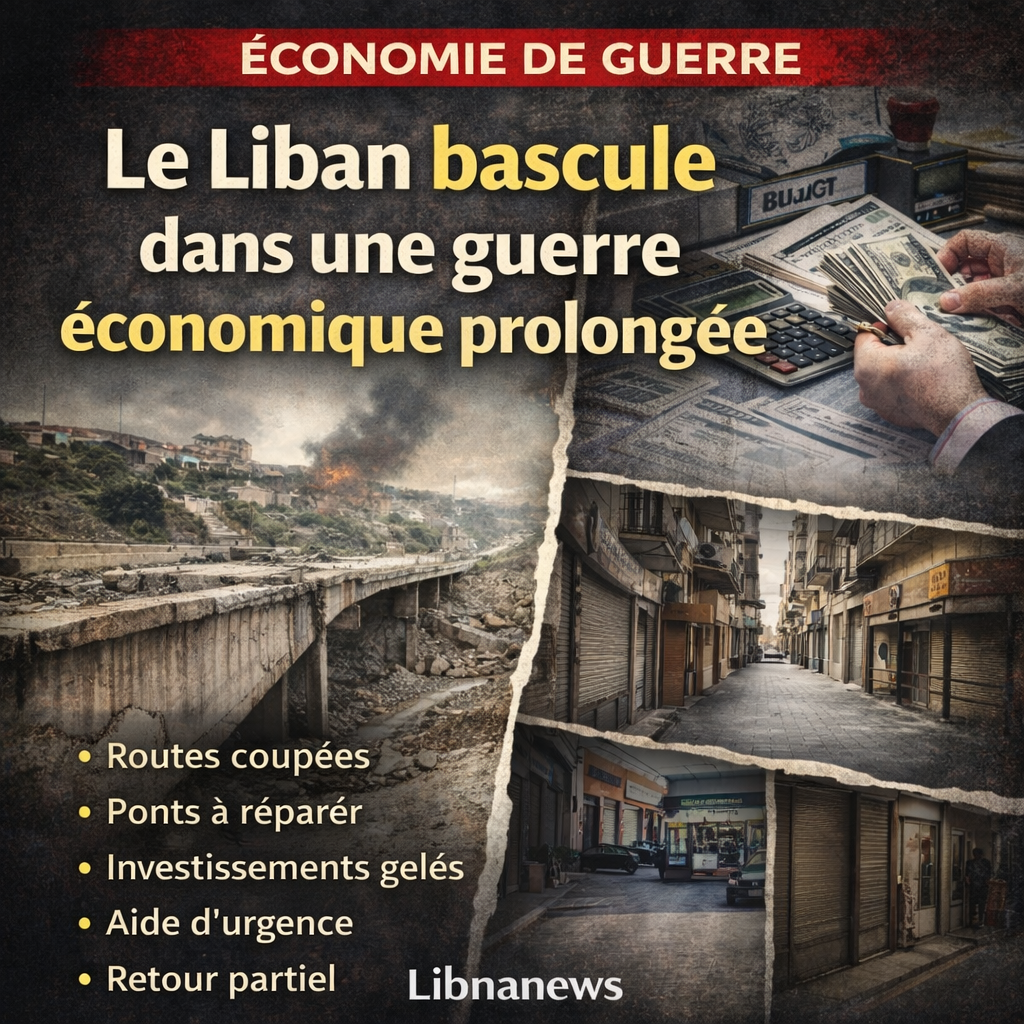
A war that not only destroys, but reprograms the economy
Lebanon is no longer just a country hit by military episodes. It becomes a country whose economy is beginning to reorganize around the permanent possibility of war. The shade is decisive. A one-off war provokes a shock and then gives hope for a gradual return to previous balances. A prolonged war, or more precisely a prolonged war economy, does otherwise. It changes behaviour, reduces the horizon of decisions, transforms the hierarchy of public and private priorities, and ends up imposing a mode of operation where urgency prevails over development.
It is in this context that the current sequence should be read. The cease-fire slowed down the fire without producing enough stabilization to re-engage a revival logic. The destruction in the South, the roads cut off, the bridges to be repaired, the partial returns, the precautionary departures and the uncertainty over the duration of the break-up prevent any classic reading of a crisis exit. The country is not in the post-war period. It is in an in-between where the economic apparatus must continue to function while integrating the credible hypothesis of a resumption of confrontation. This is a prolonged war economy: an economy that must survive in the interim, without being able to rebuild seriously, without being able to suspend its activity entirely either.
The problem is that Lebanon was already approaching this phase with weakened foundations. The monetary collapse, the banking crisis, the loss of confidence in institutions, the contraction of purchasing power and the erosion of investment had already transformed the country into a survival economy. So war does not break a solid structure. It strikes an already used structure, already fragmented, already largely organised around adaptation, circumvention and short term. At this stage, the military shock acts as an accelerator of vulnerability. It not only creates new needs. It still takes a little time off a system that was already lacking.
In this type of context, the economy loses its projection function. It ceases to be a space where we prepare the future. It becomes a tool for holding. Public decisions are often limited to covering emergencies. Private decisions seek first to protect. Households arbitrate more brutally. Companies push back their plans. Investors are waiting. Local communities manage access, debris, basic needs and social demands that they are increasingly unable to absorb. Gradually, the country slides into a logic where maintaining the minimum functioning becomes in itself a political performance.
The real cost of war is first and foremost a cost of disruption
In an economy like Lebanon, war is not only destructive by what it shaves. It is mainly because it disorganizes. A destroyed road is not only a lost axis. It is a slow village, delayed goods, a more difficult school to reach, a less accessible clinic, a shorter working day, a fragile supply chain. An affected bridge is not only a work to be repaired. It is an entire geography that folds back, detours that raise costs and logistical fatigue that spreads into the most ordinary gestures.
The Lebanese South today offers the most visible form of this disorganization. Not all inhabitants have returned, or come back only partially. The movement of families depends on the level of confidence in the truce, the state of the roads, the safety instructions and the fear of a new start. A trade does not reopen under the same conditions if the neighborhood is half populated, if the delivery of products remains complicated or if potential customers do not dare to resettle. A farm does not invest in the same way if access roads remain precarious or if destruction can resume. The war thus produces an incomplete economy, where actors remain present without being really revived.
This disorganization is not limited to areas directly exposed. It goes back to urban centres, to administrations, to suppliers, to public budgets. The state must mobilize means to reopen routes, to accompany returns, to secure travel, to respond to local emergencies. Each intervention has a cost. But even more so, each intervention diverts scarce resources to the immediate, to the detriment of other structural needs. Thus the prolonged war economy is transforming the budgetary hierarchy. What was already insufficient becomes even more disputed.
The most formidable thing in this process is that it produces invisible fatigue. The ruins are visible. Coordination costs are silently spread. A family that doesn’t know whether to go home or wait is not planning anymore. A small entrepreneur no longer takes risks. A municipality is reluctant to engage in sustainable work if the safe environment remains uncertain. On a large scale, this widespread hesitation itself becomes an economic fact. The country works, but below itself. It remains in motion, but on a minimum diet.
The return of emergency financing reveals the structural weakness of the state
The demand of $1 billion for war charges alone sums up this shift. Such a figure does not refer to an ambitious reconstruction programme. It refers to a need for crisis cash. This means that the state is not yet looking for the means of re-adhesion. First, it seeks to prevent a situation that has already deteriorated from getting bogged down. This distinction is essential. A country that asks a billion for war is not yet talking about the future. He talks about his ability to hold on to the weeks and months that come without undergoing further deterioration.
The use of international support is not a technical detail. It shows that internal margins are no longer sufficient. Lebanon no longer has the capacity to absorb a new major shock alone. This does not mean that there is no local resource. This means that the resources available, whether fiscal, administrative or financial, are too dispersed, too fragile or too politically sensitive to cover the scale of the need. The state is therefore looking outside because it knows that the budget is too thin to respond quickly to the emergency.
This is a heavy observation. He’s not just saying something about the moment. He says something about the state itself. A state in a protracted war economy does not only suffer from a lack of money. He suffers from the gap between the sum of his obligations and the weakness of his instruments. It must finance repairs, maintain services, support mobility, manage emergencies and reassure donors, all with a limited tax base, weakened administration and damaged public confidence. Emergency financing is therefore not just an economic need. It’s an institutional teller.
The paradox is cruel. The more the state needs help, the more it must show that it remains capable of executing, prioritizing and reporting. In other words, the more fragile it appears, the more it has to convince it that it is not completely. This is where the economy joins politics. The credibility of emergency funding depends on the credibility of the public command. An external partner can understand the need. He will immediately ask: who decides, who applies, who guarantees that the funds will go well to maintaining the country rather than to an endless provisional?
War imposes the short term on the entire economy
Perhaps the deepest feature of a prolonged war economy is that it imposes the short term as a general norm. Even when no strike occurs, even when a lull is announced, the whole system continues to reason as if the emergency could come back immediately. Households reduce their unnecessary spending. Companies maintain liquidity. Expansion projects are postponed. Investments expect stronger signs. The country then loses one of the fundamental conditions of a living economy: the ability to commit resources over time.
In a stable environment, a company can accept an immediate cost if it believes in future returns. A family can borrow, buy, build or invest in education with the idea that the general framework will remain sufficiently legible. A municipality can start a project on the assumption that tomorrow it will benefit from a inhabited, accessible and functional territory. In a protracted war economy, this projection collapses. We don’t think from tomorrow. We reason from tomorrow’s risk.
This shift profoundly changes the nature of the economic fabric. Sectors that are most vulnerable to risk are shrinking. Sectors capable of operating in the short term, in the liquid, in the immediate service or in the bypass are more resistant. A prolonged war economy thus ends up favouring certain behaviours rather than others. It discourages heavy investment, long credit, patient reconstruction. It promotes agility, caution, informality, rapid rotation and individual protection. The country does not stop. But it recomposes around less structural forms of activity for the future.
Lebanon has already experienced this logic since its financial crisis. The war gives it an even more brutal dimension. It deprives the country of the time it would have needed to get out of the simple economy of adaptation. It maintains it in a regime where security emergency, budgetary urgency and social emergency are mutually reinforcing. The danger is not only the decline in activity. The danger is the gradual disappearance of the medium term as a credible horizon for decision-making.
Roads, bridges, access: reconstruction begins before major plans
In classical discourses, reconstruction evokes major projects, massive envelopes, aid conferences, structuring projects and recovery schedules. The current Lebanese reality is much more modest, and much more significant. Reconstruction begins first with roads, bridges, access, the possibility of reopening a territory to its own life. It is these basic gestures that determine whether the economy of the South can at least start breathing again.
An alternative road opened by the army, a clear axis, a bridge returned to service are material facts. But they are also economic and political facts. They allow the return of the inhabitants, the passage of goods, access to schools, the resumption of a small business, the resumption of local services. They give a very concrete form to the presence of the State. They show that a truce produces something more than a statement. In such a fragile country, this materiality is worth almost as much as a global plan, because it creates an immediate possibility of activity.
The scope of this local scale should not be underestimated. Lebanon is not an economy driven solely by large industrial groupings or by a public authority capable of reorganizing everything from the centre. His economic life is also based on myriad small, medium, family, territorial and municipal units. To regain access to a territory is therefore to reinvigorate a host of tiny but decisive mechanisms. Conversely, allowing accessibility to deteriorate amounts to silently condemning local activity to autonia.
That is why the prolonged war economy cannot be combated only by figures. It must be combated by gestures of reopening. Every restored route, every secure crossing point, every proof that one can travel again counts more than it seems. For in a country where the long time is weakened, the economy starts again by the immediate possible. Before the big visions, the spaces must be made habitable.
Investment decreases when risk becomes atmosphere
Prolonged war not only destroys what exists. It also prevents what might exist from happening. This is where the decline in investment becomes central. Capital does not only need opportunities. They need readability. Lebanon is now evolving in an environment where risk is no longer an episode. It becomes an atmosphere. The Ormuz crisis, the regional tension, the face-to-face between Washington and Tehran, the fragility of the ceasefire in the South, all produce a very heavy perception. Although no general resumption of war takes place immediately, the climate is sufficient to freeze some of the decisions.
This atmosphere has a particular impact on Arab and regional investment. Capital can accept imperfect countries. It is more difficult to accept countries whose strategic security depends on an external negotiation that is still uncertain. For Lebanon, this is a major problem. Reconstruction, tourism, services, real estate, hotels, local infrastructure and even some rural or coastal development projects need a minimum of confidence. Without this, we can announce ideas, imagine scenarios, draw recovery cards. Private funding remains in decline.
The South perfectly illustrates this tension. There are already projections of what it could become in a stabilized context. Economic, tourist and development projects are mentioned. But a territory does not become a project space because it is stated. It becomes so when it ceases to be a risk space. As long as the population is reluctant to return on a sustainable basis, as long as diplomacy remains suspended, as long as the front can become active again, the economy remains trapped in a general conditionality.
In this context, the prolonged war economy acts as a great dissolver of confidence. It does not suppress any activity. It prevents investment from believing in its own duration. But an economy without sustainable investment ends up living on its stocks, on its networks, on its transfers, on its improvisation capacity. It holds, but it no longer increases its possibilities. This is exactly the trap in which Lebanon risks being locked up.
Institutional credibility itself becomes an economic variable
One of the clearest lessons of the moment is that the economy can no longer be separated from the question of public authority. Donors, external partners and private economic actors all look at the same thing: is the state able to decide, execute and protect a minimum of coherence? The war makes this issue even more decisive. A country can obtain emergency aid despite poor governance. It will be far more difficult to obtain sustainable support if it appears unable to transform such aid into stability.
Lebanon therefore plays on two tables at a time. He’s looking for money. But it must also prove that this money will not fall into a pit of institutional uncertainty. That is why the line taken by the Presidency and the Government on sovereignty, the framework for negotiations, the role of the State and the restoration of its authority have a direct economic significance. A more readable State is worth more, not only diplomatically, but budgetaryly. He’s more reassured. It makes it more credible that today’s emergency can prepare a better tomorrow.
This does not mean that institutional coherence alone will suffice. Lebanon remains exposed to regional constraints that go far beyond its own framework. But without this minimal coherence, any attempt to get out of the protracted war economy will remain bogged down. Roads can be reopened. Bridges can be repaired. Aid can be promised. If the political centre continues to appear as uncertain, fragmented or competing, confidence will only return to the surface.
Here we touch the core of the problem. The prolonged war economy is not only a state of destruction. It is a state where the future becomes too risky to be financed. Restoring a credible public authority is therefore also an economic policy. This is the condition for emergency money not to remain a mere survival fuel, but to become, gradually, the first step of a more real recovery.
A country that holds, but cannot live forever on the threshold
Lebanon has shown, for years, an impressive capacity to hold. The company is adapting. The networks compensate. Families are absorbing. Communities are improvised. Economic actors are reducing their wings, but not all are disappearing. It’s a force. It is also a danger, because this ability to hold can give the illusion that the threshold can last indefinitely. A country cannot live forever in a protracted war economy. He can cross it. He can’t make it a model.
In the long run, this regime uses everything. He uses public finances. He uses trust. It uses peripheral territories. He uses investment. He uses youth, who learn to reason outside the country or against the country. It even uses the reflexes of solidarity, because a society cannot constantly ask its own networks to compensate for what the state can no longer guarantee. The extension of this model does not only lead to poverty. It leads to the weakening of any collective capacity to project.
That’s why the diagnosis must be clean. Lebanon entered into a protracted war economy, not because war would be everywhere on a permanent basis, but because the assumption of its recovery now structures economic decisions. As long as this assumption prevails, the country will continue to seek emergency financing, reopen roads before building plans, protect the present before preparing for the future. Maybe it’s necessary. This is not sustainable as a sustainable horizon.
The real challenge is therefore twofold. You have to hold on, of course. But we must also prevent retention from becoming the only ambition. For a country that ends up asking only the means to hold has already begun to accept that living better is postponed. And in the case of Lebanon, this later has already lasted too long.
External references
No external search added for this version. I wrote the article based on the consolidated material of the press review and the analyses already produced in this thread.




