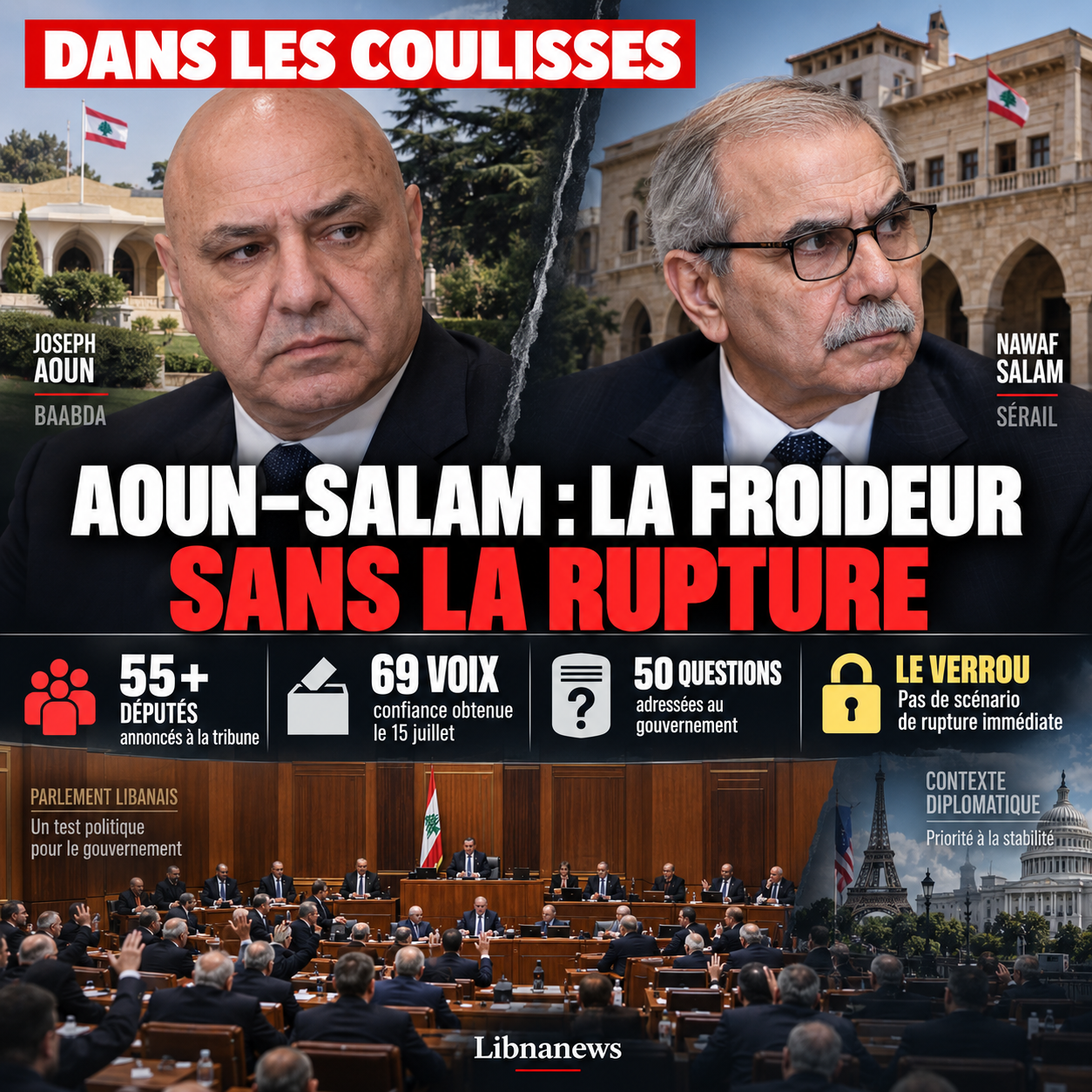
The indiscretions published on 15 September 2026 draw a paradoxical situation around the government of Nawaf Salam. On the one hand, press sources report a deterioration in his relationship with President Joseph Aoun and dissatisfaction with government performance. On the other hand, the same newspapers describe a cabinet that does not appear to be in real danger of falling during the parliamentary questioning session. A third detail completes this table: there would appear to be no external green light for government change in the current period.
Dissatisfaction with Joseph Aoun
Ad Diyar of 15 September 2026 delivers the most clear confidence on the relationship between Baabda and Serail. According to political sources cited by the newspaper, Joseph Aoun would not be satisfied with the performance of several ministers. Criticism would include the slowness of some cases and the lack of sufficiently visible economic and social results.
The daily also evokes « coldness » in the relationship between Joseph Aoun and Nawaf Salam. However, it does not describe any institutional breakdown or public confrontation between the two men. This nuance is essential. The confidence concerns an alleged deterioration in the political climate, not a declared presidential will to replace the President of the Council.
Ad Diyar also reports the appreciation of an experienced independent MP. It considers that the government has suffered from a cohesion problem since its formation. The diversity of its components and political differences would complicate the construction of homogeneous government action. The parliamentary session could thus expose to the public weaknesses that already existed within the executive.
However, the public elements available on the same day require that this indiscretion be relativized. Joseph Aoun continues his institutional consultations. Nawaf Salam continues to chair ministerial meetings, including those on the budget. Neither official publicly makes personal criticism against the other. Above all, no source reports a request by Joseph Aoun for the departure of Salam.
Three levels must therefore be distinguished. Dissatisfaction with some government results is reported from media sources. The coldness between the two responsible is a confidence attributed to these same sources. On the other hand, a rupture between Baabda and Serail is not established by the corpus.
A noisy parliamentary session but probably without the cabinet falling
The second confidence relates directly to the government’s questioning session. Al Joumhouria of 15 September 2026 reports that more than 55 deputies have asked to intervene. The announced scale of the debate could suggest a real threat to Nawaf Salam. Yet the political sources cited by the newspaper describe a much less dramatic scenario.
An important political source told Al Joumhouria that the session should remain « passenger » and without major political repercussions. The government will hear many criticisms and will receive attacks from several directions. But, according to this source, MPs should eventually divide themselves between advocates and opponents of the cabinet without producing the changeover necessary for a government crisis.
The paper puts forward a simple reason: the political forces are deeply divided on the big issues, but they would join in the current impossibility of causing a disruption of the executive. The session would therefore be primarily a political demonstration. There are many issues: economics, finance, energy, weapons, security, general amnesty and the situation in the South.
However, the question of a vote of confidence remains. Al Joumhouria reports that a request could come from Gebran Bassil. But this option poses a risk for those who wish to weaken Nawaf Salam. If the government regains confidence, even with a limited majority, its opponents could offer it new parliamentary legitimacy instead of weakening.
The previous indictment session, on 15 July, gave the government 69 votes, according to Al Joumhouria. The newspaper therefore envisages several hypotheses. A new confidence at a comparable level would show that criticism did not produce a break. A smaller majority would reveal political erosion. A higher majority would allow the government to present the vote as a confirmation of its legitimacy.
Al Sharq of 15 September brings an additional element. MP Assaad Dergham claims that the opposition has addressed fifty questions to the government on economic, social and daily issues. It considers that only 15 responses have been provided and that they are not convincing. However, he pointed out that confidence withdrawal was not envisaged at this stage.
This public statement therefore joins anonymous confidences. The government can be strongly challenged without its opponents necessarily wanting to bring it down.
The lack of outside cover would be the real lock
The third element makes it possible to understand this apparent contradiction. Al Jumhouria reports that the margin of Lebanese actors would be limited by the external environment. Its political source believes that the whole parliamentary confrontation will remain below the ceiling created by the lack of international coverage for an initiative that could upset the government.
This confidence is politically important. It means that the stability of Nawaf Salam would not depend solely on parliamentary arithmetic. The diplomatic context would also weigh on the calculations of the various forces.
Part of the timing explains this caution. Lebanon is engaged in indirect negotiations with Israel. The Paris meeting must deal with support for the army. Washington maintains its role as mediator. The issue of Israeli withdrawal remains open. The deployment of the army in the South is monitored by international partners. A government crisis would therefore introduce new uncertainty at a time when several diplomatic issues are reaching a sensitive stage.
Ad Diyar of 15 September recalls that the Salam government had received significant external support from its formation. The newspaper presents this environment as one of the factors that continue to protect the firm despite internal criticism. This does not mean that foreign partners approve every government decision. Rather, it means that they do not seem to consider its replacement desirable immediately.
The information published by Al Sharq goes even further in this direction. The newspaper reports, in an analysis based on political and diplomatic sources, that important external actors are committed to maintaining the current institutional architecture. This presentation must, however, remain attributed to the newspaper: no official American, French or Saudi declaration reproduced in the corpus does formally announce that Nawaf Salam would be « untouchable ».
The distinction is important.There are converging confidences about an external preference for government stability. There is no evidence in the sources provided of a foreign order legally or politically preventing Parliament from withdrawing its confidence.
A protected but not necessarily strengthened government
These three elements thus point to a more subtle situation than a simple opposition between a strong government and an opposition unable to overthrow it. Nawaf Salam can leave the session without falling while being politically weakened. The central question then becomes less of the firm’s survival than of its ability to govern after the session.
A real deterioration in relations with Joseph Aoun would be particularly important. The President and the Head of Government must cooperate on the budget, reforms, appointments, negotiations and the issue of the South. A personal or political coldness does not automatically cause a crisis. But it can slow down decisions and make arbitration more difficult.
Conversely, a lack of a vote of distrust does not mean that Parliament approves the government’s action. The fifty questions raised by Assaad Dergham and dozens of requests to speak show the extent of the grievances. The cabinet can maintain constitutional confidence while losing some of its political credit.
The paradox revealed by the confidences of 15 September is therefore that of an executivechallenged inside but protected against immediate rupture. Joseph Aoun would be dissatisfied with some results without wanting to provoke an open crisis with Nawaf Salam. Opponents want to use Parliament to attack the cabinet, but hesitate to give it the opportunity to gain new confidence. Finally, the main foreign partners appear to favour institutional continuity during a particularly sensitive diplomatic phase.
The real indication to be monitored is therefore not only the continuation or fall of the government. It will bethe number of votes Nawaf Salam would have if trust were actually put to the vote, and then the real state of his cooperation with Joseph Aoun after the meeting. It is at these two levels that the currently reported confidences could be confirmed or reversed.