

Lebanese apples have a new sales circuit with the partnership launched on 2 November 2026 between the Ministry of Agriculture and Toters. The operation foresees direct purchases from producers and promotions during November. It joins export and storage support efforts, with a central question: what part of the final price is the farmer’s?
Minister Nizar Hani and the general manager of Toters Fresh, Ralph Bou Khalil, presented this initiative to the ministry. It must facilitate consumer access to the local product through application and delivery services. For producers, the announced objective is to reduce the number of intermediaries between the orchard and the buyer.
Lebanese Apples Seek Regular Sales
Toters plans a campaign throughout November, with discounts and offers on quantities. The company must progressively publish their terms and conditions on its application and official pages. She also announces an introduction to apples in her digital advertising spaces.
Direct purchase is the main change presented to farmers. It aims to improve their margin while maintaining a competitive price for the consumer. However, the advertisement does not provide the producer with a national purchase schedule or a guaranteed minimum volume. Therefore, it does not yet measure the additional income that each farm could derive from it.
The results of this campaign will depend on actual and repeated orders. A promotion can facilitate a one-time sale. Its contribution to the harvest will also be measured by the quantities purchased, their origin and the prices paid to farmers. These results remain to be established after launch.
Export half the estimated harvest
The ministerial roadmap of 18 September sets the framework for the 2026 season. It estimates the harvest at about 200,000 tonnes and aims to export at least 100,000 tonnes. The target thus represents half of the expected output. It does not constitute an assessment of the shipments already carried out.
The scheme combines the search for foreign markets and the encouragement of local consumption. The Ministry also organizes meetings between producers, exporters, traders and cooperatives. They shall be used to prepare quantities, sorting, packaging and commercial conditions prior to congestion of circuits.
This includes Egypt, Iraq, Libya and the Gulf countries. Trade with Jordan also focuses on market access. The launch of the Toters campaign alone does not lead to the conclusion that all trade restrictions have disappeared.
Supported freight, purchase price to follow
On October 13, the department announced $1 million in support from CMA CGM to reduce the cost of shipping. The scheme includes shipments to Egypt and Libya. Discussions focused on a method of allocating and monitoring this aid.
Nizar Hani requested that the savings achieved on freight improve the purchase price of apples from producers. He proposed involving their representatives and municipalities in price monitoring. This requirement recognizes one key point: a reduction in the cost of export does not alone demonstrate an increase in agricultural income.
The estimate relates to logistical support. It does not correspond to an amount paid directly to each farmer. To assess its effect, the actual reduced costs will have to be reconciled with the purchase conditions applied to the crops concerned.
Storage also mobilises aid
Cold occupies another place in the response to the marketing problem. On 21 October, the Ministry announced a contribution of 300 barrels of diesel from SEAL. With contributions from oil companies, the total reserved for cold storage is 750 barrels, according to this official announcement.
The aid is intended to reduce the conservation charge and avoid fruit degradation. It must give farmers more time to find a buyer. However, the release does not provide a complete distribution balance, warehouse by warehouse, or a measure of savings per tonne retained.
Conservation and sale meet two distinct needs. Keeping fruits in good condition allows them to spread their marketing. This does not set the future price or the volume that buyers will accept. Storage expenses therefore continue to count in the result of the season.
Expected results on quantities and revenues
The measures now cover several stages: local sales, transport abroad and keeping fruit cold. Their effectiveness cannot be limited to the number of partners announced. It will depend on the sales made and the net amount retained by the operators after their expenses.
The November campaign must provide a first point of comparison. The information still awaited concerns the volumes purchased directly, the prices applied according to the categories of apples and the participating holdings. Toters, for its part, must detail its offers as they are put in place.
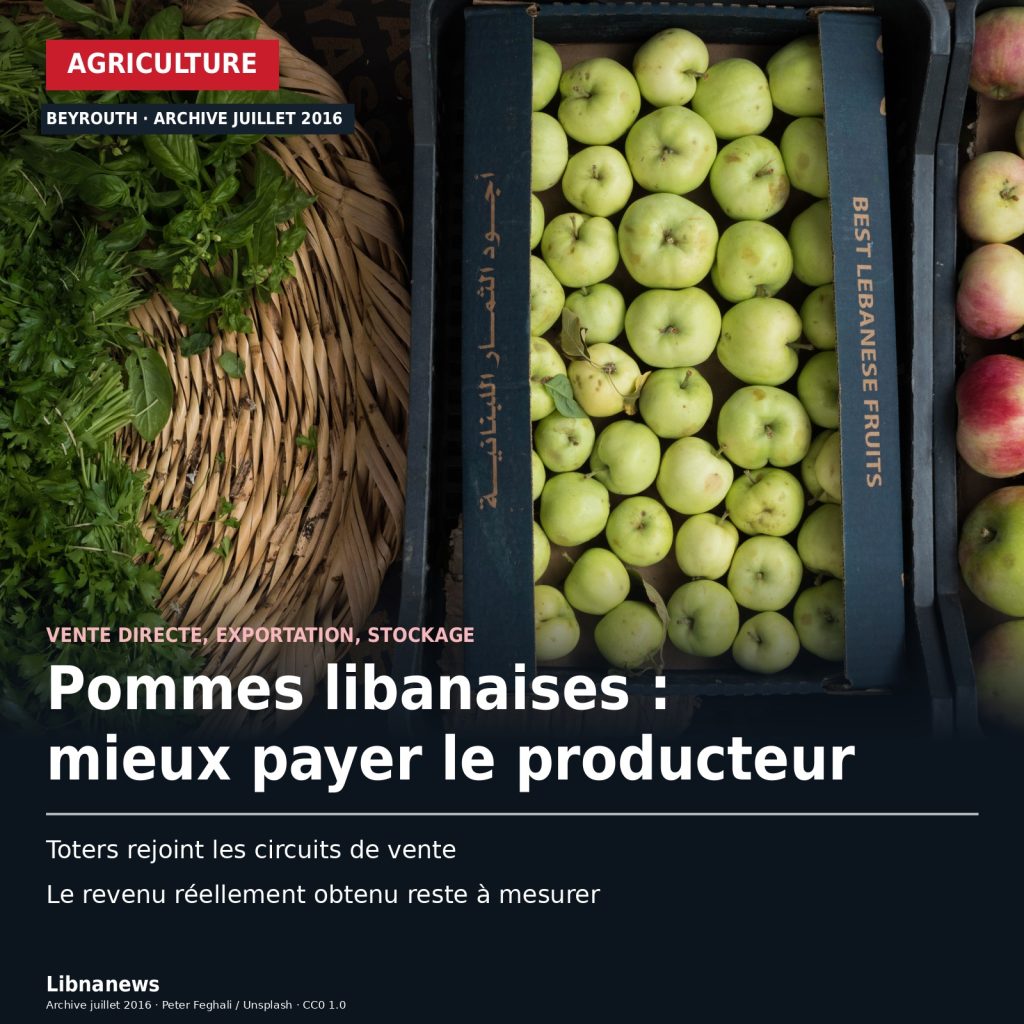
Cover: apple and coriander stall in Beirut, July 2016 archive. The agricultural origin of the fruit is not established; These are not the apples of the Toters campaign of November 2026. Photo:Peter Feghali / Unsplash, Wikimedia Commons,CC0 1.0. Boxing and dressing Libnanews.






Comments