

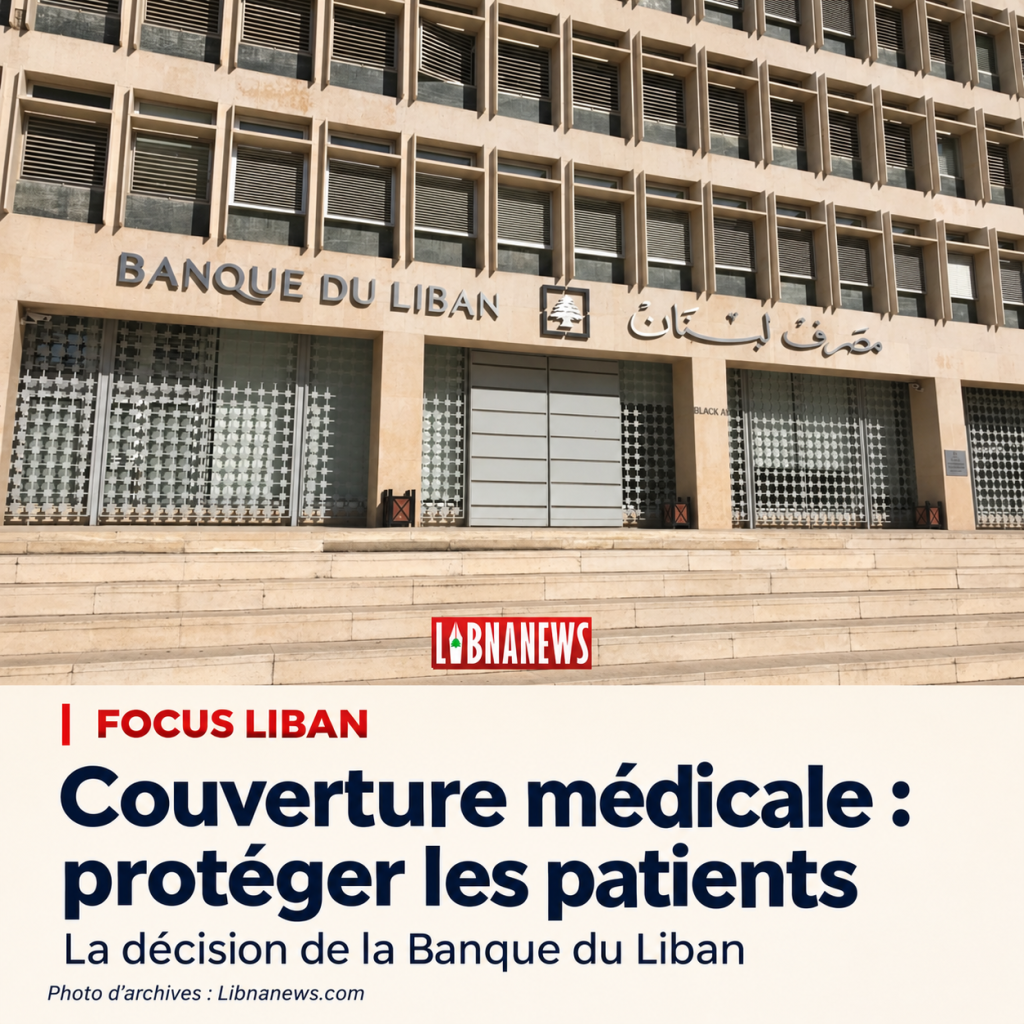
The suspension of medical coverage in two institutions, reported on 3 November by LBCI, raises an immediate question: how can beneficiaries of the Bank of Lebanon be guaranteed continued care? The sources cited by the channel invoke compliance with international sanctions and exclude any political consideration. Links to Hezbollah structures or figures are documented, but the precise legal basis for this decision remains to be explained.
An organization that funds care must respect the rules to which it is subject. It must also assess the consequences of its decisions for the sick. Between these two requirements, transparency and continuity of treatment cannot be relegated to the background. Transferring administrative or financial risk to a patient without an effective medical solution would be contrary to a needs-based ethics.
A suspension for BDL beneficiaries
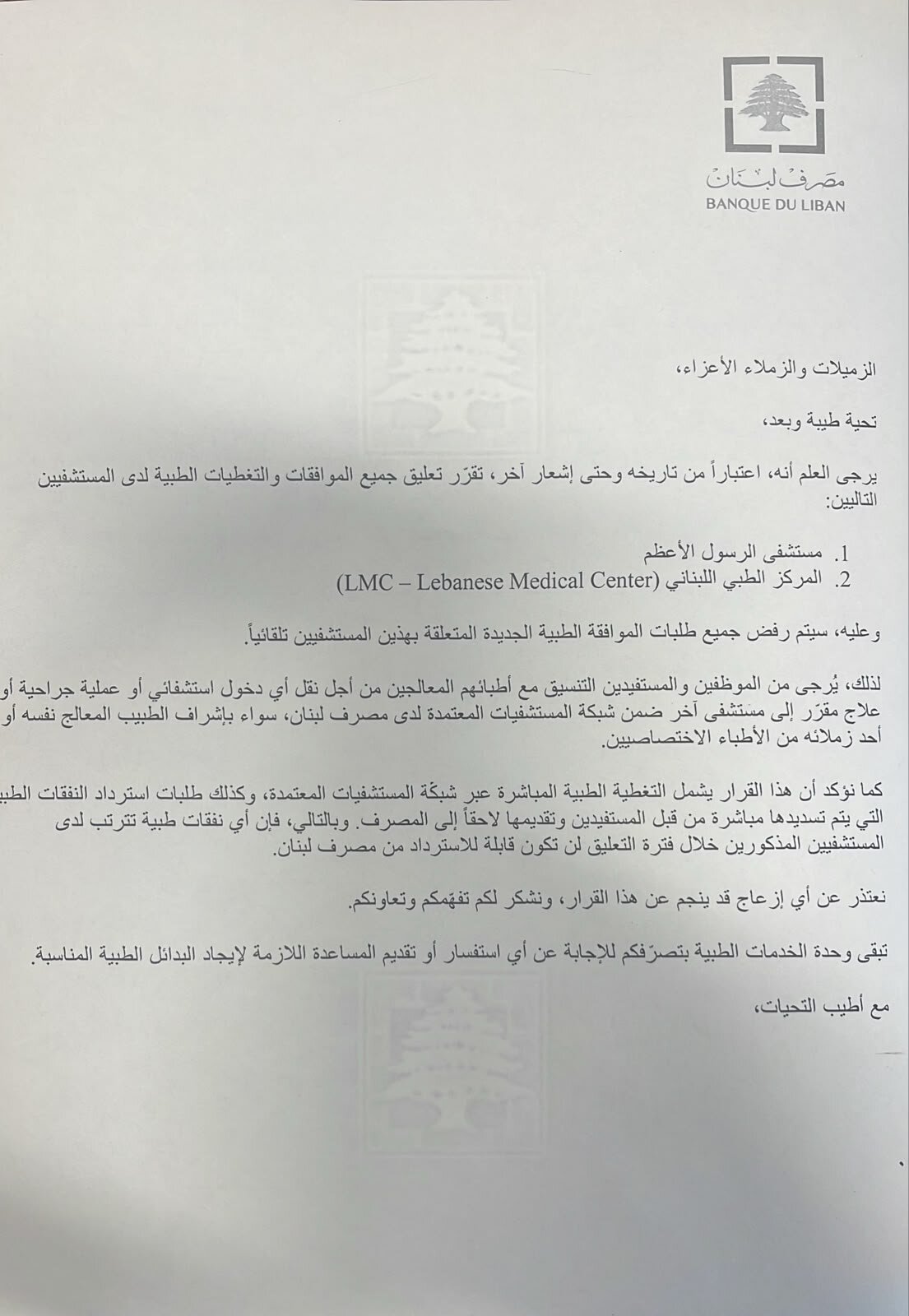
LBCI reportsthe Bank of Lebanon has issued instructions to its employees and beneficiaries of its medical system suspending authorizations and taking care of the Al-Rassoul Al-Aazam Hospital and the Lebanese Medical Centre, designated by the acronym LMC. The announced scope concerns this particular regime. It does not constitute, in the available evidence, a general prohibition on treatment in such establishments or a closure decision.
Thedocument reproduced by the channelprovides for an application from its date until further notice. New applications must be rejected automatically. The suspension affects direct payment as well as reimbursement of costs advanced by beneficiaries. In the case of hospitalisations, interventions or treatment programmes, they are invited to arrange with their doctor for treatment in another approved institution, with the same practitioner or with another specialist. The medical service offers assistance in finding alternatives.
However, the reproduction consulted does not have a numerical date, number or visible signature. It does not specify the fate of emergencies, hospitalizations already committed or previous authorizations. These silences prevent the measurement of the full practical scope of the measure. They do not make it clear that hospitalized patients have been forced out. No count of persons concerned, actual refusals or delayed treatment shall accompany the information.
What the Bank of Lebanon claims
According to BDL sources cited by LBCI, the bank regularly disseminates warnings to its staff regarding individuals and entities on international sanctions lists. These sources present the approach as administrative and regulatory, with no political significance. They argue that the bank must apply to its employees the rules it imposes on the institutions under its supervision.
This explanation deserves to be fully reflected in its principle. However, it originates from sources cited by a media outlet, not from a detailed legal reasoning contained in the document reproduced. The list concerned, the sanctioned entity, the applicable text and how it would affect each institution are not specified in the documents examined. To assert that Washington imposed this suspension would therefore go beyond the established facts.
Al-Rassoul Al-Aazam: a historical connection to Al-Shaheed
The connection of Al-Rassoul Al-Aazam Hospital with Al-Shaheed is not a mere rumor. TheLebanese Hospitals Unionthe association was founded in 1988. Onepublication hosted by the Ministry of Economyit is also described as a branch of the Al-Shaheed Charitable Social Association. However, this is an old presentation, not a register establishing its current legal situation.
The Lebanese foundation is clearly on theamerican list under the name MARTYRS FOUNDATION IN LEBANON, with in particular the alias AL-SHAHID CHARITABLE AND SOCIAL ORGANIZATION. TheUS Treasury announced designation on July 24, 2007by assigning this foundation a financial support role to Hezbollah and other organizations. This allocation must remain with the Treasury.
On the other hand, checks carried out on 3 November in the OFAC SDN list and its alias did not find nominative listing of the two hospitals. The official PDF consulted was dated October 28, 2026. This limited statement does not constitute a certificate of absence of any restriction: a structure may be concerned without being specifically named.
CML: Public Links, a Separate Legal Analysis
For the CMLLebanese Public Procurement Authorityidentified him in a procedure of October 2026 as the National Association for Higher Education in Lebanon (NAHEL). This identification alone does not provide a list of its owners or beneficial owners.
Public references to the political world of Hezbollah are nevertheless documented. Theministry of Health reports September 30the CML includes a room named Hassan Nasrallah and a transplant centre named in tribute to Hashem Safieddine. These elements illuminate the political and symbolic context. They do not automatically demonstrate a sanctioned property or the exact reason for the BDL decision.
Distinction is essential. According to the50 % OFAC rulean entity owned directly or indirectly up to at least 50 %, in total, by blocked persons may itself be blocked without registration. LOFAC states that the sole control, without this ownership threshold, does not trigger this rule. The case of a branch legally owned by a sanctioned person still requires further verification. The accessible documents do not allow these questions to be resolved for both hospitals.
The continuity of care is the true ethical test
The debate cannot therefore be reduced to an opposition between indulgence of Hezbollah and financial rigour. A patient may have chosen an institution for his or her surgeon, a specialized team, proximity to his or her home or the availability of treatment. There is nothing to deduce his political convictions from this choice. Access to appropriate care should be assessed on the basis of health status.
The medical duty to treat without distinction of political or religious opinion is part of the ethical tradition associated with the Hippocrates oath. Its modern formulation appears in theGeneva Declaration of the World Medical Association: beliefs and political affiliation must not interfere between the doctor and his patient. This is not a quotation from the ancient oath. This duty is addressed to doctors; It also sheds light on the ethical criticism of funding decisions that may compromise care.
It is therefore necessary to denounce the risk of discrimination against patients who are penalized on the basis of their religion, their actual or supposed opinions, or those lent to their institutions. There is no evidence here that such a discriminatory refusal has already taken place. This ethical criticism does not constitute a legal qualification of discrimination and does not affect the legality of the BDL decision.
TheLisbon Declaration of the World Medical Associationin particular, it establishes the principles of non-discrimination, continuity of care and reasonable assistance in organizing another care. This text is an ethical reference, not a judgment on the legality of the Lebanese decision, nor an unlimited right to the financing of any institution.
An offer of administrative assistance is useful. However, it is not sufficient to prove that a clinical solution exists. A transfer may require an available space, a transmitted file, suitable equipment and coordination between doctors. For complex processing, the delay itself may be a risk. The patient should not have to demonstrate alone, at the counter of a paying agency, why an immediate change of course would be dangerous.
It would be contrary to this ethical requirement to leave a person without proper treatment or impose an inaccessible expense without an effective alternative. Public information does not prove that such a breakdown has already occurred. However, they justify asking how it will be prevented before it occurs.
Guarantees that beneficiaries must be able to verify
The first requirement is an intelligible explanation of the basis of the decision, separately for each institution. A general reference to international sanctions does not allow patients or practitioners to understand what is prohibited, by what authority, and for how long.
The second concerns the transition. The BDL should specify the treatment of emergencies, already authorised care and patients currently being followed, as well as the modalities for a medically safe transfer. Where legal restrictions actually apply, solutions must be sought in this context, without asking for circumvention. Compliance is not exempt from organising an accessible alternative.
The third guarantee is financial and practical: an available facility, a specialist able to continue the care, a quick response on any additional costs and an interlocutor who accompanies the case until its resolution. To invite the patient to call elsewhere is not, in itself, a continuity of care.
Finally, a clear review procedure should allow the physician to report a particular risk and the beneficiary to challenge an unincorporated decision. Anonymised data on the cases concerned, the delays in transfer and the difficulties encountered would make it possible to assess the consequences without exposing personal medical information.
The duty of financial vigilance is real. The moral obligation not to abandon the sick is just as much. The BDL will be able to defend the consistency of its decision by establishing its legal basis and demonstrating that recipients have equivalent, accessible and continuous care. In the absence of these public guarantees, the ethical issue remains complete.
Cover: photo archive Libnanews.com, all rights reserved. IA-assisted illustrative layout.





Comments