





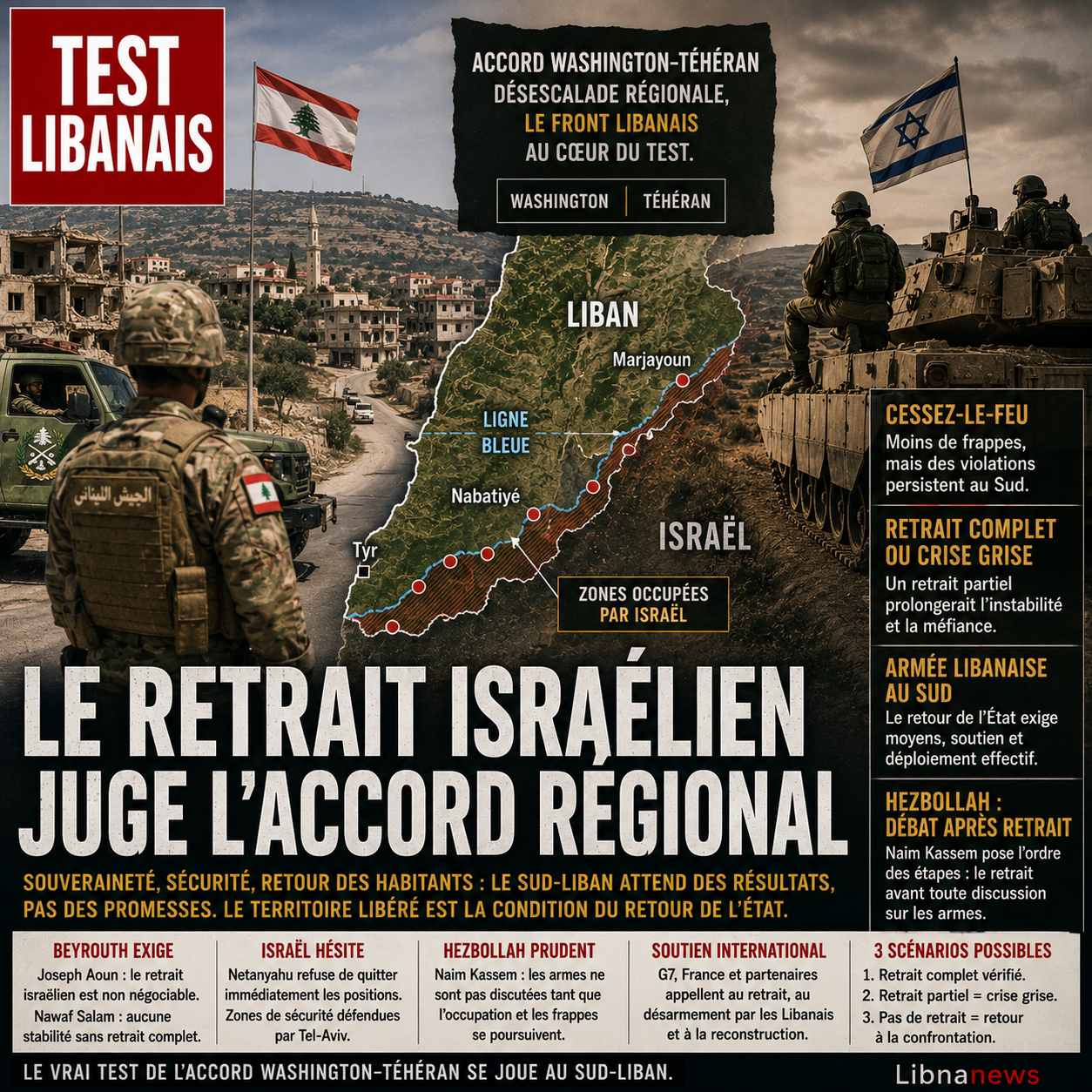
The Israeli withdrawal from southern Lebanon is the decisive test of the regional agreement between Washington and Tehran. Since the announcement of a de-escalation including the Lebanese front, the Beirut authorities, Hezbollah, Israel and Western godfathers do not speak of the same calendar. The ceasefire can reduce strikes. It is not enough to restore Lebanese sovereignty if the Israeli army retains positions, a security zone or permanent freedom of action. For Lebanon, the issue is clear: the return of the State can only be credible if the territory is liberated, secured and placed under public authority.
Strikes despite the climate of de-escalation
The sequence opened by the American-Iranian accord did not erase the reality of the terrain. In southern Lebanon, overflights, drones, point strikes and cross accusations of violations continue to be reduced but not completed. According to the international press, Israeli attacks were again reported after the announcement of the regional truce, including in areas where the inhabitants were already hoping for a gradual return to normalcy. This persistence of operations feeds Lebanese mistrust and gives the debate on withdrawal a concrete dimension.
The ceasefire can lead to a decline in military intensity. He doesn’t solve the main question: who controls the ground? As long as Israel maintains positions in Lebanon, the regional agreement remains incomplete. As long as the drones cross Lebanese airspace, sovereignty remains theoretical. As long as the people of the South cannot return without fear of a strike or a resumption of fighting, de-escalation is more like a pause than a settlement.
This difference between cessation of hostilities and effective withdrawal is central. It explains the caution of the Lebanese authorities. Beirut cannot present the agreement as a victory if areas remain occupied or if the Israeli army retains the ability to decide the pace of operations alone. The Lebanese State needs a visible result: evacuated positions, reopened roads, accessible villages and an increased presence of the Lebanese army.
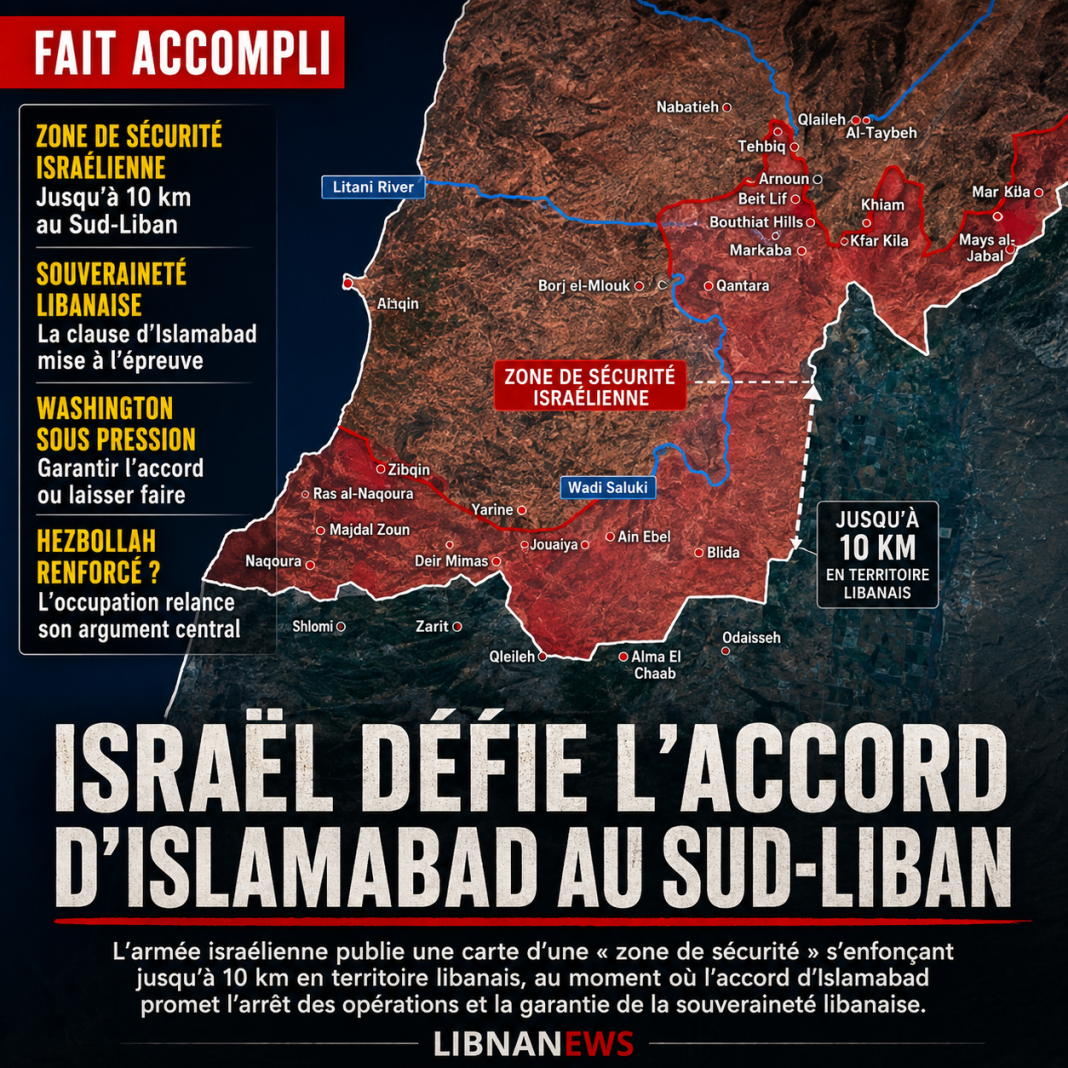
This is also what worries Israel. The government of Benjamin Netanyahu considers that South Lebanon remains a threat area as long as Hezbollah retains military capabilities. For the Israeli army, a security zone can appear as a minimum guarantee. For Beirut, it means an occupation. Between these two readings, withdrawal becomes the true justice of the peace.
The ceasefire is not enough
International law and diplomacy are not satisfied with a mere slowing down of fire. A ceasefire responds to the emergency. It protects, in principle, civilians and opens up a negotiating space. But it can also freeze an unfavourable power ratio if no withdrawal schedule is set. Lebanon knows this risk. Its recent history shows that interim arrangements can last, especially when they settle under the pretext of security.
Israel defends a safe reading. Israeli officials claimed that the army would not leave immediately the areas taken or preserved in southern Lebanon. Israel’s Defense Minister Katz has defended the maintenance of safe areas in Lebanon, Syria and Gaza in the name of the protection of Israeli citizens. According to the Israeli and international press, discussions were also initiated with Washington to preserve an Israeli military presence in the South, despite the provisions of the regional agreement on Lebanese territorial integrity.
This position puts the United States before a contradiction. Washington presents the agreement with Iran as a regional de-escalation architecture. But this architecture loses its strength if its main ally in the Middle East refuses to apply its Lebanese component. The United States can support Israel safely. They must also show that their signature commits a result. It is this relationship between strategic solidarity and diplomatic credibility that gives the Lebanese case its sensitivity.
The Group of Seven attempted to hold the two sons. In his statement, he supported a robust ceasefire in Lebanon, the State monopoly on arms and the protection of the territorial integrity of the country. This formulation seeks a balance. It calls for the strengthening of the Lebanese State and the disarmament of Hezbollah, but also recognizes that sovereignty and territorial integrity are indispensable conditions. The debate is therefore not only military. It deals with the sequence of stages.
Joseph Aoun and Nawaf Salam on a state line
President Joseph Aoun and Prime Minister Nawaf Salam defend an institutional line. It is based on three ideas: Israeli withdrawal, the strengthening of the army and the reaffirmation of the State as the only legitimate decision-making framework. Joseph Aoun made the Israeli withdrawal a non-negotiable requirement. This position is intended to prevent Lebanon from being dragged into negotiations where its sovereignty would become an adjustment variable.
Nawaf Salam carries the same logic in foreign capitals. In Paris, during his discussions with Emmanuel Macron, he insisted that no lasting stabilization is possible without complete Israeli withdrawal. France has resumed this articulation by linking Israeli withdrawal, disarmament of Hezbollah by the Lebanese themselves and reconstruction of the South. This sequence is important. It shows that the issue of arms cannot be isolated from the territory, the displaced and the return of public authority.
The Lebanese line therefore seeks to avoid two traps. The first would be to immediately open an internal confrontation on Hezbollah weapons while the Israeli army remains present. The second would be to postpone indefinitely the debate on the monopoly of force in the name of resistance. The state must find a narrow way. He has to get the withdrawal to get back on his feet. He must then turn this withdrawal into a political moment, not a mere respite.
This position requires resources. The Lebanese army must be able to deploy, maintain the roads, secure the villages, coordinate with UNIFIL and reassure the people. Without financial, logistical and political support, the discourse of sovereignty will remain fragile. That is why diplomatic discussions on aid to the army are not secondary. They condition the possibility of even a return from the state to the south.
Naim Kassem sets the order of steps
Hezbollah defends a reverse reading of that of Western chancelleries. His secretary-general, Naim Kassem, said that any serious debate on weapons must come after the Israeli withdrawal, not before. The movement says it accepts the principle of national dialogue, but it refuses disarmament under external pressure, especially if Israel maintains positions or continues its strikes.
This position corresponds to a clear political logic. Hezbollah knows that its weapons are its main trading card. He believes that abandoning them before an Israeli withdrawal would be tantamount to losing its deterrent without a guarantee of sovereignty. It therefore presents its arsenal as a response to the Israeli occupation, violations and threat. In his account, withdrawal is the preliminary proof that the land has changed.
This reasoning speaks to part of its social and political environment. The villages in the South paid a heavy price. Families are returning to destroyed neighbourhoods. Many fear that the state alone cannot prevent Israel from hitting again. Hizbullah uses this concern to defend the need to maintain its capabilities until the Lebanese army and international safeguards are deemed sufficient.
But there are also risks to this strategy. It can block the full return of the state. It can offer Israel an argument for maintaining safe areas. It can increase Western pressure on Beirut. Finally, it can place Lebanon in a long-term dependence on negotiations between Iran and the United States. If Hezbollah conditions everything after the regional agreement, the Lebanese state may remain spectator.
Israel wants to maintain a depth of security
The Israeli position is based on an internal imperative. The government must promise the people of northern Israel that they will be able to return without living under the threat of Hezbollah fire. This promise weighs heavily in the Israeli debate. It explains the emphasis on safe areas, preventive strikes and destruction of infrastructure attributed to Hezbollah.
Benjamin Netanyahu and his firm claim that the withdrawal cannot precede a real guarantee on the threat. Israel does not want to relive a scenario where the army leaves an area and sees, a few months later, Hezbollah resettling near the border. This fear is central to Israeli doctrine. It justifies, in the eyes of Tel Aviv, the maintenance of military pressure in Lebanon.
For Lebanon, this doctrine is unacceptable if it translates into a lasting presence on its territory. Sovereignty cannot depend on the security appreciation of a neighbouring State. The problem is that the Lebanese State must convince beyond its statements. It must prove that an Israeli withdrawal will not leave a vacuum exploited by armed groups. This is where the role of the army, UNIFIL and international safeguards becomes decisive.
The Israeli position can therefore produce the opposite effect of that sought. By remaining in the South, Israel reinforces Hezbollah’s argument that its weapons remain necessary. By continuing the strikes, it weakens the Lebanese authorities who want to open an internal dialogue. By refusing a timetable for withdrawal, he turned the ceasefire into a suspended truce, without a clear political horizon.
Three scenarios for Lebanon
The first scenario is a complete, verified and accompanied withdrawal. Israel evacuates its positions in southern Lebanon. The Lebanese army deploys with visible international support. UNIFIL is strengthening its coordination with Beirut. People are returning gradually. In this context, the State can open a national dialogue on Hezbollah’s weapons with a new argument: the territory is freed, security must now be the responsibility of institutions.
This scenario is the most favourable for Lebanon. It does not guarantee a speedy settlement. Hezbollah will not lay down its weapons simply by mechanical effect. But the complete withdrawal would change the political report. He would remove his most powerful argument from the movement. He would give Joseph Aoun and Nawaf Salam a base to talk about defence strategy, monopoly of force and reconstruction. It would also allow foreign partners to support the army without being accused of supporting pressure under occupation.
The second scenario is a partial withdrawal. Israel evacuates certain positions, but retains points deemed strategic, corridors of control or freedom of air action. This scenario is likely because it allows each camp to claim some of the result. Washington could say that de-escalation is progressing. Israel could say that it protects its borders. Beirut could welcome a reduction in the Israeli presence while demanding further action.
But partial withdrawal would prolong the crisis. It would prevent the full return of the inhabitants. It would keep Hezbollah in a position of resistance. It would weaken the state, forced to celebrate an incomplete advance. It would also give external actors time to renegotiate without settling the ground. The risk would be a normalization of the two: neither total war nor restored sovereignty.
The third scenario is the absence of withdrawal. Israel maintains its positions, pursues targeted strikes and affirms that the safe area will remain until Hezbollah is neutralized. In this case, the regional agreement would be weakened. Iran may accuse Washington of not respecting the spirit of the text. Hezbollah could resume or intensify its operations. The Lebanese State would be caught between international pressure to disarm the movement and political impossibility of acting under occupation.
This scenario would pave the way for a gradual return to confrontation. It may not take the form of an immediate war. It could result in incidents, fire, drones, limited retaliation and continued deterioration of life in the South. Displaced families would remain waiting. Municipalities could not rebuild. The Lebanese army would be confined to a symbolic or defensive role.
The return of the state depends on the land
The debate on Hezbollah’s weapons will not disappear. It is at the heart of Lebanese sovereignty. No State can be fully sovereign if an autonomous armed force decides war and peace alone. But this institutional truth is not enough to produce a solution. The timetable counts as much as the principle. Opening the debate under Israeli occupation can strengthen Hezbollah. Repelling him unconditionally can condemn the state to impotence.
The current window should therefore be used with method. Lebanon must demand a clear timetable for withdrawal, monitoring guarantees, immediate support for the army and an international verification mechanism. He must also prepare, internally, a discussion on the defence strategy. This discussion cannot be improvised after withdrawal. It must be thought of now, with steps, political guarantees and a clear definition of the role of the institutions.
External partners have their responsibility. Washington must show that it can weigh on Israel. Paris must support the army and bring the matter to the European level. The Group of Seven should avoid reducing Lebanese sovereignty to the disarmament of Hezbollah alone. Tehran must stop treating Lebanon as a negotiating card. Israel must understand that a prolonged presence in the South feeds exactly the threat it claims to contain.
The Israeli withdrawal from the South is therefore more than a diplomatic clause. It is the concrete criterion of the regional agreement. If the withdrawal takes place, Lebanon may attempt to transform de-escalation into state restoration. If it remains partial, the country will enter a grey crisis. If it does not happen, the ceasefire risks becoming a parenthesis before a new confrontation, while the people of the South are still waiting to know whether returning home means finally returning to a normal life.