

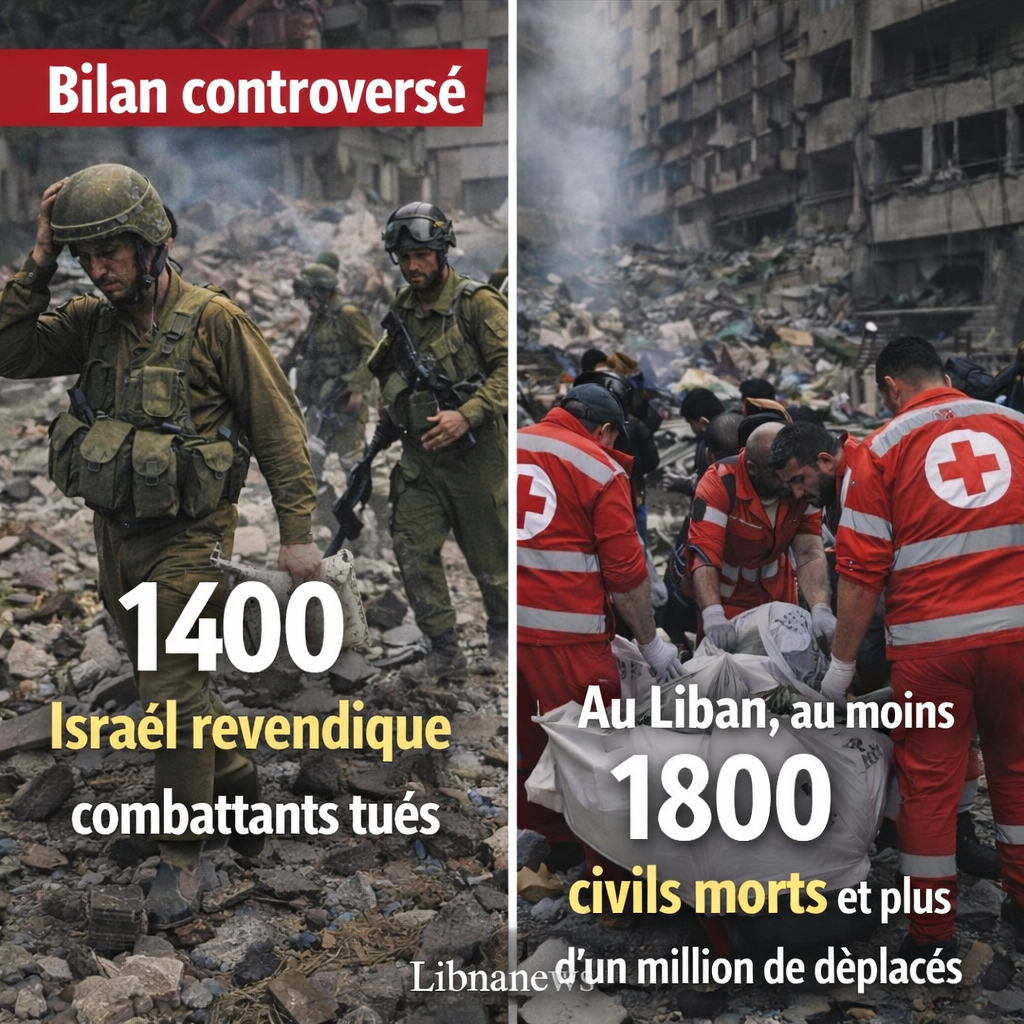
The Israeli army claims to have crossed a new threshold in its campaign in South Lebanon. In a statement, she claims that five divisions are continuing simultaneous operations, that more than 1,400 Hezbollah members have been killed since the beginning of Operation Roaring Lion and that more than 4,300 sites presented as infrastructure of the movement have been dismantled. It added that it had seized more than 1,250 weapons and carried out over 120 air strikes in support of ground troops on the last day alone. This narrative depicts a methodical, targeted and militarily effective campaign. But it faces two much more disturbing realities: on the one hand, these Israeli figures are not independently verifiable at this stage; On the other hand, the human and civilian cost in Lebanon has reached a level which seriously weakens the presentation of a war strictly centred on military objectives.
As of 9 April 2026, the most recent available record shows that more than 1,800 people have died in Lebanon since the major outbreak of the conflict on 2 March, according to the Lebanese authorities cited by Reuters, and more than 1 million have been displaced. The Israeli strikes of 8 April alone caused more than 303 deaths and more than 1,100 injuries, according to a provisional assessment, pointing out that many civilians were among the victims. WHO warned that Lebanese hospitals risked running out of vital supplies in a few days to treat the wounded. In these circumstances, using the language of the Israeli army on « terrorist sites » or « targeted disposals » as such would erase the central question: who really dies, where, and on what basis are these targets designated?
A very constructed Israeli version, but not transparent
The Israeli communiqué is based on a classical military communication architecture. It adds up the divisions involved, the infrastructure destroyed, the weapons seized and the air strikes carried out. This accounting has a mastery effect. It suggests a clean campaign, ordered and guided by a logic of precision. However, neither the categories used nor the counting methods are publicly detailed. The Israeli army does not publish, in this type of balance sheet, the precise criteria for classifying a person killed as « terrorist » or those who transform a building, depot, crossroads or house into « terrorist infrastructure ». This is an essential point, because the gap between a proven military target and an alleged target radically changes the legal and political reading of operations.
The main weakness of this version is therefore its internal consistency rather than its lack of independent verification. Reuters reports that Israel claims more than 1,400 fighters killed, but the same agency also mentions much lower Lebanese estimates for Hezbollah losses, around 400 fighters. Such a gap is not marginal. It reveals that in the heart of the war there is also a battle of numbers. However, when the difference relates to a factor of more than three, the journalistic reflex cannot be the resumption, but the distance. This does not mean that the Israeli army is mechanically lying on every number. This means that its figures serve a political and operational purpose and must be presented as belligerent party statements, not as an established state of affairs.
This caution applies equally to the notion of « terrorist infrastructure ». In recent Israeli practice, this category includes weapons depots, launching ramps, tunnels, firing positions, but also buildings or neighbourhoods where the army claims that Hezbollah is hiding or storing equipment. However, several investigations and field reports reported by the PA and Reuters show that strikes have hit densely populated areas of Beirut and other Lebanese regions, sometimes without sufficient warning, with large civilian casualties. Israel claims to be targeting Hezbollah; Residents, Lebanese officials and international observers challenge the military nature of certain affected areas. The problem is not only the number of sites destroyed, but the very definition of what has been destroyed.
The Lebanese civilian record now weighs more than the operational record
The current civilian record in Lebanon is the blind spot in the Israeli communiqué. He doesn’t appear. It now structures any serious reading of the conflict. Approximately 1,800 people have been killed in Lebanon since 2 March. The most recent strikes hit densely populated areas, killing more than 300 people in one day according to local authorities. On 9 April, ambulances took dead bodies directly to the organ of Rafic Hariri Hospital, with 92 dead in Beirut and 61 in the southern suburbs for this single sequence. WHO reported that three weeks of trauma stocks had been consumed in a single day. These elements no longer relate to marginal collateral damage. They define the war as it is lived in Lebanon.
The massive population displacement confirms this scale break. A joint declaration by 63 States and the European Union to the United Nations mentions more than one million internally displaced persons. This data is crucial because it shows that the conflict is no longer just a face-to-face border between the Israeli army and Hezbollah. It has become a Lebanese national crisis, with humanitarian, health and institutional effects that go well beyond the immediate combat zones. The more the war spreads in cities, the more the Israeli discourse on « targeted » raids loses credibility among outside public opinion. Doctrinal targeting may exist; It becomes politically unaudable when the affected neighbourhoods are dense urban spaces and hospitals threaten to collapse.
In addition, the case of rescue workers and protected personnel must be added. 12 rescue workers were killed in one day on 8 April. On the same day, dozens of States at the United Nations condemned the recent attacks on UNIFIL peacekeepers after the death of three Indonesian soldiers. A coalition of 63 countries mentioned possible war crimes and asked for accounts. Again, this does not automatically assign each incident to deliberate criminal intent. But this shows how the war in Lebanon is now viewed under a humanitarian and legal prism, not just a strategic one. This development mechanically weakens the strength of the Israeli discourse centered on military efficiency.
Why Israeli numbers must be treated with distance
In all contemporary wars, armies publish reports that serve several purposes at the same time: to reassure their opinion, to send a signal of power to the adversary, to weigh on the allies and to prepare diplomatic ground. The Israeli communiqué does not escape this logic. To claim more than 1,400 Hezbollah fighters killed means that the organization has suffered massive attrition. To claim more than 4,300 dismantled infrastructure is to argue that Israel is not just hitting, but that it is permanently destructing the movement’s structure in South Lebanon. These numbers provide a simple argument: military pressure would produce strategic results.
But there are several elements that require a relativization of this reading. First, Hezbollah continues to fire rockets, missiles and drones into Israel. Then, despite the scale of the strikes and the earthly commitment, none of the major international actors today describes a near or decisive Israeli victory. Analysts and diplomats do not see a clear military outcome in the short term. Finally, the very fact that Israel announces that it wants to open direct talks with Lebanon while continuing the strikes suggests that the war has not yet produced the expected political shift. An army that gains unambiguously generally does not feel the need to justify its numbers and objectives so intensively in full operation.
The criticism of the Israeli version is also based on an empirical observation: the more the army highlights global statistics, the less detailed it provides on the more controversial concrete cases. It is precisely these cases that matter to judge the proportionality and truthfulness of the story. When residential buildings, Beirut arteries or entire villages are affected, the issue is not just how many « sites » have been destroyed, but precisely what military target was there, what immediate threat it represented, what precautions were taken, and who was killed. On this ground, Israeli communication remains far below what a fully convincing demonstration would require.
A war of words around legitimacy
The language used by the Israeli army is not neutral. Talking about « terrorists », « terrorist sites » and « neutralized threats » creates a moral framework in which the campaign appears, by definition, justified. This lexicon is central to Israel’s international communication strategy. It allows to merge into the same armed adversary category, its logistic environment, its supposed areas of presence and sometimes the territories it influences. The more this category expands, the greater the military margin of action. But the more it expands, the greater the risk of seeing civilians and civilian property absorbed in a language that invisibilizes them.
This is precisely what feeds the challenge of the Israeli version. The PA reported that Lebanese officials and residents denied Hizbullah’s military presence in some central areas of Beirut, which were hit on 8 April. Reuters described numerous civilian casualties, including entire families and Syrian workers, as well as difficulties in identifying bodies. When the facts on the ground reveal destroyed buildings, panicked neighbourhoods and overcrowded morgues, Israeli military semantics cease to be merely descriptive. It becomes a political issue in itself.
Concrete examples that weaken the Israeli version
The Israeli version of a strictly « targeted » campaign comes first against the reality of the 8 April strikes on Beirut and other Lebanese regions. The media describe one of the most deadly days of the recent war in Lebanon. Both agencies point out that the bombings hit heavily populated neighbourhoods, sometimes without warning, and that many civilians were among the victims. Lebanese residents and officials also challenged the existence of visible military targets in several areas of the capital.
The case of UNIFIL is a third very sensitive point. A preliminary United Nations investigation concluded that an Indonesian peacekeepers had been killed by an Israeli tank fire, while two other soldiers had died in a separate incident probably related to a Hezbollah device. A few days later, 63 States and the European Union condemned the attacks against peacekeepers in Lebanon to the United Nations, recalling that such acts could constitute war crimes. This episode is particularly embarrassing for Israel, as it touches an international force identified, protected and theoretically known to all belligerents.
Another heavy example is the reported use of white phosphorus in a residential area in southern Lebanon. Human Rights Watch claimed, on 9 March 2026, that it had verified and geolocated images showing white phosphorus munitions fired over homes in Yohmor, with fires in houses and a civilian vehicle. Again, the stake is not limited to the materiality of the shooting. It relates to the location concerned, the presence of civilians and the conformity of the use of such munitions with international humanitarian law. This episode feeds the accusations that some Israeli practices in Lebanon go far beyond strictly military operations.
Finally, it should be recalled that these examples are part of a much broader human context. As at 9 April 2026, more than 1,800 people had been killed in Lebanon since 2 March and more than 1 million people had been displaced. WHO has warned that Lebanese hospitals are likely to lack vital supplies within a few days after having absorbed in a single day the equivalent of three weeks of trauma equipment. In this context, the Israeli presentation of a surgical war is becoming increasingly difficult to support politically and morally.




