

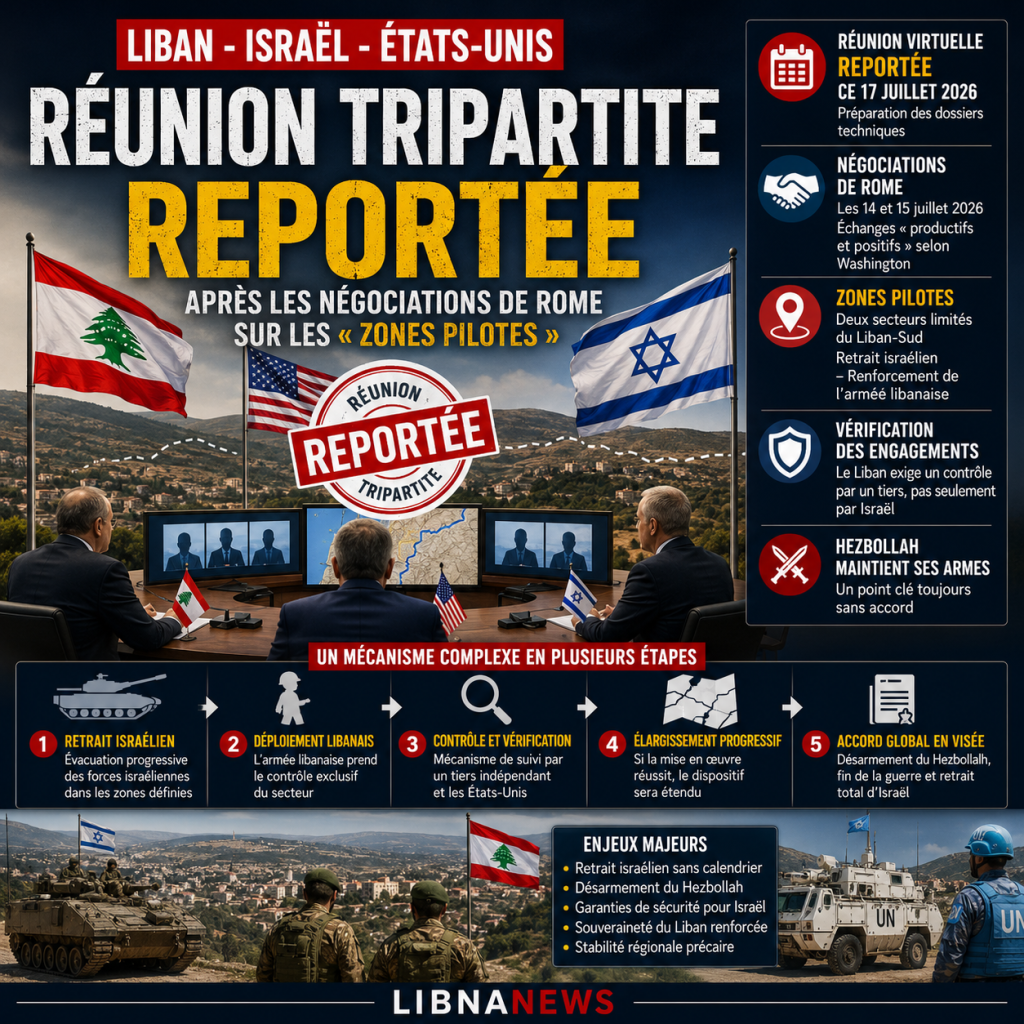
The tripartite virtual meeting, which was scheduled to bring together Lebanese, Israeli and American representatives on Friday, 17 July, 2026, was postponed in order to prepare the technical dossiers. The meeting was to extend the discussions held on 14 and 15 July in Rome and clarify the modalities for the implementation of the « pilot zones » in the South Lebanon. Deferral does not at this stage mean a break in the process. However, it reveals the complexity of a mechanism that must combine Israeli withdrawal, the deployment of the Lebanese army, the verification of measures on the ground and the treatment of the issue of Hezbollah weapons. American negotiators have described Rome’s trade as « productive and positive », but several key points remain without a public calendar.
The tripartite virtual meeting, which was scheduled to bring together Lebanese, Israeli and American representatives on Friday, 17 July, 2026, was postponed in order to prepare the technical dossiers. The meeting was to extend the discussions held on 14 and 15 July in Rome and clarify the modalities for the implementation of the « pilot zones » in the South Lebanon. Deferral does not at this stage mean a break in the process. However, it reveals the complexity of a mechanism that must combine Israeli withdrawal, the deployment of the Lebanese army, the verification of measures on the ground and the treatment of the issue of Hezbollah weapons. American negotiators have described Rome’s trade as « productive and positive », but several key points remain without a public calendar.
Tripartite meeting postponed after Rome
The electronic meeting was to finalize the results achieved in the Italian capital. According to information broadcast on Friday by a Lebanese channel, it was postponed to prepare the necessary documents. No new appointments were announced immediately.
This period comes after two days of negotiations under American mediation. The Lebanese and Israeli delegations met at the United States Embassy in Rome. This was the sixth round of discussions since the start of the process and the first after the framework agreement concluded in Washington on 26 June.
One US official reported that participants had approved the general structure and guidelines of the pilot zone mechanism. These elements still need to be finalized before they are implemented. Future discussions should focus on the technical aspects, but also on the other aspects of the tripartite framework.
The postponement shows that political agreement in principle is not enough. The parties must define the maps, withdrawal sequences, responsibilities of each force and control procedures. They must also decide who will see the implementation of the commitments and on what criteria.
« Pilot zones » at the heart of the scheme
Pilot zones are the first concrete step envisaged in the framework negotiated with Washington. The principle is to apply, in two limited sectors of the South, a mechanism for further expansion. Israeli forces should withdraw from the areas concerned. The Lebanese army would then strengthen its deployment there and exercise official military authority alone.
The Rome talks focused on this transition. Negotiators were to determine the procedures for the departure of Israeli units, the arrival or strengthening of Lebanese troops and the verification of the absence of non-State weapons.
The localities mentioned in the available information include Frun, Ghandouriya, Qalawiyé, Borj Qalawiyé and Kfar Dounine, in Bint Jbeil district. Other villages in Nabatiyah and Tyre districts also appear in Lebanese military preparations. However, the definitive limits have not been made public.
This inaccuracy already feeds questions. Some of the localities mentioned are not directly occupied by Israeli forces. The Lebanese army was also present before the announcement of the device. The concept of « retirement » does not therefore apply equally in all sectors.
Lebanese Army strengthens its presence
In parallel with the negotiations, the Lebanese Army intensified its patrols in several villages close to the occupied areas. It has installed or strengthened dams, observation posts and surveillance movements. Frun is among the localities concerned.
These measures aim to prepare for possible rapid implementation. They also enable Beirut to show that the military institution can assume the tasks envisaged by the framework. The government presents the deployment of the army as a central element in the restoration of sovereignty in the South.
However, the operational situation remains difficult. The army must intervene in areas marked by fighting, destruction and the possible presence of unexploded ordnance. It must also avoid any incidents with Israeli forces still deployed on the other side of the contact lines or in Israeli-held areas.
The question of means also arises. Sustainable deployment requires personnel, fuel, communication equipment, demining capabilities and logistical support. Lebanon ‘ s international partners could be called upon to build these capacities.
Israeli withdrawal remains unscheduled
The main Lebanese objective remains the withdrawal of Israeli forces from national territory. Beirut hoped that the Rome meeting would lead to specific steps. The US communiqué confirmed an agreement on the method, but did not provide any dates.
This lack of timetable is one of the main weaknesses of the framework. Israel claims to be ready to move forward in both pilot areas. His Foreign Minister, Gideon Saar, said at the beginning of the Rome talks. However, the Israeli authorities link any lasting withdrawal to the disappearance of the threat posed by Hezbollah.
Israeli officials also claimed that their forces would remain in a security zone about ten kilometres along the border as long as the Shiite movement retained its weapons. This position contradicts the Lebanese demand for a complete and progressive withdrawal.
The disagreement therefore concerns the sequence of stages. Lebanon wants Israel to withdraw to allow the army to regain control. Israel demands guarantees of disarmament and the impossibility of returning Hezbollah to the evacuated areas.
The tripartite framework aims at a wider agreement
Pilot zones are only a first step. According to the US State Department, technical negotiations must now cover the whole tripartite framework. The stated aim is to reach a comprehensive agreement between Lebanon and Israel.
The text negotiated in Washington seeks to end the state of war between Israel and Hezbollah in Lebanon. It provides for the disarmament of the Iranian-backed movement, the deployment of the Lebanese army in the South and the gradual withdrawal of Israeli forces.
The political scope of the process therefore goes beyond a local military arrangement. It affects Lebanon’s sovereignty, arms monopoly, border security and the nature of relations with Israel.
No peace agreement is imminent. Lebanon and Israel remain officially in a state of war. Negotiations are conducted under American mediation and do not mean diplomatic normalization. In Beirut, any developments on the ground remain extremely sensitive.
Hezbollah rejects agreement
Hezbollah rejects the US-sponsored framework. In particular, the movement challenges the demand for disarmament and considers its weapons necessary in the face of Israel. He did not participate directly in the Washington or Rome negotiations.
This opposition is a major obstacle. The Lebanese Government can negotiate on behalf of the State, but the implementation of the arms component requires difficult internal decisions. It also requires a political and security capacity that Lebanese institutions have rarely been able to impose without compromise.
Hezbollah has traditionally linked the issue of its arsenal to the continued Israeli occupation and threats against Lebanon. Israel adopts the opposite reasoning. He made his withdrawal conditional on the organisation’s neutralization.
This circle explains the search for limited experimentation. The pilot areas must allow a limited sequence to be tested before enlargement. Success will depend on trust between the parties, but also on the American capacity to guarantee the commitments made.
Audit as a sensitive point of discussion
Lebanon requests that a third party verify the performance of the tasks entrusted to its army. Beirut does not want the assessment to depend solely on Israeli assessments. This requirement is intended to prevent Israel from delaying its withdrawal on the basis of unconfirmed default.
Technical discussions must therefore define a control mechanism. The United States could play a central role, along with other international actors. The presence of the United Nations Interim Force in Lebanon is also part of the regional arrangement, although its exact role in the pilot areas has not been publicly detailed.
The audit will have to answer several questions. Who will inspect the villages? Which sites can be visited? How will the absence of weapons be found? What procedure will apply in case of disagreement? And what consequences will a violation follow?
Without a precise answer, the mechanism may remain blocked by conflicting interpretations. A local incident could then call into question the entire process.
A postponement that does not close negotiations
The adjournment of the virtual meeting can be interpreted as a technical delay rather than a diplomatic failure. The Rome trade resulted in an agreement on a working structure. US officials have announced the transition to an expanded phase of technical negotiations.
None of the parties formally left the process. Israel claims to want to move forward. Lebanon is preparing its army and insists on withdrawal. Washington maintains its mediation. These evidences show that discussions are continuing despite differences.
However, the postponement highlights the gap between a political declaration and its implementation. Each detail can become a blocking point: a map boundary, a road, an observation post, a calendar or a verification method.
Negotiators must also deal with realities on the ground. Military operations, strikes, demolitions and regional tensions can rapidly change the context. A further escalation would reduce the margin for compromise.
Next steps still to be set
The immediate priority is to reprogram the tripartite meeting and finalize the Rome dossiers. Technical teams will have to transform the guidelines into applicable procedures. They will have to produce validated maps, a timeline and a control mechanism.
The Lebanese government will have to specify the tasks entrusted to the army and the guarantees obtained on the Israeli withdrawal. Israel should indicate the positions it is prepared to evacuate and the exact conditions attached to that decision.
Washington, for its part, will seek to prevent the disagreement on Hezbollah’s weapons from blocking experimentation from the outset. American mediation is based on the idea that limited progress can create a broader dynamic.
The real test will therefore not be the formulation of a new communiqué. He will intervene when an Israeli unit effectively leaves a position, the Lebanese army takes control of it and an independent mechanism validates the operation. On Friday evening, no public date had yet been set for this first stage.




