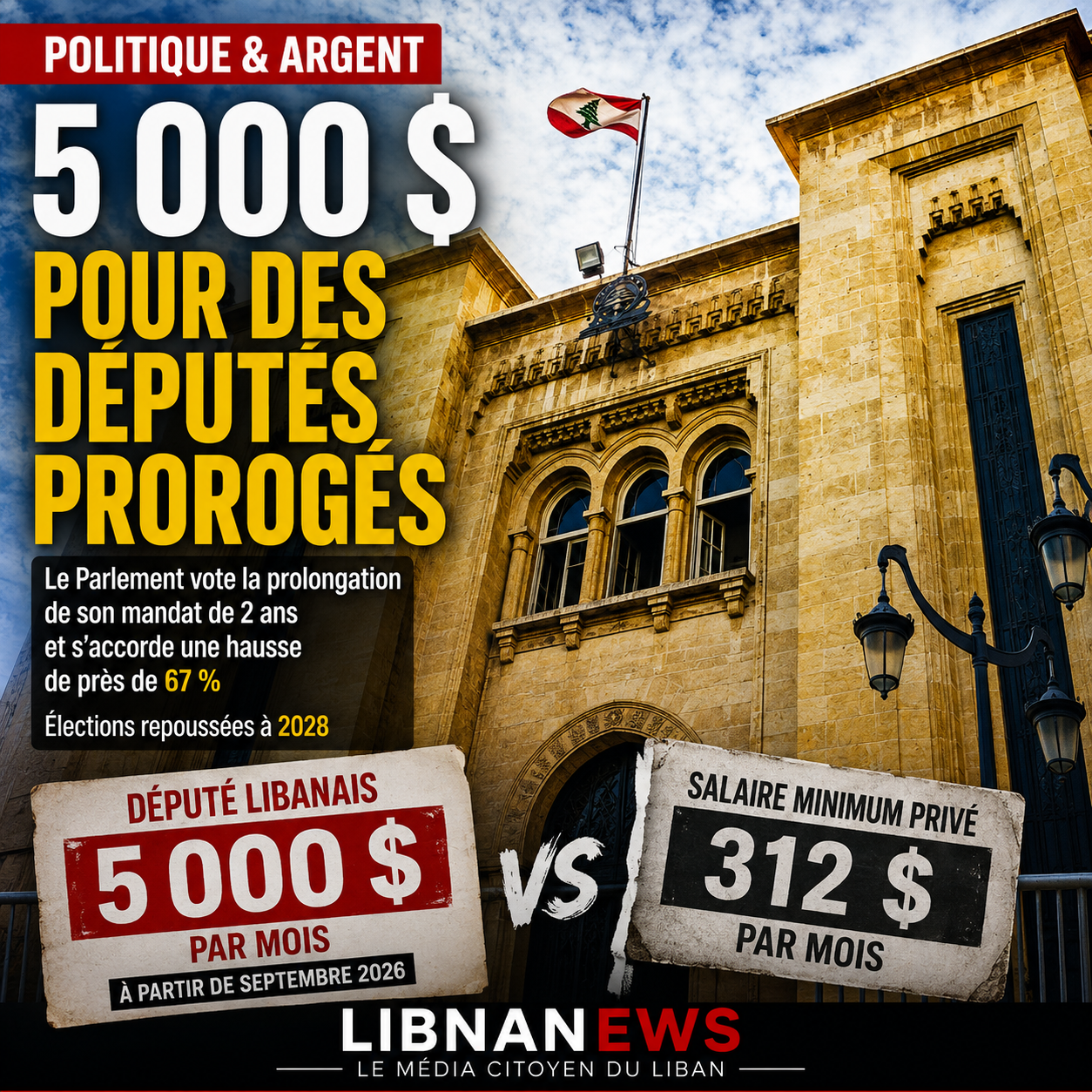
Lebanese MPs are expected to receive approximately $5,000 a month from September 2026, compared with nearly $3,000 previously, thanks in particular to an increase in the resources of the House’s mutual fund financed by the Treasury. The increase, close to 67 per cent, occurred while the legislature that had emerged from the May 15, 2022 election should have been put into play in May 2026, but the Parliament voted on 9 March for a two-year extension of its own mandate, repelling the elections to 2028. The contrast is all the more marked as the private minimum wage remains close to $312 per month, as civil servants and pensioners still rely on multiple and temporary support, and as the major banking, tax and institutional reforms promised since the collapse of 2019 remain incomplete. Moreover, the $5,000 does not represent all the material status of elected officials: the international base available indicates that parliamentary salaries and allowances are not subject to income tax, that MPs may retain outside paid activities and that Parliament itself sets the level of certain allowances. In a country where the same elected representatives vote the budget, change their own mandates and legislate on sectors to which several of them remain economically linked, the decision revives the issue of conflict of interest and political responsibility.
The figure of $5,000 is not a mere basic salary publicly adopted in this form. The parliamentary compensation system combines treatment, crisis-related adjustments and benefits from the House’s mutual assistance fund. According to information released at the beginning of August, the increase should be made possible by a transfer of public funds to the fund. This budgetary detour does not change the economic origin of the expenditure: it is based on state finances.
The additional cost remains modest at the budget level. An increase of approximately $2,000 per month for 128 MPs is theoretically just over $3 million per year. Lebanon would of course not solve its banking crisis or its public deficit by abolishing that sum. The stakes are elsewhere. For the past seven years, citizens have understood that every wage increase, every reimbursement and every reform must expect sufficient revenue, audits or political agreement. The speed with which parliamentary revenues can be restored contrasts with this overall slowness.
A Chamber that extended its mandate
The calendar is central. The parliamentary elections were to be held in May 2026. On 9 March, as the regional war intensified and Lebanon was under heavy Israeli bombardment, Parliament adopted a two-year extension of its mandate. Seventy-six members voted in favour, 41 against and four abstained. The elections were therefore postponed to 2028.
Security circumstances were serious. Hundreds of thousands of people had been displaced and several parts of the country were affected. It would therefore be simplistic to present the postponement as an act without justification. But the institutional conflict of interest remains: the immediate beneficiaries of the extension are also those who have had the power to vote.
The parliamentary mandate remains legally valid. It would be incorrect to say that Members are sitting without a legal basis. On the other hand, their initial political mandate was to be re-voted by the citizens in May 2026. This deadline was postponed by the House itself. It is this distinction that makes salary revalorisation more sensitive.
A more protective rule could have foreseen that a significant increase in earnings would only apply to the next legislature. The elected representatives could then have considered it necessary to raise the parliamentary salary without being certain that they would benefit themselves. On the contrary, the application from September onwards has the opposite effect: members of an extended Chamber receive the increase directly.
$5,000 compared to approximately $312 at the legal minimum
The minimum private wage is £28 million. At a rate close to £89,500 per dollar, this represents approximately $312. The announced parliamentary revenue thus reaches nearly 16 times that floor.
A minimum paid person should work about 16 months to reach the equivalent of one month to $5,000. Over a year, his minimum income is approximately $3,744, less than the monthly salary announced for a member.
The comparison does not mean that a parliamentarian should receive the minimum wage. Adequate compensation also protects democracy: it must enable people who do not have a personal fortune to exercise a mandate. But this argument implies that remuneration is transparent and that elected officials cannot compensate for low wages by private interests or external income that may create dependency.
However, data from the Inter-Parliamentary Union indicate that Lebanese MPs may retain paid activity outside Parliament. They must report the income associated with these activities, but the possibility of cumulation and private activity remains open. The problem is therefore not only the amount paid by the State. It covers all economic interests that an elected official may retain while voting on laws affecting the same sectors.
Tax advantage rarely recalled
Pay comparisons become even more difficult when looking at taxation. The latest detailed data provided to the Inter-Parliamentary Union indicate that Lebanese MPs do not pay income tax on their parliamentary salaries, nor are their allowances subject to this tax.
This information is historical and the international base has not been fully updated after recent currency upheavals. However, they show an important feature of parliamentary status: the tax treatment of the income of elected officials does not necessarily correspond to that of an ordinary employee.
A salary of $5,000 exempt does not have the same net worth as a $5,000 income subject to tax. This difference should be explicitly presented in any debate on parliamentary remuneration.
The Chamber publishes very little consolidated information to enable immediate information on gross treatment, allowances, their tax system and their total cost. The Inter-Parliamentary Union also notes that no detailed information on salaries and allowances is available on the parliamentary website. In a context of distrust, this opacity itself becomes a problem.
Parliament also sets its own allocations
The Inter-Parliamentary Union also states that the Parliament determines the amount of allowances paid to its members through the Bureau of the Assembly. This is important to understand the conflict of interest.
The legislative branch is therefore not content to receive an entirely external wage. It has an institutional role in determining part of the financial benefits of its members.
This operation is not unique in Lebanon. In many democracies, assemblies have budgetary autonomy. But this autonomy is usually compensated by precise rules, high transparency, independent controls or delayed entry into force of increases.
In Lebanon, the difficulty comes from the addition of several elements: Parliament intervenes on its own mandate, fixes certain allocations, votes the State budget and benefits from the resources so voted. The concentration of these functions does not prove illegality, but it calls for much stronger safeguards.
Benefits that do not stop at monthly payment
Parliamentary remuneration must also be distinguished from the overall status attached to the function. Historically, elected and former elected officials have benefited from protection and compensation mechanisms that have been regularly criticized, including post-term pensions and benefits.
Prior to the crisis, the annual cost of former presidents, former deputies and families of deceased officials was estimated at approximately $20 million. This expenditure involved some 210 former presidents or parliamentarians and families of more than a hundred dead officials. It illustrates a system in which the cost of a term of office could continue long after the House was removed.
We must avoid mechanically transposing the amounts from 2019 to 2026: the collapse of the pound has profoundly changed their real value and several rules have evolved. But the principle remains relevant. The public cost of a Member of Parliament is not only measured at the current month’s salary.
On benefits in kind, recent public documentation is paradoxically limited. The Inter-Parliamentary Union base confirms that an office is available to Parliament, but does not list accommodation, staff funded by the Chamber, or general constituency allowance. The former customs and registration exemptions on MPs’ vehicles were officially abolished by the government in 2019. To present them as a current tax advantage would therefore be inaccurate.
Rather, this documentary difficulty reinforces the need for an annual consolidated publication. The citizen should be able to know the total cost of each mandate, the benefits actually financed and the benefits still in force, instead of depending on historical information sometimes become obsolete.
Officials always paid by successive aids
The contrast with the public sector remains particularly strong. Since 2019, the value of the salaries of teachers, military personnel, administrative agents and pensioners has collapsed with the book. The state did not immediately rebuild a sustainable salary scale. It has multiplied the aids, bonuses and multiples applied to old treatments.
Again in 2026, the budget debate was dominated by demands from public officials and retired military personnel. Among other things, the latter demanded that their pensions should regain some of their pre-crisis value. At the same time, government officials stressed the considerable weight of wages and pensions in public spending.
This caution may be justified. A general increase of hundreds of thousands of people obviously costs far more than an increase of 128 Members. But the deviation in the method remains politically difficult to defend: for civil servants, each correction is presented as a budgetary risk; for parliamentarians, the adjustment is advanced by a House-specific fund.
The message sent is therefore that of a hierarchy of power. Categories able to decide directly have faster access to compensation mechanisms than those which have to demonstrate or negotiate.
Seven years of banking crisis without final settlement
Criticism becomes heavier when we look at the legislative record since 2019. Banks began to restrict access to deposits in the autumn of that year. In August 2026, Lebanon still did not complete a definitive framework allowing each applicant to know exactly what it will recover and at what rate.
Legislation has been adopted or amended on bank secrecy, restructuring and loss allocation. Others have experienced several versions. The debate remains lively on bank rights, shareholder responsibilities and depositor protection.
Parliament is not solely responsible for these delays. Governments, the Bank of Lebanon, commercial banks and key political forces all contributed to the blockages. But no comprehensive banking reform can be implemented without legislation.
Comparison with parliamentary allowances is therefore inevitable. A reform involving tens of billions of dollars is naturally more complex than an increase in wages. But seven years are enough for slowness to cease to be only technical and become political.
Conflict of interest is at the heart of banking reform
This slow pace refers precisely to conflicts of interest. Several parliamentarians or their families own, own or maintain interests in banks, businesses, real estate, media, insurance or professions.
Having a private activity is not a fault. The problem arises when an elected official intervenes on a text that can directly change the value of his assets or the interests of a sector to which he remains economically bound.
Banking restructuring is the most obvious example. Parliament must decide in what order the losses will be borne by shareholders, the State, the Bank of Lebanon and depositors. The banks have historically maintained close ties with the main political forces.
The conflict of interest cannot be settled by a general declaration of good faith. It requires truly exploitable heritage statements, recusal rules and clear publicity of relevant economic interests prior to voting.
The fact that Members can legally retain external paid employment further reinforces this need.
The promised reforms remain partial
Since the preliminary agreement with the International Monetary Fund in 2022, Lebanon has committed itself to restructuring its banking sector, improving governance, strengthening the anti-corruption framework, reforming public finances and making the Bank of Lebanon more transparent.
There is progress. Several laws were passed and the audit of the central bank provided new information. Prosecutions against Riad Salamé and former banking officials also show that some cases are progressing.
But the economic heart of the crisis remains unsolved. Not all banks are yet restructured, depositors do not have a final return schedule and the mechanisms for allocation of losses remain contested.
In this context, increasing parliamentary remuneration is not a cause of the crisis. It becomes an indicator of how the state prioritizes its decisions.
Institutions show that they can act quickly on a financial issue where consensus exists. The real question is therefore why this consensus remains so difficult to achieve when it comes to imposing losses or responsibilities on the most powerful groups.
The cost is low, but the symbol is heavy
The budgetary argument for the increase remains simple: an additional $3 million per year represents a marginal amount compared to the national budget, reconstruction needs and bank losses.
That’s right. But this argument can be reversed. If the budgetary challenge is so low, why not postpone the increase until the next legislature and thus eliminate the most obvious conflict of interest?
Such a rule would have made it possible to recognize that a Member must be properly remunerated while avoiding the immediate benefit of the decision for elected officials who have been extended.
The same principle could be applied in the future: any substantial change in parliamentary remuneration or allowances would come into effect after the next election. The debate would then focus on the function, not on the personal advantage of serving members.
Lebanon does not need underpaid MPs. It needs a system where their remuneration is legible, fiscally transparent and separated as far as possible from their decision-making power over their own interests.
$5,000 becomes the figure of a representation crisis
The debate finally goes beyond whether $5,000 is an excessive salary for a parliamentarian. In absolute terms, the amount may be lower than in many countries. What makes it politically explosive in Lebanon is the context in which it is granted.
The MPs were scheduled to put their terms of office at stake in May. They extended it for two years. They have a role in fixing their allowances. The international data available indicate that their wages and allowances enjoy preferential tax treatment. They may also engage in external gainful activity in a country where economic conflicts of interest remain imperfectly regulated.
In the face of them, the minimum wage remains close to 312 dollars, public officials still depend on successive aid and depositors have been waiting since 2019 for a final settlement of their assets.
So the first issue is not to withdraw a few million dollars from MPs to claim to solve public finances. The question is whether the House will now agree to publish the total cost of its members, their allowances, the applicable tax system and external professional interests, and then apply to its own benefits the transparency that it requires from other institutions. Otherwise, the $5,000 will remain less the symbol of a salary than that of a Parliament capable of quickly settling its own affairs in a country where the heaviest reforms are still waiting.