





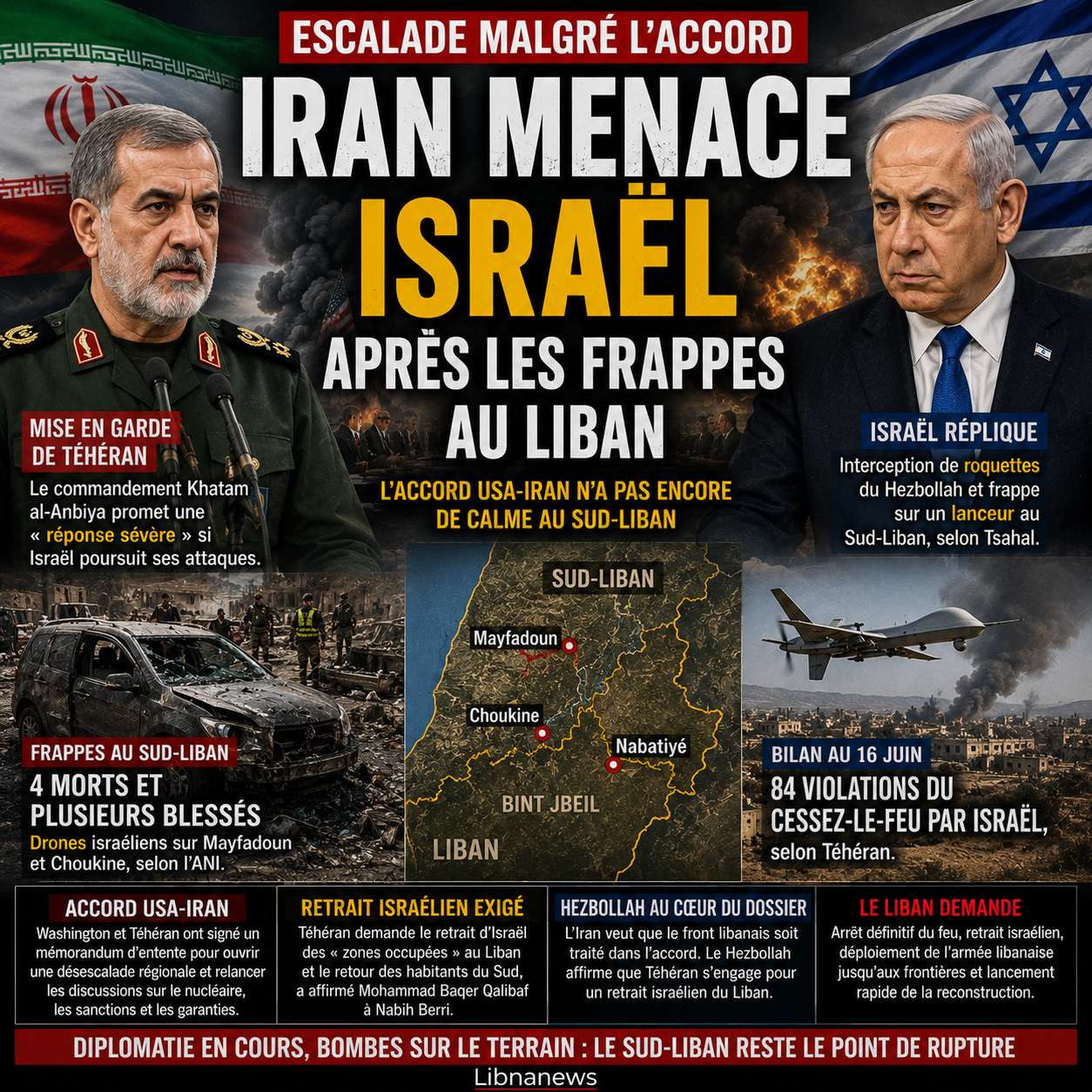
The Iranian army raised its tone on Tuesday, June 16, after a new series of Israeli strikes in southern Lebanon. The Khatam al-Anbiya command of the Iranian armed forces threatened Israel with a « severe response » if the attacks continued, according to a statement quoted by Iranian state television. This warning comes despite the announcement of an agreement between the United States and Iran, presented as a framework for regional de-escalation including the Lebanese front.
On the ground, violence continued. Drone strikes targeted vehicles in Mayfadoun and Choukin in the Nabatiyah area, killing at least four and injuring several people according to the Lebanese National Information Agency. Israel, for its part, claims to have intercepted rockets fired by Hezbollah to an area where its soldiers operated in southern Lebanon, before hitting the launcher used.
Tehran raises tone against Israel
The Iranian declaration gives a new dimension to a day already marked by the instability of the ceasefire. The Khatam al-Anbiya command accused « the infanticide army of the Zionist regime » of continuing its attacks in southern Lebanon. He warned that if these attacks continue, Israel should expect a response from the Iranian armed forces.
According to the same count quoted by Iranian state television, Israel violated the ceasefire in Lebanon at the time84 timessince the announcement of the agreement on Monday. The formulation goes beyond the usual record of political support for Hezbollah. It places the Iranian army directly in the language of threat, as Washington tries to turn the deal with Tehran into a stabilization mechanism.
Four dead in Mayfadoun and Choukine
The human impact of the day reinforced the scope of this position. In the Nabatiyah area, Israeli drones targeted two vehicles in Mayfadoun and one in Choukin. The information reported by the Lebanese official agency indicated a provisional assessment of at leastfour deadand several wounded.
The attacks have affected areas already weakened by the bombings of recent weeks. Since Monday, Israeli strikes in southern Lebanon have killed at least five people, despite the relative decline in fighting intensity observed after the announcement of the American-Iranian agreement. This sequence feeds the feeling, both in Beirut and in the border localities, that the announced de-escalation has not yet reached the ground.
Israel reports intercepting rockets
The Israeli army presented a different version of the day. In a statement, she claimed that her aircraft had intercepted several rockets fired by Hizbullah to the area where Israeli soldiers were operating in southern Lebanon. She then reported hitting and destroying the launcher from which some of the projectiles had been fired.
Israel thus justifies its strikes by maintaining a direct threat against its forces. This version does not answer the question raised by Beirut and Tehran: the Israeli presence in certain Lebanese areas after the agreement. For Lebanon, as long as the Israeli army remains in occupied areas, the ceasefire remains incomplete and politically fragile.
Israeli withdrawal becomes central issue
The main Iranian negotiator, Mohammad Baqer Qalibaf, added a diplomatic component to the military threat. In a telephone interview with the President of the Lebanese Parliament, Nabih Berri, he said that Israel should withdraw from the « occupied areas » in Lebanon. He also stated that the people of the South must be able to return home.
This message is part of the Iranian interpretation of the agreement with Washington. Tehran maintains that the end of the war requires the treatment of the Lebanese front and Israeli withdrawal. American officials remain more cautious about the exact scope of the text. The full content of the agreement has not yet been made public, and several points are already being interpreted differently.
The calendar reinforces this tension. The United States and Iran must formalize on Friday an agreement to end their war and open a new phase of discussions on nuclear, sanctions and regional safeguards. The announcement was presented as a turning point after weeks of direct confrontation and blocking of the Strait of Ormuz.
But the Lebanese part appears to be one of the most unstable points of the scheme. Tehran wants to link calm to Israeli withdrawal. Israel affirms that it retains its right of action in Lebanon and refuses to renounce safe areas that it considers necessary. Washington seeks to maintain the balance between regional de-escalation and guarantees given to Israel. Lebanon, on the other hand, is trying to avoid its territory becoming a clause discussed by others.
A Test for the USA-Iran Agreement
The question asked by some Israeli media sums up the issue. Will Iran succeed in imposing Israeli withdrawal from southern Lebanon as a condition for signing the memorandum with the United States? This question reveals the concern of part of the Israeli debate.
If withdrawal becomes a formal or political condition of the agreement, Israel would find itself under US and international pressure. If, on the contrary, the withdrawal remains outside the mechanism, the agreement may not produce real stabilization in Lebanon. In both cases, the Lebanese front becomes a credibility test for the entire open sequence between Washington and Tehran.
For Hezbollah, this situation creates a political space. The movement can say that the Lebanese front is not marginal, since it is now at the heart of the trade between Iran, the United States and Israel. He can also argue that the Israeli presence justifies the continuation of the resistance.
This reading remains contested by a large part of the Lebanese political class, which accuses Hezbollah of having led the country into war without a state mandate. But Tuesday’s strikes, Israeli refusal to withdraw and the Iranian threat complicate the debate. They give the party arguments at the very moment when its adversaries demand a monopoly of arms by the Lebanese army.
Beirut facing a narrow margin
For the Lebanese Government, there is still little room for manoeuvre. President Joseph Aoun and Prime Minister Nawaf Salam have established the constants of the official position: a final stop to the fire, an Israeli withdrawal, the deployment of the Lebanese army to international borders, the return of prisoners and the launching of reconstruction.
Nabatiyah’s strikes show that this architecture remains theoretical as long as the ceasefire is not respected. They also show that the Lebanese army cannot regain control of the South alone if the fighting continues. Sustainable stabilization therefore requires a verification mechanism, international safeguards and a clear timetable for withdrawal.
However, the Iranian threat poses an obvious risk. By warning Israel of a severe response, Tehran can seek to deter further strikes. But this rhetoric can also fuel an escalation. Israel could see this as a justification for maintaining its operations and positions in Lebanon. The United States could be forced to clarify the terms of the agreement more quickly, including those related to Hezbollah and the Israeli withdrawal.
Tuesday confirms that Lebanon remains the weak point of the American-Iranian agreement. The announcement of a regional ceasefire reduced some tensions, but it did not eliminate military logic. Israel continues to strike. Hezbollah remains armed and affirms its role in the balance of power. Iran wants to make Israeli withdrawal a political condition. Washington is trying to preserve an incomplete text.
In the villages of Mayfadoun, Choukin and Nabatiyé, however, diplomacy is a simple fact: the strikes continued and civilians were killed again. The next step will depend on the ability of the mediators to impose a common reading of the agreement, while Tehran now warns that it will not allow Israel to define the terms of the ceasefire alone in Lebanon.