






There is a phrase in Lebanon that is often heard and that sums up part of our problem alone: « He is good, he is rich. »
As if the two things were necessarily going together. As if having a lot of money was enough to say something about a person’s worth, his honesty or what he actually accomplished.
It is rarely asked how this wealth was acquired. We see that it exists, we look at the house, the car, the travels, the relationships, the table around which the guests rush and that seems sufficient. Money becomes a kind of certificate of achievement, sometimes even a certificate of respectability.
Yet the question should be obvious: has this man enriched himself by his work, because he has set up a business, developed an activity, taken risks or built something? Or has it enriched itself by stealing, taking advantage of its political relations, diverting money from the state, ruining its associates, exploiting its employees or participating in criminal activities?
Did he create wealth or did he content himself with taking that of others?
This distinction seems to have lost much of its importance in us. It must also be said that in a country where so many fortunes have been created through war, public procurement, monopolies, trafficking, political protection and, more recently, the dispossession of savers, it would sometimes be embarrassing to ask too many questions.
We then prefer to look at the result and forget the path we have come.
A man may have stolen thousands of people, but if he receives well, if he distributes some favors, if he finances an association or shows himself generous with his entourage, one will always find someone to explain that basically, « he is a good person. ».
We know what he did. The origins of his fortune are not even always obscure. They are sometimes known to everyone. But this knowledge does not prevent admiration or the search for his company. We publicly criticize corruption, then rush to be photographed with those who took the most advantage. We denounce the theft of public money, but we envy the house built with this money.
This is probably where the biggest problem lies. It is not just about the existence of thieves or criminals. There are in every country. He cares about the place we give them and the fascination they exert on part of society.
From the moment wealth erases everything else, the message to the younger ones becomes quite simple: no matter how rich you are, the essential thing is to manage to keep your money long enough for others to forget how you got it.
And that message is devastating.
Why work for twenty or thirty years when those who chose shortcuts are more admired? Why respect the rules when those who bypassed them became notable? Why study, build an activity or take risks when proximity to a politician, community leader or criminal network sometimes makes it possible to go much faster?
A society not only conveys its values through what it teaches in schools or through what parents repeat to their children. It also transmits them by the people she presents as examples.
But in our home, real models often remain in the shadows.
There are entrepreneurs who took years to build their business. There are traders who have gone through crises without ceasing to pay their employees. There are doctors, artisans, engineers, farmers and professionals who have succeeded without belonging to a clan, without obtaining a rigged market and without stealing anyone.
Some have even earned a lot of money. They live well, they ensure the future of their children and have the right to be proud of what they have accomplished. But because they do it discreetly, without buying their reputation and without turning every expense into a show, they are much less interested.
They are not considered models because they do not give the impression of having defeated everyone. They have simply worked, which seems almost banal, whereas this should be the first thing we respect.
I do not, of course, praise poverty here. There is nothing righteous about staying poor and nothing shameful about wanting to get rich. Ambition is necessary. Lebanon needs people who invest, start businesses, develop activities and earn money. He even needs it much more than people who explain to others that money does not matter.
Money counts. It gives independence, allows to protect your family, to undertake, to help others and sometimes to advance a whole society.
But it does not automatically make respectable.
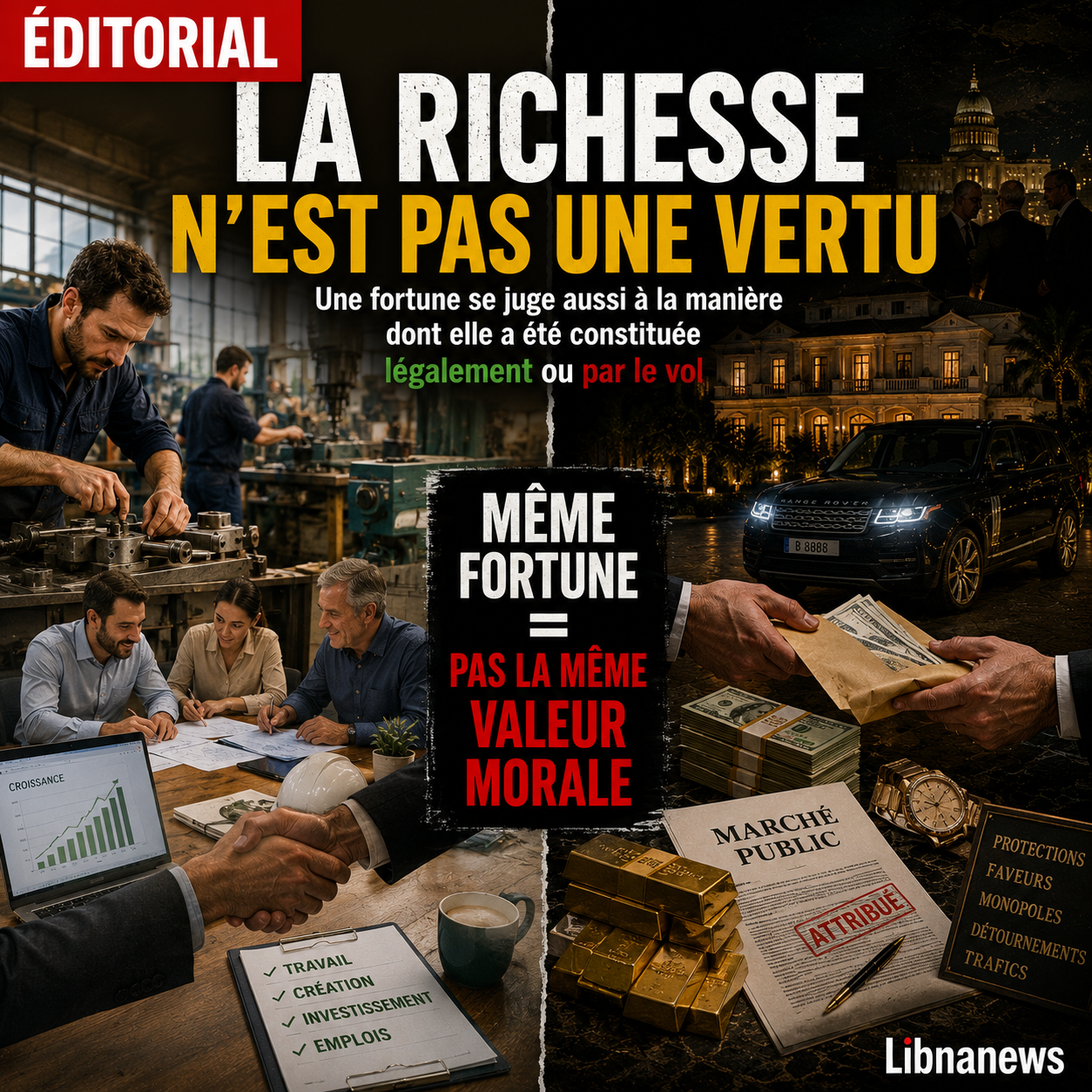
A fortune should never be viewed separately from the way it was constituted. Money earned by labor does not have the same moral value as stolen money. The one who creates a business and employs 100 people is not comparable to the one who hijacks a public market. The one who patiently builds his wealth is not comparable to the one who appropriates the savings of his clients. They may have the same amount, but they have not accomplished the same.
One created wealth. The other holds a loot.
One should therefore stop saying that a person is « good » only because she is rich. It can be said that she has money, that she has succeeded materially or that she is powerful. But to know if she’s good, you still have to look at what she’s done, how she treats others, and what her fortune has cost those around her.
True success is not just about getting rich. It also consists of being able to explain how it has become without having to lie, threaten someone or rely on collective amnesia.
We must certainly teach our children to be ambitious. We have to tell them to work, create, earn money and not be ashamed of wanting to live better than us. But we must also teach them that there are things that we do not do, even to become rich.
Because success should not only be measured by what we have. It should also be measured against what has been refused to possess it.
Lebanon does not need new thieves rich enough to be treated as models. He already has too many. He needs people who succeed without stealing, who enrich themselves without destroying others and whose fortune can be admired without having to forget the origin.
People must be encouraged to become rich, certainly. But they must also be taught to become virtuous and worthy of being. And above all, examples that we can offer our children without having to hide part of the story from them.