

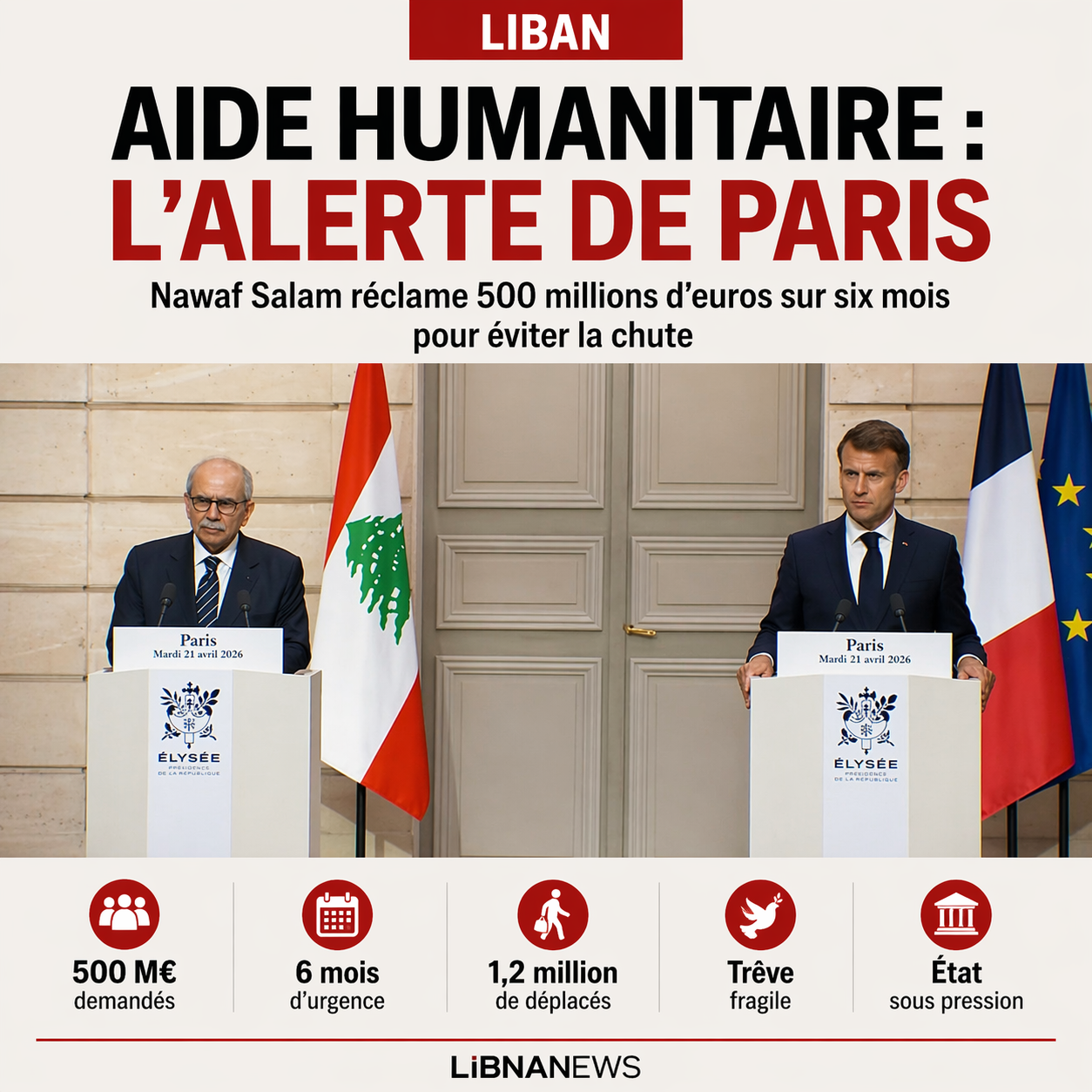
In Paris, humanitarian aid to Lebanon took a precise figure and a very clear political form. Lebanon did not come to ask for a symbolic gesture. He came to encrypt an emergency. By claiming EUR 500 million in humanitarian aid over six months, Prime Minister Nawaf Salam wanted to give an order of magnitude to what the Israeli-Lebanese conflict has already produced: a country that has been displaced again, ravaged regions, a state that is under duress, and an economy that is in danger of relapse as it emerged from a few years of collapse. The appeal made from the French capital is therefore not just a matter of diplomacy. It’s a warning. Lebanon is not yet talking about general reconstruction. He talks about endurance, administrative survival and prevention of a new national breakout.
The sum itself illuminates the moment. EUR 500 million over six months does not represent a Marshall Plan, a Recovery Strategy or a Structural Transformation Programme. Compared to the semester, it corresponds to just over EUR 83 million per month. In a country that has already suffered the banking collapse, the rapid impoverishment of the middle classes, the deterioration of public services and the de facto dollarisation of a large part of economic life, this envelope would not fund a restart. It would be used first to hold. Feeding, treating, hosting, reopening a few logistical circuits, limiting internal exodus, supporting proven administrations and preventing the humanitarian crisis from turning into a regime crisis.
That is what makes this request so political. Since Paris, the Lebanese Prime Minister has not only described a social catastrophe. He implicitly told his European partners that Lebanon is entering a danger zone where humanitarian aid, internal stability and the regional balance of power can no longer be dealt with separately. A country that no longer manages to absorb its displaced persons, maintain a minimum of services and protect its social balances becomes a much more vulnerable area to radicalization, community fractures and externally imposed arrangements.
Humanitarian aid in Lebanon is no longer a peripheral issue
Humanitarian aid to Lebanon has often been thought of in recent years as a complement to the country’s survival. After the financial crisis of 2019, then the explosion of the port of Beirut, it allowed to close, mitigate, to support sections of the population that the state could no longer manage to cover. Today, logic has changed. Help is no longer an additional net. It becomes one of the last dikes before another breakup.
The figure put forward by Nawaf Salam is part of an already massive human context. The open conflict in early March caused more than 1.2 million displaced people in Lebanon from the South, East and South suburb of Beirut. Thousands of families had to leave their homes several times. Some have found refuge in schools, public buildings or with relatives. Others joined already fragile areas, where housing, water, electricity and care were insufficient even before the war resumed. In this type of situation, each additional week of tension increases the social bill and makes it more difficult to return.
The country does not face limited, localized and temporary displacement. It must manage a large-scale internal shock that affects entire regions and changes the balance between communities, territories and resources. When more than a million people move in a few weeks in an already under-capitalised country, already dependent on transfers, already weakened by the absence of massive public investment, the effect does not stop at the humanitarian. It reaches the labour market, rents, infrastructure, schools, clinics, supply networks and, ultimately, political stability itself.
This reality is all the more serious since the ceasefire in force since 17 April remains extremely fragile. The Israeli strikes did not stop completely. Destruction continues in some areas of the South. Hezbollah resumed retaliatory fire towards northern Israel after accusing Israel of truce violations. And another strike hit the West Bekaa Wednesday morning. In these circumstances, humanitarian aid to Lebanon cannot be seen as a peaceful transition from war to post-war. It must respond to a changing emergency, where needs increase while the safe environment remains uncertain.
What the EUR 500 million actually covers
The amount requested by Beirut must be read accurately. It does not cover the total cost of war. It also does not cover the reconstruction needs of destroyed villages, damaged roads, schools, water systems or public buildings. It corresponds to the management of the humanitarian crisis over six months. This means that this is an immediate stabilization sum.
Behind this expression, we must hear several positions. Temporary accommodation for displaced persons. Food aid. Access to medicines, emergencies and basic care. Support for overcrowded local communities. Restarting certain essential services. Transport, sanitation, water supply, child protection, support for schools hosting displaced families, and initial work to make certain places of return at least practicable.
This detail is decisive because it shows that Lebanon is not yet asking the world to finance its political or economic reconstruction. He asks his partners to prevent an additional fall. In the scale of crises, this is a very special moment. A state does not request EUR 500 million for six months because it has a large project. He does so because he believes that without this money he can no longer absorb the shock under acceptable conditions.
The Israeli-Lebanese conflict strikes a country that is already breathless
The effect of the conflict is even more serious because it does not affect a healthy country. It strikes an already exhausted country. Lebanon was not entering this war from a solid base. It barely emerged from a very slight macroeconomic improvement after years of collapse. In January, a major international financial institution saw a modest rebound in the economy in 2025, at 3.5 per cent, and was still considering growth of 4 per cent in 2026, provided reforms continued, modest reconstruction flows appeared and, above all, political stability was maintained.
This condition was central. The expected growth was less a structural transformation than a fragile breath: a little tourism, expatriate transfers, more private consumption, relative exchange rate stability and some less degraded political signals. Clearly, Lebanon was not cured. He was breathing a little better. The Israeli-Lebanese conflict now threatens this thin respite.
War strikes precisely the most sensitive pillars of this timid recovery. It reduces internal and external displacement. It depresses consumption. It diverts public spending towards emergency. It increased the cost of logistics. It undermines confidence, which is already one of the rarest assets in the Lebanese economy. It suspends private investment. It weighs on tourism, which was becoming vital again in some regions. It accelerates the shift from part of households to simple daily survival.
In a country with strong budget margins, such a shock could be cushioned by a national emergency plan, low-cost debt or centralized public action. Lebanon does not have any of these facilities at the necessary scale. His state remains weak. His banking system is discredited. His public finances are under pressure. Its administration works, but at the cost of extreme compression. Its major reforms remain unfinished. This gives the EUR 500 million request its alert character. Lebanon has no cushion. Each additional shock approaching the breaking point.
A risk of economic collapse
To talk about collapse would, however, be insufficient if it were not specified which collapse it is. The word refers not only to money, budget or growth. It refers to a broader risk: that of simultaneous disorganization of social, territorial and political.
At the social level, the extension of internal displacement creates continuous pressure on families, municipalities and self-help networks. Many Lebanese already live on unstable incomes, often in partial dollars, in a very unequal economy. Adding to this the costs of rent, food, mobility and care for displaced families amounts to pushing part of the population beyond its capacity to adapt.
At the territorial level, the South and some areas of the Bekaa or the southern suburbs are not only bombed areas. These are areas where return remains uncertain, because destruction is significant, roads are sometimes damaged, military operations persist and Israel still maintains a presence in a southern part of the country. As long as these realities remain, some of the internally displaced will not return for long. The humanitarian emergency is therefore mechanically extended.
Politically, economic weakening and security pressure fuel deep internal divisions. The debate on Hezbollah, on negotiations with Israel, on state sovereignty and on the price paid by the Shia population or by the entire country is getting tougher. Several Lebanese voices fear that the current sequence will revive community logics and memories of civil war. Insufficient humanitarian aid alone does not explain an internal deflagration. But its absence can speed up tensions by making each camp more convinced that it will have to protect itself.
Paris as a forum, but also as a test
The choice of Paris is not trivial. For Beirut, France remains a major political, diplomatic and symbolic partner. It maintains a historical presence, a capacity for initiative, a direct link with Lebanese institutions and a special interest in the stability of the country. When Nawaf Salam came to ask for 500 million euros from Paris, he wanted to talk to France, but also to Europe and, beyond that, to all the donors who could intervene quickly.
The message sent is double. First, Lebanon calls for immediate financial support to avoid humanitarian escalation. Secondly, he recalled that the Lebanese question could not be dealt with solely from a military or diplomatic perspective. It is not enough to talk about the truce, withdrawal, sovereignty or disarmament of Hezbollah if the State does not have the means to stand up socially as these negotiations move forward.
This is the whole paradox of the moment. In Washington, the United States is pushing discussions with Israel on the consolidation of the ceasefire. In Islamabad, mediators seek to extend the pause with Iran. But on the Lebanese ground, stabilization also depends on a much less spectacular variable: the money available to prevent the country from picking up again. A truce does not only hold with military guarantees. It also runs with reopening schools, functioning health centres, eating families and municipalities that do not collapse under the influence of the displaced.
The demand from Paris also says the weakness of the state
We must, however, see what this scene reveals from Lebanon itself. If the Prime Minister has to estimate the minimum cost of national humanitarian survival from abroad, it is also because the State can no longer rely solely on its own instruments. This dependency is not new. It settled with the financial crisis, then consolidated after the explosion of the port and successive political blockages. But war gives him a new intensity.
The country is already heavily dependent on remittances from the diaspora, sectoral aid, the activity of multiple international organizations and bilateral support to make the essential parts of its daily life work. The Israeli-Lebanese conflict does not create this dependency. It suddenly amplifies. It also makes it more political, because it is now part of a sequence where emergency aid conditions the state’s ability to remain credible in the face of its population.
This dimension counts for Lebanon’s partners. A humanitarian envelope can be paid relatively quickly. It still needs to be distributed with minimal efficiency, targeting and transparency. The question is not secondary. Donors know that Lebanon has suffered for years from an institutional confidence deficit. They also know that aid cannot dissolve in local clientelism or in administrative fragmentation. That is why the Paris application will be judged not only on the amount, but on the state’s capacity to administer the emergency.
Humanitarian emergency does not replace reconstruction
One of the risks of the current debate would be to confuse two temporalities. The first is the emergency: six months, 500 million euros, displaced people, shelters, food, care, logistics, saturated municipalities. The second is reconstruction, which involves much higher amounts, a truly stabilized ceasefire, political guarantees and a minimum of post-conflict visibility.
For now, Lebanon is still in the first temporality. It did not even reach the moment when reconstruction can be thought seriously. As long as the strikes have not stopped completely, as long as the South remains partially inaccessible, as long as the truce remains in dispute and until the negotiations with Israel clarify the security framework, talk of general revival remains premature.
This also explains why discussions were initiated with an international financial institution on quick funding ranging from $800 million to $1 billion. Again, the signal is clear. Lebanon does not seek first to launch a major transformation project. It is seeking emergency resources to absorb the war effect on its budget and humanitarian response. It is administrative resistance financing more than development financing.
This distinction is fundamental to understanding the risk of collapse. A country can sometimes delay its reconstruction without collapse. However, it cannot for a long time delay the treatment of hundreds of thousands of displaced persons, food aid or urgent care without exposing its social fabric to rapid breakdowns. In other words, the humanitarian emergency is not a secondary chapter pending the major policy. It is already the heart of stability.
What Europe can still prevent
The request from Paris also puts Europeans before their own contradictions. For years, the European Union and several Member States have claimed to want to avoid Lebanese chaos. They know that the collapse of Lebanon would have direct regional consequences: more migration, increased instability on the eastern side of the Mediterranean, increased polarization between regional actors and further deterioration of the security situation in an area already crossed by several fronts.
However, between diagnosis and action, the passage often remains slow. Europeans are more comfortable with conferences, policy statements and targeted programmes than with rapid decisions on massive support. Today, however, Lebanon is asking precisely for speed. Not in the three-year promise. In the next six months.
The stakes are therefore not just budgetary. He’s strategic. If Europe still wants to weigh in Lebanon, it must show that it understands that humanitarian aid to Lebanon has become an instrument for regional stabilisation. Financing schools, care, shelters and municipalities is not simply a matter of compassion. It is also a way to prevent a country that has already been fractured from becoming even more permeable to the logics of war, armed counter-societies and the outsourcing of its sovereignty.
Lebanon asks what to do before asking for a recovery
Basically, the Parisian scene summarizes the exact state of the country. Lebanon does not present itself as a state that is already planning for the post-war period. It presents itself as a state that seeks to prevent a fatal relapse even before it has been able to reopen a stable political horizon. This nuance is essential. It shows how much more serious the current sequence is than just a short-term humanitarian deterioration.
When a government asks for EUR 500 million for six months, in a country of the size of Lebanon, it recognises that the national resilience has reached a threshold. He acknowledged that informal solidarity, community networks, the diaspora, NGOs and local dispatches would no longer be enough to contain the shock. He also said that the country’s pre-existing fragility prevented spontaneous absorption of the conflict.
Lebanon pays here the price of an accumulation. The financial crisis has never really been resolved. Reforms have moved too slowly. Public services have not recovered. The banking system has not regained credibility. Investment remained low. Part of the population has already learned to live in permanent insecurity. Then the war came back. So it does not strike a country simply poor or in debt. It strikes a worn-out country.
That is why the word collapse must be heard in all its density. It does not only mean that GDP would decline or that public finances would deteriorate further. It means that an already fragile country could lose, in the same movement, its capacity to assist internally displaced persons, to arbitrate its internal tensions, to negotiate without imposing its conditions and to preserve minimum cohesion while the region continues to simmer.
The Paris appeal has at least the merit of clarifying this moment. Lebanon does not yet demand funding for its renaissance. He asked for help not to be further damaged. Five hundred million euros will not rebuild its economy, will not repair its villages, will not settle the Hezbollah issue, will not end Israeli pressure and will not close the fractures opened since 2019. But without this assistance, or without a similar effort, the Lebanese State will approach the next phase — that of returns, negotiations, security arbitration and possible reconstruction — with even less resources, even less legitimacy and even less time, while European donors are now called upon to say very quickly whether the warning issued from Paris will remain a diplomatic signal or become a concrete commitment.




