

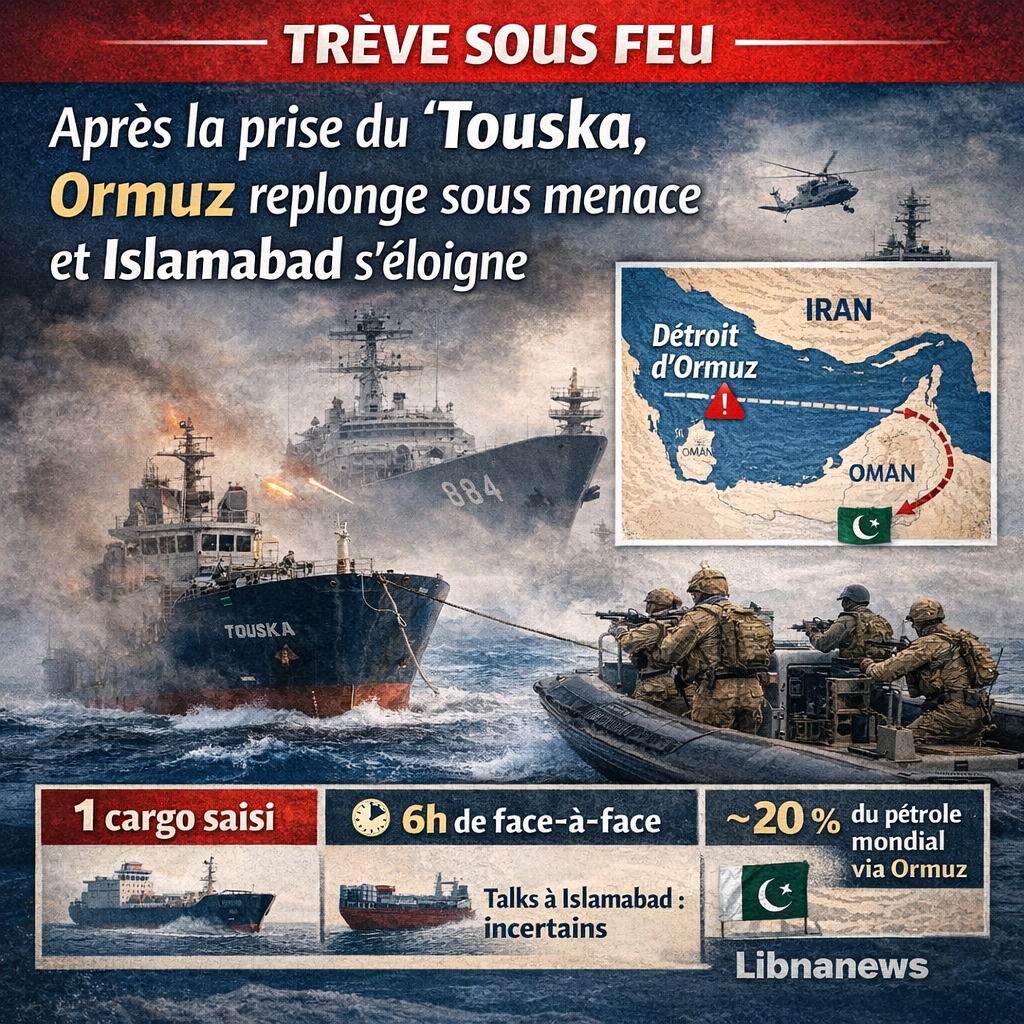
At 0935 Lebanese time, the Gulf again entered a phase of very high uncertainty. The announced truce between Washington and Tehran is still legally binding, but it no longer holds on to a political thread. At sea, the signals contradict each other from hour to hour. Commercial vessels continue to attempt the passage. Others report shooting. And, at night, the United States crossed an additional threshold by claiming to take an Iranian cargo ship.
The sequence of the last hours is based on four mutually reinforcing facts. First, the ceasefire seems more fragile than ever as it approaches its deadline. Then the Strait of Ormuz remains practicable at times, but certainly not standardized. Third, theAllskathe most spectacular military gesture since the maritime blockade against Iran was put in place by US forces. Finally, the negotiations expected in Islamabad now seem to be very compromised, even if, at this time, it would be excessive to talk about formal cancellation.
That grade point counts. For several days, Pakistan has been trying to keep a canal open between the two camps. According to the international press, Islamabad was still preparing to host a second round of discussions, possibly over several days, with the idea of tearing up at least one provisional text that would prolong the truce. At the same time, however, the Iranian authorities have indicated that they are not valid for a new meeting under present conditions. Between a visible reception system in Pakistan and an Iranian refusal to confirm the meeting, regional diplomacy entered a grey zone.
In the Gulf, this grey area is still dangerous. A complete closure of the strait would be a clear, brutal act, immediately legible by markets, shipowners and capitals. The current situation is even more volatile. Iran partially reopened the passage and then restored strict military control. Oil tankers have been circulating. Cargo ships continued their journey. But armed incidents were also reported against merchant ships. In practice, the corridor is neither closed nor free. It works under threat.
The Gulf goes back to the logic of the balance of power
Since the resumption of indirect dialogue between Washington and Tehran, a scenario dominated diplomatic calculations. The idea was not to get a full peace agreement quickly. Rather, it was a matter of building a transitional framework, solid enough to extend the two-week truce announced in early April, while allowing more time for negotiators. This mechanism required at least two conditions: a clear schedule of discussions and even a limited reduction in military pressure at sea. However, these two conditions have deteriorated at the same time for 24 hours.
According to a press agency and several Anglo-Saxon media, the US administration continues to show optimism about the possibility of a compromise. But this optimism is accompanied by a continued maritime blockade, repeated public threats and now armed seizure. Seen from Tehran, the message seems contradictory: Washington says it wants to speak while increasing its levers of coercion. Seen from Washington, on the contrary, this pressure would be precisely the way to reach an agreement before the end of the truce. It is this asymmetry of reading that explains the brutality of the current sequence.
In this context, the ceasefire becomes less a suspension of hostilities than an area of competition between diplomacy and demonstration of force. Both sides are still avoiding an open break. But they test the limits of the current text. Iran is doing so by reaffirming its control over the strait and letting the threat to navigation. The United States is doing so by maintaining the blockade and now intercepting an Iranian flag vessel. These are two different ways of saying the same thing: the truce does not erase the balance of power, it moves it.
The Gulf becomes the real thermometer of the crisis. As long as the diplomats were talking about a second round, Islamabad could still embody the possibility of slowing down the climb. Since maritime events took over, Ormuz dictates the pace. Every shot reported on a civilian ship, every Iranian radio message, every American destroyer movement weighs more in the short term than political announcements. Markets are understood first and foremost. Shipowners too.
The passage of Ormuz is not standardized
We must stop at what happened around the strait before the seizure of theAllska. The previous day had already produced a major contradictory signal. Tehran had first suggested that the commercial crossing could remain open for the remainder of the ceasefire. This gesture was seen as a sign of relaxation. Oil prices had declined immediately. Many actors wanted to read the beginning of a de-escalation.
But this respite was short-lived. Very quickly, Iran reintroduced strict military control over navigation and conditioned traffic to its own safety rules. Marine sources reported that merchant vessels received radio messages prohibiting or limiting transit. At least two vessels reported firing. Western authorities have acknowledged that traffic is resumed in places, while stressing that it remains far from normal operation.
This distinction between possible and normal passage is central. A strait can be officially opened and in fact remain almost impassable. For this reason, it is sufficient that companies no longer know whether the rules change from hour to hour, whether the permitted corridors are stable, whether local authorities will follow their own announcements and whether insurance coverage will be maintained in the event of an incident. The Gulf is exactly in this situation. On paper, a few ships pass. In reality, everyone knows that the road can close politically or economically at any time.
For shipowners, this uncertainty is almost as much as a closure. A captain may receive a theoretical green light and find himself, a few miles further, facing armed stars, a contradictory radio message or intimidation. A company may consider that a crossing remains legal but is no longer insurable at an acceptable cost. A trader can keep a cargo on board while integrating that a delay, diversion or seizure will blow up his final invoice. In this sense, the Gulf is not just a security crisis. He was experiencing a crisis of predictability.
This gradual deterioration also explains why incidents reported against cargo ships have a political weight greater than their immediate material balance. Even when they do not cause massive sinking or loss of life, they change the perception of risk. They tell the crews that civil navigation is no longer separated from strategic confrontation. They tell the markets that the fluidity of the strait now depends on military calculation, not just a traffic regime. They finally told the Pakistani mediators that diplomatic time was shrinking.
TheAllskamarks a new threshold
The heaviest event of the last hours, however, remains the interception and then the capture of theAllska. According to the U.S. Central Command, the Iranian ship was heading towards Bandar Abbas when it was intercepted in the North Arabian Sea by the destroyerUSS Spruance. U.S. forces claim to have multiplied warnings for six hours. After that they ordered the evacuation of the engine room, opened fire on the propulsion, and then sailed Marines aboard. The building is now under American control.
A now coercive blockade
The White House and the US President presented this operation as the strict enforcement of the maritime blockade imposed around Iranian ports. The vocabulary used was not annoid. Washington is talking about a ship in violation of a pre-announced ban. Tehran speaks of armed piracy and violation of the ceasefire. Between these two qualifications, there is not only a legal disagreement. There are two incompatible accounts of the very nature of the truce.
For the United States, the ceasefire clearly does not mean the suspension of all pressure instruments. The blockade remains in place. Controls too. Sanctions have not been lifted. As a result, an Iranian vessel attempting to reach a port in the country can be treated as a prohibited target. For Iran, on the contrary, the spirit of the truce required at least a freeze on actions likely to produce a direct confrontation between American forces and Iranian interests. TheAllskathus, in Iranian reading, becomes proof that Washington wants to negotiate under permanent threat.
Operational detail also counts. This is not a simple administrative interception, nor is it an inspected and then released vessel. The United States admitted to having shot the vessel to neutralize its propulsion before seizing it. This is the first such explicit demonstration of the coercive implementation of the embargo against an Iranian-flagged cargo ship since its entry into force. In a crisis where each party carefully measures its thresholds, this gesture creates an immediate precedent. He told all companies in the region that the blockade was no longer merely declaratory.
The ship itself adds a symbolic dimension. TheAllskait is included in the United States sanctions lists and is linked, according to the United States Treasury, to the shipping company of the Islamic Republic. Washington can therefore argue that it is not an ordinary cargo ship. But from a regional point of view, the signal far exceeds this specific case. What is observed from the Iranian shore, by the Gulf monarchies and by maritime traders, is that the United States is ready to forcibly deactivate an Iranian building on its way to Bandar Abbas while discussions are supposed to resume.
The human assessment of the operation was not clearly established at the time this article was written. This is another feature of this crisis: images circulate faster than certainties. The Pentagon broadcast sequences showing interception and boarding. The Iranian authorities promised a prompt response. But beyond images, the essential point remains political. From the moment an Iranian cargo ship is struck and seized by the American Navy, the truce changes in nature. It is no longer simply fragile. It becomes disputed in its foundations.
Why Tehran Sees Ceasefire Violation
The Iranian reaction soon followed. Military and state media officials have denounced an attack and announced reprisals. This sequence is consistent with Tehran’s position for several days. Iran still agreed to leave room for Pakistani mediation, but refused to separate diplomatic discussion from the reality of military and commercial pressure. In other words, Tehran does not want to appear as a power that negotiates while its ports are being blocked, its infrastructure threatened and its ships seized.
This position also responds to a need for internal and regional credibility. After partially reopening Ormuz, and then tightening control, the Iranian authorities had to show that they did not allow Washington to set the rules of the game alone. Absence of reaction to theAllskawould have weakened their speech. A response too fast and too broad would, on the other hand, pave the way for a general resumption of fighting. The whole Iranian difficulty is there: to display firmness without offering to the adversary the pretext of a total shift.
That is why the strait remains at the centre of Iranian options. It allows to replicate without necessarily passing, immediately, through a classical frontal confrontation. Strengthening controls, slowing down convoys, allowing insurance to scath up, increasing risk signals around the passage: each of these measures increases the cost of the US strategy without automatically triggering an open war. The Gulf then became a graduated response instrument.
It should be added that the language used by Tehran on Islamabad is consistent. By rejecting the idea that discussions are ready to resume, Iran does not necessarily close the door forever. First, it raises the political price of renewed contact. The message to Pakistani mediators and Americans is clear: there will be no credible second meeting if Washington maintains both the blockade, threats and spectacular actions at sea. Again, diplomacy is theoretically possible, but it is placed under conditions.
Islamabad without a clear timetable
It is on this point that the shade imposes the most. Many comments already refer to cancelled negotiations. The available elements allow a more conservative formula. Pakistan continued to be ready. Security measures were strengthened in Islamabad. According to the international press, hotels directly linked to the scheme even asked their customers to leave the premises before delegations could arrive. The Prime Minister of Pakistan, for his part, reaffirmed his willingness to facilitate a political outcome and met with the Iranian President.
Pakistani mediation suspended from Iranian yes
However, neither Islamabad nor Tehran confirmed at this time that a new meeting would actually take place today in an agreed framework. That is an essential point. A meeting that no one officially validates does not yet exist diplomatically. The distinction may seem technical. She’s decisive. To say that the talks are compromised is correct. To say that they are formally cancelled goes further than the solids confirm.
This lack of a clear date is not a logistical detail. In this type of crisis, the timetable is part of the balance of power. When two parties really want to see each other quickly, they find a place, an hour and a formula. When they let the calendar float, they send a political message. This message is double. Pakistan still wants to preserve its role as mediator. Iran wants to show that he will not come under duress. The United States publicly maintains the idea that the door remains open. Each one therefore maintains its own narrative, but none produces the concrete gesture that would stabilize the next one.
According to reports published in the night by a Qatari media outlet, the mediators still hoped that a provisional memorandum could prolong the truce by several weeks if delegations returned to Islamabad. This scenario is not completely dead. It is simply much more difficult since the seizure of theAllska. For a transitional text implies a minimum of procedural confidence. However, it has been severely undermined. How can one enter a negotiating room when one of the parties believes that the other has just violated the very spirit of the truce?
Pakistan thus finds itself in a delicate position. Its interest is obvious: to prevent the Gulf crisis from spilling further over into South Asia, to preserve its diplomatic role and to avoid a new energy surge. But Pakistani mediation depends on two conditions that Islamabad does not fully control: a minimum discipline of actors on the ground and a real desire not to turn every maritime incident into a political break. The last few hours just show the opposite.
The Gulf also speaks to markets
The reaction of the oil markets already says a lot of the real state of the crisis. After a lull linked to the announced reopening of Ormuz, prices rose sharply. The Brent returned to more than 5% and the US crude oil nearly 6% in the first quotations, indicating that operators now regard the truce as vulnerable and free movement in the Gulf as deeply uncertain. Markets no longer buy political ads alone. They’re waiting for operational evidence.
This increase in prices is not only based on the fear of a formal closure of the Strait. It is also based on deteriorating transit conditions. A corridor may remain theoretically open and become, for some of the actors, too risky to function normally. This is where the Gulf has its global effect. It is sufficient that the number of trips carried forward, diverted or increased so that tension spreads far beyond the region. Refiners, insurers, shipowners and importing states then adjust their expectations in an emergency.
Insurance plays a central role in this mechanics. Since the beginning of the crisis, war bonuses have jumped to exceptional levels, in some cases up to ten times their previous level according to market estimates relayed by the Anglo-Saxon press. Every shot reported against a civilian ship, every threat of closure, every armed seizure adds a layer of cost. In other words, even when ships pass, the Gulf can already produce a form of economic rationing.
For Lebanon and for the fragile economies of the region, this aspect is not theoretical. A further sustained increase in oil, shipping premiums and freight costs would quickly be passed on to domestic prices, energy and imports. The Gulf issue is therefore not separated from the rest of the Middle East. It is now one of the most concrete multipliers. When Ormuz deranges, the whole region pays.
What is confirmed, what remains open
At this time, four elements can be considered solid. The first is that the truce arrives in its last days without clear political architecture for its extension. The second is that the Strait of Ormuz remains a very heavy traffic space, with incidents reported against civilian vessels. The third is that the United States has seized theAllskaafter neutralizing it. The fourth is that the discussions hoped for in Islamabad do not have sufficiently clear confirmation to be considered as acquired.
However, several points still need to be handled with caution. At this time, there is no consolidated human assessment of the Iranian cargo. Nor can it be said with certainty that an officially dated round was cancelled at the last moment, since the problem seems first to be the lack of common validation. Finally, while the probability of an Iranian response is high in terms of the rhetoric used, its exact nature remains unknown.
It is in this in-between that the day of April 20 is played. The Gulf has not yet returned to an open maritime war, but it is no longer in a simple phase of controlled de-escalation. The ceasefire still exists, but it is being undermined by the very acts that should prepare for its extension. Islamabad did not get out of the game completely, but Pakistani diplomacy lost what it needed most: a minimum of calm time.
If nothing changes in the next few hours, the question will no longer be whether the truce can survive its expiry. It will also be necessary to ask how many more incidents the Gulf can absorb before the threat-crossing logic turns into a confrontation assumed, with a cargo seized, slow convoys, undated negotiators, and a region suspended from the next radio message in the Strait.




